Loading questions...
Updated
Want a break from the ads?
Become a Supporter and enjoy a completely ad-free experience, plus unlock Learn Mode, Exam Mode, AstroTutor AI, and more.
Which of the following factors could negatively influence a review?
You are the Test Manager for a project to develop a web customer portal of a Pay-TV company that allows customers (with a smartcard and a set-top box) to purchase digital contents.
In the "select" page the system displays a dialogue where the customer can select the items (digital contents) he/she is interested in. In this page he/she can add one or more items to a shopping cart. An item consists of a product and a duration.
There are three types of products: Movie, sport and premium (movie and sport).
There are four possible durations: 1 months, 2 months, winter (from the beginning of January to end of March) and summer (from the beginning of July to end of
September).
All the combinations of products and durations are allowed to define an item. Thus there are twelve possible items. A maximum of six different items can be added to the shopping cart at a time.
When the customer decides to check out he/she goes to the "purchase" page where he/she can pay the total amount of the shopping cart in three different ways:

Which of the following answers describes the best execution schedule in this scenario?
Assume you are working on a CAS (Conditional Access System) for Pay-TV that allows the access, selection and transfer of services and media to authorized users. Authorized users can choose their services through different channels: Web Customer Portal, IVR (Interactive Voice Response), Call Centre and SMS. The system uses a Smart Card to receive and decrypt the broadcasted encrypted control words which allow decrypting pay-per-view TV. Every authorized user must have a Smart Card and a Set-Top Box to view the contents.
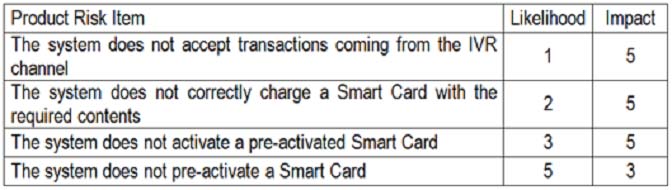
The following is an excerpt from the product risk analysis document:
Both likelihood and impact have been rated on the following scale: (1 Very low, 2 Low, 3 Medium, 4 High, 5 Very High).
The required test environment and code have been delivered. All test cases for each identified product risk item have been written and are ready to be executed.
The Database used to contain the Smart Cards is empty and so only new Smart Cards can be used during test execution.
A Smart Card can only be activated if it has been previously pre-activated. This means the post-conditions for the execution of the test cases to test the pre- activation of the Smart Card are the pre-conditions for activation of the Smart Card.
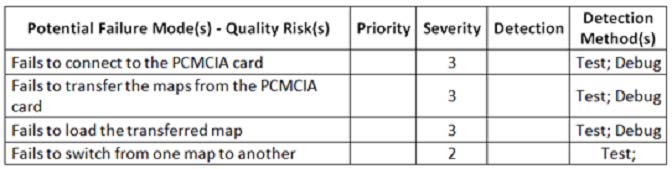
Which of the following statements represents the most effective contribution of the stakeholders to the completion of the failure mode analysis table?

The main objectives the senior management team wants to achieve are:
You are estimating the effort for the integration testing activities of a new project. Consider the following factors, which can affect that estimation:
I. Availability of re-usable test systems and documentation from previous, similar projects
II. Unexpected timing of components arrival
III. Stability of the integration test team (no turnover)
IV. Many and geographically distributed sub-teams
Which of the following statements is true?
Which of the following statements, about the test reporting activities for a project adopting an iterative lifecycle model with very short iterations (e.g. two weeks iterations), is correct?
Assume you are managing the system testing execution phase of a project.
The system test execution period for that project is scheduled for eighteen weeks and the release date is scheduled at the end of system testing.
During the sixth week of system test execution, at the staff meeting, the project manager informs you that the project deadlines are changed and the release date that is only three weeks ahead.
This new release will not allow the completion of the system tests. Suppose also that you have followed a risk-driven test approach for this project.
Which of the following statements represents the worst way to lead your test team in the next three weeks?
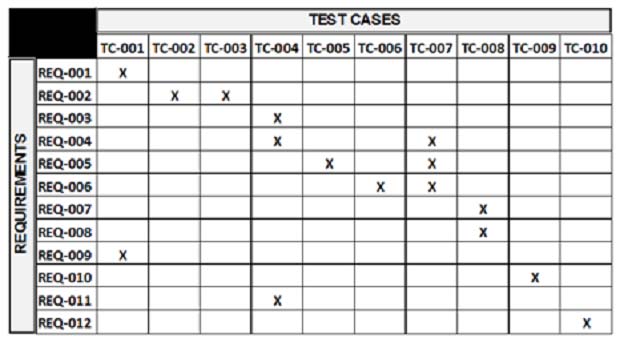
Assume that the following test cases have been executed at the end of the first week of test execution: TC-001, TC-002 and TC-007. All these tests are passes.

What is the MINIMUM number of the remaining test cases that must be successfully executed to fulfill the EX1 exit criteria?
An agile development team decides to hire a tester who has always worked.
You are the Test Manager for a project to develop a client-server application that allows wine vendors to order custom-assorted packages of wines of several winemakers to sell special packages in their wine shops.
You decide to apply a blended risk-based and reactive testing strategy. Below the exit criteria for the system testing.
EXCR1- Each "critical" quality risk item must be covered by at least one test condition
EXCR2- Each "critical" requirement must be covered by at least one test condition
The following are the "critical" requirements of the application:
REQ-SEL-1. The application shall allow the user to order only one package at a time
REQ-SEL-2. The application shall allow the user to select between four different packages (2-bottles, 6-bottles, 12-bottles, 15-bottles)
REQ-SEL-3. The application shall allow the user to order a package containing at least 1 bottle and no more bottles than the package size. No error messages shall be displayed if the user selects a valid number of bottles (at least 1 bottle and no more than the package size)
REQ-SEL-4. The application shall display an error message "Invalid number of bottles" if an invalid number of bottles is selected by the user (zero bottles or a number higher than the package size)
REQ-PAY-1. The application shall allow the user to pay with the three accepted credit cards (Visa, MasterCard, American Express)
REQ-PAY-2. The application shall display an error message "Invalid credit card" if invalid credit card data are given by the user
The following is the unique "critical" quality risk item that has been identified:
CR-RSK-1. The GUI of the application might accept non-integer values for the input field designed to get the number of bottles from the user
Test analysis for system testing has just begun and the following test conditions have been identified.
TC-SEL-2. Test the selection of the package sizes
TC-SEL-4. Test wrong numbers of bottles for an order
TC-CR-RSK-1. Test the accepted values from the input field designed to get the number of bottles from the user
What is the MINIMUM number of test conditions that must be added to fulfill both the EXCR1 and EXCR2 exit criteria?
Which of the following statements describing the consequences of specifying test conditions at a detailed level is NOT true?
Which of the following is an example of the test closure activity indicated as "lessons learned"?
You are the Test Manager for a project to develop a client-server application that allows wine vendors to order custom-assorted packages of wines of several winemakers to sell special packages in their wine shops.
You decide to apply a blended risk-based and reactive testing strategy. Below the exit criteria for the system testing.
EXCR1- Each "critical" quality risk item must be covered by at least one test condition
EXCR2- Each "critical" requirement must be covered by at least one test condition
The following are the "critical" requirements of the application:
REQ-SEL-1. The application shall allow the user to order only one package at a time
REQ-SEL-2. The application shall allow the user to select between four different packages (2-bottles, 6-bottles, 12-bottles, 15-bottles)
REQ-SEL-3. The application shall allow the user to order a package containing at least 1 bottle and no more bottles than the package size. No error messages shall be displayed if the user selects a valid number of bottles (at least 1 bottle and no more than the package size)
REQ-SEL-4. The application shall display an error message "Invalid number of bottles" if an invalid number of bottles is selected by the user (zero bottles or a number higher than the package size)
REQ-PAY-1. The application shall allow the user to pay with the three accepted credit cards (Visa, MasterCard, American Express)
REQ-PAY-2. The application shall display an error message "Invalid credit card" if invalid credit card data are given by the user
The following is the unique "critical" quality risk item that has been identified:
CR-RSK-1. The GUI of the application might accept non-integer values for the input field designed to get the number of bottles from the user
Test analysis for system testing has just begun and the following test conditions have been identified.
TC-SEL-2. Test the selection of the package sizes
TC-SEL-4. Test wrong numbers of bottles for an order
TC-CR-RSK-1. Test the accepted values from the input field designed to get the number of bottles from the user
Assume that you have used traceability to determine the logical test cases that cover all the requirements and the single risk item identified in that scenario.
Which of the following is a positive logical test that is complete and correct, and covers the REQ-SEL-4 requirement?
The following are the requirements identified as "critical":
REQ-SEL-001. The user shall be able to combine all the three products with all the four durations to define an item to purchase
REQ-SEL-002. The user shall be able to add a maximum of six different items to the shopping cart
REQ-PUR-001. The user shall be able to purchase all the items in the shopping cart using a credit voucher
REQ-PUR-002. The user shall be able to purchase all the items in the shopping cart using the available credit already charged on the smartcard
REQ-PUR-003. The user shall be able to purchase all the items in the shopping cart using all the accepted credit cards (Visa, MasterCard and Great Wall Card)
REG-LOGO-001. The user shall be able to logout (by clicking the logout button) from both the "select" and "purchase" pages going back to the "browse" page
(anonymous navigation)
Moreover the following quality risk item has been identified as "critical":
QR-P1. The web customer portal might not be able to provide the expected response time (less than 10 sec) for the purchase transactions under a load of up-to
1000 concurrent users
Test analysis for system testing has just begun and the following test conditions have been identified.
TC-SEL-01. Test the combinations of products and durations to define an item to purchase
TC-SEL-02. Test the maximum number of items, which can be added to the shopping cart
TC-PUR-01. Test the purchase of an item
TC-PUR-02. Test the purchase of an item with the credit charged on the smartcard
What is the MINIMUM number of test conditions that must be added to fulfill both the EXCR1 and EXCR2 exit criteria?
Assume that you are the Test Manager for a small banking application development project.
You have decided to adopt a risk-based testing strategy and 5 product risks (R1, R2, R3, R4, and R5) have been identified during the quality risk analysis.
The following table shows the risk level associated to these product risks (higher numbers mean higher risk):

55 test cases have been designed and implemented to cover all these 5 product risks. The coverage is described in a traceability matrix.
This is the test execution status table, after the after the first week of test execution:
About 56% of the planned test cases have been successfully executed.
Assume that no additional product risks have been identified during the first week of test execution.

Which of the following answers would you expect to best describe the residual risks associated with the identified product risks, at the end of the first week of test execution?
You can count on well-written requirements, but you cant count on an adequate contribution of the stakeholders to the quality risk analysis. You have to mitigate the insufficient contribution of the stakeholders because the risk-based testing approach shall minimize the product risks. Your test team has one expert tester in security testing.
Which of the following test activities would you expect to be the less important in this context?
Assume that you are the Test Manager for a small insurance application development project.
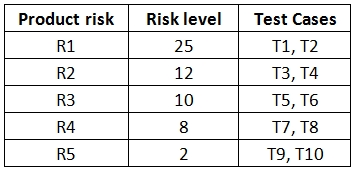
You have decided to adopt a risk-based testing strategy: 5 product risks (R1, R2, R3, R4, R5) have been identified and their levels of risk have been assessed. 10 test cases (T1, , T10) have been designed to cover all the product risks.
The following table shows the risk level and the test cases associated to the identified product risks (higher risk level means higher risk):

You are not confident with the assessment of the risk level and you suspect that it will be possible to find high-priority bugs in low-risk areas.
Furthermore the period for test execution is very short. Your goal is to test all the product risks in a risk-based way, while assuring that each product risk gets at least some amount of testing.
Which of the following answers describes the best test execution schedule in this scenario?
During the follow-up phase the following conditions are checked:
X1. The code has been completely reviewed
X2. All the identified defects have been correctly fixed and the modified code has been compiled successfully and run through all the static analyzers used by the project without warnings and errors
X3. The modified code is available under the configuration management system with a new version number for the specified CI
If these conditions are fulfilled then the review process terminates.
Which of the following characteristics of a formal review is missing in this description?
Assume you are managing the system testing phase of a project.
The system test execution period is scheduled to twenty weeks.
All tests are manual tests. You are following a risk-driven test approach.
During the last staff meeting the project manager tells you new deadlines that will not allow completion of all the system tests.
Which of the following would you expect to be the best way to respond to this situation?
You are performing a quality risk analysis for a CSCI (Computer Software Configuration Item) used to implement a CBIT (Continuous Built-In Test) module of a safety-critical system.
During the quality risk analysis you are trying to identify the ways in which failures of the CBIT module can occur, for each of them trying to determine the potential causes and likely effects, and the risk level (calculated as the product of three factors: severity, occurrence and detection).
Which of the following risk analysis techniques are you working with?
You are working on a project to develop an authentication system for an e-commerce website. This system provides two features: Registration and authentication.
Two different development teams develop these two features.
There is a high likelihood that the delivery of the authentication feature to the test team will be three weeks later. To complete the registration the user must provide the following registration inputs: Name, surname, birth date, fiscal code and he/she can select a username and a password.
A registered user can be a special user or a normal user. To be identified as a special user, he/she must also provide, during the registration process, a voucher possibly received from the IT department.
Access is granted only if a user is registered and the password is correct: In all other cases access is denied. If the registered user is a special user and the password is wrong, a special warning is shown on the system console.
You are currently performing a quality risk analysis using FMEA.
Based only on the given information, which of the following is NOT a product risk that could be identified during the quality risk analysis?
Which of the following statements describing how identified product quality risks should be mitigated and managed, is true?
Which of the following statements about management of product quality risks in mature organizations with respect to the lifecycle, is true?
Assume you are currently working on a project developing a system where functional requirements are very well specified. Unfortunately non-functional requirements do almost not exist.
You are the Test Manager. You have to choose a technique for test selection that allows testing of non-functional characteristics, especially reliability.
Which of the following techniques for test selection do you expect being most useful in this scenario?
In the test strategy document your organization declares: