QuestionQ2
VerifiedManaging the ProductAssume you are working on a CAS (Conditional Access System) for Pay-TV that enables authorized users to access, select, and transfer services and media. Authorized users may select services through different channels: Web Customer Portal, IVR (Interactive Voice Response), Call Centre, and SMS. The system uses a Smart Card to receive and decrypt the broadcast encrypted control words that permit decryption of pay-per-view TV. Each authorized user must have a Smart Card and a Set-Top Box to view the content.
The following is an extract from the product risk analysis document:
Both likelihood and impact are rated using this scale: (1 Very low, 2 Low, 3 Medium, 4 High, 5 Very High).
The required test environment and code have been delivered. All test cases for every identified product-risk item have been written and are ready for execution.
The database used to store the Smart Cards is empty; therefore, only new Smart Cards can be used during test execution.
A Smart Card can be activated only if it was previously pre-activated. Thus, the post-conditions for executing the test cases that test pre-activation of the Smart Card are the pre-conditions for Smart Card activation.
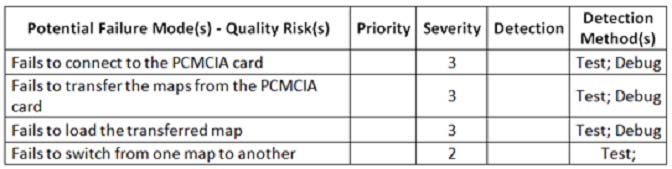
Which of the following statements is the most effective stakeholder contribution to completing the failure mode analysis table?
Community Discussion