QuestionQ1
VerifiedManaging the Test ActivitiesYou are the Test Manager for a project developing a Pay-TV company web customer portal that enables customers—with a smartcard and a set-top box—to buy digital content.
On the select page, the system shows a dialog in which the customer can choose the digital-content items he or she is interested in. From this page, he or she can add one or more items to a shopping cart. An item comprises a product and a duration.
There are three product types: Movie, sport, and premium (movie and sport).
There are four possible durations: 1 months, 2 months, winter (from the beginning of January to the end of March), and summer (from the beginning of July to the end of September).
Every combination of product and duration is permitted to define an item. Therefore, there are twelve possible items. A maximum of six distinct items may be added to the shopping cart at one time.
When the customer chooses to check out, he or she goes to the purchase page, where the total cost of the shopping cart can be paid in three different ways:
- using a credit voucher
- using credit already charged on the smartcard
- using a credit card (accepted credit cards are Visa, MasterCard, and Great Wall Card)
The customer may log out from both the select and purchase pages. In that case, no purchase is made.
You decide to use a blended risk-based and reactive testing strategy, and the following are a subset of the exit criteria for system testing:
- EXCR1- Each "critical" quality risk item must be covered by at least one test condition
- EXCR2- Each "critical" requirement must be covered by at least one test condition
You are using a risk-based testing strategy. Test execution time is very limited. Assume all product risk items require approximately the same test effort.
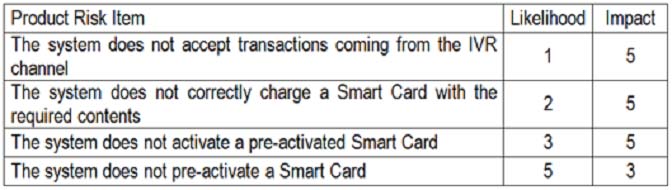
Which of the following answers describes the best execution schedule in this scenario?
Community Discussion