About the Exam

This exam is for practitioners who design and operate enterprise campus access networks. It covers networking architectures and technologies, switching and routing, Aruba WLAN solutions, security standards and concepts, authentication and authorization, operational resilience with HPE Aruba Networking Central, management and monitoring, troubleshooting, and performance optimization. Passing demonstrates you can implement and operate enterprise-level HPE Aruba Networking campus access solutions.

Exam Topics

  • Network Stack4%
  • Connectivity9%
  • Network Resiliency and virtualization6%
  • Switching10%
  • WLAN25%
  • Routing9%
  • Security11%
  • Authentication/Authorization10%
  • Troubleshooting10%
  • Performance Optimization6%

How to Use This Practice Exam

  1. Browse — Read each question, select your answer, and reveal the explanation.
  2. Exam Mode — Simulate real exam conditions with a timed session and score report.
  3. Learn Mode — Spaced repetition schedules questions you struggle with for long-term retention.

Download the Full Exam PDF

Get every question and answer in a clean, printable PDF built for offline study. Purchase once, keep permanent access, and re-download the latest version anytime.

Last updated July 15, 2026 at 1:27 PM

Topic filter
Question status
Question sort
Questions per page

QuestionQ1

VerifiedWLAN

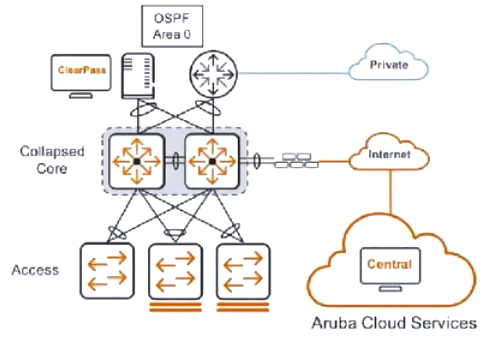
A global cruise line company must refresh its current fleet. It will refresh the ship’s ‘insides’ to be cost-effective and improve sustainability. It will replace all WLAN/LAN hardware on the ship. As part of this refresh, the company will not change its existing security requirements. The CIO also wants to minimize the number of unused switch ports. Any future expansion will always require a hardware refresh. The company will begin with the smallest ship, which accommodates a maximum of 800 guests.

Each ship has a LAN infrastructure comprising two core switches, up to 10 redundant distribution switches, and up to 500 access switches (400 cabins and 100 technical rooms). The core switches reside in the ship’s MDF, and the distribution switches reside in the IDFs. Each cabin and technical room receives one individual access switch.

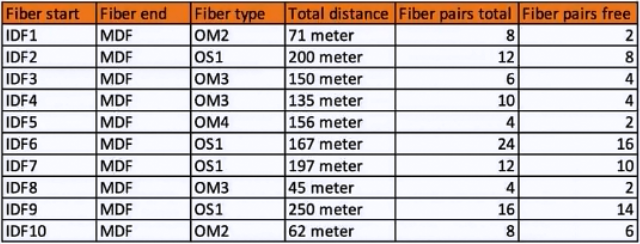
The ship’s cabling structure will not be refreshed. Each IDF connects to the MDF through SMF, with two pairs available for the core-to-distribution interconnect. The SM fiber length between the MDF and IDF is under 300 meters (980 ft), and the fiber type is OS1. Each cabin connects to the IDF through one OM2 pair, with a maximum length of 60 meters (200 ft). Each technical room connects to the IDF through one OM2 pair, with lengths from 100 to 150 meters (320 to 500 ft).

For every cabin/technical room, the customer wants to replace its current fan-less 2530/2540 switches without altering requirements, except that the uplink to the distribution switch must be upgraded to 10GbE to accommodate increased network traffic, and technical rooms require redundant power.

The WLAN infrastructure will be refreshed 1:1, with no new cabling or AP locations. Its WLAN infrastructure uses 200/300 series indoor and outdoor APs running InstantOS (fewer than 300 APs), and the customer has no changes to WLAN requirements.

The cruise line company will replace its current Internet connection before the LAN/WLAN refresh. The new Internet connection will provide 99.8% uptime, needed to keep paid guest Wi-Fi operational. With this new Internet connection, the CIO wants to base the design on Aruba’s ESP architecture because the Internet connection is guaranteed.

Based on best practices and the customer requirements, what is the correct WLAN approach?

Explanation

An AOS 10 deployment with APs and gateways uses gateway-based tunnel mode, rather than AP-only bridge mode. The gateway cluster provides centralized wireless traffic handling and policy enforcement while Aruba Central supplies the cloud-managed ESP operational model. This retains enterprise security control for the guest WLAN and is suitable when dependable Internet connectivity is available for cloud management. Aruba’s AOS 10 migration guidance defines tunnel mode as gateway-based and bridge mode as AP-only with no gateway required.

Learn more

Community Discussion

No comments yet. Be the first to start the discussion!

QuestionQ2

VerifiedTroubleshooting

Which platforms can be used to demonstrate your solution to a customer?

Choose three
Explanation

Aruba CX Switch Simulator, Innovation Zone, and Demo Experience Platform are the designated platforms for demonstrating Aruba solutions to customers. The CX Switch Simulator provides a virtual AOS-CX switching environment, while Innovation Zone and Demo Experience Platform provide customer-facing solution demonstrations. The Support Portal and Solution Exchange serve support and solution-discovery purposes rather than being the listed demonstration platforms.

Learn more

Community Discussion

No comments yet. Be the first to start the discussion!

QuestionQ3

VerifiedWLAN

Which alternative source is most appropriate for site surveys or simulations when floor plans are not available?

Explanation

A fire escape plan is the most suitable substitute because it provides an existing representation of the building’s internal layout and can be captured and scaled as the base map for a site survey or simulation. Satellite imagery does not show interior walls, while an unscaled blank page or ad hoc drawing is less reliable as a starting layout.

Learn more

Community Discussion

No comments yet. Be the first to start the discussion!

QuestionQ4

VerifiedPerformance Optimization

A customer wants the ability to view network usage. Which product would provide this visibility?

Explanation

HPE Aruba Networking Central provides centralized network monitoring and dashboards, including health and usage monitoring for networks, devices, and applications.

Learn more

Community Discussion

No comments yet. Be the first to start the discussion!

QuestionQ5

VerifiedPerformance Optimization

The client’s current network has intermittent voice dropouts during phone calls between office locations. It has been determined that packet loss is not occurring and that QoS is likely responsible.

With which phenomenon is the client currently having issues?
Explanation

Jitter is variation in packet-arrival timing. Excessive jitter disrupts the steady packet delivery required for real-time voice and can cause intermittent audio dropouts even when packets are not lost.

Community Discussion

No comments yet. Be the first to start the discussion!
Know a question that should be here? Contribute to this exam
Back home