About the Exam

This professional-level Cisco exam is a concentration exam for CCNP Wireless and earns the Cisco Certified Specialist - Wireless Advanced Solutions credential. Aimed at wireless engineers, it covers FlexConnect, QoS, multicast, location services with CMX and Cisco Spaces, ISE-based client security and guest access, monitoring with Catalyst Center, and device hardening. Passing demonstrates the ability to implement and troubleshoot advanced features on Cisco wireless networks.

Exam Topics

  • FlexConnect15%
  • QoS on a Wireless Network10%
  • Multicast10%
  • Location Services10%
  • Advanced Location Services10%
  • Security for Wireless Client Connectivity20%
  • Monitoring15%
  • Device Hardening10%

How to Use This Practice Exam

  1. Browse — Read each question, select your answer, and reveal the explanation.
  2. Exam Mode — Simulate real exam conditions with a timed session and score report.
  3. Learn Mode — Spaced repetition schedules questions you struggle with for long-term retention.

Download the Full Exam PDF

Get every question and answer in a clean, printable PDF built for offline study. Purchase once, keep permanent access, and re-download the latest version anytime.

Last updated September 27, 2026 at 8:54 PM

Topic filter
Retired questions
Question sort
Questions per page

QuestionQ1

QoS on a Wireless Network

How many retries can a station make before a Cisco AP discards the frame?

Explanation

Cisco workgroup-bridge behavior uses 64 frame retransmissions by default. If the parent AP still does not acknowledge the frame after that limit, the station treats the parent as no longer valid and initiates roaming; with drop behavior configured, it stops retrying the frame. 32 is a possible lower, faster-roaming configuration, not the default retry limit in this context.

Learn more

Community Discussion

No comments yet. Be the first to start the discussion!

QuestionQ2

Monitoring

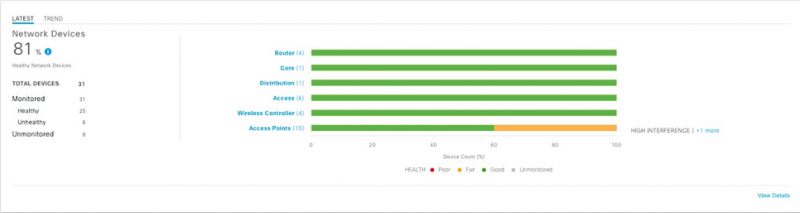
What does the following figure illustrate?
Question Image

Explanation

Cisco DNA Center’s Global Network Health view summarizes the health of managed network devices and breaks it down by device role, such as routers, core, distribution, access, wireless controllers, and access points. Cisco documents this view under Assurance > Health > Network > Global. Cisco Prime Infrastructure Health is a dashboard from a different management platform, while a Users Health view would report client health rather than device-role health.

Learn more

Community Discussion

No comments yet. Be the first to start the discussion!

QuestionQ3

QoS on a Wireless Network

In wireless LAN networks, what mechanism corresponds to CSMA/CD in wired networks?

Explanation

CSMA/CA is the IEEE 802.11 wireless-medium access method. Wireless stations use carrier sensing and collision-avoidance measures, such as waiting and randomized backoff, because they cannot reliably detect collisions while transmitting as wired Ethernet devices can. The similar expansion using “Media Access” is not the standardized meaning of CSMA; the M stands for Multiple.

Learn more

Community Discussion

No comments yet. Be the first to start the discussion!

QuestionQ4

Device Hardening

For which of the following applications would an AP model with internal antennas be most appropriate?

Explanation

APs with internal antennas are generally designed to provide broad, near-omnidirectional coverage around the device, making them appropriate where a relatively wide coverage area is needed. Coverage primarily toward one side, or a patch-antenna pattern, requires directional antennas that concentrate RF energy in a selected direction rather than the broad pattern associated with typical integrated indoor AP antennas.

Learn more

Community Discussion

No comments yet. Be the first to start the discussion!

QuestionQ5

Device Hardening

What is the greatest number of subordinate access points (APs) of the same model that can download the image from the primary AP?

Explanation

A primary AP can serve image downloads to at most three same-model subordinate APs at one time because it supports a maximum of three concurrent TFTP connections for this process. Any higher concurrent count is therefore not permitted; remaining subordinate APs wait and retry after a download slot becomes available.

Learn more

Community Discussion

No comments yet. Be the first to start the discussion!
Know a question that should be here? Contribute to this exam
Back home