About the Exam

CCNA is a 120-minute Cisco exam with no formal prerequisites, aimed at learners and IT professionals building networking skills. It covers network fundamentals, network access, IP connectivity, IP services, security fundamentals, and automation and programmability. Passing earns the Cisco Certified Network Associate (CCNA) certification and demonstrates foundational skills for installing, configuring, and troubleshooting Cisco networks.

Exam Topics

  • Network Fundamentals20%
  • Network Access20%
  • IP Connectivity25%
  • IP Services10%
  • Security Fundamentals15%
  • Automation and Programmability10%

How to Use This Practice Exam

  1. Browse — Read each question, select your answer, and reveal the explanation.
  2. Exam Mode — Simulate real exam conditions with a timed session and score report.
  3. Learn Mode — Spaced repetition schedules questions you struggle with for long-term retention.

Download the Full Exam PDF

Get every question and answer in a clean, printable PDF built for offline study. Purchase once, keep permanent access, and re-download the latest version anytime.

Last updated July 7, 2026 at 7:59 PM

Topic filter
Retired questions
Question sort
Questions per page

QuestionQ1

Network Fundamentals

What are two characteristics that distinguish optical-fiber cabling from copper cabling?

Choose two
Explanation

Optical-fiber cabling supports higher bandwidth and data-rate options than copper cabling, and it can transmit signals over much longer distances because it uses light rather than electrical signaling. Copper cabling is limited by greater attenuation and electromagnetic interference and is also the medium used for PoE, whereas fiber is not.

Learn more

Community Discussion

No comments yet. Be the first to start the discussion!

QuestionQ3

Automation and ProgrammabilityRetired

What is one advantage of Cisco DNA Center compared to traditional campus device management?

Explanation

Cisco DNA Center improves on traditional campus management by centrally discovering and onboarding existing network devices in brownfield environments, which reduces manual per-device setup and makes adoption of controller-based management much easier. Network assurance, extensibility, and cluster high availability are important features, but straightforward autodiscovery of existing campus elements is the clearest direct advantage in this comparison.

Learn more

Community Discussion

No comments yet. Be the first to start the discussion!

QuestionQ4

Network Fundamentals
Question Image

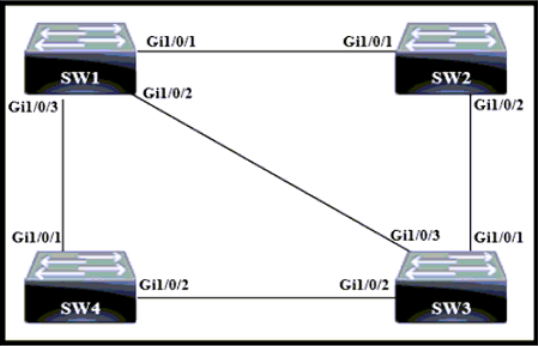
Refer to the exhibit. Which switch will become the root bridge?

Explanation

The root bridge in Spanning Tree Protocol is elected using the lowest Bridge ID. Bridge ID comparison uses the lowest bridge priority first, and if there is a tie, the lowest MAC address wins. The lowest listed priority is 8192, shared by SW4 and SW2. Between those two, SW2 has the lower MAC address (00:ac:f0:9b:dc:72), so it has the lowest Bridge ID and is elected the root bridge.

Learn more

Community Discussion

No comments yet. Be the first to start the discussion!

QuestionQ5

IP Services

Refer to the exhibit. A network associate configured OSPF with the command:

City(config-router)# network 192.168.12.64 0.0.0.63 area 0

After finishing the configuration, the associate finds that not all interfaces are participating in OSPF. Based on this configuration statement, which three interfaces shown in the exhibit will participate in OSPF?

Question Image

Choose three
Explanation

In Cisco OSPF, the network command enables OSPF on interfaces whose IP addresses fall within the address range defined by the network address and wildcard mask. The wildcard 0.0.0.63 matches a /26 block, so network 192.168.12.64 0.0.0.63 area 0 covers addresses from 192.168.12.64 to 192.168.12.127. The interfaces in that range are 192.168.12.65, 192.168.12.121, and 192.168.12.125, which correspond to FastEthernet0/1, Serial0/0, and Serial0/1.102.

Learn more

Community Discussion

No comments yet. Be the first to start the discussion!

QuestionQ6

IP Services

What is the PUT method within HTTP?

Explanation

The HTTP PUT method is used to create or replace the representation of a resource at the target URI. Standards documentation describes PUT as replacing the state of the target resource, and it is idempotent, which rules out the choices describing it as nonidempotent, read-only, or used to display a website.

Learn more

Community Discussion

No comments yet. Be the first to start the discussion!
Know a question that should be here? Contribute to this exam

Back home