About the Exam

This is a 90-minute Cisco CCNP Data Center concentration exam that tests troubleshooting of a data center infrastructure. It covers network, compute platforms, storage network, automation, management, and operations. Passing it earns the Cisco Certified Specialist - Data Center Operations certification and can satisfy the CCNP Data Center concentration exam requirement.

Exam Topics

  • Network25%
  • Compute Platforms25%
  • Storage Network15%
  • Automation15%
  • Management and Operations20%

How to Use This Practice Exam

  1. Browse — Read each question, select your answer, and reveal the explanation.
  2. Exam Mode — Simulate real exam conditions with a timed session and score report.
  3. Learn Mode — Spaced repetition schedules questions you struggle with for long-term retention.

Download the Full Exam PDF

Get every question and answer in a clean, printable PDF built for offline study. Purchase once, keep permanent access, and re-download the latest version anytime.

Last updated June 27, 2026 at 12:04 PM

Topic filter
Retired questions
Question sort
Questions per page

QuestionQ1

Network

Question Image

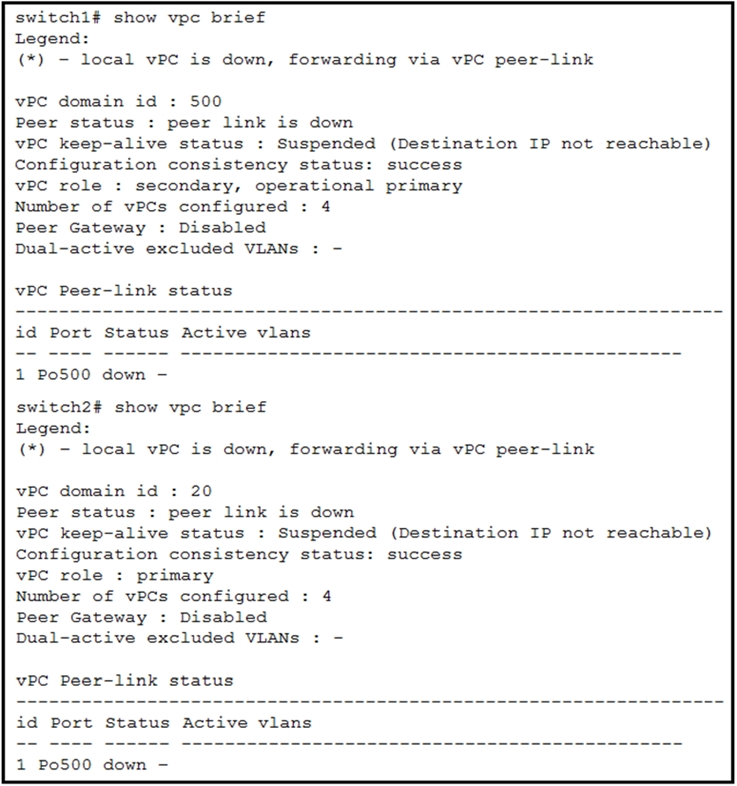
Refer to the exhibit. The vPC between switch1 and switch2 is not working. Which two actions resolve the issue?

Choose two
Explanation

Both vPC peers must use the same vPC domain ID. The vPC peer link and peer-keepalive link must also be correctly configured and operational; an unreachable peer-keepalive destination prevents the peer relationship from forming. Cisco NX-OS requires the peer-keepalive link before the vPC peer link can form.

Learn more

Community Discussion

No comments yet. Be the first to start the discussion!

QuestionQ2

Network

A mission-critical server is connected to site A. Connectivity to this server from site B is lost because the MAC route is absent from the OTV VDC on the Cisco Nexus 7000 at site B as a result of MAC aging. Which action permits flooding of the unknown-unicast MAC on the Nexus 7000 in the OTV VDC?

Explanation

Cisco Nexus 7000 OTV supports selective unicast flooding with the otv flood mac mac-address vlan vlan-id command. It configures flooding for the specified destination MAC when the OTV MAC route is unavailable, such as after MAC aging. Cisco Nexus 7000 Series NX-OS OTV Configuration Guide—Configuring Advanced OTV Features

Learn more

Community Discussion

No comments yet. Be the first to start the discussion!

QuestionQ3

Network

A customer configures HSRP between two data centers interconnected through OTV. The configuration succeeds, but traffic between two ESXi virtual hosts at the same site is routed suboptimally through the OTV overlay. Which two actions optimize the traffic?

Choose two
Explanation

An OTV-edge Layer 3 VACL blocks HSRP control packets from crossing sites, and a Layer 2 MAC list prevents the HSRP virtual MAC from being advertised or used across the overlay. This localizes first-hop gateway behavior and keeps same-site traffic from taking an unnecessary OTV path.

Learn more

Community Discussion

No comments yet. Be the first to start the discussion!

QuestionQ4

Network

A client reports frequent flapping and server-cluster disconnects in its data center. While investigating the problem, an engineer finds that a network attack is targeting Cisco Nexus 7000 Series Switches and that its source IP addresses are spoofed. Which first-line security solution resolves this problem?

Explanation

Unicast RPF checks ingress packets against the forwarding information base to verify that the source address has a valid reverse path. Packets with forged or unverifiable source IP addresses are dropped, mitigating spoofed-source attacks.

Learn more

Community Discussion

No comments yet. Be the first to start the discussion!

QuestionQ5

Management and Operations

A Cisco ACI environment includes three Cisco APICs, two spine switches, and four leaf switches. An engineer erases and reboots all APICs first, then erases and reboots the leaf and spine switches individually, and completes the Initial Setup dialog from the APIC1 CIMC KVM console. After logging in to the APIC1 web GUI, the engineer finds that no directly connected leaf switches are being discovered under Fabric > Inventory > Fabric Membership. What is causing the issue?

Explanation

A clean-reloaded leaf can receive stale infrastructure fabric parameters through LLDP from a switch that has not yet been cleaned. Those mismatched parameters prevent the leaf from registering or appearing in fabric membership. Cisco documents that all leaf switches must be clean rebooted simultaneously when infrastructure parameters change; otherwise a clean-reloaded leaf can learn the old infrastructure VLAN and fail to register with the APIC.

Learn more

Community Discussion

No comments yet. Be the first to start the discussion!
Know a question that should be here? Contribute to this exam
Back home