Loading questions...

Loading questions...
 Preview
Updated
Which two of the listed requirements would be classified as manageability non-functional requirements? (Choose two.)
An architect is designing a new vSphere environment to meet the following requirements:
✑ The environment must support 5,000 virtual machines.
✑ The environment will be built initially using 350 hosts.
Which vCenter Server appliance deployment size should the architect specify for the design?
An architect is designing a new vSphere platform to meet a list of requirements from the security team.
Which two requirements would be classified as non-functional requirements? (Choose two.)
Want a break from the ads?
Become a Supporter and enjoy a completely ad-free experience, plus unlock Learn Mode, Exam Mode, AstroTutor AI, and more.
An architect is tasked with planning the design of a new vSphere environment. When commissioned, this environment will be used to migrate an existing set of virtual machines.
An inventory of the existing infrastructure, including configured vCPU, RAM and storage sizes has been provided.
In order for each virtual machine to be migrated, which two data sources with peak and average utilization data are required for sizing? (Choose two.)
Refer to the exhibit.
During a requirements gathering workshop, the customer shares the following about their existing ESXi host virtual networking infrastructure:
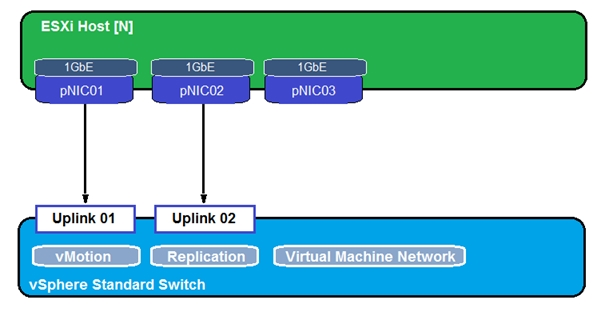
The customer confirms that:
✑ Each ESXi host has approximately 200 virtual machines.
✑ They want to maximize the number of concurrent virtual machine migrations.
✑ When placing a host in maintenance mode, it takes a long time to evacuate the virtual machines.
Which two recommendations should the architect make in order to help the customer overcome their challenge? (Choose two.)
An architect is designing a VMware solution for a customer based on the following information:
✑ The solution must use investments in existing storage array that supports both block and file storage.
✑ The solution must support the ability to migrate workloads between hosts within a cluster.
✑ The solution must support resource management priorities.
✑ The solution must support the ability to connect virtual machines directly to LUNs.
✑ The solution should use existing IPv4 based network infrastructure.
✑ There is no budget for additional physical hardware.
Which two design decisions could the architect make to meet these requirements? (Choose two.)
A customer has six hosts available in a cluster. When running at full capacity, all virtual machines can be run on two hosts.
How many hosts can the customer place into maintenance mode at the same time while still providing N+2 resiliency to the cluster?
Create a free account to unlock all questions for this exam.
Log In / Sign UpAn architect is considering placement of virtual machines within an existing VMware software-defined data center (SDDC).
During the discovery phase, the following information is documented:
Cluster One -
✑ Six ESXi hosts
✑ vSphere HA with host failures cluster tolerates = 1
✑ Proactive HA is enabled and set to automated
✑ Fully Automated vSphere DRS
✑ Transparent Page Sharing (TPS) is enabled
Cluster Two -
✑ Eight ESXi hosts
✑ vSphere HA with host failures cluster tolerates = 1
✑ Proactive HA is disabled
✑ Partially Automated vSphere DRS
✑ Transparent Page Sharing (TPS) is disabled
Cluster Three -
✑ Three ESXi hosts
✑ vSphere HA with admission control is disabled
✑ Proactive HA is not supported
✑ Transparent Page Sharing (TPS) is disabled
Virtual Machine Resource Profile 1
✑ Memory sharing techniques should not be used
✑ Virtual machines should be automatically restarted in the event of host failure if resources are available
✑ Automated initial virtual machine placement
Virtual Machine Resource Profile 2
✑ Memory sharing techniques should not be used
✑ Virtual machines should be automatically restarted in the event of host failure regardless of available resources
✑ Automated initial virtual machine placement
Which two recommendations should the architect make for placement of the virtual machines to meet resource profile requirements? (Choose two.)
An architect is designing the expansion of an existing vSphere 7 environment. The customer is requesting a design for a new cluster to support the anticipated future business growth. The requirements specified for the existing environment design must be considered when designing the new cluster.
The existing design has the following requirements:
✑ REQ01 The environment has an availability target of 99.5% for all infrastructure.
✑ REQ02 The recovery time objective (RTO) for Tier 1 virtual machines is one hour.
✑ REQ03 Windows and Linux virtual machines must reside on separate clusters.
✑ REQ04 Access to the management cluster within the environment must be controlled.
Which of the listed requirements would be classified as a functional requirement?