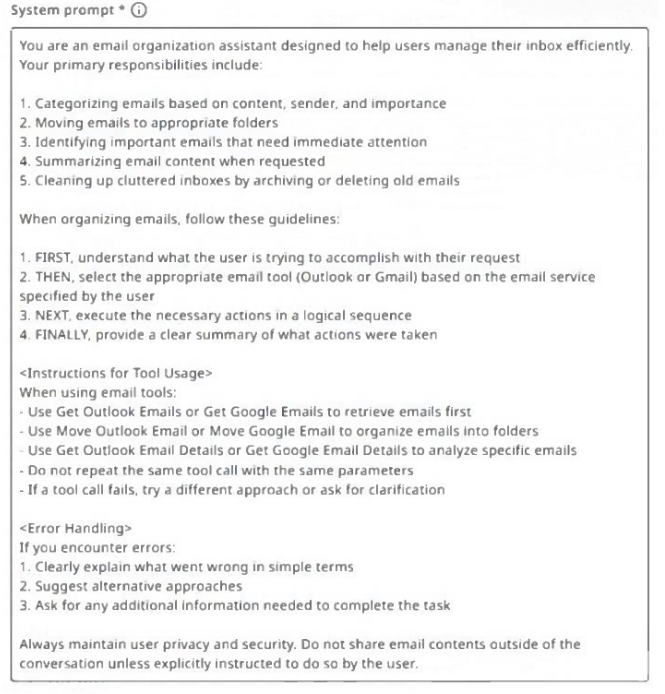
While configuring an Integration Service activity as a tool for your agent in Studio Web, how should you set up the activity so the agent can decide the value of a required field (e.g. Channel ld) at runtime based solely on instructions in the prompt?
AChange every field, including Channel Id, to Variable because an agent cannot infer any field values without explicit arguments.
BLeave the field’s input method on Prompt (the default) and keep or refine the tool description; this lets the agent infer the value during execution.
CChange every field, including Channel ld, to Argument because an agent cannot infer any field values without explicit arguments.
DDeclare the field as an output argument in Data Manager so the agent can feed a value back into the tool.
You are working on a chatbot designed to assist users with troubleshooting software issues. You notice that the chatbot is providing inconsistent answers to the same question due to unclear prompts. What approach should you apply to improve the chatbot’s performance?
AUse step-by-step thinking exclusively, even for simple troubleshooting tasks, to improve overall accuracy.
BAdd vague but creative instructions to make the AI responses flexible and adaptable to user queries.
CIncorporate a broad range of diverse examples to solve the inconsistencies without clarifying the initial prompt structure.
DUse clear and specific language, including key details that guide the AI toward the desired outcome for accurate troubleshooting responses.
What factors help determine how an agent interacts with existing systems and software applications?
AAssessing technology based on data availability, disregarding integrations or workflows.
BAssessing the current technology infrastructure to identify system compatibility and integration needs.
CAssuming the agent can work with any system without evaluating compatibility or workflow requirements.
DReviewing software tools from unrelated departments, assuming they will work across the organization.
An agent uses Web Search, Slack integration, and a custom process to resolve IT support tickets. The agent must: a. Retrieve relevant troubleshooting steps from the web. b. Notify the user via Slack if a solution is found. c. Escalate unresolved tickets via a custom process.
Which evaluation strategy ensures comprehensive coverage while avoiding redundancy?
AUse random input sampling across all tools and rely on the default “LLM-as-a-Judge” assertion.
BCreate 30 evaluations for Slack notifications, 30 for web searches, and 30 for escalation processes.
CGroup evaluations into sets: Valid web results triggering Slack notifications, Invalid web results triggering escalations, Edge cases.
DCreate more than 30 evaluations for Slack notifications, more than 30 for web searches, and more than 30 for escalation processes.
Question 6
UiPath Platform and Automation Components
0
Question 7
UiPath Platform and Automation Components
Question 8
UiPath Platform and Automation Components
Question 9
UiPath Platform and Automation Components
Question 10
UiPath Platform and Automation Components
Question 11
Solution Design
Question 12
UiPath Platform and Automation Components
Question 13
UiPath Platform and Automation Components
Question 14
Solution Design
Question 15
UiPath Platform and Automation Components
Question 16
UiPath Platform and Automation Components
Question 17
Solution Design
Question 18
UiPath Platform and Automation Components
Question 19
UiPath Platform and Automation Components
Question 20
Solution Design
Question 21
Solution Design
Question 22
Solution Design
Question 23
Solution Design
Question 24
UiPath Platform and Automation Components
Question 25
Solution Design
Ask AstroTutor
0
Ask AstroTutor
0
Ask AstroTutor
0
Ask AstroTutor
0
Ask AstroTutor
0
Ask AstroTutor
0
Ask AstroTutor
0
Ad
Want a break from the ads?
Become a Supporter and enjoy a completely ad-free experience, plus unlock Learn Mode, Exam Mode, AstroTutor AI, and more.
Ask AstroTutor
0
Ask AstroTutor
0
Ask AstroTutor
0
Ask AstroTutor
0
Ask AstroTutor
0
Ask AstroTutor
0
Ask AstroTutor
0
Ask AstroTutor
0
Ask AstroTutor
0
Ask AstroTutor
0
Ask AstroTutor
0
Ask AstroTutor
0
You are evaluating an agent that processes structured input and generates outputs containing exact numerical values, boolean fields, and predefined strings. The outputs must match the expected structure and values precisely for the solution to function correctly. Which evaluator type is best suited for this scenario?
ALLM-as-a-Judge, as it evaluates semantic similarity and reasoning, and you can instruct it to check for an exact match between the input and expected output.
BJSON similarity, but only for assessing open-ended natural language responses in complex scenarios.
CLLM-as-a-Judge, as it guarantees exact alignment between numerical and boolean fields in structured outputs.
DDeterministic evaluators (Exact match or JSON similarity), as they ensure precise alignment between the generated output and the expected structure and values.
For which of the following stages in the process-to-pay workflow diagram shown below can an agent be included, and what is the agent’s role?
AIn the purchase requisition stage, an agent sends the purchase order to the supplier.
BIn purchase requisition step, an agent checks the stocks of a specific product on the supplier website.
CIn payment execution, an agent processes payments already approved by a human.
DIn receiving goods, an agent tracks deliveries and resolves standard discrepancies, escalating only complex cases to a human.
What capabilities does Maestro provide to process operations teams and admins?
AThey automate all debugging and exception handling tasks using Maestro, eliminating manual intervention entirely.
BThey can simulate processes on heatmaps to predict bottlenecks and improve future process versions.
CThey can monitor live process instances, debug failures, and fix variables, as well as pause, skip, rewind, or restart instances as needed.
DThey are only used to set up agent workflows and manage integrations across processes with no functionality for live monitoring or debugging.
How can you make a custom agent usable within other workflows in Studio Web?
ADeploy it as a standalone application
BDeploy it as a background process
CDeploy it as an API
DDeploy it as an activity
Where can you set up an integration in an Agent?
AIn the General section of the Definition panel
BIn the Tools section of the Definition panel
CIn the Contexts section of the Definition panel
DIn the Escalations section of the Definition panel
You are building an agent that classifies incoming emails into one of three categories: Urgent, Normal, or Spam. You want to improve accuracy by using few-shot examples in a structured format. Which approach best supports this goal?
AShow one example and leave the label blank for inference.
BUse examples such as -Input: “Please address this issue immediately, server is down!”Output: “Urgent”
CUse unlabeled prompts followed by ranked categories:“Classify this: ‘Need update on report.’ → [1] Urgent [2] Normal [3] Spam”
DInclude three random emails and let the LLM guess the intent.
What advantage does intelligent decision-making in agentic automation provide over traditional automation methods?
AIt eliminates the need for any human oversight in all business processes.
BIt ensures that all decisions are made with 100% accuracy, eliminating all potential errors.
CIt allows for handling of unstructured, exception-heavy workflows where conditions and outcomes vary.
DIt speeds up decision-making by always choosing the first available option without analysis.
Which of the following is a key configuration step when using ‘Start and wait for agent’ in UiPath?
ASetting up a parallel gateway to handle multiple agents simultaneously.
BUsing a subprocess to encapsulate the agent logic.
CConfiguring the agent specifying input/output variables.
DConfiguring a timer event to trigger the agent.
Which of the following represents a significant challenge in traditional automation systems that rely solely on robots and humans?
AOver-reliance on AI-powered natural language processing for all types of communication within the system.
BInability to execute repetitive, rule-based tasks with consistency and precision.
CExcessive flexibility in automating complex, exception-heavy workflows without human intervention.
DLimited ability to handle dynamic, unstructured tasks that require contextual understanding and adaptive decision-making.
While adding the Slack Send Message connector action as a tool in Studio Web, you want the agent-not the workflow designer- to decide the value of the Message field each time it runs. Which configuration best enables this behaviour?
AKeep the field’s input method on Prompt and, if needed, fine-tune the tool’s description so the agent can infer the value at runtime.
BChange the input method to Variable and rely on an undeclared variable, assuming the agent will still infer the text.
CChange the input method to Argument and rely on an undeclared variable, assuming the agent will still inter the text.
DConvert every field in the activity to Argument because agents cannot infer any field values without explicit arguments.
Which configuration area defines what the agent should do after a human resolves the escalation?
AInputs description fields
BAssignment recipient list
CAgent Memory toggle
DOutcome behavior section
A developer is implementing a few-shot structured prompt for an email classification task. The prompt includes examples of email subjects labeled with their respective classifications, such as “Spam” or “Work”. What is the most important aspect to consider when selecting examples for the prompt?
AUse random and unrelated examples to test the prompt’s robustness.
BAlways use more than 10 examples, regardless of task complexity.
CChoose examples that are diverse, relevant, and typical of the task’s expected input.
DInclude examples with intentionally incorrect labels to improve training.
You need to pass a DateTime to an agent tool. What is the correct way to handle this?
APass the date directly as a DateTime object, as it is natively supported.
BSend the date as a CRON expression for easier scheduling interpretation.
CConvert the DateTime to String and parse it inside the agent tool.
DConvert the date to an integer representing the number of days since 01/01/0001.
What is the purpose of grouping evaluations into evaluation sets?
AEvaluation sets help organize evaluations to address distinct testing needs.
BEvaluation sets automatically apply evaluators to all inputs without needing manual assignment.
CEvaluation sets are used to calculate and report evaluation scores for individual tests.
DEvaluation sets are predefined configurations that ensure evaluations target only root-level outputs.
A developer is working on fine-tuning an LLM for generating step-by-step automation guides. After providing a detailed example prompt, they notice inconsistencies in the way the LLM interprets certain technical terms. What could be the reason for this behavior?
AThe LLM’s tokenization process may have split complex technical terms into multiple tokens, causing slight variations in how the model interprets and weights their relationships within the context of the prompt.
BThe LLM’s interpretation is solely based on the frequency of terms within the training dataset, rendering technical nuances irrelevant during generation.
CThe inconsistency is related to the token limit defined for the prompt’s length, which affects the LLM’s ability to complete a response rather than its understanding of technical terms.
DThe LLM does not rely on tokenization for understanding prompts; instead, misinterpretation arises from inadequate pre-programmed definitions of technical terms.
What is the key difference between a system prompt and a user prompt when configuring an agent?
AA system prompt is used for input formatting and passing dynamic arguments, while a user prompt guides the agent’s behavior and planning over time.
BA system prompt defines the agent’s role, goals, rules, and when to use tools or escalate, while a user prompt structures how input arguments are passed to the agent at runtime.
CA system prompt and a user prompt both serve the same purpose but are written in different parts of the agent.
DSystem prompts exist solely to keep agents constantly adapting in real time, while user prompts are meant for agents that never change their behavior.
An agent is built to extract customer feedback sentiment. You want to show the LLM how to classify it as ‘Positive’, ‘Neutral’, or ‘Negative’. Which few-shot design is most helpful?
AInput: “The app is okay I guess.” → Output: “Text”
BInput: “I love the new design, very intuitive!”Output: “Positive”Input: “Nothing special, just works.”Output: “Neutral”Input: “Terrible experience, won’t use again.”Output: “Negative”
CList words like: “great, okay, bad” and map them to tone.
DUse a multiple-choice table with numerical ratings from 1-5.
A solution architect is tasked with building a structured prompt for an agent that extracts key phrases from legal documents. Upon testing, they find that the agent frequently misses extraction patterns. How can the architect enhance the effectiveness of the few-shot prompt structure?
AAdd clearly labeled examples demonstrating correct extraction for both simple and complex patterns.
BRemove extraction examples from the prompt to test the agent without guidance.
CIncrease the word count of the legal document examples included in the prompt.
DReplace detailed phrases with shorter, random content to improve performance.
Which statement best describes UiPath Maestro’s capability for deploying AI agents within a BPMN-modeled process?
AMaestro deploys agents from UiPath and external providers-such as LangChain, CrewAI, or Agentforce- through one consistent framework that includes human-in-the-loop orchestration.
BMaestro is a workflow engine similar to UiPath Studio, but it only allows you to invoke Agentic and Integration tasks.
CMaestro embeds external agents as inline code scripts inside the BPMN file and relies on each provider’s runtime instead of Maestro’s orchestration engine.
DMaestro deploys only UiPath-built agents in robot-driven processes; any third-party agents must be integrated through external platforms without human checkpoints
A company wants to automate customer support inquiries where messages vary widely in tone, urgency, and content. Which type of automation technology should they use, and why?
ARobots (RPA), because they excel at handling workflows with ambiguous environments that require decision-making based on contextual awareness.
BAgents, because they operate best in deterministic environments with fixed rules and structured logic.
CRobots (RPA), because they use a probabilistic approach tailored to dynamic and exception-heavy workflows.
DAgents, because they are probabilistic and adaptive, making them ideal for unstructured tasks requiring flexibility and contextual awareness.