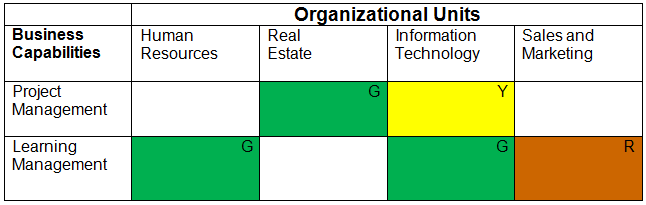
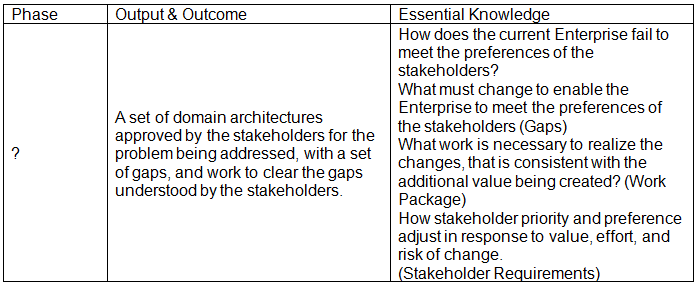
Consider the following modeling example, relating business capabilities to organization units so as to highlight duplication and redundancy:
(Note in this example the cells colored green, yellow, and red, are also marked G, Y, and R, respectively)
Which of the following best describes this technique?
ARelationship Mapping
BCapability Mapping
CPerspective Analysis
DGap Analysis
Which of the following is a purpose of mapping capabilities to value stream stages?
ATo identify and eliminate business capabilities that do not contribute to the business.
BTo classify, group, and align capabilities into categories for a deeper understanding.
CTo describe the business in terms of services provided and consumed.
DTo provide a self-contained business description that is independent of the organizational structure.
Consider the following statements:
A whole corporation or a division of a corporation.
A government agency or a single government department
Partnerships and alliances of businesses working together, such as consortium or supply chain.
What are those examples of according to the TOGAF Standard?
AOrganizations
BArchitecture Scopes
CBusiness Unit
DEnterprises
Which of the following best describe the relationship between business models and business architecture?
ABusiness Architecture provides a conceptual summary view, whereas business models support in-depth analysis.
BBusiness Architecture breaks a business model down into the core functional elements that describe how the business works.
CBusiness models are useful for impact analysis, however Business Architecture is needed for scenario analysis.
DBusiness model development is a prerequisite for a Business Architecture development.
Question 6
Introduction to the ADM
0
Question 7
TOGAF Business Scenarios
Question 8
Organization Mapping
Question 9
Business Capabilities
Question 10
Applying Business Architecture Techniques within the TOGAF ADM
Question 11
Introduction and Concepts
Question 12
Applying Business Architecture Techniques within the TOGAF ADM
Question 13
Value Streams
Question 14
Business Modeling
Question 15
Information Mapping
Question 16
Business Modeling
Question 17
Applying Business Architecture Techniques within the TOGAF ADM
Question 18
Business Capabilities
Question 19
Applying Business Architecture Techniques within the TOGAF ADM
Question 20
Introduction and Concepts
Question 21
Introduction to the ADM
Question 22
Information Mapping
Question 23
Value Streams
Question 24
Value Streams
Question 25
Information Mapping
Ask AstroTutor
0
Ask AstroTutor
0
Ask AstroTutor
0
Ask AstroTutor
0
Ask AstroTutor
0
Ask AstroTutor
0
Ask AstroTutor
0
Ad
Want a break from the ads?
Become a Supporter and enjoy a completely ad-free experience, plus unlock Learn Mode, Exam Mode, AstroTutor AI, and more.
Ask AstroTutor
0
Ask AstroTutor
0
Ask AstroTutor
0
Ask AstroTutor
0
Ask AstroTutor
0
Ask AstroTutor
0
Ask AstroTutor
0
Ask AstroTutor
0
Ask AstroTutor
0
Ask AstroTutor
0
Ask AstroTutor
0
Ask AstroTutor
0
Complete the sentence. The TOGAF standard covers the development of four architecture domains. Business, Data, Technology and _________.
ACapability
BApplication
CTransition
DSegment
Which of the following best describes where business scenarios are used in the TOGAF ADM?
AThey are used to resolve impacts across the Architecture Landscape in Phases B, C, and D.
BThey are used in the Preliminary Phase. Phase A, and Phase B.
CThey are used as part of the lessons learned activity at the end of Phase F.
DThey are used as part of a business transformation readiness assessment in Phase E.
Which of the following is a difference between an organization map and an organization chart?
AAn organization map highlights where in the organization that stakeholder concerns are not being addressed by a business architecture.
BAn organization map can be impacted by a business model change.
CAn organization map reduces the time, cost, and risk of business operations.
DAn organization map is limited to formal relationships between business units.
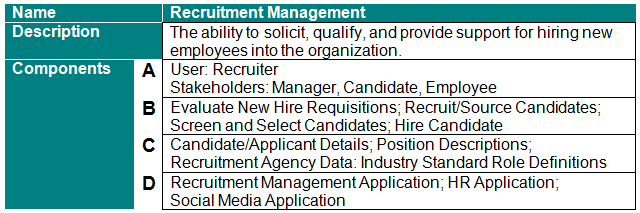
Consider the following Business Capability Example:
Which of the following are A and C?
AOrganization Data
BWho, What
CRoles, Information
DActors, Actions
Consider the following:
In Phase A a business capability map and a core set of value streams were created while developing the Architecture Vision.
Why would such Architecture Descriptions need to be updated in Phase B?
APhase B requires that all Architecture Descriptions be updated.
BThe development of Business Architecture Descriptions is always iterative.
CPhase B is an ADM Architecture Development phase.
DA new value stream was assessed as in the project scope.
What is defined as the effect of uncertainty on objectives?
AThreat
BContinuity
CRisk
DVulnerability
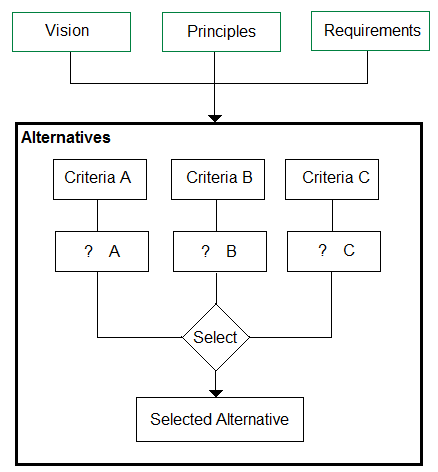
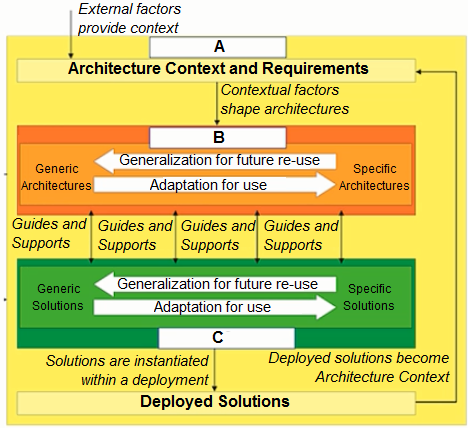
Consider the following graphic illustrating a method supporting the TOGAF ADM.
What does the method help identify?
ASolution Building Blocks
BBusiness Scenarios
CAlternative Target Architectures
DArchitecture Solutions
Which approach to model, measure, and analyze business value is primarily concerned with identifying the participants involved in creating and delivering value?
AValue chains
BValue networks
CLean value streams
DValue streams
Which of the following describes how business models are used within the TOGAF standard?
ATo identify, classify, and mitigate risks to the business.
BTo tailor the enterprise architecture for the business.
CTo document the factors impacting the business migration plan.
DTo help formulate architecture and business principles.
Which of the following can be used to help define information concepts in an information map?
AStakeholder Map
BValue streams
CStatement of business goals and drivers
DOrganization Map
Complete the sentence. A business model is a description of the rationale for how an organization creates, delivers, and captures _________.
Astrategy
Bbusiness function
Cbest practices
Dvalue
Which of the following Business Architecture concepts should the architect examine and search for when developing the Architecture Vision?
AArchitecture Principles, Business Goals
BImplementation Factor Catalog, Business Value Assessment Matrix
CArchitecture Continuum, Architecture Repository
DOrganization Map, Business Capabilities
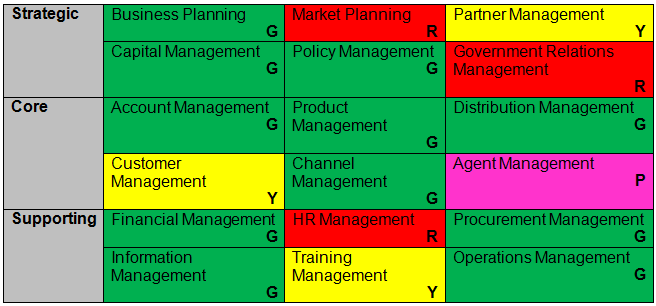
Consider the following business capability map, where cells of a model are given different colors to represent maturity levels (note the letters G, R, Y, P also denote the colors used = Green, Red, Yellow and Purple):
Which of the following best describes this technique?