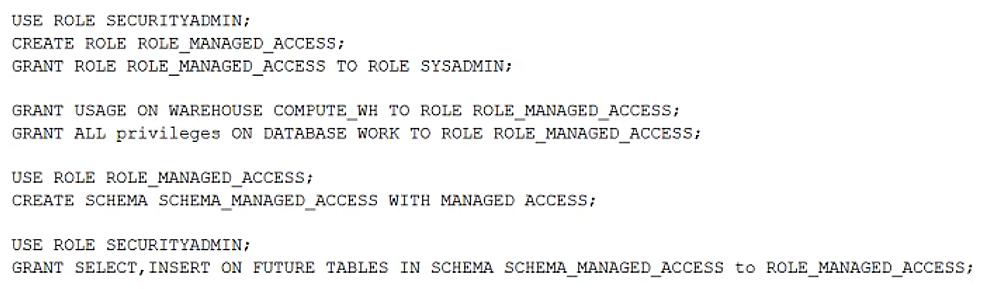
BUSE ROLE ROLE_MANAGED_ACCESS;DROP SCHEMA WORK.SCHEMA_MANAGED_ACCESS;CREATE SCHEMA SCHEMA_MANAGED_ACCESS;Then recreate all needed objects.
CREVOKE SELECT, INSERT ON FUTURE TABLES IN SCHEMA SCHEMA_MANAGED_ACCESS FROMROLE MANAGED ACCESS;ALTER SCHEMA SCHEMA_MANAGED_ACCESS DISABLE MANAGED ACCESS;
DUSE ROLE ROLE_MANAGED_ACCESS;DROP SCHEMA WORK.SCHEMA_MANAGED_ACCESS;CREATE SCHEMA SCHEMA_MANAGED_ACCESS WITHOUT MANAGED ACCESS;Then recreate all needed objects.
When a role is dropped, which role inherits ownership of objects owned by the dropped role?
AThe SYSADMIN role
BThe role above the dropped role in the RBAC hierarchy
CThe role executing the command
DThe SECURITYADMIN rote
Question 6
Accounts
0
Question 7
Security and Governance
Question 8
Data Sharing and Collaboration
Question 9
Disaster Recovery, Backup, and Replication
Question 10
Security and Governance
Question 11
Security and Governance
Question 12
Query Performance, Monitoring, and Optimization
Question 13
Query Performance, Monitoring, and Optimization
Question 14
Data Sharing and Collaboration
Question 15
Security and Governance
Question 16
Security and Governance
Question 17
Security and Governance
Question 18
Security and Governance
Question 19
Security and Governance
Question 20
Database Objects and Virtual Warehouses
Question 21
Security and Governance
Question 22
Database Objects and Virtual Warehouses
Question 23
Database Objects and Virtual Warehouses
Question 24
Security and Governance
Question 25
Security and Governance
Ask AstroTutor
0
Ask AstroTutor
0
Ask AstroTutor
0
Ask AstroTutor
0
Ask AstroTutor
0
Ask AstroTutor
0
Ask AstroTutor
0
Ad
Want a break from the ads?
Become a Supporter and enjoy a completely ad-free experience, plus unlock Learn Mode, Exam Mode, AstroTutor AI, and more.
Ask AstroTutor
0
Ask AstroTutor
0
Ask AstroTutor
0
Ask AstroTutor
0
Ask AstroTutor
0
Ask AstroTutor
0
Ask AstroTutor
0
Ask AstroTutor
0
Ask AstroTutor
0
Ask AstroTutor
0
Ask AstroTutor
0
Ask AstroTutor
0
What are the requirements when creating a new account within an organization in Snowflake? (Choose two.)
AThe account requires at least one ORGADMIN rote within one of the organization's accounts.
BThe account name is immutable and cannot be changed.
CThe account name must be specified when the account is created.
DThe account name must be unique among all Snowflake customers.
EThe account name must be unique within the organization.
For Snowflake network policies, what will occur when the account_level and user_level network policies are both defined?
AThe account_level policy will override the user_level policy.
BThe user_level policy will override the account_level policy.
CThe user_level network policies will not be supported.
DA network policy error will be generated with no definitions provided.
An Administrator receives data from a Snowflake partner. The partner is sharing a dataset that contains multiple secure views. The Administrator would like to configure the data so that only certain roles can see certain secure views.
How can this be accomplished?
AApply RBAC directly onto the partner's shared secure views.
BIndividually grant imported privileges onto the schema in the share.
CClone the data and insert it into a company-owned share and apply the desired RBAC on the new tables.
DCreate views over the incoming shared database and apply the desired RBAC onto these views.
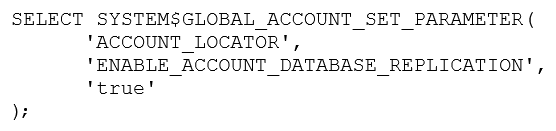
A Snowflake organization MYORG consists of two Snowflake accounts:
The ACCOUNT1 has a database PROD_DB and the ORGADMIN role enabled.
Management wants to have the PROD_DB database replicated to ACCOUNT2.
Are there any necessary configuration steps in ACCOUNT1 before the database replication can be configured and initiated in ACCOUNT2?
A
B
CNo configuration steps are necessary in ACCOUNT1. Replicating databases across accounts within the same Snowflake organization is enabled by default.
DIt is not possible to replicate a database from an Enterprise edition Snowflake account to a Standard edition Snowflake account.
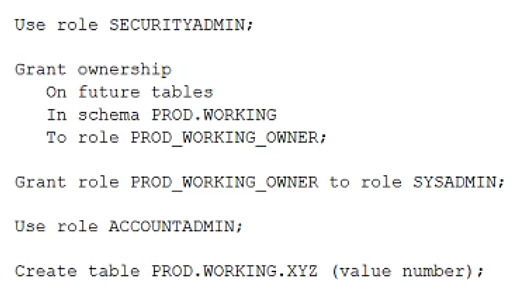
The following SQL command was executed:
Which role(s) can alter or drop table XYZ?
ABecause ACCOUNTADMIN created the table, only the ACCOUNTADMIN role can alter or drop table XYZ.
BSECURITYADMIN, SYSADMIN, and ACCOUNTADMIN can alter or drop table XYZ.
CPROD_WORKING_OWNER, ACCOUNTADMIN, and SYSADMIN can alter or drop table XYZ.
DOnly the PROD_WORKING_OWNER role can alter or drop table XYZ.
What session parameter can be used to test the integrity of secure views based on the account that is accessing that view?
AMIMIC_CONSUMER_ACCOUNT
BTEST_ACCOUNT_ID
CPRODUCER_TEST_ACCT
DSIMULATED_DATA_SHARING_CONSUMER
A Snowflake Administrator has a multi-cluster virtual warehouse and is using the Snowflake Business-Critical edition. The minimum number of clusters is set to 2 and the maximum number of clusters is set to 10. This configuration works well for the standard workload, rarely exceeding 5 running clusters. However, once a month the Administrator notes that there are a few complex long-running queries that are causing increased queue time and the warehouse reaches its maximum limit at 10 clusters.
Which solutions will address the issues happening once a month? (Choose two.)
AUse a task to increase the cluster size for the time period that the more complex queries are running and another task to reduce the size of the cluster once the complex queries complete.
BHave the group running the complex monthly queries use a separate appropriately-sized warehouse to support their workload.
CIncrease the multi-cluster maximum to 20 or more clusters.
DExamine the complex queries and determine if they can be made more efficient using clustering keys or materialized views.
EIncrease the minimum number of clusters started in the multi-cluster configuration to 5.
A Snowflake customer is experiencing higher costs than anticipated while migrating their data warehouse workloads from on-premises to Snowflake. The migration workloads have been deployed on a single warehouse and are characterized by a large number of small INSERTS rather than bulk loading of large extracts. That single warehouse has been configured as a single cluster, 2XL because there are many parallel INSERTs that are scheduled during nightly loads.
How can the Administrator reduce the costs, while minimizing the overall load times, for migrating data warehouse history?
AThere should be another 2XL warehouse deployed to handle a portion of the load queries.
BThe 2XL warehouse should be changed to 4XL to increase the number of threads available for parallel load queries.
CThe warehouse should be kept as a SMALL or XSMALL and configured as a multi-cluster warehouse to handle the parallel load queries.
DThe INSERTS should be converted to several tables to avoid contention on large tables that slows down query processing.
Which type of listing in the Snowflake Marketplace can be added and queried immediately?
AMonetized listing
BStandard listing
CRegional listing
DPersonalized listing
A user has built a view named DB.VWS.TEST_VIEW in Snowflake which only allows users having ROLE_XYZ to retrieve data from the view.
Roles Setup:
GRANT USAGE ON DATABASE DB TO ROLE ROLE_ALPHA;
GRANT USAGE ON SCHEMA DB.VWS TO ROLE ROLE_ALPHA;
GRANT SELECT ON VIEW TEST_VIEW IN SCHEMA DB.VWS TO ROLE ROLE_ALPHA;
GRANT ROLE ROLE_ALPHA TO ROLE ROLE_XYZ;
GRANT ROLE ROLE_XYZ TO ROLE ROLE_BETA;
GRANT ROLE ROLE_ALPHA TO USER USER1;
GRANT ROLE ROLE_BETA TO USER USER2;
GRANT ROLE ROLE_XYZ TO USER USER3;
View definition:
CREATE VIEW DB.VWS.TEST_VIEW AS -
(
SELECT * FROM TEST TABLE -
WHERE IS_ROLE_IN_SESSION('ROLE_XYZ')=TRUE
) ;
Which user and current role combination can retrieve data from the view? (Choose two.)
AUSER1 and ROLE_ALPHA
BUSER2 and ROLE_BETA
CUSER3 and ROLE_XYZ
DUSER1 and ROLE_XYZ
EUSER3 and ROLE_ALPHA
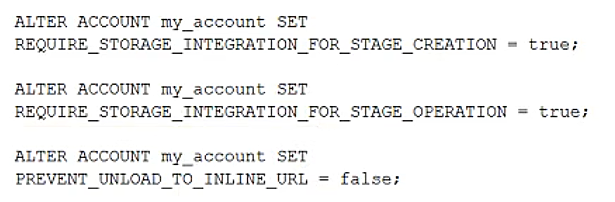
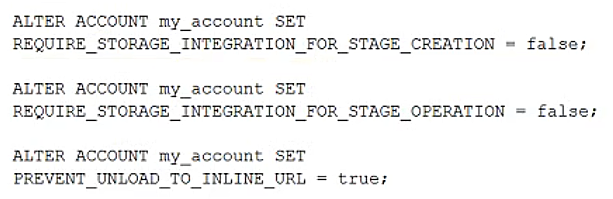
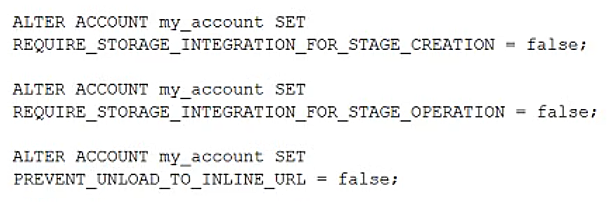
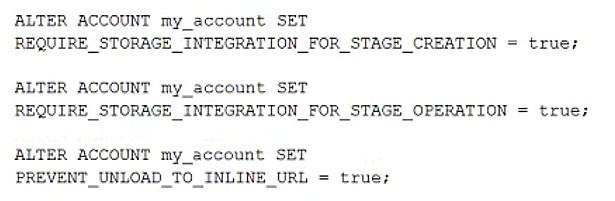
What is required for stages, without credentials, to limit data exfiltration after a storage Integration and associated stages are created?
A
B
C
D
What roles or security privileges will allow a consumer account to request and get data from the Data Exchange? (Choose two.)
ASYSADMIN
BSECURITYADMIN
CACCOUNTADMIN
DIMPORT SHARE and CREATE DATABASE
EIMPORT PRIVILEGES and SHARED DATABASE
What SCIM integration types are supported in Snowflake? (Choose three.)
AAmazon Web Services (AWS)
BGoogle Cloud Platform (GCP)
COkta
DCustom
EAzure Active Directory (Azure AD)
FDuo Security Provisioning Connector
Which commands can be performed by a user with the ORGADMIN role but not the ACCOUNTADMIN role? (Choose two.)
ASHOW REGIONS;
BSHOW USERS;
CSHOW ORGANIZATION ACCOUNTS;
DGRANT ROLE ORGADMIN TO USER <username>;
E
When does auto-suspend occur for a multi-cluster virtual warehouse?
AWhen there has been no activity on any cluster for the specified period of time.
BAfter a specified period of time when an additional cluster has started on the maximum number of clusters specified for a warehouse.
CWhen the minimum number of clusters is running and there is no activity for the specified period of time.
DAuto-suspend does not apply for multi-cluster warehouses.
An Administrator has a user who needs to be able to suspend and resume a task based on the current virtual warehouse load, but this user should not be able to modify the task or start a new run.
What privileges should be granted to the user to meet these requirements? (Choose two.)
AEXECUTE TASK on the task
BOWNERSHIP on the task
COPERATE on the task
DUSAGE on the database and schema containing the task
EOWNERSHIP on the database and schema containing the task
A Snowflake Administrator wants to create a virtual warehouse that supports several dashboards, issuing various queries on the same database.
For this warehouse, why should the Administrator consider setting AUTO_SUSPEND to 0 or NULL?
ATo save costs on warehouse shutdowns and startups for different queries
BTo save costs by running the warehouse as little as possible
CTo keep the data cache warm to support good performance of similar queries
DTo keep the query result cache warm for good performance on repeated queries
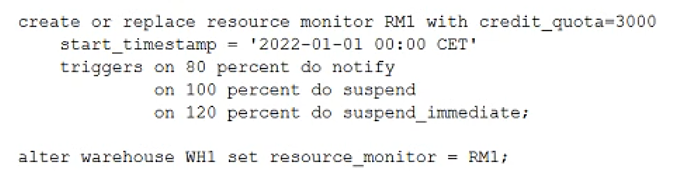
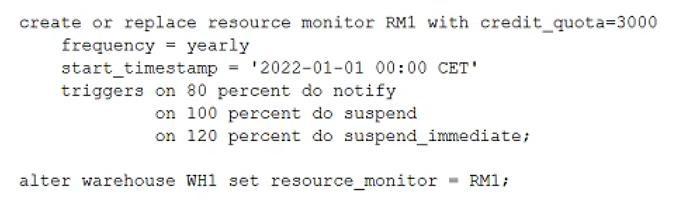
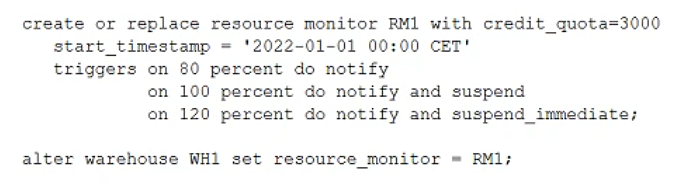
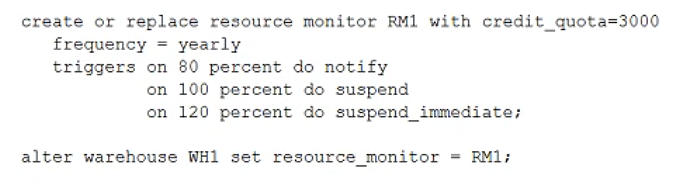
An Administrator has a warehouse which is intended to have a credit quota set for 3000 for each calendar year. The Administrator needs to create a resource monitor that will perform the following tasks:
At 80% usage notify the account Administrators.
At 100% usage suspend the warehouse and notify the account Administrators.
At 120% stop all running executions, suspend the warehouse, and notify the account Administrators.
Which SQL command will meet these requirements?
A
B
C
D
What are characteristics of Dynamic Data Masking? (Choose two.)
AA masking policy that is currently set on a table can be dropped.
BA single masking policy can be applied to columns in different tables.
CA masking policy can be applied to the VALUE column of an external table.
DThe role that creates the masking policy will always see unmasked data in query results.
EA single masking policy can be applied to columns with different data types.
Which tasks can be performed by the ORGADMIN role? (Choose three.)
ACreate one or more accounts in the organization.
BView a list of all regions enabled for the organization.
CCreate secure views on application tables within the organization.
DView usage information for all accounts in the organization.
EPerform zero-copy cloning on account data.
FCreate a reader account to share data with another organization.