When implementing a synchronous API where the event source is an HTTP Listener, a developer needs to return the same correlation ID back to the caller in the HTTP response header.
How can this be achieved?
ANo action is needed as the correlation ID is returned to the caller in the response header by default
BEnable the CorrelationID checkbox in the HTTP Listener configuration
CConfigure a custom correlation policy
DEnable the auto-generate CorrelationID option when scaffolding the flow
0
Question 2
Implement performant and reliable Mule applications
0
Question 3
Implement monitorable Mule applications
0
Question 4
Secure data at rest and in transit
0
Question 5
Implement performant and reliable Mule applications
0
That's the end of the Preview
This exam has 57 community-verified practice questions. Create a free account to access all questions, comments, and explanations.
Topics covered:
Expose production-ready Anypoint Platform-managed APIs from Mule applicationsImplement maintainable and modular Mule applications and their Maven buildsImplement monitorable Mule applicationsImplement performant and reliable Mule applicationsSecure data at rest and in transit
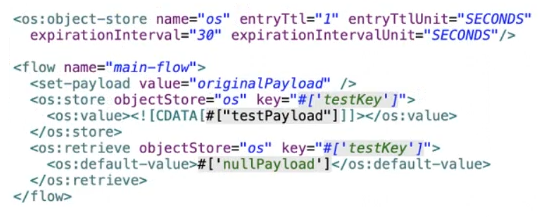
A Mule Object Store is configured with an entry TTL of one second and an expiration interval of 30 seconds.
What is the result of the flow if processing between os:store and os:retrieve takes 10 seconds?
AoriginalPayload
BOS:KEY_NOT_FOUND
CtestPayload
DnullPayload
An order processing system is composed of multiple Mule applications responsible for warehouse, sales, and shipping. Each application communicates using Anypoint MQ. Each message must be correlated against the original order ID for observability and tracing.
How should a developer propagate the order ID as the correlation ID across each message?
AUse the underlying HTTP request of Anypoint MQ to set the "X-CORRELATION-ID" header to the order ID
BWrap all Anypoint MQ Publish operations within a With CorrelationID scope from the Tracing module, setting the correlation ID to the order ID
CSet a custom Anypoint MQ user property to propagate the order ID and set the correlation ID in the receiving applications
DUse the default correlation ID; Anypoint MQ will automatically propagate it
What is the MuleSoft recommended method to encrypt sensitive property data?
AThe encryption key should be different for each environment and the sensitive data should be the same for all environments
BThe encryption key should be identical for all environments and the sensitive data should be different for each environment
CThe encryption key and sensitive data should be different for each environment
DThe encryption key and sensitive data should be the same for all environments
Two APIs are deployed to a two-node on-prem cluster. Due to a requirement change, the two APIs must communicate to exchange data asynchronously.
How can this be solved?
AIt is not possible to use the VM Connector since the APIs are running in a cluster mode and each node has its own set of VM Queues
BIf the two APIs use the same domain, the VM Connector can be leveraged
CThe VM Connector is used for inter-application communication, so it is not possible to use the VM Connector
DInstead of using the VM Connector use directly
Question 6
Implement monitorable Mule applications
0
Question 7
Implement maintainable and modular Mule applications and their Maven builds
Question 8
Implement performant and reliable Mule applications
Question 9
Implement maintainable and modular Mule applications and their Maven builds
Question 10
Secure data at rest and in transit
Question 11
Implement maintainable and modular Mule applications and their Maven builds
Question 12
Secure data at rest and in transit
Question 13
Implement performant and reliable Mule applications
Question 14
Implement performant and reliable Mule applications
Question 15
Implement maintainable and modular Mule applications and their Maven builds
Question 16
Secure data at rest and in transit
Question 17
Secure data at rest and in transit
Question 18
Implement monitorable Mule applications
Question 19
Secure data at rest and in transit
Question 20
Expose production-ready Anypoint Platform-managed APIs from Mule applications
Question 21
Implement monitorable Mule applications
Question 22
Secure data at rest and in transit
Question 23
Implement performant and reliable Mule applications
Ask AstroTutor
0
Ask AstroTutor
0
Ask AstroTutor
0
Ask AstroTutor
0
Ask AstroTutor
0
Ask AstroTutor
0
Ask AstroTutor
0
Ad
Want a break from the ads?
Become a Supporter and enjoy a completely ad-free experience, plus unlock Learn Mode, Exam Mode, AstroTutor AI, and more.
Ask AstroTutor
0
Ask AstroTutor
0
Ask AstroTutor
0
Ask AstroTutor
0
Ask AstroTutor
0
Ask AstroTutor
0
Ask AstroTutor
0
Ask AstroTutor
0
Ask AstroTutor
0
Ask AstroTutor
0
A Mule application for processing orders must log the order ID for every log message output.
What is a best practice to enrich every log message with the order ID?
AUse flow variables within every logger processor to log the order ID
BCreate a custom XML SDK component to wrap the logger processor and automatically add the order ID within the connector
CSet a flow variable and edit the log4j2.xml file to output the variable as part of the message pattern
DUse the Tracing module to set logging variables with a Mapped Diagnostic Context
A company has been using CI/CD. Its developers use Maven to handle build and deployment activities.
What is the correct sequence of activities that takes place during the Maven build and deployment?
A developer deploys an API to CloudHub and applies an OAuth API policy on API Manager. During testing, the API response is slow, so the developer reconfigures the API so that the out-of-the-box HTTP Caching policy is applied first, and the OAuth API policy is applied second.
What will happen when an HTTP request is received?
AIn case of a cache hit, both the OAuth and HTTP Caching policies ate evaluated; then the cached response is returned to the caller
BIn case of a cache miss, only the HTTP Caching policy is evaluated; then the API retrieves the data from the API implementation, and the policy stores the data to be cached in Object Store
CIn case of a cache miss, both the OAuth and HTTP Caching policies are evaluated; then the API retrieves the data from the API implementation, and the policy does not store the data in Object Store
DIn case of a cache hit, only the HTTP Caching policy is evaluated; then the cached response is returned to the caller
Which statement is true when using XML SDK for creating custom message processors?
AOperations can be reused in recursive calls
BAll operations are public
CAn XML SDK provides both inbound and outbound operations
DProperties are fields defined by an end user of the XML SDK component and serve as a global configuration for the entire Mule project in which they are used
Mule application A is deployed to CloudHub and is using Object Store v2. Mule application B is also deployed to CloudHub.
Which approach can Mule application B use to remove values from Mule application A's Object Store?
AObject Store Connector
BObject Store v2 REST API
CCloudHub REST API
DCloudHub Connector
Multiple individual Mule applications need to use the Mule Maven plugin to deploy to CloudHub. The plugin configuration should be reused where necessary and anything project-specific should be property-based.
Where should the Mule Maven plugin details be configured?
AA parent pom.xml
BA Bill of Materials (BOM) parent pom
Csettings.xml
Dpom.xml
Refer to the exhibit.
What is the result of the Mule Maven Plugin configuration of the value of property tls.keystore.keyPassword in CloudHub 2.0?
AThe Mule server encrypts the value
BCloudHub encrypts the value
CAnypoint Studio secures the value
DRuntime Manager masks the value
A Mule application deployed to a standalone Mule runtime uses VM queues to publish messages to be consumed asynchronously by another flow.
In the case of a system failure, what will happen to in-flight messages in the VM queues that have not been consumed?
AFor any type of queue, the message will be lost
BFor transient queues, the message will be processed after the system comes online
CFor any type of queue, the message will be processed after the system comes online
DFor persistent queues, the message will be processed after the system comes online
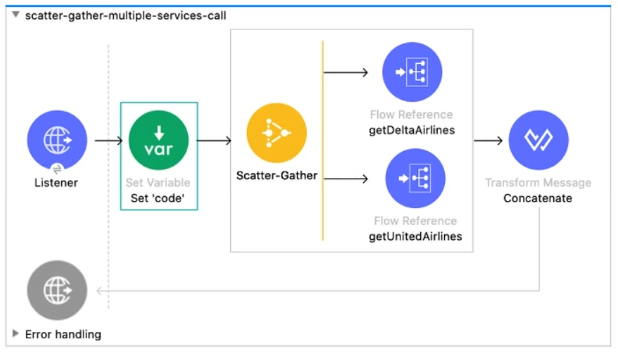
Refer to the exhibit.
What required changes can be made to give a partial successful response in case the United Airlines API returns with a timeout?
AAdd Flow Reference components inside a Try scope.Set the payload to a default value " " inside the error handler using the On Error Propagate scope.
BAdd a Scatter-Gather component inside a Try scope.Set the payload to a default value "Error" inside the error handler using the On Error Propagate scope.
CAdd Flow Reference components inside a Try scope.Set the payload to a default value " " inside the error handler using the On Error Continue scope.
DAdd a Scatter-Gather component inside a Try scope.Set the payload to a default value "Error" inside the error handler using the On Error Continue scope.
Which plugin or dependency is required to unit test modules created with XML SDK?
AMUnit Extensions Maven plugin
BXMLUnit
CMUnit Maven plugin
DJUnit
A custom policy needs to be developed to intercept all outbound HTTP requests made by Mule applications.
Which XML element must be used to intercept outbound HTTP requests?
Ahttp-policy:processor
Bhttp-policy:operation
CIt is not possible to intercept outgoing HTTP requests, only inbound requests
Dhttp-policy:source
When a client and server are exchanging messages during the mTLS handshake, what is being agreed on during the cipher suite exchange?
AThe TLS version
BAn encryption algorithm
CA protocol
DThe public key format
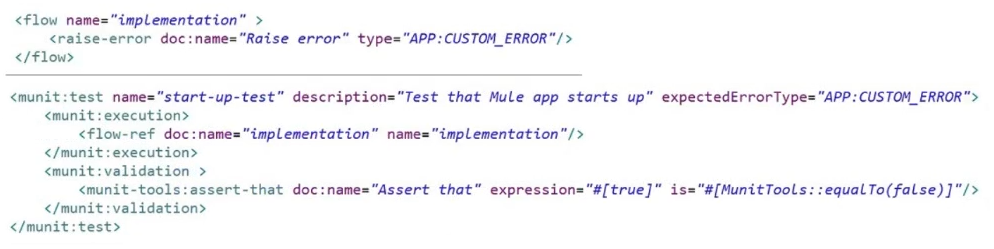
Refer to the exhibits.
The flow name is "implementation" with code for the MUnit test case.
When the MUnit test case is executed, what is the expected result?
AThe test case fails with an assertion error
BThe test case throws an error and does not start
CThe test case passes
DThe test case fails with an unexpected error type
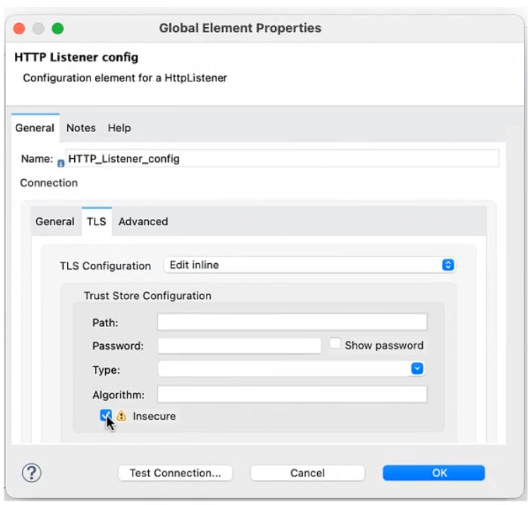
Refer to the exhibit.
What is the result if "Insecure" is selected as part of the HTTP Listener configuration?
AThe HTTP Listener will accept any unauthenticated request
BMutual TLS authentication will be enabled between this HTTP Listener and an HTTP client
CThe HTTP Listener will trust any certificate presented by the HTTP client
DThe HTTP Listener will only accept HTTP requests
When registering a client application with an existing API instance or API Group instance, what is required to manually approve or reject request access?
ATo only have Exchange Administrator permission
BTo configure the SLA tier for the application and have the Exchange Administrator permission
CTo configure the SLA tier for the application and have the role of Organization Administrator, API Manager Environment Administrator, or the Manage Contracts permission
DTo configure the SLA tier for the application
A company with MuleSoft Titanium support develops a Salesforce System API using MuleSoft's out-of-the-box Salesforce Connector and deploys the API to CloudHub.
Which steps provide the average number of requests and average response time of the Salesforce Connector?
AChange the API implementation to capture the information in the log.Retrieve the information from the log file.
BAccess Anypoint Monitoring's built-in dashboard.Select a resource.Locate the information under Log Management > Raw Data.
CAccess Anypoint Monitoring's built-in dashboard.Select a resource.Locate the information under the Connectors tab.
DAccess Anypoint Monitoring's built-in dashboard.Select a resource.Create a custom dashboard to retrieve the information.
An API has been developed and deployed to CloudHub. Among the policies applied to this API is an allowlist of IP addresses. A developer wants to run a test in Anypoint Studio and does not want any policies applied because their workstation is not included in the allowlist.
What must the developer do in order to run this test locally without the policies applied?
ARun the test as-is, with no changes, because the Studio runtime will not attempt to connect to API Manager
BCreate a properties file specifically for local development and set the API instance ID to a value that is not used in API Manager
CPass in the runtime parameter "-Danypoint.platform.gatekeeper=disabled"
DDeactivate the API in API Manager so the Autodiscovery element will not find the application when it runs in Studio
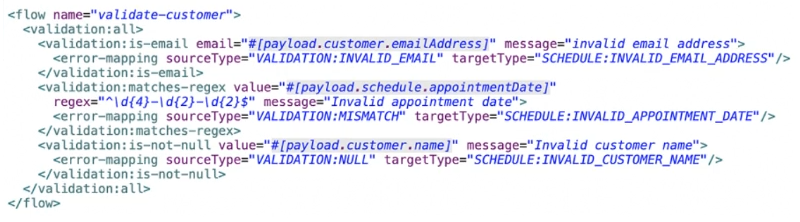
Refer to the exhibit.
An API has been built to enable scheduling emails for a healthcare provider. The front-end system does very little data entry validation, and problems have started to appear in the emails that go out to patients. A "validate-customer" flow is added to validate the data.
What is the expected behavior of the "validate-customer" flow?
AIf the appointment date and customer name are invalid, a SCHEDULE:INVALID_APPOINTMENT_DATE error is raised
BIf only the email address is invalid, a VALIDATION:INVALID_EMAIL error is raised
CIf all of the values are invalid, the last validation error is raised: SCHEDULE:INVALID_CUSTOMER_NAME
DIf the email address is invalid, processing continues to see it the appointment date and customer name are also invalid