Certified Integration Architect Practice Exam — Free Online Test
QuestionQ1
Salesforce Integration Patterns
Save question
Northern Trail Outfitters is in the final stages of merging two Salesforce orgs, but must keep the retiring org available for a short time for lead management because it is connected to multiple public website forms. The Sales department has requested that new leads be available in the new Salesforce instance within 30 minutes.
Which two approaches will require the least development effort?
Choose two
AConfigure named credentials in the source org.
BUse the Composite REST API to aggregate multiple leads in a single call.
CUse the Tooling API with Process Builder to insert leads in real time.
DCall the Salesforce REST API to insert the lead into the target system.
0
Community Discussion
No comments yet. Be the first to start the discussion!
QuestionQ2
Salesforce Integration Patterns
0
Community Discussion
No comments yet. Be the first to start the discussion!
QuestionQ3
Salesforce Integration Capabilities
0
Community Discussion
No comments yet. Be the first to start the discussion!
QuestionQ4
Salesforce Integration Capabilities
0
Community Discussion
No comments yet. Be the first to start the discussion!
QuestionQ5
Salesforce Integration Capabilities
0
Community Discussion
No comments yet. Be the first to start the discussion!
It's free
100% of the questions are free for all users. No strings attached.
A global financial company sells financial products and services that include the following:
Bank accounts
Loans
Insurance
The company has a state-of-the-art core banking system that serves as the master system for storing financial transactions, financial products, and customer information. The core banking system currently processes 10 million financial transactions each day. The company's CTO is considering building a community portal so customers can review their bank account details, update their information, and review their account financial transactions.
What solution should an integration architect recommend to enable customer community users to view their financial transactions?
AUse Salesforce External Service to display financial transactions in a community Lightning page.
BUse Salesforce Connect to display the financial transactions as an external object.
CMigrate the financial transaction records to Salesforce custom object and use ETL tool to keep systems in sync.
DUse Iframe to display core banking financial transactions data in the customer community.
A customer is assessing the Platform Events solution and needs help comparing it with Outbound Messaging for real-time/near-real-time requirements. They anticipate that 3,000 customers will view messages in Salesforce.
Which three considerations should be assessed and emphasized when choosing between these solutions?
Choose three
ANumber of concurrent subscribers to Platform Events is capped at 2,000. An Outbound Messaging configuration can pass only 100 notifications in a single message to a SOAP end point.
BBoth Platform Events and Outbound Messaging offer declarative means for asynchronous near-real time needs. They aren't best suited for real-time integrations.
CIn both Platform Events and Outbound Messaging, the event messages are retried by and delivered in sequence, and only once. Salesforce ensures there is no duplicate message delivery.
DMessage sequence is possible in Outbound Messaging, but not guaranteed with Platform Events. Both offer very high reliability. Fault handling and recovery are fully handled by Salesforce.
EBoth Platform Events and Outbound Messaging are highly scalable. However, unlike Outbound Messaging, only Platform Events have Event Delivery and Event Publishing limits to be considered.
Universal Containers (UC) is a large printing company that sells advertising banners. The company collaborates with third-party agents on initial banner design concepts. The design files are kept in an on-premises file store that UC internal users and third-party agencies can access. UC wants to collaborate with the third-party agencies on the design files and let them view the design files in the community.
The conceptual design files are 2.5 GB in size.
Which solution should an integration architect recommend?
AUse Salesforce Files to link the files to Salesforce records and display the record and the files in the community.
BDefine an External Data Source and use Salesforce Connect to upload the files to an external object. Link the external object using Indirect lookup.
CCreate a custom object to store the file location URL: when a community user clicks on the file URL, redirect the user to the on-premise system file location.
DCreate a Lightning component with a Request and Reply integration pattern to allow the community users to download the design files.
An architect has recommended using Apex code to make callouts to an external system for processing insurance quotes.
What should the integration architect consider to ensure that this is the appropriate integration option?
AThe maximum callouts in a single Apex transaction.
BThe maximum number of parallel Apex callouts in a single continuation.
CThe limit of pending operations in the same transaction.
DThe limit on long-running requests (total execution time).
QuestionQ6
Salesforce Integration Patterns
0
Community Discussion
No comments yet. Be the first to start the discussion!
QuestionQ7
Integrating with Salesforce: Security
QuestionQ8
Salesforce Integration Patterns
QuestionQ9
Salesforce Integration Capabilities
QuestionQ10
Salesforce Integration Patterns
QuestionQ11
Enterprise Integration Architecture Concepts
QuestionQ12
Salesforce Integration Patterns
QuestionQ13
Enterprise Integration Architecture Concepts
QuestionQ14
Integrating with Salesforce: Security
QuestionQ15
Salesforce Integration Patterns
QuestionQ16
Salesforce Integration Patterns
QuestionQ17
Salesforce Integration Patterns
QuestionQ18
Integrating with Salesforce: Security
QuestionQ19
Integrating with Salesforce: Security
QuestionQ20
Enterprise Integration Architecture Concepts
QuestionQ21
Salesforce Integration Capabilities
QuestionQ22
Salesforce Integration Patterns
QuestionQ23
Enterprise Integration Architecture Concepts
QuestionQ24
Salesforce Integration Patterns
QuestionQ25
Salesforce Integration Patterns
Save question
0
Community Discussion
No comments yet. Be the first to start the discussion!
Save question
0
Community Discussion
No comments yet. Be the first to start the discussion!
Save question
0
Community Discussion
No comments yet. Be the first to start the discussion!
Save question
0
Community Discussion
No comments yet. Be the first to start the discussion!
Save question
0
Community Discussion
No comments yet. Be the first to start the discussion!
Save question
0
Community Discussion
No comments yet. Be the first to start the discussion!
Save question
0
Community Discussion
No comments yet. Be the first to start the discussion!
Ad
Want a break from the ads?
Go ad-free and unlock Learn Mode, Exam Mode, AstroTutor AI and every premium tool — everything you need to walk in prepared, and confident.
No comments yet. Be the first to start the discussion!
Save question
0
Community Discussion
No comments yet. Be the first to start the discussion!
Save question
0
Community Discussion
No comments yet. Be the first to start the discussion!
Save question
0
Community Discussion
No comments yet. Be the first to start the discussion!
Save question
0
Community Discussion
No comments yet. Be the first to start the discussion!
Save question
0
Community Discussion
No comments yet. Be the first to start the discussion!
Save question
0
Community Discussion
No comments yet. Be the first to start the discussion!
Save question
0
Community Discussion
No comments yet. Be the first to start the discussion!
Save question
0
Community Discussion
No comments yet. Be the first to start the discussion!
Save question
0
Community Discussion
No comments yet. Be the first to start the discussion!
Save question
0
Community Discussion
No comments yet. Be the first to start the discussion!
Save question
0
Community Discussion
No comments yet. Be the first to start the discussion!
A company uses an external system to process and track orders. Sales representatives manage leads and their opportunity pipeline in Salesforce. Currently, the two systems are disconnected, and order processing requires substantial manual entry by sales representatives. This causes delays in order processing and incomplete data from manual entry.
As part of modernization efforts, the company has decided to integrate Salesforce with the Order Management System. The following technical requirements have been identified:
Orders must be created from Salesforce in real time.
Minimal customization and code should be written because of a tight timeline and limited developer resources.
Sales representatives must be able to view order history and the most current information on present order status.
Managers must be able to run Salesforce reports to view daily and monthly order volumes and fulfillment timelines.
The legacy system is hosted on-premise and is currently connected to the Enterprise Service Bus (ESB). The ESB is flexible enough to provide any methods and connection types required by the Salesforce team.
There are 1,000 sales representatives. Each user processes/creates an average of 15 orders per shift. Most orders contain 20 to 30 line items.
How should an integration architect integrate the two systems based on the technical requirements and system constraints?
BUse Salesforce big object. SOAP API and Dataloader.
CUse Salesforce external object and OData connector.
DUse Salesforce standard object. REST API, and extract, transform, load (ETL).
A healthcare services company operates a Patient Prescriptions System containing more than 50 million records in a secure database. Its customer base and data set are growing rapidly. The company needs to ensure these policies are enforced:
Identifiable patient prescriptions must reside only in the company’s secure system database and be encrypted at rest.
Identifiable patient prescriptions must be available only to individuals explicitly authorized in the Patient Prescriptions System: assigned nurses and doctors, the patient, and people the patient authorizes.
Access must be limited to verified and pre-approved people or legal entities.
To support this, the company offers these capabilities:
Single-use identity tokens for patients, nurses, doctors, and other people that expire within a few minutes.
Certificates for legal entities.
RESTful services.
The company has a Salesforce Community Cloud portal for patients, nurses, doctors, and other authorized people. A limited number of employees analyze de-identified data in Einstein Analytics.
Which two capabilities should the integration architect require for the Community Cloud portal and Einstein Analytics?
Choose two
AIdentity token data storage
BEncryption in transit and at rest
CCallouts to RESTful services
DBulk load for Einstein Analytics
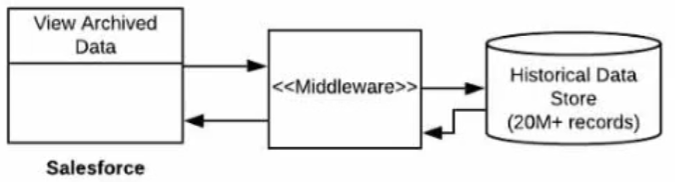
Given the diagram below, a Salesforce org, middleware, and a Historical Data store exist with connectivity between them.
Historical records archived from Salesforce and moved to a Historical Data store—which contains 20 million records and is growing—are tuned for performant search queries.
When reviewing occasional special cases, call center agents who use Salesforce have requested access to view the historical case items related to submitted cases.
Which mechanism and patterns are recommended to maximize declarative configuration?
AUse an ESB tool with Request and Reply pattern and then make a real-time Apex callout to the ESB endpoint to fetch and display historical data in a custom lightning component related to Case object.
BUse an ESB tool with a Fire and Forget pattern and then publish a platform event for the requested historical data.
CUse an extract, transform, load (ETL) tool with a Batch Data Synchronization pattern to migrate historical data into Salesforce and into a custom object (Historical Data) related to Case object.
DUse an ESB tool with Data Virtualization pattern, expose OData endpoint, and then use Salesforce Connect to consume and display the external object alongside with the Case object.
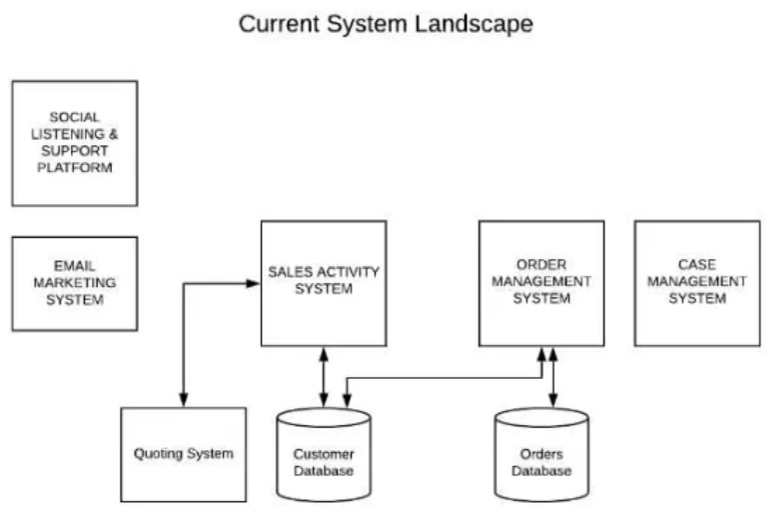
A large business-to-consumer (B2C) customer plans to implement Salesforce CRM to become a customer-centric enterprise. The following is their current system landscape diagram.
The goals of the Salesforce implementation include:
Build a 360-degree view of the customer.
Use Salesforce capabilities for marketing, sales, and service processes.
Reuse enterprise capabilities built for quoting and order-management processes.
Which three systems in the current system landscape can be retired when Salesforce is implemented?
Choose three
AOrder Management System
BSales Activity System
CCase Management System
DQuoting System
EEmail Marketing System
Universal Containers (UC) owns a range of cloud-based applications, including Salesforce, as well as several on-premise applications. The on-premise applications are secured behind a corporate network that has limited external access to outside systems.
UC wants to expose data from the on-premise applications to Salesforce to provide a more unified user experience. The data must be available from Salesforce in real time.
Which two actions should be recommended to meet this system requirement?
Choose two
ARun a batch job with an extract, transform, load (ETL) tool from an on-premise server to move data to Salesforce.
BDevelop an application in Heroku that connects to the on-premise database via an Open Database Connectivity (ODBC) string and Virtual Private Cloud (VPC) connection.
CDevelop custom APIs on the company's network that are invokable by Salesforce.
DDeploy MuleSoft to the on-premise network and design external facing APIs to expose the data.
A customer’s enterprise architect has identified requirements involving caching, queuing, error handling, alerts, retries, event handling, and similar concerns.
The company has requested that the Salesforce Integration Architect help address these aspects through its Salesforce program.
Which three recommendations should the Salesforce Integration Architect make?
Choose three
AEvent handling in a publish/subscribe scenario, the middleware can be used to route requests or messages to active data-event subscribers from active data-event publishers.
BEvent handling processes such as writing to a log, sending an error or recovery process, or sending an extra message can be assumed to be handled by middleware.
CTransform a Fire and Forget mechanism to Request and Reply, which should be handled by middleware tools (like ETL/ESB) to improve performance.
DMessage transformation and protocol translation should be done within Salesforce. Recommend leveraging Salesforce native protocol conversion capabilities as middleware tools are NOT suited for such tasks.
EProvide true message queueing for integration scenarios (including orchestration, process choreography, quality of service, etc.) given that a middleware solution is required.
Northern Trail Outfitters uses Salesforce to track leads and opportunities and capture order details. However, Salesforce is not the system that stores or processes orders. After order details are captured in Salesforce, an order must be created in the remote system, which manages the order lifecycle. The project integration architect recommends a remote system that subscribes to the platform event defined in Salesforce.
Which integration pattern should be used for this business use case?
ARemote Call-In
BFire and Forget
CBatch Data Synchronization
DRequest and Reply
An enterprise architect has asked the Salesforce integration architect to review the following diagram and description, and to provide recommendations after carefully considering the constraints of the enterprise systems and Salesforce platform limits.
About 3,000 phone sales agents concurrently use a Salesforce Lightning UI to check whether a customer is eligible for a qualifying offer.
Multiple externally hosted eligibility systems provide this service. Their current processing and response times can be up to 90 seconds; discussions to reduce those times are underway, but no commitment has been made.
The eligibility systems are accessible through APIs orchestrated by an ESB (MuleSoft).
All Salesforce requests must pass through the customer's API Gateway layer, which times out requests after 9 seconds.
Which three recommendations should be made?
Choose three
AUse Continuation callouts to make the eligibility check request from Salesforce Lightning UI at page load.
BESB (Mule) with cache/state management to return a requestID (or) response if available from an external system.
CRecommend synchronous Apex callouts from Lightning UI to External Systems via Mule and implement polling on an API Gateway timeout.
DCreate a platform event in Salesforce via Remote Call-In and use the empAPI in the Lightning UI to serve 3,000 concurrent users when responses are received by Mule.
EImplement a "Check Update" button that passes a requestID received from ESB (user action needed).
Northern Trail Outfitters wants to improve the performance and security of outbound integrations from Salesforce to on-premises servers.
What should the architect consider before recommending a solution?
AShield Platform Encryption limitations
BExternal gateway products in use
CConsiderations for using Deterministic Encryption
DDefault gateway restrictions
A business needs to automate checking and updating the phone-number type classification (mobile versus landline) for all inbound calls routed to its phone sales agents. The following conditions apply:
At peak, the call center may receive up to 100,000 calls per day.
An external service API provides the phone-number type classification.
The business is flexible about the timing and frequency for checking and updating records; processing throughout the night or every 6–12 hours is sufficient.
A Remote-Call-In pattern and/or Batch Synchronization (Replication via ETL: System -> Salesforce) are determined to work with middleware hosted on the customer premises.
To implement these patterns and mechanisms, which component should an integration architect recommend?
AConfigure Remote Site Settings in Salesforce to authenticate the middleware.
BFirewall and reverse proxy are required to protect internal APIs and resources being exposed.
CConnectedApp configured in Salesforce to authenticate the middleware.
DAn API Gateway that authenticates requests from Salesforce into the middleware (ETL/ESB).
Which three factors should an integration architect consider when recommending Platform Event as an integration solution?
Choose three
AEvent messages using SOQL are unable to be queried.
BA Lightning record page for platform events is unable to be created.
CSubscribe to an AssetTokenEvent stream to monitor OAuth 2.0 authentication activity.
DWhen an event definition is deleted, it's permanently removed and can't be restored.
EEvent Monitoring is used to track user activity, such as logins and running reports.
Universal Containers (UC) is a leading global provider of management training. UC has requested that students’ course-registration data generated from the Salesforce student community be synchronized with the learning management system (LMS). Any changes to the course-registration data must be reflected in the LMS.
Which integration mechanism should be used to meet this requirement?
APlatform Event
BStreaming API
CChange Data Capture (CDC)
DOutbound Message
Salesforce users must read data from an external system through an HTTP request.
Which two security methods should an integration architect use within Salesforce to secure the integration?
Choose two
ATwo-way SSL
BAuthorization Provider
CConnected App
DNamed Credentials
A subscription-based media company’s system landscape requires many subscribers to keep multiple accounts and log in more than once. An Identity and Access Management (IAM) system that supports SAML and OpenId was recently implemented to improve the subscriber experience with self-registration and single sign-on (SSO).
The IAM system must integrate with Salesforce to provide new self-service customers immediate access to Salesforce Community Cloud.
Which two requirements must Salesforce Community Cloud support for self-registration and SSO?
Choose two
ASAML SSO and Just-in-Time (JIT) provisioning
BOpenId Connect Authentication Provider and Registration Handler
COpenId Connect Authentication Provider and JIT provisioning
DSAML SSO and Registration Handler
Universal Containers (UC) currently operates a custom monolithic web service on an on-premises server.
This monolithic web service handles Point-to-Point (P2P) integrations between:
Salesforce and a legacy billing application
Salesforce and a cloud-based Enterprise Resource Planning application
Salesforce and a data lake
UC has determined that tight interdependencies among the systems are causing integration failures.
What should an architect recommend to decouple the systems and improve integration performance?
ARe-write and optimize the current web service to be more efficient.
BLeverage modular design by breaking up the web service into smaller pieces for a microservice architecture.
CUse the Salesforce Bulk API when integrating back into Salesforce.
DMove the custom monolithic web service from on-premise to a cloud provider.
An integration architect must build a solution that uses the Streaming API, while minimizing data loss even if the client reconnects every few days.
Which two Streaming API event types should be considered?
Choose two
APushTopic Events
BChange Data Capture Events
CHigh Volume Platform Events
DGeneric Events
Service agents at Northern Trail Outfitters use Salesforce to manage cases and B2C Commerce for order processing.
Which integration solution should an architect recommend so that service agents can view order history from a business-to-consumer (B2C) Commerce system?
AREST API offered by Commerce Platform
BREST API offered by Salesforce Platform
CSalesforce B2C Commerce to Service Cloud Connector
DMuleSoft Anypoint Platform
A new Salesforce program has the following high-level, abstract requirement: Business processes performed on Salesforce require data updates between their internal systems and Salesforce.
Which three relevant details should a Salesforce Integration Architect specifically seek to resolve the program’s integration-architecture needs?
Choose three
AIntegration Style - Process-based, Data-based, and Virtual integration.
BTiming aspects, real-time/near real-time (synchronous or asynchronous), batch and update frequency.
CSource and Target system, Directionality, and data volume & transformation complexity, along with any middleware that can be leveraged.
DIntegration skills, SME availability, and Program Governance details.
ECore functional and non-functional requirements for User Experience design, Encryption needs, Community, and license choices.
A company is developing a Lightning Web Component (LWC) that displays transactions aggregated from multiple sources. Its current system landscape is as follows:
Transactions can be created at any time by various on-premises and cloud-based systems.
All required transactions are replicated to a custom Transaction object in Salesforce. It is updated periodically, so it contains only a subset of the required transactions between updates.
Middleware supports publish-subscribe interactions and provides RESTful Enterprise APIs that retrieve transactions from on-premises and cloud-based systems.
The company wants to resolve a usability concern about incomplete data shown in the LWC component.
What should the integration architect specify so that the LWC can display all required transactions?
APublish a Platform Event, have the middleware subscribe and update the custom object on receipt of Platform Event.
BCall the Enterprise APIs directly from the LWC's JavaScript code and redisplay the LWC on receipt of the API response.
CUse the Continuation class to call the Enterprise APIs and then process the response in a callback method.
DLet the Lightning Data Service with an @wire adapter display new values when the custom object records change.
A company must be able to send data from Salesforce to a home-grown system behind a corporate firewall. The data must be pushed in only one direction and does not need to be delivered in real time. The average volume is 2 million records per day.
What should an integration architect consider when selecting the appropriate option for building the integration between the external system and Salesforce?
ADue to high volume of records, number of concurrent requests can hit the limit for the REST API call to the external system.
BDue to high volume of records, the external system will need to use a BULK API Rest endpoint to connect to Salesforce.
CDue to high volume of records, Salesforce will need to make a REST API call to the external system.
DDue to high volume of records, a third party integration tool is required to stage records off platform.


Community Discussion