Loading provider exams...
1Z0-908: MySQL 8.0 Database Administrator Oracle Practice Exam
About the Exam Intended for database administrators working with MySQL 8.0, this exam validates core administration skills for a MySQL environment. Oracle's official prep materials cover MySQL architecture, installation and configuration, monitoring, maintenance, security, backup strategies, replication topologies, and InnoDB Cluster. Passing the exam demonstrates the candidate has the skills associated with the Oracle Certified Professional, MySQL 8.0 Database Administrator credential.
Exam Topics Architecture 15% Installation and Configuration 15% User Administration 17% Database Design 14% Performance 14% Backup and Recovery 12% Database Security 13% How to Use This Practice Exam Browse — Read each question, select your answer, and reveal the explanation.Exam Mode — Simulate real exam conditions with a timed session and score report.Learn Mode — Spaced repetition schedules questions you struggle with for long-term retention.Download the Full Exam PDF Get every question and answer in a clean, printable PDF built for offline study. Purchase once, keep permanent access, and re-download the latest version anytime.
Last updated November 29, 2025 at 12:09 AM
Topic filter All Topics Question sort Question Number
Question Q 1Installation and Configuration Copy link Report a problem Ask AstroTutor Save question
Which command activates rule-based MySQL Auditing capabilities?
A shell> mysql < audit_log_filter_linux_install.sql B shell> mysqld --initialize --log-raw=audit.log C mysql> INSTALL PLUGIN audit_log; D mysql> INSTALL COMPONENT audit_log; Show Answer Answer Explanation Rule-based MySQL Enterprise Audit requires the audit log plugin together with its accompanying audit tables and filter functions. On Linux, audit_log_filter_linux_install.sql installs those required elements; installing the plugin alone results in legacy filtering rather than rule-based auditing.
Learn more
Question Q 2Backup and Recovery Copy link Report a problem Ask AstroTutor Save question
Question Q 3Architecture Copy link Report a problem Ask AstroTutor Save question
Question Q 4Database Security Copy link Report a problem Ask AstroTutor Save question
Question Q 5Architecture Copy link Report a problem Ask AstroTutor Save question It's free 100% of the questions are free for all users.
Topics covered Architecture Installation and Configuration User Administration Database Design Performance Backup and Recovery Database Security
Which two of the following statements are true regarding MySQL Enterprise Backup?
Choose two A It supports backing up only table structures. B It can perform hot or warm backups. C It creates logical backups. D It supports the creation of incremental backups. E It supports backup of a remote MySQL system. F It supports restoring to a remote MySQL system. Show Answer Answer Explanation MySQL Enterprise Backup performs physical backups. It can take hot backups for InnoDB tables and warm backups for tables using other storage engines, and it supports incremental backups that capture changes since a prior backup.
Learn more Review this command, which executes successfully on an InnoDB Cluster: dba.dropMetadataSchema()
Which two statements are true?
Choose two A Group Replication will be dissolved and all metadata purged. B Group Replication is still operational, but InnoDB Cluster must be reimported under MySQL Shell. C The mysql_innodb_cluster_metadata schema is dropped from the instance where the connection was established. D The command drops the mysql_innodb_cluster_metadata schema and re-creates it. E The mysql_innodb_cluster_metadata schema is dropped from all reachable members of the cluster. F Connections driven by MySQL Router are not affected by the command. Show Answer Answer Explanation Dropping the metadata schema removes MySQL Shell’s InnoDB Cluster metadata without dissolving the underlying Group Replication deployment, so the deployment must be adopted again for MySQL Shell management. The metadata schema removal is applied across reachable cluster members. MySQL Router depends on this metadata; its existing connections are dropped and new connections are refused after the metadata is removed.
Learn more Which two statements are correct about InnoDB data-at-rest encryption?
Choose two A It supports only non-blob datatypes. B It does not support the transportable tablespaces feature. C It supports all indexes transparently. D It decrypts data for use in memory. E It enforces encryption from disk to memory and over network transmission. Show Answer Answer Explanation InnoDB data-at-rest encryption transparently supports all indexes. Data is encrypted in the tablespace files and is decrypted when read into memory; network traffic requires separate MySQL network encryption such as SSL/TLS.
Learn more Examine the following statements, which execute successfully:
Which two storage engines would return a nonempty recordset for the test table when the statements are executed?
Choose two A InnoDB B MEMORY C NDB D BLACKHOLE E ARCHIVE Show Answer Answer Explanation MEMORY and ARCHIVE are nontransactional storage engines, so the row inserted after BEGIN is not undone by ROLLBACK. InnoDB and NDB support transactions, while BLACKHOLE discards data and always returns an empty result set.
Learn more
Question Q 6Installation and Configuration Copy link Report a problem Ask AstroTutor Save question
Question Q 7Backup and Recovery Copy link Report a problem Ask AstroTutor
Question Q 8Installation and Configuration Copy link Report a problem Ask AstroTutor
Question Q 9Architecture Copy link Report a problem Ask AstroTutor
Question Q 10Installation and Configuration Copy link Report a problem Ask AstroTutor
Question Q 11Database Security Copy link Report a problem Ask AstroTutor
Question Q 12Backup and Recovery Copy link Report a problem Ask AstroTutor
Question Q 13Installation and Configuration Copy link Report a problem Ask AstroTutor
Question Q 14Performance Copy link Report a problem Ask AstroTutor
Question Q 15Database Security Copy link Report a problem Ask AstroTutor
Question Q 17Database Security Copy link Report a problem Ask AstroTutor
Question Q 18User Administration Copy link Report a problem Ask AstroTutor
Question Q 19Backup and Recovery Copy link Report a problem Ask AstroTutor
Question Q 20Installation and Configuration Copy link Report a problem Ask AstroTutor
Question Q 21Installation and Configuration Copy link Report a problem Ask AstroTutor
Question Q 22Installation and Configuration Copy link Report a problem Ask AstroTutor
Question Q 24Backup and Recovery Copy link Report a problem Ask AstroTutor
Question Q 25Database Security Copy link Report a problem Ask AstroTutor
Question Q 26Installation and Configuration Copy link Report a problem Ask AstroTutor
Question Q 27Architecture Copy link Report a problem Ask AstroTutor Save question
Save question
Save question
Save question
Save question
Save question
Save question
Save question
Save question
Save question
Save question
Save question
Save question
Save question
Save question
Save question
Save question
Save question
Save question
Your MySQL server runs on the Microsoft Windows platform.
Which three local connection protocols are available?
Choose three A named pipes B shared memory C SOCKET D X Protocol E UDP F TCP/IP Show Answer Answer Explanation On Windows, MySQL supports TCP/IP connections as well as the Windows-specific named-pipe and shared-memory transports. Unix socket-file transport is not available on Windows, and UDP is not a MySQL client connection transport. MySQL Reference Manual: Connection Transport Protocols
Learn more Review this command, which runs successfully:
mysqlpump -–user=root --password > full_backup.sql
Which two databases are excluded from this dump?
Choose two A information_schema B world C employee D sys E mysql Show Answer Answer Explanation By default, mysqlpump dumps all databases except schemas subject to its built-in restrictions. INFORMATION_SCHEMA is not dumped, and the sys schema is also excluded by default; each must be explicitly selected where supported. The mysql database is included as a database, although mysqlpump has separate restrictions on certain grant tables.
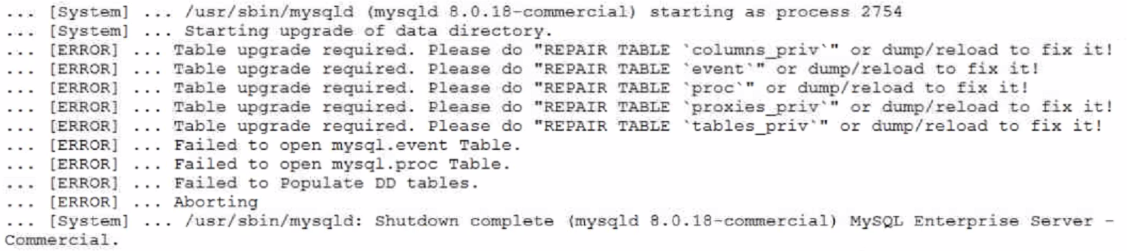
Learn more You upgraded the MySQL binaries from 5.7.28 to 8.0.18 using an in-place upgrade.
Review the message sequence produced during the first startup of MySQL 8.0.18:
Which step, or set of steps, resolves the errors?
A Remove the redo logs. Replace the MySQL binaries with the 5.7.28 binaries. Prepare the tables for upgrade. Upgrade to 8.0.18 again. B Execute: mysqlcheck --check-upgrade mysql columns_priv event proc proxies_priv tables_priv. C Start mysqld again using the --upgrade=FORCE option. D Execute: mysqlcheck --repair mysql columns_priv event proc proxies_priv tables_priv. E Go to the <datadir>/mysql directory and execute: myisamchk --update-state columns_priv event proc proxies_priv tables_priv. Show Answer Answer Explanation A failed MySQL 5.7-to-8.0 upgrade reverts changes to the data directory. The 8.0 redo logs must be removed before restarting the original 5.7 server, where the system tables can be prepared or repaired. After a slow shutdown of 5.7, retrying the 8.0 upgrade allows the server to upgrade and open the required MySQL system tables.
Learn more Which three statements about MySQL replication are true?
Choose three A Replication can use only TCP/IP connections. B Any instance can have multiple slaves, but it can have only one master. C Each instance in a replication topology must have a unique server ID. D Binary logs contain only transactions originating from a single MySQL instance. E Each slave must have its own MySQL user for replication. F Binary logging must be enabled on the master in order to replicate to other instances. Show Answer Answer Explanation MySQL replication requires TCP/IP connectivity between a replica and its source. Every server participating in a replication topology must use a unique server_id. Binary logging must be enabled on a source because its binary log supplies the changes that replicas replicate.
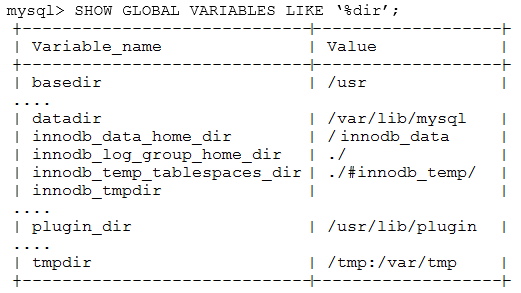
Learn more You are upgrading a MySQL instance to the most recent 8.0 release.
Review this output:
You intend to add this parameter to the configuration:
innodb_directories=’/innodb_extras’
Which statement is correct?
A It defines all innodb tablespace options relative to a starting parent directory. B It is not necessary because innodb_data_home_dir is already defined. C It allows scanning of other locations to discover more innodb tablespaces. D It moves all innodb tablespaces to the /innodb_extras directory to enable a new innodb_data_home_dir to be defined. E It adds more temporary workspace in addition to the innodb_tmpdir location. Show Answer Answer Explanation innodb_directories defines directories that InnoDB scans at startup to discover tablespace files. Adding /innodb_extras makes that additional location available for discovery of InnoDB tablespaces; it does not move tablespaces or change the data-home or temporary-directory settings.
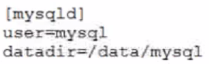
Learn more MySQL is installed on a Linux server with the following configuration:
Which method configures SHA-256 hashing as the default authentication method for user account passwords?
A Set validate-user-plugins=caching_sha2_password in the configuration file. B Define CREATE USER ''@'%' IDENTIFIED WITH sha256_password in the MySQL instance. C Add default_authentication_plugin=mysql_native_password in the configuration file. D Add default_authentication_plugin=sha256_password in the configuration file. Show Answer Answer Explanation The default_authentication_plugin server option controls the authentication plugin assigned by default to newly created user accounts. Setting it to sha256_password configures basic SHA-256 password authentication as that default; specifying a plugin in CREATE USER affects only the individual account.
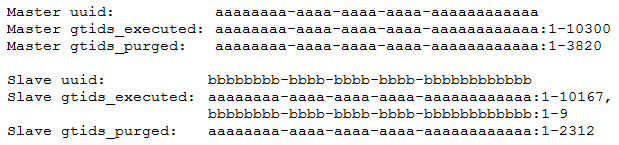
Learn more You have configured GTID-based asynchronous replication with a single master and a single slave.
A user accidentally updated data on the slave. To correct this, you stopped replication and successfully reverted the accidental changes.
Examine the current GTID information:
You must correct the GTID sets on the slave to prevent unwanted transactions from being replicated in the event of a failover.
Which set of actions would allow the slave to resume replication without erroneous transactions?
A RESET MASTER;SET GLOBAL gtid_purged=aaaaaaaa-aaaa-aaaa-aaaa-aaaaaaaaaaaa:1-10167; B SET GLOBAL gtid_purged=aaaaaaaa-aaaa-aaaa-aaaa-aaaaaaaaaaaa:1-2312,bbbbbbbb-bbbb-bbbb-bbbb-bbbbbbbbbbbb:1-9;SET GLOBAL gtid_executed=aaaaaaaa-aaaa-aaaa-aaaa-aaaaaaaaaaaa:1-10167; C RESET SLAVE;SET GLOBAL gtid_purged=aaaaaaaa-aaaa-aaaa-aaaa-aaaaaaaaaaaa:1-3820;SET GLOBAL gtid_executed=aaaaaaaa-aaaa-aaaa-aaaa—aaaaaaaaaaaa:1-10300; D RESET MASTER;SET GLOBAL gtid_purged-aaaaaaaa-aaaa-aaaa-aaaa-aaaaaaaaaaaa:1-2312;SET GLOBAL gtid_executed=aaaaaaaa-aaaa-aaaa-aaaa-aaaaaaaaaaaa:1-10167; E RESET SLAVE;SET GLOBAL gtid_purged=aaaaaaaa-aaaa-aaaa-aaaa-aaaaaaaaaaaa:1-10167; Show Answer Answer Explanation RESET MASTER clears the GTID execution and purged sets. Setting gtid_purged to aaaaaaaa-aaaa-aaaa-aaaa-aaaaaaaaaaaa:1-10167 records exactly the valid transactions received from the master and adds them to gtid_executed. The unwanted local GTIDs bbbbbbbb-bbbb-bbbb-bbbb-bbbbbbbbbbbb:1-9 are removed, so GTID auto-positioning can continue with the master’s subsequent transactions without treating those erroneous transactions as part of the slave’s history.
Learn more Consider the following shell output and commands that were executed:
[root@oel7 ~]# ps aux | grep mysqld
mysql 2076 3.5 24.6 1386852 372572 ? Ssl 12:01 0:01 /usr/sbin/mysqid
[root@oel7 ~]# kill -15 2076
Which statement is true regarding MySQL server shutdown?
A kill -15 should be avoided. Use other methods such as mysqladmin shutdown or systemctl stop mysqld. B kill -15 and kill -9 are effectively the same forced shutdown that risk committed transactions not written to disk. C kill -15 carries out a normal shutdown process, such as mysqladmin shutdown. D mysqld_safe prohibits commands that would harm the operation of the server. An error would be returned by the kill command. Show Answer Answer Explanation On Unix, signal 15 (SIGTERM) instructs mysqld to perform its normal shutdown process. MySQL documents this as equivalent to executing the SQL SHUTDOWN statement, whose shutdown functionality is also provided by mysqladmin shutdown.
Learn more Data in an instance is transient, and neither backup nor replication is required.
The database size does not change.
Its size, including indexes, is 19G.
Total system memory is 32G.
It is currently performing poorly.
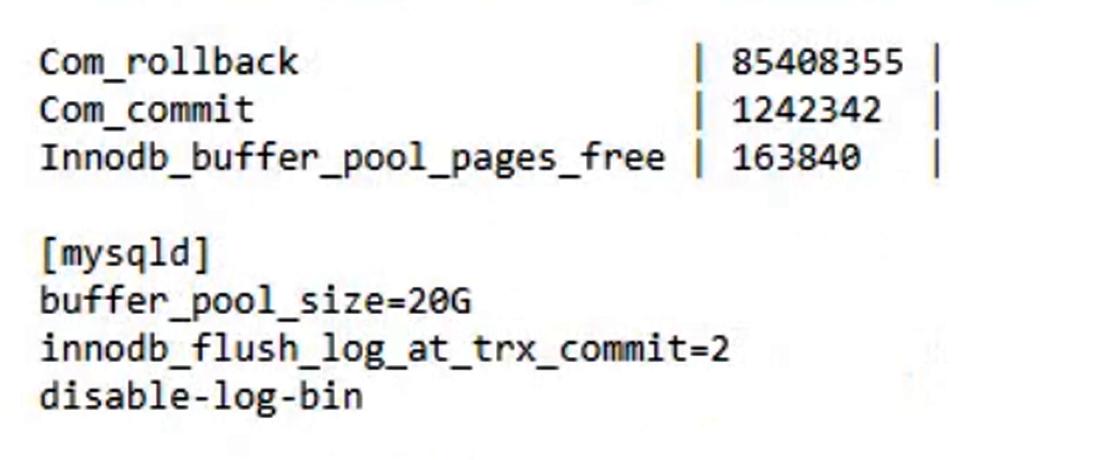
Review these MySQL status and global variables collected after profiling:
OS metrics show that disk is a bottleneck.
All other variables remain at their default values.
Which two changes will deliver the most benefit to the instance?
Choose two A innodb_log_file_size=1G B innodb_doublewrite=0 C sync_binlog=0 D max_connections=10000 E innodb_flush_log_at_trx_commit=1 F buffer_pool_size=24G Show Answer Answer Explanation A larger InnoDB redo log reduces checkpoint flush activity, avoiding unnecessary disk writes when the workload is write-intensive. Disabling the InnoDB doublewrite buffer removes durability and torn-page recovery protection but can improve performance when data integrity after a failure is not required. The buffer pool already has substantial free space, so enlarging it is not the most beneficial disk-I/O change.
Learn more During an examination, your MySQL installation’s datadir is found to be recursively world-readable, writable, and executable.
What are two major concerns of operating an installation with incorrect file privileges?
Choose two A Users could overwrite configuration files. B Data files could be deleted. C SQL injections could be used to insert bad data into the database. D MySQL binaries could be damaged, deleted, or altered. E Extra startup time would be required for the MySQL server to reset the privileges. Show Answer Answer Explanation World-writable permissions on the MySQL data directory allow unauthorized operating-system users to delete or alter database files. They also expose files stored in that directory, including persisted server configuration, to modification. MySQL documents that the data directory requires restricted permissions and that mysqld-auto.cnf is located in the data directory.
Learn more Review this MySQL client command for connecting to a remote database:
mysql -h remote.example.org -u root -p --protocol=TCP --ssl-mode=
Which two --ssl-mode values ensure that an X.509-compliant certificate is used to establish the SSL/TLS connection to MySQL?
Choose two A REQUIRED B VERIFY_CA C VERIFY_IDENTITY D PREFERRED E DISABLED Show Answer Answer Explanation VERIFY_CA requires TLS and validates the server certificate against configured CA certificates. VERIFY_IDENTITY performs that CA validation and also verifies that the certificate identity matches the target host name. Both modes require a matching CA certificate source, such as --ssl-ca or --ssl-capath.
Learn more Which two methods can a DBA use to reset a user's password?
Choose two A ALTER USER statement B mysql_secure_installation utility C SET PASSWORD statement D mysqladmin client program E GRANT statement Show Answer Answer Explanation ALTER USER changes properties of an existing MySQL account, including its authentication credentials. SET PASSWORD is also a dedicated statement for assigning a password to a MySQL user account.
Which two benefits does mysqlbackup provide instead of mysqldump?
Choose two A mysqlbackup can perform partial backup of stored programs. B mysqlbackup allows logical backups with concurrency resulting in faster backups and restores. C mysqlbackup does not back up MySQL system tables, which shortens backup time. D mysqlbackup can back up tables with the InnoDB engine without blocking reducing wait times due to contention. E mysqlbackup integrates tape backup and has the virtual tape option. Show Answer Answer Explanation MySQL Enterprise Backup performs hot, online, non-blocking backups for InnoDB data, reducing application disruption and lock-contention waits. It can also interface with media-management software such as Oracle Secure Backup for tape backups; Oracle Secure Backup supports virtual tape libraries.
Learn more Which four connection methods may MySQL clients specify with the --protocol option when connecting to a MySQL server?
Choose three A TCP B SOCKET C PIPE D DIRECT E IPv6 F FILE Show Answer Answer Explanation MySQL supports TCP, SOCKET, PIPE, and MEMORY as values for --protocol. TCP, SOCKET, and PIPE appear in the choices; the fourth valid value, MEMORY, is absent. IPv6 can be used as an address family with a host value, but it is not a --protocol value.
Learn more An existing asynchronous replication configuration is running MySQL 8.
Which two steps are part of implementing GTID replication?
Choose two A Enable GTID by executing this on the master and the slave:SET GLOBAL GTID_ENABLED=on; B Execute this on the slave to enable GTID:START SLAVE IO_THREAD WITH GTID; C Restart MySQL (master and slave) with these options enabled:--gtid_mode=ON--log-bin--log-slave-updates--enforce-gtid-consistency D Execute this on the slave to enable GTID:RESET SLAVE; START SLAVE GTID_NEXT=AUTOMATIC; E On the slave, alter the MySQL master connection setting with:ALTER channel CHANGE MASTER TO MASTER_AUTO_POSITION = 1; F On the slave, alter the MySQL master connection setting with:CHANGE MASTER TO MASTER_AUTO_POSITION = 1; Show Answer Answer Explanation GTID-based replication is configured by enabling gtid_mode and enforce-gtid-consistency on the participating MySQL servers, with binary logging enabled for the source; the standard startup configuration can also enable replica update logging. The replica is switched to GTID-based positioning by setting MASTER_AUTO_POSITION = 1 in CHANGE MASTER TO, allowing it to synchronize using GTID sets rather than binary-log file positions.
Learn more You need to review configuration options for a new, large, heavily used reporting data-warehousing MYSQL instance.
Examine this parameter:
[mysql]
innodb_data_file_path=
Which two configurations would each satisfy long-term storage requirements?
Choose two A ibdata1:12M:autoextend B ibdata1:12M:autoextend;ibdata2:12M:autoextend C ibdata1:12M;/tmp/ibdata2:12M:autoextend D ibdata1:12M;ibdata2:12M:autoextend E ibdata1:12M F ibdata1:12M;ibdata2:12M;ibdata3:12M Show Answer Answer Explanation For long-term growth, the InnoDB system tablespace requires its last data file to use autoextend. A single auto-extending file satisfies this requirement, as does a configuration with fixed preceding files and an auto-extending final file. The autoextend attribute is permitted only on the last specified data file; a /tmp location is not appropriate for durable long-term data storage.
Learn more An InnoDB Cluster is configured with three servers.
Consider this command, which completes successfully:
mysqldump -uroot -p -d mydatabase > mydatabase_backup.sql
Because of data loss, the cluster is initialized and a restore is attempted, producing this error:
ERROR 13176 (HY000) at line 23: Cannot update GTID_PURGED with the Group Replication plugin running
Which two actions, either of which can correct this error and enable a successful cluster restore?
Choose two A Stop all instances except the primary read/write master instance and run the restore. B Remove the @@GLOBAL.gtid_purged statement from the dump file. C Create the backup by using the --set-gtid-purged=OFF option. D Remove the group replication plugin from each instance before restoring. E Remove the @@GLOBAL.gtid_executed statement from the dump file. F Restore using the --set-gtid-purged=OFF option. Show Answer Answer Explanation By default, mysqldump includes a SET @@GLOBAL.gtid_purged statement when GTIDs are enabled and gtid_executed is nonempty. That statement cannot run while the Group Replication plugin is active. Deleting it from the existing dump, or generating the dump with --set-gtid-purged=OFF so it is not emitted, prevents the prohibited GTID_PURGED update.
Learn more Which two statements about the mysql_config_editor program are true?
Choose two A It manages the configuration of the MySQL Firewall feature. B It manages the configuration of client programs. C It can move datadir to a new location. D It manages the configuration of user privileges for accessing the server. E It will use [client] options by default unless you provide --login-path. F It can be used to create and edit SSL certificates and log locations. Show Answer Answer Explanation mysql_config_editor manages login-path options used by MySQL client programs, storing connection credentials in the obfuscated .mylogin.cnf file. Unless --login-path specifies another login path, it operates on the client login path by default.
Learn more Which two statements are accurate about MySQL Installer?
Choose two A It installs most Oracle MySQL products. B It performs product upgrades. C It provides only GUI-driven, interactive installations. D Manual download of separate product packages is required before installing them through MySQL Installer. E It provides a uniform installation wizard across multiple platforms. Show Answer Answer Explanation MySQL Installer simplifies installation and updating for a wide range of MySQL products. Its console supports an upgrade operation for one or more installed products; it also supports command-line and silent operation, rather than only GUI-driven installation.
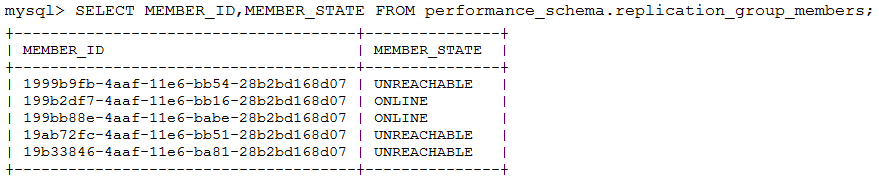
Learn more Five MySQL instances are configured in a functioning Group Replication group. Review the group-members output:
Which two statements about network partitioning in the cluster are true?
Choose two A The cluster will shut down to preserve data consistency. B The cluster has built-in high availability and updates group_replication_ip_whitelist to remove the unreachable nodes. C The group replication will buffer the transactions on the online nodes until the unreachable nodes return online. D There could be both a 2 node and 3 node group replication still running, so shutting down group replication and diagnosing the issue is recommended. E A manual intervention to force group members to be only the working two instances is required. Show Answer Answer Explanation Group Replication requires a majority to reach consensus. With only two reachable members in a five-member group, that partition has no quorum and cannot determine whether the three unreachable members failed or form a separate three-member majority partition. The minority partition should be stopped while the issue is diagnosed. If the other three instances are confirmed failed and the two surviving instances must continue, an administrator must manually force a new group membership containing those two instances.
Learn more 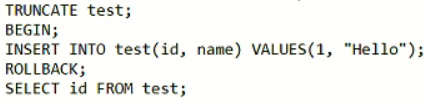

Community Discussion