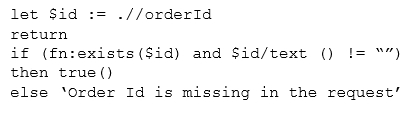
Consider an order recognition rule where the validation rule XQuery expression contains the following lines of code. When a CRM application tries to create orders that would be processed by this recognition rule by using the CreateOrder web service, which are two possible responses it could receive depending on the output of the validation expression?
Aa "CreateOrderResponse" message with the created "Order Id"
Ba "Fault" message with the description containing "No matching Order Recognition rule found"
Ca "Fault" message with a description containing "Order Id is missing in the request"
Da "Fault" message with a description containing "Transaction not allowed"
Ea "Fault" message with the description containing "Error in validation expression. See order for details"
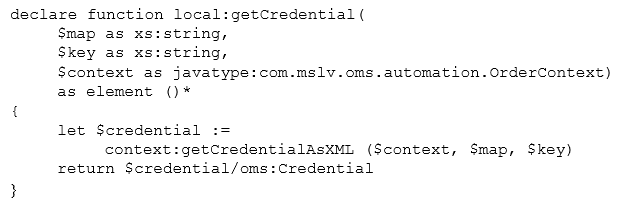
The following function is called in an XQuery automation plug-in before performing a logic that you have developed. Identify the functional action that would be executed with the output of this code.
AAuthenticate with a southbound interface.
BReceive responses from a JMS queue.
CPublish messages to a JMS queue.
DCommunicate with another running order in the same OSM instance.
ECheck the users that are running tasks in the current order.
Identify three functions of the OSM Task Web client.
AIt enables order processing personnel to monitor and manage tasks within an order and to ensure that all associated tasks are completed.
BIt enables order fallout managers to diagnose and manage the order fallouts associated with an order.
CIt enables users to associate roles or workgroups with task and manually complete the activities associated with those tasks.
DIt enables users to monitor email notifications and handle them through acknowledgement, escalation, and forwarding to other users.
EIt enables users to suspend and resume orders, cancel orders, and create orders manually.
Your customer requests OSM to be installed in a highly available environment to support a large volume of inbound orders and outbound requests. Which three components of the OSM architecture would you consider to propose to your customer?
AOracle WebLogic installation with a cluster of admin servers
BOracle Database with Real Applications Cluster (RAC)
CAdministrator application installation in a clustered environment
DLoad balancer to balance the workload among Oracle WebLogic Servers
EWebLogic Node Managers to control the Managed Servers
Identify the outcome when an upstream system creates an order and some transformation errors are generated in the recognition rule.
AOSM accepts the order and immediately transitions it to the Failed state.
BOSM rejects the order back to the external system with an error message indicating the discrepancies.
COSM queues the order in the web service queue until an administrator resolves it.
DOSM accepts the order and transitions it to the Not Started state.
EOSM accepts the order and transitions it to the In Progress state.
Question 6
Oracle Database 12c: Administration II
0
Question 7
Oracle Database 12c: Administration II
Question 8
Oracle Database 12c: Data Guard Administration
Question 9
Oracle Database 12c: Administration I
Question 10
Oracle Database 12c: Administration I
Question 11
Oracle Database 12c: Data Guard Administration
Question 12
Oracle Database 12c: Administration I
Question 13
Oracle Database 12c: Administration I
Question 14
Oracle Database 12c: Administration II
Question 15
Oracle Database 12c: Administration I
Question 16
Oracle Database 12c: Administration II
Question 17
Oracle Database 12c: Administration II
Question 18
Oracle Database 12c: Administration I
Question 19
Oracle Database 12c: Administration I
Question 20
Oracle Database 12c: Administration I
Question 21
Oracle Database 12c: Administration I
Question 22
Oracle Database 12c: Administration I
Question 23
Oracle Database 12c: Administration I
Question 24
Oracle Database 12c: Administration II
Question 25
Oracle Database 12c: Administration II
Ask AstroTutor
0
Ask AstroTutor
0
Ask AstroTutor
0
Ask AstroTutor
0
Ask AstroTutor
0
Ask AstroTutor
0
Ask AstroTutor
0
Ad
Want a break from the ads?
Become a Supporter and enjoy a completely ad-free experience, plus unlock Learn Mode, Exam Mode, AstroTutor AI, and more.
Ask AstroTutor
0
Ask AstroTutor
0
Ask AstroTutor
0
Ask AstroTutor
0
Ask AstroTutor
0
Ask AstroTutor
0
Ask AstroTutor
0
Ask AstroTutor
0
Ask AstroTutor
0
Ask AstroTutor
0
Ask AstroTutor
0
Ask AstroTutor
0
You must implement a dependency between two order components within a product specification, where the dependent order component will wait the amount of time defined in an order item property after the blocking order component finishes its execution and before starting its own execution.
What are the two tasks required to configure this behavior?
Adefining a Wait Condition in the dependency, which is configured with the task state "Received"
Bdefining a Wait For Condition in the dependency, which is configured with the task state "Completed"
Cdefining a Wait For Condition in the dependency, which is configured with a data change notification
Ddefining a Wait Delay in the dependency, which is configured with a fixed time duration
Edefining a Wait Delay in the dependency, which is configured with a duration expression
Fdefining a Wait Condition in the dependency, which is configured with no delay duration
Why would you create a new composite cartridge?
Ato assemble a solution in OSM from a complete collection of all composite cartridges
Bto create multiple solutions in OSM for all composite cartridges
Cto assemble a single solution in OSM from a collection of component cartridges
Dto create a solution that always includes all the component cartridges present in the workspace
EBecause the composite cartridge feature is not included in OSM. It includes only compound or classic cartridges.
You decide to implement a jeopardy notification to ensure that a manual task is completed within an hour. Which two jeopardy notification configurations would you consider?
AThe jeopardy condition "Raise a Jeopardy when the Order is Received within" should be configured with the value of "1 Hours."
BThe jeopardy condition "Raise a Jeopardy when Task Duration Exceeds:" should be configured with "Given Duration" set to "1 Hours."
CThe jeopardy rule should be configured with the "null rule" value.
DThe jeopardy polling interval should be configured as "Once."
EThe jeopardy condition "Raise a Jeopardy when Process Duration Exceeds:" should be configured with "Given Duration" set to "1 Hours."
When designing a decomposition rule, you include a decomposition condition with the following expression. Identify the reason for this development methodology.
Ato include only order items with a ServiceActionCode property that does not equal "NONE" in the target order component
Bto include only order items with a ServiceActionCode property that equals "NONE" in the target order component
Cto generate a target order component only when at least one order item in the source order component has a ServiceActionCode property that does not equal "NONE"
Dto generate a target order component only when at least one order item in the source order component has a ServiceActionCode property that equals "NONE"
Eto generate a target order component only when all order items in the source order component have a ServiceActionCode property that does not equal "NONE"
Fto generate a target order component only when all order items in the source order component have a ServiceActionCode property that equals "NONE"
Which three statements are true about the Rapid Offer Design and Order Delivery (RODOD) solution?
AOSM in the Central Order Management role is responsible for customer order mapping, decomposition, and orchestration.
BOSM manages the order fulfillment life cycle by providing complete lifecycle visibility and regular status updates to the CRM system.
CNew commercial offerings can eventually be introduced with zero configuration in OSM.
DCentral Order Management is the multi-channel order capture and consumer support system.
ECentral Order Management interfaces with the Element Management and Network Management systems.
You have implemented a custom logic that indicates in a field of your order data if the point-of-no-return (PoNR) has been reached or not. Identify two places where you should implement the logic to check this PoNR when order entry systems want to apply changes to an in-flight order.
Ain a behavior in the Creation Task that is used to create your order
Bin the Cancel Order transitions of the Order Lifecycle Policy
Cin the Submit Amendment transitions of the Order Lifecycle Policy
Din the Process Amendment transitions of the Order Lifecycle Policy
Ein the order recognition rule that recognizes your order
Your OSM solution fulfills orders originating from two different countries, C1 and C2. Two roles, R1 and R2, are created in your cartridges. Which design feature can you use to enable users with role R1 to view and manage orders only from country C1 and users with role R2 to view and mange orders only from country
C2?
AQuery
BFilters
CTask Data
DOrder Data
ERoles, which alone are sufficient to meet the desired functionality
In a manual task, there are three text fields configured: FIrstName, LastName, and FullName. In the FirstName and LastName fields, a Constraint Behavior is configured. In the FullName field, a Calculation Behavior is added with the following XPath expression:
While executing the manual task, a user enters values in the FirstName and LastName fields, but the FullName field is not calculated automatically. What should be done to have the FullName field automatically calculated?
ARemove the Calculation Behavior from the FullName field and add it to either the FirstName or the LastName field.
BAdd an Event Behavior to the FirstName and LastName fields.
CEliminate the Constraint Behavior from the FirstName and LastName fields.
DRemove the Constraint Behavior from the FirstName and LastName fields and add it to the FullName field.
EAdd a Relevant Behavior to the FirstName and LastName fields.
You must extend an OSM sealed cartridge, which is part of a composite cartridge solution provided by Oracle. In this extension, you need to add new data elements to a generic task. Which step would you need to perform to achieve this requirement?
ACreate a new task in the composite cartridge with the same name as the generic task and with the new elements in its task data.
BCreate a Composite Cartridge View in a component cartridge to define the task data as an additive view.
CCreate a new task in a new component cartridge, which extends the generic one from the sealed cartridge, and add the new desired elements.
DCreate the new elements in the Generic View under the Model Variables section of the composite cartridge.
EUnseal the cartridge and create the new elements in the existing task data of the generic task.
You are defining configuration management to support your OSM solution. What are two recommendations that you should follow about modifications to the solution?
AIf the modification is considered an evolution, the cartridge version should be incremented. Existing in-flight orders will not be affected by this modification.
BIf the modification is considered a fix to a problem in production, the cartridge version should not be incremented. Existing in-flight orders could be affected by this modification.
CIf the modification is considered an evolution, the cartridge version should be incremented. Existing in-flight orders will be affected by this modification.
DIf the modification is considered a fix to a problem in production, the cartridge version should not be incremented. Existing in-flight orders will not be affected by this modification.
EIf the modification is considered an evolution, the cartridge version is incremented automatically. Existing in-flight orders will not be affected by this
What kind of fallout scenario might occur during communication between OSM and a downstream system that should eventually be resolved by simply retrying the communication?
Ainvalid message request sent to the downstream system
Bnetwork connectivity error
Cfailure due to slow downstream system processing
Dinternal downstream system application error
Eunsupported business process requests
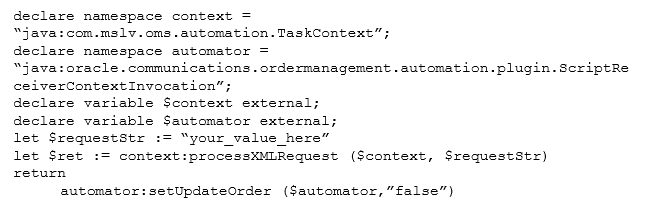
You configure an External Event Receiver XQuery Automator with the following incomplete lines of code in your automated task. To complete this implementation, you must substitute the value assigned to the $requestStr variable with another appropriate value. What could be the possible value for this variable?
Aa request to update order data
Bthe request that was sent to an activation system
Cthe response received from an automation system
Dthe data associated with this task
Ethe request that will be sent to an activation system
When defining a new stage of decomposition that decomposes order times by VPN site, you realize that you cannot model each site as an order component because you cannot estimate the number of sites at design time. How would you propose a solution to this situation?
Aby defining a single order component with a component ID expression that generates distinct values for distinct sites
Bby defining as many order components as it is needed to accept any possible combination of VPN sites
Cby modeling as many stages of decomposition as the number of VPN sites that you expect to handle at run time.
Dby modeling a decomposition rule with a logic that determines the target order component at run time, based on VPN site information
Eby using multi-instance order components with a pivot node that will generate at run time as many order components as the sites present in the order
Identify two mandatory properties that you must define when modeling an order item specification.
Athe property that indicates the order item name displayed on the Order Management Web client
Bthe property that indicates what product specification is assigned to an order item
Cthe property that indicates what product class is assigned to an order item
Dthe property that indicates the delivery date requested for an order item
Ethe property that stores the XML payload received when an order is created and associated with an order item
Which three aspects can you ascertain by analyzing an orchestration plan in the Order Management Web client?
AYou can find the order items that are associated with each fulfillment function.
BYou can identify the order components that will be executed in parallel.
CYou can identify the order components that will be executed at the beginning of order execution.
DYou can identify the fulfillment mode associated with an order.
EYou can define the dependency conditions between order components.
Which two functions can you perform by using XQuery expressions in your orchestration sequence?
Aselecting a fulfillment mode for an order
Bapplying a condition to an orchestration stage
Ccalculating a property of your order item
Didentifying order items from incoming orders
Eapplying dependencies between orchestration stages
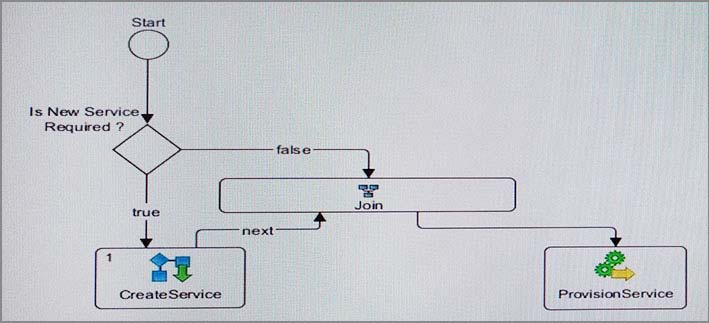
You have configured the following process flow in your OSM. Identify two possible outcomes of this process.
AWhen the Join Type configuration of the Join element is set to ALL, the ProvisionService task will never be executed.
BThe Join Type configuration of the Join element must be set to ALL for the process to execute correctly.
CThe Join element can be eliminated from the process and the same logic can be implemented with the remaining elements.
DThe "Is New Service Required?" element can have as many exit flows as needed, if the use case logic requires it.
EThere would be an error if the "Next" transition is substituted by a transition without status.
When submitting test orders to OSM from Design Studio, you realize that the interface is not responding. What could be the reason?
AThe CreateOrder web service operation is not working.
BThe CreateOrderBySpecification web service operation is not working.
CThe database connection is not set.
DThe ReceiveOrder XML API operation is not working.
EThe Task Web client Create option is not working.
You have a cartridge that defines three stages of decomposition. The first stage contains order components that represent functions, the second stage contains order components that represent target systems, and the third stage contains order components that represent granularities. You want to define decomposition rules that always apply the same granularity to a function, independent of the target system that this function is communicating to. How would you design these decomposition rules such that it is easy to maintain them in the future evolutions of your system topology?
Aa single decomposition rule with the function as the source order component and the granularity as the target order component
Ba single decomposition rule that has all target systems as source order components and the granularity as the target order component
Ca single decomposition rule that has only the target systems used by the function as source order components and the granularity as the target order component
Done decomposition rule for each target system, having this target system as the source order component and the granularity as the target order component
Eone decomposition rule for each target system used by the function, having this target system as the source order component and the granularity as the target
Which two pieces of information must be retrieved from the order items of an incoming order to create a follow-on order dependency?
Athe reference number of the follow-on order
Bthe display name property of an order item in the base order
Cthe index of an order item in the base order
Dthe line ID property of an order item in the follow-on order