Which two statements are true about JD Edwards EnterpriseOne subsystem jobs functionality? (Choose two.)
ARunning a report multiple times as a subsystem job overwrites the PDF output file after each execution and creates only one PDF output at the end of the subsystem job execution.
BThere is no difference between executing a subsystem job on the client and enterprise servers.
CYou cannot control the limit for simultaneous execution of subsystem jobs per report.
DShort duration jobs are an ideal fit for running as subsystem jobs and they run into an infinite loop throughput the UBE logic avoiding multiple submissions of the same job.
EThere is no difference between Ending or Stopping a subsystem job as both terminates the subsystem jobs instantly.
The server package build on a Linux enterprise server fails with the following error in the server package build logs.
What should you verify in order to troubleshoot this issue?
ACheck the database connectivity between the deployment server and the JAS server.
BCheck the database connectivity between the deployment server and the enterprise server.
CCheck the database server name for all data source entries where Data Source Use = DB to ensure that the name (uppercase/lowercase) matches exactly with the actual host name of the database server.
DCheck the enterprise server name for all data source entries where Data Source Use = SVR to ensure that the name (uppercase/lowercase) matches exactly with the actual host name of the enterprise server.
ECheck the connectivity between the deployment server and enterprise server host machines by using the ping test or telnet.
You are setting up Oracle Access Manager (OAM) to support an EnterpriseOne Single Sign-On configuration.
What is the EnterpriseOne SSO parameter configuration required on the Responses tab of the Protected Resource Policy?
AType = Header, Name=JDE_SSO_UID, and Value = userid.$user
BType = Header, Name=SSO_JDE_UID, and Value = /jde/HostedE1Servlet
CType = Header, Name=SSO_JDE_UID, and Value = /jde/E1Menu.maf
DType = Header, Name=JDE_SSO_UID, and Value = /jde/HostedE1Servlet
EType = Header, Name=JDE_SSO_UID, and Value = $user.userid
Which two statements are true about JDEBase Database Middleware? (Choose two.)
AIt provides a set of translation programs to JD Edwards EnterpriseOne that are embedded in data source definitions.
BIt contains processing requests such as business functions, batch jobs, and EnterpriseOne login security.
CIt provides platform-independent Application Program Interfaces (APIs) to access multiple database versions.
DIt is the JD Edwards EnterpriseOne proprietary communication middleware package that provides server-to-server and client-to-server communication.
Question 6
Configurable Network Computing (CNC) Foundation and Terminology
0
Question 7
Configurable Network Computing (CNC) Foundation and Terminology
Question 8
Configurable Network Computing (CNC) Foundation and Terminology
Question 9
Configurable Network Computing (CNC) Foundation and Terminology
Question 10
Configurable Network Computing (CNC) Foundation and Terminology
Question 11
Configurable Network Computing (CNC) Foundation and Terminology
Question 12
Configurable Network Computing (CNC) Foundation and Terminology
Question 13
Configurable Network Computing (CNC) Foundation and Terminology
Question 14
Configurable Network Computing (CNC) Foundation and Terminology
Question 15
Configurable Network Computing (CNC) Foundation and Terminology
Question 16
Configurable Network Computing (CNC) Foundation and Terminology
Question 17
Configurable Network Computing (CNC) Foundation and Terminology
Question 18
Configurable Network Computing (CNC) Foundation and Terminology
Question 19
Configurable Network Computing (CNC) Foundation and Terminology
Question 20
Configurable Network Computing (CNC) Foundation and Terminology
Question 21
Configurable Network Computing (CNC) Foundation and Terminology
Question 22
Configurable Network Computing (CNC) Foundation and Terminology
Question 23
Configurable Network Computing (CNC) Foundation and Terminology
Question 24
Configurable Network Computing (CNC) Foundation and Terminology
Question 25
Configurable Network Computing (CNC) Foundation and Terminology
Ask AstroTutor
0
Ask AstroTutor
0
Ask AstroTutor
0
Ask AstroTutor
0
Ask AstroTutor
0
Ask AstroTutor
0
Ask AstroTutor
0
Ad
Want a break from the ads?
Become a Supporter and enjoy a completely ad-free experience, plus unlock Learn Mode, Exam Mode, AstroTutor AI, and more.
Ask AstroTutor
0
Ask AstroTutor
0
Ask AstroTutor
0
Ask AstroTutor
0
Ask AstroTutor
0
Ask AstroTutor
0
Ask AstroTutor
0
Ask AstroTutor
0
Ask AstroTutor
0
Ask AstroTutor
0
Ask AstroTutor
0
Ask AstroTutor
0
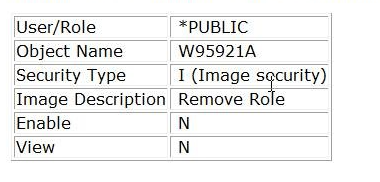
What does the following security record found in Security Workbench (P00950) enforce?
AThe Remove Role button is not shown for all users in the Work With Role Relationships application on a Fat client machine.
BThe Remove Role button is not shown for all users in the Work With Role Relationships application on a Web client.
CThe Remove Role button is disabled for all users in the Work With Role relationships application on both the Web and Fat client machines.
DThe Remove Role button is not shown for all users in the Work With Role relationships application on both the Web and Fat client machines.
EThe error message “Not Authorized” is displayed when a user clicks the Remove Role button.
You have installed an Electronic Software Update (ESU) and are reviewing the Software Update report R96701.
In the PDF, what does the value ‘2’ indicate for the Object Install Flag?
AThe object specification from the ESU have been merged with object specifications from the environment.
BThe updated object from the ESU was installed in the environment.
CA backup was successfully performed for the object.
DThe object was not updated because the existing object is more recent than the object in the ESU.
EThe object was not updated because it has been set to obsolete.
A JDE user has two roles assigned: Role1 (FINUSR) with sequence number 25 and Role2 (FINSUP) with sequence number 35.
When the user signs in with the *ALL role, what is the hierarchy that security records read when the user attempts any operation?
AUser ->Role2->Role1->*PUBLIC
BUser ->Role1->Role2->*PUBLIC
C*PUBLIC ->Role2->Role1->User
D*PUBLIC ->Role1->Role2->User
E*PUBLIC ->User->Role1->Role2
Which option determines whether a data source is shown in Machine Search & Select (W986115E) of the P986115 application?
AOCM Data Source
BData Source Use
CData Source Type
DData Class
EUse Table Owner
What is the function of the white list component in the JD Edwards EnterpriseOne IoT Orchestrator?
Aprovides a set of designer-defined data relationships
Bprovides a service call to the Application Interface Services (AIS) Server
Cprovides a list of unique name of Orchestrator processes
Dprovides an initial security check of an incoming device signature
Eprovides a list of rules that define a true or false state
Before you apply an Electronic Software Update (ESU) to an existing environment, which two methods can be used to maintain proper change control over potentially affected objects? (Choose two.)
ADownload the executable and evaluate it by using Configuration Assistant.
BDownload the executable and evaluate it by using Change Assistant and the Impact Analysis tool
CRun the download executable and then evaluate the changed objects by using the OMW Analysis tool.
DRun the download executable and then run the Impact Analysis tool in the EnterpriseOne Software Updates application.
ERun the downloaded executable and then run the compare UBE R96IMPANL.
After installing an AIS server, what other important EnterpriseOne server component is needed to complete AIS configuration?
AE1 HTML server and E1 BSSV server
BE1 HTML server
CE1 HTML server and Transaction server
DE1 BSSV server and Enterprise server
EE1 BSSV server
Which three statements are true about managing and configuring JDE kernels? (Choose three.)
AEnabling debug logging on a kernel requires restart of the JDE services on an enterprise server.
BThe security kernel supports multi-thread processing, and handles multiple data/cache requests at a time.
CThe configuration setting maxNetProcesses defines the maximum number of jdenet_n processes that are allowed to run simultaneously.
DThe TCP port number defined in the ServiceNameConnect configuration parameter is used to listen to all incoming JDENET messages.
EThe JDENET process has the capability to launch a child process called Kernels (jdenet_k) as and when request messages come in from clients or servers.
FThe Reset Cache operation from the Work With Server (P986116) application affects only the Call Object kernels. No other kernel is impacted.
Which two statements are true about deploying JDE on OPC by using JDE One-Click Provisioning tools? (Choose two.)
ADeploying the JDE web servers on Java web servers on Java Cloud Service (JCB) is not supported.
BDeploying the JDE database on Database Cloud Database Cloud Service (DBCS) is supported.
CDeploying the JDE database on top of a database server that is running in Compute Cloud Service is not supported.
DWeb server clustering is supported only by using Oracle Traffic Director and Oracle HTTP Server.
EAfter provisioning, DNC needs to run Install Plan and Workbench to wire up the provisioned JDE servers.
What does the following command install?
AThe PACKAGE package to Enterprise Application Server named Compact
BDevelopment objects of the PACKAGE package to installpath
CProduction objects of the PACKAGE package to installpath
DDevelopment objects of the PACKAGE package to installpath in silent installation.
EProduction objects of the PACKAGE to package installpath in silent installation.
The ACME company is upgrading from E1 9.1 to E1 9.2 by using the Simplified Upgrade method.
Which of the following activities is considered a prerequisite for the upgrade?
Arunning Planner Validation Report – R9840B
Brunning Path Code Copy – R9800942
Crunning Impact Analysis Report – R96711
Drunning Object Librarian Merge – R98604
Erunning Spec Merge Report – R98700
How should you configure a custom-made mobile application to work in disconnected mode?
AJD Edwards EnterpriseOne does not support mobile applications in disconnected mode.
BConfigure “Mode=Disconnected” under the [FORMSERVICE] section of the HTML Server’s JAS.
CThe application must be specifically designed and coded to support disconnected functionality.
DOn the App Configuration page of the mobile device, select the Work Offline radio button.
EConfigure “Mode=Disconnected” under the [Basic Config] section of REST.INI in the Application Interface Server (AIS), followed by an AIS server restart.
Which two steps are required for a multitier deployment? (Choose two.)
ASchedule packages by using the Multitier Package application.
BDefine deployment locations.
CDefine named users.
DDefine Deployment Server definitions for each remote location.
EDeploy packages by using the Multitier Package application.
What is the correct URL syntax to launch the JDE One-Click Provisioning Console in a web browser?
Ahttps://public_ip_address:5000
Bhttp://public_ip_address:4000
Chttp://public_ip_address:3000
Dhttps://public_ip_address:4000
Ehttps://public_ip_address:3000
A user is unable to save One View Reports from JDE applications. An “Invalid user and password” error message is logged in the HTML server error log.
Which two things must be verified to troubleshoot the issue? (Choose two.)
Awhether the JD Edwards EnterpriseOne user is mapped to the BI Publisher user
Bwhether correct security overrides are set up for the JD Edwards EnterpriseOne user
Cwhether the softcoding record is set up for the correct environment and user combination in P954000
Dwhether the Security Server is enabled in JAS.INI
Ewhether View Security is enabled for OVR
There are three BSSV servers: BSSV1 and BSSV2 on Machine M1 and BSSV3 on Machine M2.
How would you cluster these servers to attain high availability?
Avertical clustering within BSSV1 and BSSV2, and then horizontal clustering in BSSV3
Bvertical clustering within all three servers
Chorizontal clustering within all three servers
Dvertical clustering within BSSV2 and BSSV3, and then horizontal clustering in BSSV1
Evertical clustering within BSSV1 and BSSV3, and then horizontal clustering in BSSV2
You have a built a full package and noticed that there was a problem with the client package build process for one of the business function objects, B9840, included in the CINSTALL library because the reported “ERROR” in the R9622C pdf.
Which log file should you examined to determine the cause of the business function compile problem?
ACINSTALL.sts
BBuildLog.txt
CClientPkgBuild.log
DCINSTALL.log
EB9840.err
Company ACME reported that Runtime Metrics for the Enterprise Server is not populating or displaying the data in the Server Manager console.
Which three troubleshooting statements are true regarding the issue reported? (Choose three.)
ACheck for e1root JAS logs on the Enterprise Server.
BCheck for [MANAGEMENT] configuration settings instanceName and jdeHome on JDE.INI on the Enterprise Server.
CCheck for Call Object Kernel logs for any error messages on the Enterprise Server.
DCheck the Management Kernel logs for any error messages on the Enterprise Server.
ECheck for Firewall status on the Server Manager console and agent machines.
FRemove and register the Enterprise Server again in the Server Manage console.
Which two directories are automatically backed up in a.jar file while upgrading the Deployment Server Tools Release by using Server Manager? (Choose two.)
A\JDK
B\thirdparty
C\OneWorld Client Install
D\System
E\systemcomp
EnterpriseOne provides the Server Manager as its interface where administrators can capture vital resource information about the running EnterpriseOne kernels.
Which two diagnostic types can be captured as a part of Resource Manager? (Choose two.)