I’m sorry, but I couldn’t reliably verify the official exam objectives/topics for Oracle exam 1Z0-151 from the available Oracle sources.
Ask AstroTutor
The Credit_Rating item in the Customers block of an Order Entry form must be restricted to three possible values: Good, Poor, or Null (the latter value indicates that the credit rating has not been determined). Order entry clerks must be able to update this item to any of the preceding three values.
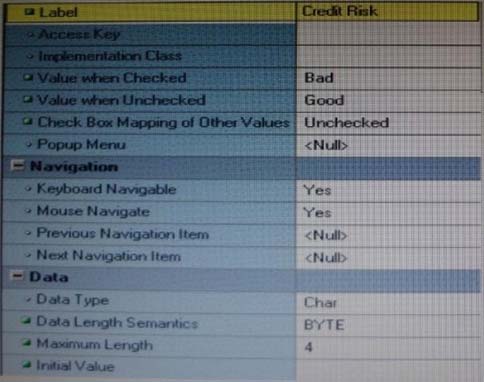
You want to change the item to a check box labeled "Credit Risk" that should be selected if the customer has poor credit, the check box should not be selected if the customer's credit rating is good or undetermined.
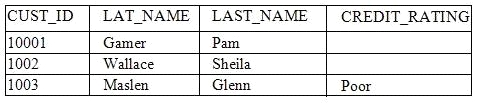
You change the item type to Checkbox, set other properties as shown in the Exhibit, and then run your form and insert three records: two with good credit and the check box deselected, and one with poor credit and the check box selected. You commit the data and query the records, with the following result set:
The first two records show an undetermined credit rating, although your intention was to set the value to Good for these customers. What change must you make in the properties of the Credit_Ratinq item to enable values of Good, Poor, and Null to be entered?
AChange the initial Value property to Good.
BChange the Check Box Mapping of Other Values property to Not Allowed.
CChange the initial Value property to Good and the Value When Unchecked property to Null.
DChange the initial Value property to Good and the Chock Box Mapping of Other Valued property to Null.
EChange the initial Value property to Good and the Check Box Mapping of Other Values property to checked.
FChange the item type. It is not appropriate to use a check box to enable entry and update of more than two values in an item.
0
Question 2
I’m sorry, but I couldn’t reliably verify the official exam objectives/topics for Oracle exam 1Z0-151 from the available Oracle sources.
0
Question 3
I’m sorry, but I couldn’t reliably verify the official exam objectives/topics for Oracle exam 1Z0-151 from the available Oracle sources.
0
Question 4
I’m sorry, but I couldn’t reliably verify the official exam objectives/topics for Oracle exam 1Z0-151 from the available Oracle sources.
0
Question 5
I’m sorry, but I couldn’t reliably verify the official exam objectives/topics for Oracle exam 1Z0-151 from the available Oracle sources.
The Order Entry application contains several forms. The inventories form uses an LOV that is based on a record group that queries the Warehouses table to return a warehouse ID.
Several of the forms use LOVs that are based on the same query. You decide to centralize the creation of the record group to the entry form of the application, which opens all the other forms, for example, to open the inventories form, there is a When-Button Pressed trigger on the inventories button with the following code;
OPEN _FORM ('inventories');
in a When-New-Form-instance trigger for the entry form, you create the warehouse_rg record group by using the CREATE_GROUP_QUERY built in with the following arguments:
('warehouse_rg' , 'SELECT ALL WAREHOUSE.WAREHOUSE_ID, WAREHOUSE.WAREHOUSE_NAME FORM WAREHOUSE order by warehouse_name);
You also populate the record group in this trigger.
What must you do to make this record group available to the inventories form and the other forms?
Ain the When-New-Form-instance trigger for the entry form, add a values for the SCOPE argument of CREATE_GROUP_QUERY.
Bin the entry form, move the record group code to the end of the When-Button-Pressed triggers for the buttons that open other forms, so that the record group is created and populated immediately after OPEN_FORM is called.
Cin the entry form, move the record group code to the beginning of the When-Button-Pressed triggers for the button that open other forms, so that the record group is created and populated just before OPEN_FORM is called.
Din the When-Button_Pressed triggers of the entry from the buttons that open other forms, add a value for the SESSION argument of OPEN_FORM.
Ein the other forms, refer to the record group as: global.warehouse_rg.
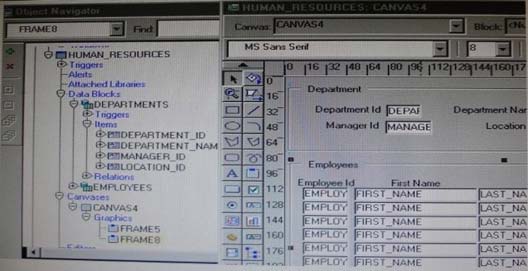
View the Exhibit.
Iin the Human Resources form shown in the Exhibit, you want to modify the prompts, heights, and widths of the Department Id, Manager Id, and Location Id Holds in the Departments data block.
What must you select before invoking the Layout Wizard in reentrant mode to modify these item properties?
AFrame5
BFrames
CCanvas4
Dthe Departments block
Ethe DEPARTMENT_ID, MANAGER_ID and LOCATION_ID items
You are implementing a JavaBean in a form, the bean has no visible component on the form when invoked, the bean displays an input text where users enter a zip code, the bean has a single method that returns a short weather forecast for that zip code as a character value.
How can you retrieve that value so that you can display it to the user?
AUse FBEAN.ENABLE_EVENT to register a listener for the bean event. Obtain the value of SYSTEM.CUSTOM_ITEM_EVENT in a When-Custom item Event trigger, and then use that value as an argument to the MESSAGE built in.
BUse FBEAN.REGISTER_BEAN as an argument to the MESSAGE built in to invoke the bean's method and return the value as a message displayed to the user.
CUse FBEAN.REGISTER_BEAN to register the bean, so that when the user enters a zip code into the bean s input text, the value is automatically displayed in the bean area item.
DUse FBEAN.ENABLE_EVENT to register a listener for the bean event. Obtain the value of SYSTEM.CUSTOM_EVENT_PARAMETER in a When_Custom-
The Orders database table uses Order_id as its primary key. You have written the following code to use in the Orders block of a form:
SELECT orders_seq.NEXTVAL -
INTO :orders.order_id -
FROM SYS.dual;
Which statement is true about this code?
AIf you place this Code in a trigger that fires when the record is inserted into the database, you will likely have more gaps in Order IDs than if you use the sequence as a default value for the item.
BIf you place this code in a trigger, you should ensure that Order_Id has its required property set to Yes.
CIf you place this code in a trigger, you should ensure that Order_Id has its Database Item property set to No.
DIf the named sequence does not exist, it is automatically created the first time the code is called.
EYou should place this code a in a database trigger to minimize the gaps in Order IDs.
FYou should place this code in Pre-insert trigger to minimize the gaps in Order IDs.
Question 6
I’m sorry, but I couldn’t reliably verify the official exam objectives/topics for Oracle exam 1Z0-151 from the available Oracle sources.
0
Question 7
I’m sorry, but I couldn’t reliably verify the official exam objectives/topics for Oracle exam 1Z0-151 from the available Oracle sources.
Question 8
I’m sorry, but I couldn’t reliably verify the official exam objectives/topics for Oracle exam 1Z0-151 from the available Oracle sources.
Question 9
I’m sorry, but I couldn’t reliably verify the official exam objectives/topics for Oracle exam 1Z0-151 from the available Oracle sources.
Question 10
I’m sorry, but I couldn’t reliably verify the official exam objectives/topics for Oracle exam 1Z0-151 from the available Oracle sources.
Question 11
I’m sorry, but I couldn’t reliably verify the official exam objectives/topics for Oracle exam 1Z0-151 from the available Oracle sources.
Question 12
I’m sorry, but I couldn’t reliably verify the official exam objectives/topics for Oracle exam 1Z0-151 from the available Oracle sources.
Question 13
I’m sorry, but I couldn’t reliably verify the official exam objectives/topics for Oracle exam 1Z0-151 from the available Oracle sources.
Question 14
I’m sorry, but I couldn’t reliably verify the official exam objectives/topics for Oracle exam 1Z0-151 from the available Oracle sources.
Question 15
I’m sorry, but I couldn’t reliably verify the official exam objectives/topics for Oracle exam 1Z0-151 from the available Oracle sources.
Question 16
I’m sorry, but I couldn’t reliably verify the official exam objectives/topics for Oracle exam 1Z0-151 from the available Oracle sources.
Question 17
I’m sorry, but I couldn’t reliably verify the official exam objectives/topics for Oracle exam 1Z0-151 from the available Oracle sources.
Question 18
I’m sorry, but I couldn’t reliably verify the official exam objectives/topics for Oracle exam 1Z0-151 from the available Oracle sources.
Question 19
I’m sorry, but I couldn’t reliably verify the official exam objectives/topics for Oracle exam 1Z0-151 from the available Oracle sources.
Question 20
I’m sorry, but I couldn’t reliably verify the official exam objectives/topics for Oracle exam 1Z0-151 from the available Oracle sources.
Question 21
I’m sorry, but I couldn’t reliably verify the official exam objectives/topics for Oracle exam 1Z0-151 from the available Oracle sources.
Question 22
I’m sorry, but I couldn’t reliably verify the official exam objectives/topics for Oracle exam 1Z0-151 from the available Oracle sources.
Question 23
I’m sorry, but I couldn’t reliably verify the official exam objectives/topics for Oracle exam 1Z0-151 from the available Oracle sources.
Question 24
I’m sorry, but I couldn’t reliably verify the official exam objectives/topics for Oracle exam 1Z0-151 from the available Oracle sources.
Question 25
I’m sorry, but I couldn’t reliably verify the official exam objectives/topics for Oracle exam 1Z0-151 from the available Oracle sources.
Ask AstroTutor
0
Ask AstroTutor
0
Ask AstroTutor
0
Ask AstroTutor
0
Ask AstroTutor
0
Ask AstroTutor
0
Ask AstroTutor
0
Ad
Want a break from the ads?
Become a Supporter and enjoy a completely ad-free experience, plus unlock Learn Mode, Exam Mode, AstroTutor AI, and more.
Ask AstroTutor
0
Ask AstroTutor
0
Ask AstroTutor
0
Ask AstroTutor
0
Ask AstroTutor
0
Ask AstroTutor
0
Ask AstroTutor
0
Ask AstroTutor
0
Ask AstroTutor
0
Ask AstroTutor
0
Ask AstroTutor
0
Ask AstroTutor
0
In Forms Builder, the iconic buttons on the form are blank, but when you click Run Form the form appears in the browser with Images in the iconic buttons.
What are two things that you can check to track the source of this problem?
Aforms Builder runtime preferences
Bthe UI_ICON setting in the operating system
Cthe iconpath setting in the Forms registry file
Dthe UI_ICOM_EXTENSION setting in the operating system
Ethe iconextension setting in the Forms registry file
Fthe FORMS_PATH setting in the Forms environment file
You want to display employee records in tabular format, but the form is not wide enough to display all the items in the Employees block. The employee IDs and names of displayed records should always be visible, but you want to scroll the additional information as users tab through the Items, the form should look like a spreadsheet with the first two columns frozen.
Which canvas types would be most appropriate in this scenario?
Acontent canvas in a window with a horizontal scroll bar
Bcontent canvas and multiple tab canvases
Ccontent canvas and a tab canvas with multiple tab pages
Dcontent canvas and a stacked canvas with a horizontal scroll bar
Emultiple content canvases
You have created a complex menu structure with several types of menu objects. To which objects would you assign menu commands?
Amain menus
Bindividual menus
Csubmenus
Dmenu items
Eall of the above
To avoid overloading the database during busy times, you decide to restrict the queries that are executed on the Orders form so that users query by either Order
ID or Customer ID during these times. Which trigger is most appropriate for the code to enforce this restriction?
AWhen-New-Form-instance
BWhen-New-Block-instance
COn-Query
DPre-Query
EPost-Query
You put some code in a Post_Update trigger and raise the FORM_TRIGGER_FAILURE under certain conditions. Does a rollback take place if the trigger falls?
AYes. Although the update has been applied to the database, the old column values are retained as rollback data; so a failure of this trigger automatically reinstates the original values.
BNo. It is too late to perform a rollback at this stage because the update has already been applied.
CThe value have already been applied, so you must programmatically save the old values in the global variables or PL/SQL variables if you want to reinstall the
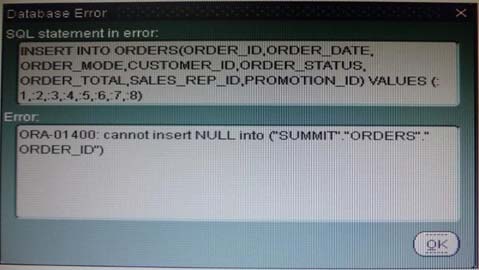
View the Exhibit.
You have placed the following code in a Post insert trigger on the Orders block:
SELECT orders_seq.NEXTVAL -
INTO :orders.order_id -
FORM SYS.dual;
You have also set Item properties for the Order_Id Item in the form so that users cannot directly enter an Order ID.
As the SUMMIT user, you run the form to test it. Yon are able to insert a record in the block, but when you click Save, you have a database error as shown in the
Exhibit.
What is the probable cause of this error?
AThe code should be in Pre_insert trigger instead
BThe code should be in a database trigger instead
CYou should change the code to select the sequence number from SUMMIT.dual instead.
DYou should create the sequence in the database, because the runtime error is an indication that is does not exist.
EYou should assign a temporary value to the Order_Id item before saving the form.
You are coding a When-Checkbox-Changed trigger.
Which statements are available for use in your code?
Aunrestricted built-ins only
Brestricted and unrestricted built-ins only
CPL/SQL statements and unrestricted built-ins only
DPL/SQL statement-, and any built-ins
On the Employees form, you do not want the cursor to enter the Employee_Id text item, which is the first item in the first block on the form. You code a Pre-Text- item trigger for that item that uses the GO_ITEM built-in to navigate to the next item.
What happens when you run the form from Forms Builder?
AYou receive a compilation error.
BThe form starts to run, but immediately closes. So If an error message Is displayed, you are unable to see it.
CThe form runs, but as soon as it appears, you receive a runtime error.
DThe form runs, but as soon as you perform any navigation, a runtime error occurs.
EThe form runs with no problem.
Yon have created a list item for the Credit__Rating field in the Customers form, the Finance department usually determines a range of scores that pertain to the customer, the values in the list are Excellent, Good, Fair, and Poor, corresponding to the ranges provided by Finance. The default value Fair, because that is the range that applies to most customers.
Sometimes, Finance can provide an exact credit score; so users must be able to enter the exact numerical value if it is known. Often clerks enter the customer data before the performance of a credit check, so they must be able to enter a blank value if the credit rating is not yet determined.
Users want to be able to select a blank value from the list, but the list does not display a blank line for them to select. How can you meet this requirement without changing the default value of the list item?
AAdd a blank line to the list item when you define the static values.
BSet Mapping of other Values for the Credit_Rating Item to NULL.
CSet the Required property of the Credit_Rating item to No.
DDelete the NOT NULL constraint for the Credit_Rating Column in the database.
EYou cannot change this type of list item to display a blank value; users must delete the default value records if the credit rating is not known.
A clerk is using the Human Resources form, which displays a department and its associated employees on the same canvas. Only two Items in the form are enabled.
Possible navigation units that can occur during navigation of this form are:
Outside the form
The Human Resources form
The Departments block
The Employees block
The current Departments record
The current Employees record
The Department_Id item
The Employee_Id item
With the cursor in : Departments.Department_Id, the clerk clicks the :Employees.Employee_Id item.
What is the sequence of navigational unit movement that occurs?
A1, 2, 3, 4, 5, 6, 7, and 8
B7, 5, 3, 2, 4, 6, and 8
C7, 5, 3, 2, 4, 6, and 8 only
D7, 5, 3, 4, 6, and 8 only
E7 and 8 only
You want to use WebUtil functionality in the Orders form. What three things must you do to integrate WebUtil into the Orders Form?
ACopy the WebUtil object group from the WebUtil object library into a separate object library.
BSubclass the WebUtil object group from the WebUtil object library into the Orders form.
CEnsure that the WebUtil block is the last block under the Data Blocks node in the Object Navigator.
DEnsure that the WebUtil block is the first block under the Data Blocks node in the Object Navigator.
EAttach the WebUtil library to the Orders form.
FCopy the WebUtil library to the same directory as the Orders form.
Iin an Order Entry form, the Order_Items block has a text item called Shipping Date, which is of the Date data type. The Lowest Allowed Value and the Highest
Allowed Value properties are not defined for this item.
Assuming that the following are defined, which three are valid settings for the initial Value = property of the Shipping_Date Item?
A$$DBDATE$$
B:Orders.Order_Date + 3
CSYSDATE
D:GLOBAL.SHIP_DATE
E:PARAMETER.SHIP
FORDER_ITEMS_SEQ
The Employees database table contains more columns than can be displayed at one time in a form. You create a data block that uses all the columns. How can you enable users to interact with all the items and switch between them without scrolling or closing anything?
ADefine multiple content canvases and display them in multiple modeless windows.
BDefine multiple content canvases and display them in the same modeless window.
CDefine multiple content canvases and display them in multiple modal windows.
DDefine multiple content canvases; display one in a modeless window and the others in modal windows.
EThis is not possible because items from a single block must be displayed on the same canvas and window.
You have designed a form with two content canvases. The window for the first canvas was created implicitly, and you have not changed its default properties.
You want users to be able to navigate between the canvases easily while viewing both simultaneously. Therefore, you create a second window, changing only its name from the default properties.
However, when you test the form, you find that you are unable to close either window. What must you do to provide this functionality?
AChange the second window to a modal window.
BCode a When-Window-Closed trigger for each window.
CSet Close Allowed to Yes for both windows.
DSet Hide on Exit to Yes for both windows.
Identify a function of the Forms Servlet.
AIt creates a dynamic HTML file.
BIt starts a Forms runtime session.
CIt manages network requests from the Forms Client.
DIt connects to and communicates with the database server.
EIt renders the Forms Services application display for the user.
Your company applies three different interest rates for customers based on their credit rating, which is classified as being Excellent, Fair, Poor or Unknown.
In the years past, clerks entered credit ratings manually, which resulted in some of them being mistyped. To improve data entry accuracy you modify the
Customers form so that the Credit_Rating item is a static list item that allows only those four values.
Users report to you that some of the customer records can no longer be accessed when they use the modified Customers form. How can you fix this problem?
AEnsure that required is set to No for the list item so that a blank line appears in the list.
BSet the Mapping of Other Values property for the list item.
CSet the Default Value property for the list item.
DSet the Query Allowed Property for the list Item.
EUsers must re-enter the records for those customers that cannot be accessed.
A user at a remote location reports a problem that occurs when the Orders; form runs and the user clicks the invoice button. You are not able to reproduce the problem, so you decide to use remote debugging.
The steps involved in diagnosing the problem are listed below, but they are ordered incorrectly. What is the correct sequence of Steps?
You set a breakpoint in the When Button-Pressed trigger for the invoice button.
The user's screen goes blank.
The user reports the host and port to you.
You uses the debugger to step through the code.
The user clicks a button that calls DEBUG.ATTACH.
You attach to the user's process.
You open the Orders.fmb file from which the running .fmx was generated.
The user clicks the invoice button.
A5, 3, 6, 7, 1, 8, 2, 4
B8, 3, 6, 5, 4, 7, 1, 2
C7, 1, 3, 6, 5, 1, 8, 4
D3, 6, 5, 7, 8, 1, 2, 4
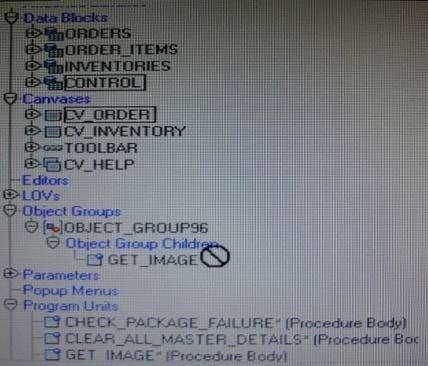
View the Exhibit.
You are attempting to drag the Control and CV_Order objects to an object group as shown in the Exhibit, but you are unable to release them in the Object Group
Children node of the object group.
What is the reason for this?
AYou cannot drag a canvas to an object group.
BYou cannot drag a block to an object group.
CYou need separate object groups for different types of objects.
DYou cannot drag multiple types of objects to an object group at the same time.
EYou should drag them to the ObjectGroup96 node, not to its Object Group Children node.
You wish to use a javaBean in a form. This javaBean has no visible component.
You use the Layout Editor to create a bean area item that implements this JavaBean. You want to be able to see the bean area item in the Layout Editor so that you can easily interact with it at design time.
What can you do to ensure that the bean area item does not appear on the form at run time?
ASet its Visible property to No.
BSet its Height and Width properties to 1.
CSet its Implementation class programmatically at run time.
DYou do not have to do anything; if Implementation Class does not display a visible component, the bean area does not show at run time.
EYou cannot avoid displaying the Bean area at run time.
You have a form that called a database stored procedure. You do not want processing to continue, so immediately after the call to the stored procedure, you add the following code:
IF NOT FORM_SUCCESS THEN -
MESSAGE ('Stored Procedure failure');
RAISE FORM_TRIGGER_FAILURE;
END IF;
You test the code and input some data that intentionally causes the stored procedure to fail. However, the message that you defined does not appear. What are two possible reasons for this?
AYou must handle database errors in an exception clause of the trigger.
BYou must test for FORM_FAILURE when testing for failure of a stored procedure.
CYou must test for FORM_FATAL when testing for failure of a stored procedure.
DFORM_SUCCESS tests for failure of Forms built-ins, not stored procedures.
EYou cannot test for failure of a stored procedure, because database errors are transparent to Forms.