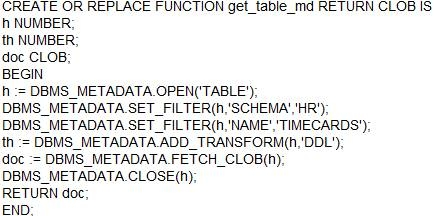
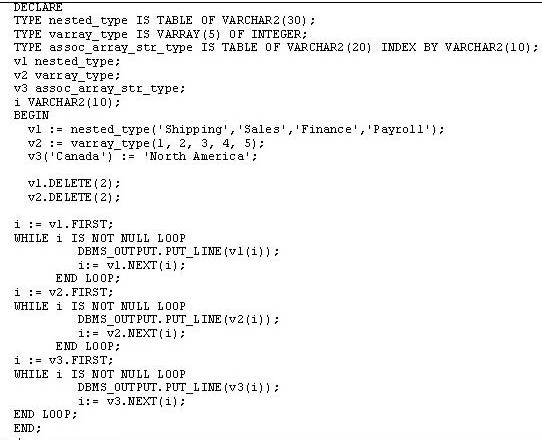
Examine the PL/SQL block; While executing the PL/SQL statements generates the errors, what is the reason?
AThe DELETE(n) method cannot be used with varrys
BThe DELETE(n) method cannot be used with nested tables
CThe NEXT method cannot be used with an associate array with VARCHAR2 key values
DThe NEXT method cannot be used with a nested table from which an element has been deleted
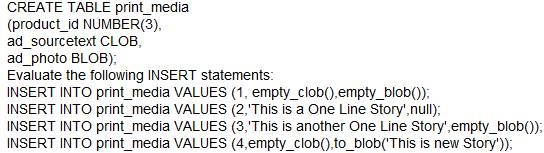
See the exhibit:
Which of the above INSERT statements are valid?
AOnly the first statement is valid
BAll the statement are valid
COnly the first and fourth statements are valid
DOnly the first and second statements are valid
EOnly the first, second and third statements are valid
The database instance was started up using the automatic memory management feature. No value was set for the RESULT_CACHE_MAX_SIZE parameter.
Examine the following initialization parameter settings for your database:
MEMORY_TARGET = 500M -
RESULT_CACHE_MODE=MANUAL -
You execute a query by using the result_cache hint. Which statement is true in this scenario?
AThe query results are not stored because no memory is allocated for the result cache
BThe query results are stored and 0.5% of the memory target is allocated to the result cache
CThe query results are stored and 0.25% of the memory target is allocated to the result cache
DThe query results are not stored because the RESULT_CACHE_MODE parameter is not set to FORCE
You designed a CardValidation.java java source file. You also have the corresponding CardValidation.class file. As part of invoking a Java class method, you executed this command at the command prompt:
Loadjava -user oe/oe CardValidation.java
Which statement is true about the command?
AIt loads the Java code into the database
BIt publishes Java methods in CardValidation.java
CIt loads the metadata related to the Java class file into the database
DIt loads the java class file into the Java pool in the database instance
Question 7
Application Developer
0
Question 8
Database Administrators
Question 9
Database Administrators
Question 10
Database Administrators
Question 11
Database Administrators
Question 12
Application Developer
Question 13
Application Developer
Question 14
Database Administrators
Question 15
Database Administrators
Question 16
Application Developer
Question 17
Application Developer
Question 18
Database Administrators
Question 20
Database Administrators
Question 21
Database Administrators
Question 22
Database Administrators
Question 23
Database Administrators
Question 24
Database Administrators
Question 25
Database Administrators
Question 26
Database Administrators
Question 27
Database Administrators
Ask AstroTutor
0
Ask AstroTutor
0
Ask AstroTutor
0
Ask AstroTutor
0
Ask AstroTutor
0
Ask AstroTutor
0
Ask AstroTutor
0
Ad
Want a break from the ads?
Become a Supporter and enjoy a completely ad-free experience, plus unlock Learn Mode, Exam Mode, AstroTutor AI, and more.
Ask AstroTutor
0
Ask AstroTutor
0
Ask AstroTutor
0
Ask AstroTutor
0
Ask AstroTutor
0
Ask AstroTutor
0
Ask AstroTutor
0
Ask AstroTutor
0
Ask AstroTutor
0
Ask AstroTutor
0
Ask AstroTutor
0
Ask AstroTutor
0
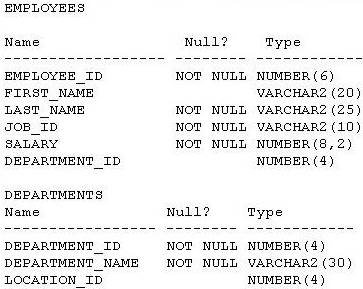
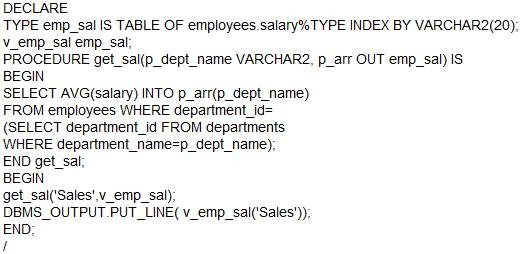
See the Exhibit:
Examine the strucutre of the EMPLOYEES and DEPARTMNETS tables.
See the PL/SQL block that you execute to find the average salary for employees in the 'Sales' department.
What is the outcome?
AIt executes successfully and gives the correct output
BIt generates an error because the assocaitive array definition is not valid
CIt generates an error because an assocaitive array cannot be passed to a procedure in OUT mode
DIt generates an error because an associative array cannot be used with the SELECT INTO statement
Examine the following settings for a session:
Which statement would be true in this scenario?
AThe compiler would automatically inline subprograms
BThe compiler would inline the code for external subroutines
CThe compiler would inline the code even if the INLINE pragma is set to NO
DThe compiler would not inline the code unless the INLINE pragma is set to YES
Which two statements are true about SecureFile LOB options? (Choose two.)
AThe COMPRESSION HIGH option can be enabled only for CLOBs
BThe COMPRESSION HIGH option can be enabled for all internal LOBs
CThe DECRYPT option can be used to remove encryption only if the LOB column is empty
DThe DECRYPT option can be used to remove encryption from LOB columns that are empty or contain data
Identify three guidelines for the DBMS_ASSERT package.(Choose three.)
APrefix all calls to DBMS_ASSERT with the SYS schema name
BEmbed DBMS_ASSERT verification routines inside the injectable string
CEscape single quotes when you use the ENQUOTE_LITERAL procedur e
DDefine and raise exceptions explicitly to handle DBMS_ASSERT exceptions
EPrefix all calls to DBMS_ASSERT with a schema name that owns the subprogram that uses the DBMS_ASSERT package
Identify the two type of PL/SQL programs for which you consider setting the compilation method to native mode. (choose two.)
APL/SQL programs that are still in the debugging phase of development
BPL/SQL programs that have computation-intesive procedural operations
CA PL/SQL program, which is called with the same parameters by multiple sessions
DPL/SQL programs that spend most of their execution time in executing SQL statements
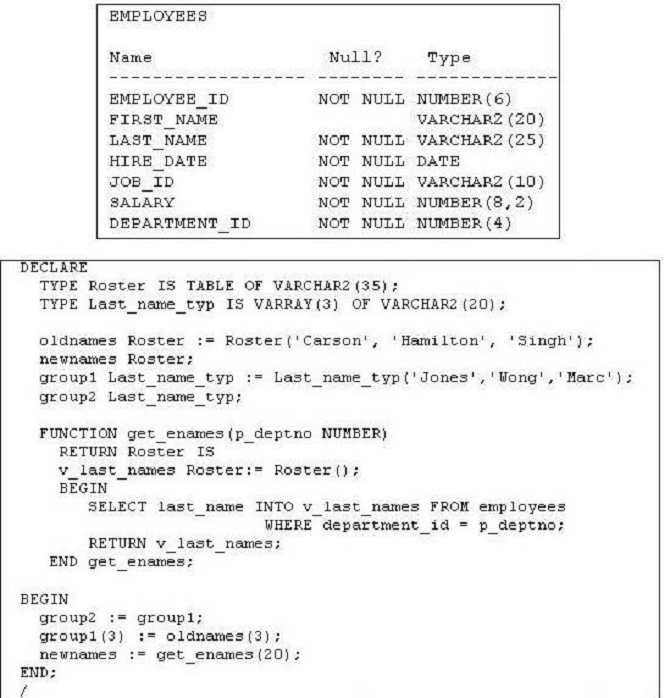
See the Exhibit:
The PL/SQL block fails to execute;
What could be the reason?
ANested tables cannot be returned by a function
BThe NEWNAMES nested table has not been initialized
CThe assignment operator cannot be used to transfer all the element values from GROUP1 to GROUP2
DThe third element of OLDNAMES cannot be assigned to the thrid element of GROUP1 because they are of incosistent data types
ELAST_NAME values cannot be assigned to the V_LAST_NAMES nested table because local collection types are not allowed in SQL statements
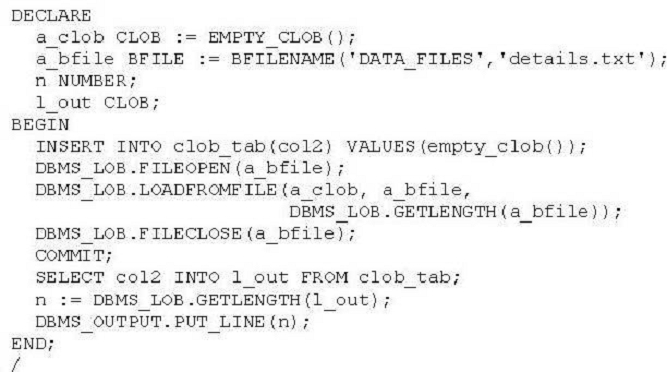
See the Exhibit:
DATA_FILES is a directory object that contains the DETAILS.txt text file. You have the required permissions to access the directory object. You have a table using the following command:
CREATE TABLE clob_tab(col2,CLOB);
Examine the PL/SQL statement in exhibit that you execute for loading the external text file into the table that currently has no rows. The PL/SQL block results in an error. What correction must be done to ensure the PL/SQL block executes successfully?
AThe L_OUT variable must be initialized to an empty locator
BThe L_OUT variable has to be declared as a temporary LOB
CThe A_CLOB variable has to be declared as a temporary LOB
DThe clause RETURINING col2 INTO a a_clob should be added to the INSERT statement to correctly initialize the locator
Which two types of query result cannot be stored in the query result cache? (Choose two.)
ASubquery results
BResults of a query having the SYSDATE function
CResults of a query having the GROUP BY clause
DResults of a query having the DATE data type in the WHERE clause
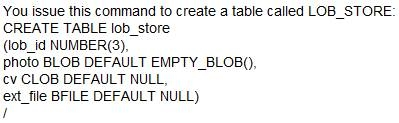
What is the outcome?
AThe table is created successfully
BIt generates an error because DEFAULT cannot be set to EMPTY_BLOB() during table creation
CIt generates an error because DEFAULT cannot be set to null for a CLOB column during table creation
DIt generates an error because DEFAULT cannot be set to null for a BFILE column during table creation
Which two statements are true about associative arrays and varrays? (Choose two.)
AOnly varrays must use sequential numbers as subscripts
BOnly varrays can be used as column types in database tables
CBoth assocaitive arrays and varrays must use sequential numbers as subscripts
DBoth assocative arrays and varrays can be used as column types in database tables
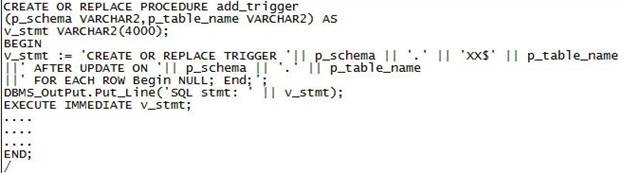
See the Exhibit:
Which three statements are appropriate for protecting the code in the procedure from SQL injection? (Choose three.)
AExplicitly validate the identifier length limit
BAdd AUTHID DEFINER to the definition of the procedure
CUse PRAGMA RESTRICT_REFERENCES in the procedure
DFilter out control characters in user-supplied identifier names
EUse the object ID of the table from the data dictionary to build the trigger name
You created a PL/SQL function with the RESULT_CACHE and RELIES_ON clauses. In which scenarios is the cached reuslt bypassed? (Choose all that apply)
AWhen the size for the memory allocated for the result cache is increased
BWhen the function is executed in a session frequently with the same parameter value
CWhen the database administrator has disabled the use of the result cache during application patching
DWhe a data manipulation language statement in a session on a table or view that was specified in the RELIES_ON clause of a result-cached function
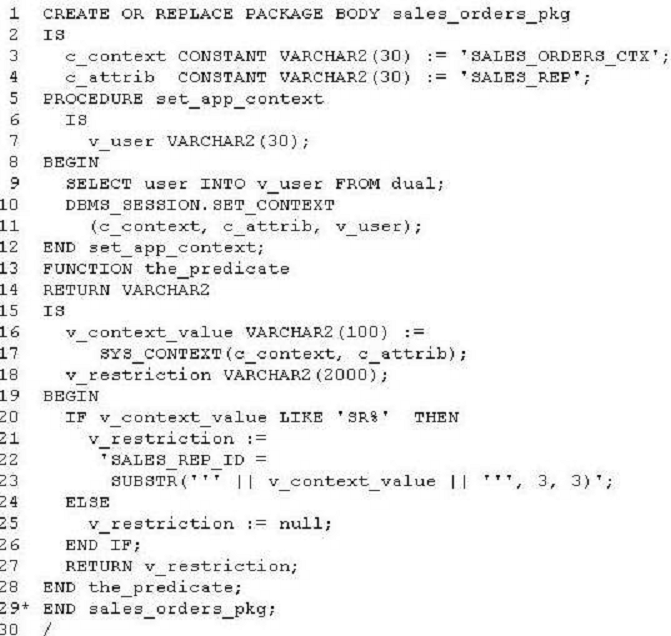
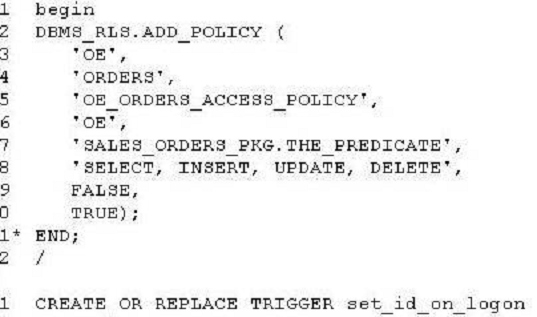
See the Exhibit:
Exhibit1:
Exhibit2:
When executing the above PL/SQL statement to create SALES_ORDERS_CTZ context to use the OE.SALES_ORDERS_PKG package.
ERROR at line 2:
ORA-28112: Failed to execute policy function.
What could be the reason for the error?
AThe user has insufficient privileges on the DBMS_SESSION package
BThe subprograms inside the package have not been created with the invokers right
CThe THE_PREDICATE function has an insufficient number of parameters in the package
DThe policy is created by using SALES_ORDERS_PKG. THE_PREDICATE without a parameter
Examine the following PL/SQL statements:
Stmt='SELECT session_id FROM sessions WHERE '|| p_where_stmt;
Identify a solution for preventing SQL injection in the above code.
AReplace P_WHERE_STMT with a bind variable
BDo not use APIs that allow arbitrary query parameters to be exposed
CUse the RESTRICT_REFERENCES clause in the PL/SQL subprogram that contains the code
DUse DBMS_SQL to detect that the expression provided for P_WHERE_STMT is free from SQL injection
Which two statements are true about cursor variables? (Choose two.)
ACursor variables can be parameterized like cursors
BThe query associated with a cursor variable cannot reference host varaible and PL/SQL variables
CThe FETCH statemetn executes the query assocaited with a cursor variable and identifies the result yet
DCursor attributes (%FOUND,%NOTFOUND,%ISOPEN and %ROWCOUNT) can be applied to a cursor variable
EThe OPEN FOR statement executes the query associated with a cursor variable and identifies the result set
Which two statements are true about the SQL Query Result Cache? (Choose two.)
AIt can store the query results for temporary tables
BIt can be set at the system, session or query level
CIt is used only across statements in the same session
DCached query results become invalid when the data accessed by the query is modified
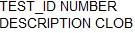
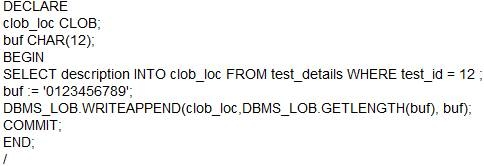
Examine the structure of the BEST_DETAILS table:
DESCRIPTION dat was entered earlier and saved for TEST_ID 12.
You execute this PL/SQL block to add data to the end of the existing data in the DESCRIPTION column for TEST_ID 12;
It generates an error on execution.
What correction should you do to achieve the required result?
AWRITEAPPEND must be replaced with APPEND
BThe BUF variable data type must be changed to CLOB
CFOR UPDATE must be added to the SELECT statement
DThe GETLENGTH routine must be replaced with the LENGTH built-in function in WRITEAPPEND
You execute teh following command to alert the session parameter:
Which two statements are true in this scenario? (Choose two.)
AIF the SYSAUX tablespace is unavailable and you compile a program unit, PL/scope does not collect data for the compiled object
BAll the identifies declared in compiled program units before altering the parameter settings appear in the *_IDENTIFIER static data dictionary views
CAll the identifiers declared in compiled program units before altering the parameter settings do not appear in the *_IDENTIFIER static data dictionary views
DIf the SYSAUX tablespace is unavailable and you compile a program unit, PL/Scope collects data for the compiled object and stores it in the SYSTEM
Which statements are true about the SecureFile storage paradigm? (Choose two.)
ASecureFile storage can be used for internal and external LOBs
BAutomatic segment space management must be enabled for a tablespace to store SecureFile LOBs
CSecureFile options enabled for a LOB column can be overriden on a per-LOB basis within the column
DSecureFile is the default stroage paradigm for all LOBs that are stored in locally managed tablespaces if the DB_SECUREFILE parameter is set to ALWAYS
Which statements are true about internal LOBs? (Choose all that apply)
AThey cannot use redo logging
BThe can be used as attributes of a user-defined data type
CThey cannot be passed as parameters to PL/SQL subprograms
DThey can be stored in a tablespace that is different from the tablespace that stores the table containing the LOB column