The CURSOR_SHARING and OPTIMIZER_CAPTURE_SQL_PLAN_BASELINES parameters are set to default. The top five wait events in an AWR report are due to a large number of hard parses because of several almost identical SQL statements.
Which two actions could reduce the number of hard parses? (Choose two.)
ACreate the KEEP cache and cache tables accessed by the SQL statements.
BCreate the RECYCLE cache and cache tables accessed by the SQL statements.
CIncrease the size of the library cache.
DSet OPTIMIZER_CAPTURE_SQL_PLAN_BASELINES to TRUE.
Which three types of statistics are captured by Statspack with snap level 6? (Choose three.)
AParent and child latches
BParent and child latches
COptimizer execution plans
DPlan usage data
EEnqueue statistics
FSegment-level statistics
You execute the following:
EXECUTE DBMS_AUTO_TASK_ADMIN.DISABLE;
Which advisor remains enabled?
AAutomatic SQL Tuning
BSQL Plan Management Evolve Advisor
COptimizer Statistics Advisor
DAutomatic Optimizer Statistics Collection
EAutomatic Segment Advisor
You want to reduce the amount of db file scattered read that is generated in the database.
You execute the SQL Tuning Advisor against the relevant workload.
Which two can be part of the expected result? (Choose two.)
Arecommendations regarding the creation of additional indexes
Brecommendations regarding rewriting the SQL statements
Crecommendations regarding the creation of materialized views
Drecommendations regarding the creation of SQL Patches
Erecommendations regarding partitioning the tables
Multiple sessions are inserting data concurrently into a table that has an LOB column.
At some point in time, one of the sessions cannot find available space in the LOB segment and needs to allocate a new extent.
Which wait event will be raised in the other sessions that need space in the LOB column?
Aeng: SQ - contention
Beng: TM - contention
Ceng: HW - contention
Deng: TX - allocate ITL entry
Question 6
Monitoring and Tuning Database Performance
0
Question 7
Monitoring and Tuning Database Performance
Question 8
Monitoring and Tuning Database Performance
Question 9
Monitoring and Tuning Database Performance
Question 10
Managing Memory Components
Question 11
Tuning SQL Statements
Question 12
Managing Memory Components
Question 13
Monitoring and Tuning Database Performance
Question 14
Tuning SQL Statements
Question 15
Monitoring and Tuning Database Performance
Question 16
Monitoring and Tuning Database Performance
Question 17
Using Automatic Tuning Features
Question 18
Monitoring and Tuning Database Performance
Question 19
Monitoring and Tuning Database Performance
Question 20
Monitoring and Tuning Database Performance
Question 21
Managing Memory Components
Question 22
Managing Memory Components
Question 23
Using Automatic Tuning Features
Question 24
Managing Memory Components
Question 25
Monitoring and Tuning Database Performance
Ask AstroTutor
0
Ask AstroTutor
0
Ask AstroTutor
0
Ask AstroTutor
0
Ask AstroTutor
0
Ask AstroTutor
0
Ask AstroTutor
0
Ad
Want a break from the ads?
Become a Supporter and enjoy a completely ad-free experience, plus unlock Learn Mode, Exam Mode, AstroTutor AI, and more.
Ask AstroTutor
0
Ask AstroTutor
0
Ask AstroTutor
0
Ask AstroTutor
0
Ask AstroTutor
0
Ask AstroTutor
0
Ask AstroTutor
0
Ask AstroTutor
0
Ask AstroTutor
0
Ask AstroTutor
0
Ask AstroTutor
0
Ask AstroTutor
0
Which two types of performance problems are reported by ADDM for PDBs? (Choose two.)
AI/O capacity limits
BExcessive checkpoint writes
CSGA sizing issues
DTop SQL statements
EUser I/O waits
What is the right time to stop tuning an Oracle database?
AWhen the allocated budget for performance tuning has been exhausted
BWhen all the concurrency waits are eliminated from the Top 10
CWhen the buffer cache and library cache hit ratio is above 95%
DWhen the I/O is less than 10% of the DB time
EWhen the tuning goal has been met
Database performance degraded between 23:15 and 23:30 for the last three nights. The AWR snapshot interval is one hour. The ADDM report contains nothing about this performance problem.
With which tool can you further analyze this problem?
ASQL Performance Analyzer
BAWR Compare Periods report
CSQL Tuning Advisor
DActive Session History report
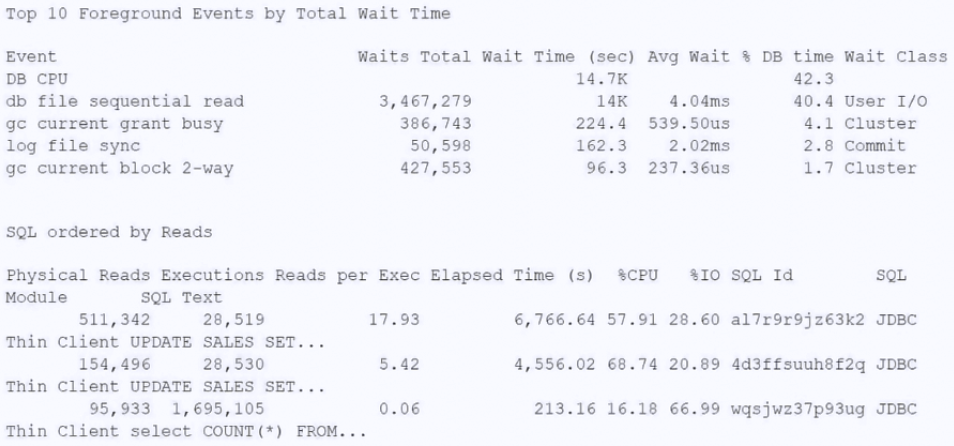
Examine this AWR report excerpt:
You must reduce the impact of database I/O, without increasing buffer cache size and without modifying the SQL statements.
Which compression option satisfies this requirement?
ACOLUMN STORE COMPRESS FOR QUERY LOW
BROW STORE COMPRESS
CROW STORE COMPRESS ADVANCED
DCOLUMN STORE COMPRESS FOR QUERY HIGH
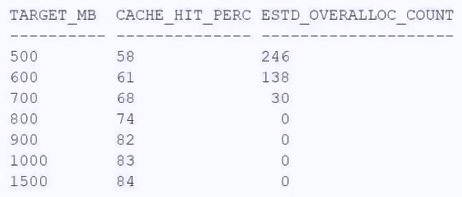
Examine this output of a query of V$PGA_TARGET_ADVICE:
Which statements is true?
AWith a target of 700 MB or more, all multipass executions work areas would be eliminated.
BPGA_AGGREGATE_TARGET should be set to at least 800 MB
CPGA_AGGREGATE_TARGET should be set to at least 700 MB.
DWith a target of 800 MB or more, all one-pass execution work areas would be eliminated.
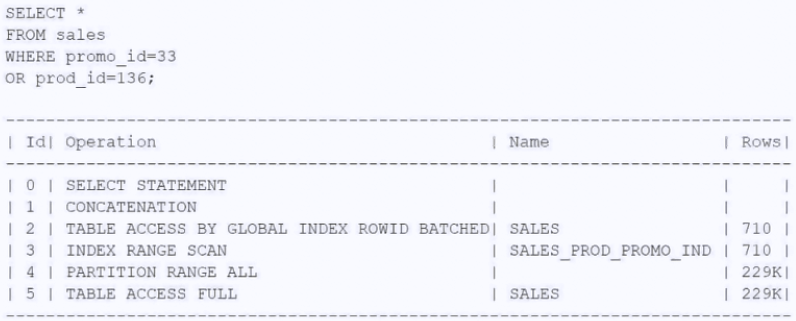
Examine this statement and its corresponding execution plan:
Which phase introduces the CONCATENATION step?
ASQL Semantic Check
BSQL Execution
CSQL Row Source Generation
DSQL Transformation
ESQL Adaptive Execution
Which two statements are true about Data Pump import for objects that used the In Memory (IM) column store in their source database? (Choose two.)
AIt always gives preference to the IM column store clause defined at the tablespace level over table-level definitions.
BIt must always transport existing INMEMORY attributes.
CIts INMEMORY_CLAUSE of the Data Pump Export allows modifications to IM column store clause of a table with existing INMEMORY setting
DIts TRANSFORM clause can be used to add the INMEMORY clause to exported tables that lack them.
EIt ignores the IM column store clause of the exporting objects.
FIt can generate the INMEMORY clause that matches the table settings at export time.
For which two actions can SQL Performance Analyzer be used to assess the impact of changes to SQL performance? (Choose two.)
Astorage, network, and interconnect changes
Boperating system upgrades
Cchanges to database initialization parameters
Ddatabase consolidation for pluggable databases (PDBs)
Eoperating system and hardware migrations
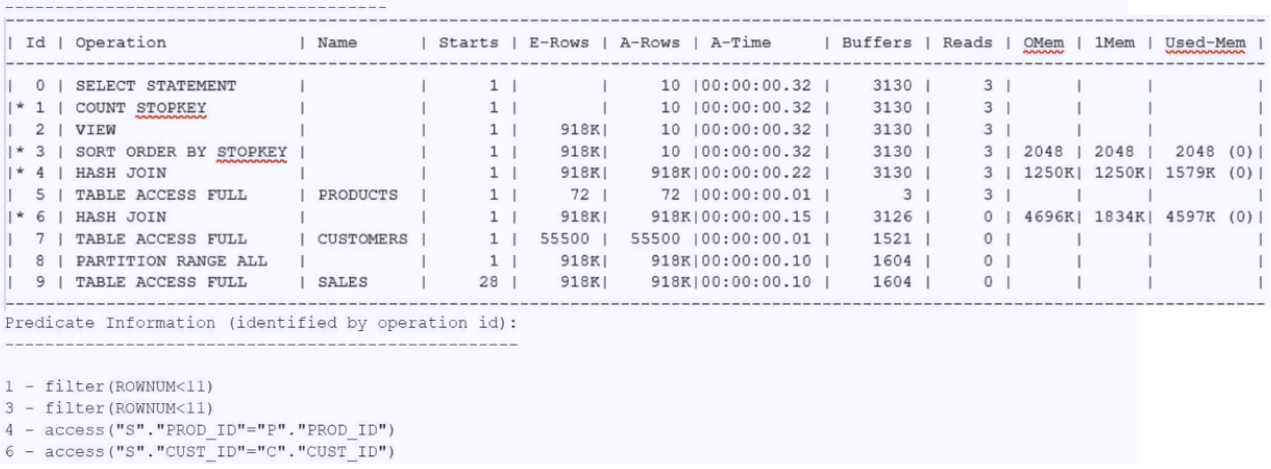
You must write a statement that returns the ten most recent sales. Examine this statement:
Users complain that the query executes too slowly. Examine the statement's current execution plan:
What must you do to reduce the execution time and why?
ACreate an index on SALES.TIME_ID to force the return of rows in the order specified by the ORDER BY clause.
BReplace the FETCH FIRST clause with ROWNUM to enable the use of an index on SALES.
CCollect a new set of statistics on PRODUCT, CUSTOMERS, and SALES because the current stats are inaccurate.
DEnable Adaptive Plans so that Oracle can change the join method as well as the join order for this query.
ECreate an index on SALES.CUST_ID to force an INDEX RANGE SCAN on this index followed by a NESTED LOOP join between CUSTOMERS and SALES.
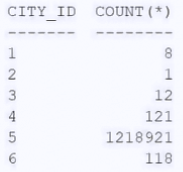
You manage a 19c database with default optimizer settings.
This statement is used extensively as subquery in the application queries:
SELECT city_id FROM sh2.sales WHERE city_id=:B1
You notice the performance of these queries is often poor and, therefore, execute:
SELECT city_id,COUNT(*) FROM sh2.sales GROUP BY city_id;
Examine the results:
There is no index on the CITY_ID column.
Which two options improve the performance? (Choose two.)
AGenerate frequency histograms on the CITY_ID column.
BCreate an index on the CITY_ID column.
CUse a SQL Profile to enforce the appropriate plan.
DForce the subquery to use dynamic sampling.
EActivate the adaptive plans.
Which two statements are true about space usage in temporary tablespaces? (Choose two.)
AWhen a global temporary table instantiation is too large to fit in memory, space is allocated in a temporary tablespace.
BTemporary tablespaces setting includes quotas to limit temporary space used by a session for that Temporary tablespace.
CA sort will fail if a sort to disk requires more disk space and no additional extent can be found/allocated in/for the sort segment.
DWhen a session consumes all temporary tablespace storage, then the session would hang until the temporary space used by that session is cleared
ELack of temporary tablespace space for sort operations can be prevented by using temporary tablespace groups.
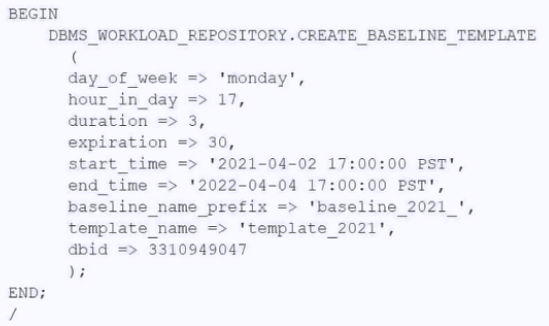
Examine this command:
What is the maximum number of baselines generated by this command that you can have at any given time?
A1
B3
C52
D5
Which two statements are true about session wait information contained in v$session or v$session_wait? (Choose two.)
ARows for sessions displaying WAITED UNKNOWN TIME in the STATE column indicate that the session is still waiting.
BRows for sessions that are currently waiting have a wait time of 0.
CRows for sessions that are not waiting might contain the actual wait time for the last event for which they waited.
DRows for sessions that are currently waiting have their wait time incremented every microsecond.Rows for sessions that are not waiting always contain the total wait time since the session started.
Accessing the SALES table causes excessive db file sequential read wait events.
Examine this AWR excerpt:
Now, examine these attributes displayed by querying DBA_TABLES:
Finally, examine these parameter settings:
Which two must both be used to reduce these excessive waits? (Choose two.)
APartition the SALES table.
BIncrease PCTFREE for the SALES table.
CRe-create the SALES table.
DCompress the SALES table.
ECoalesce all SALES table indexes.
Which two statements are true about the use and monitoring of Buffer Cache Hit ratios and their value in tuning Database I/O performance? (Choose two.)
AThe performance of workloads that primarily generate full table scans and fast full index scans are always affected by the cache hit ratio.
BA 99% cache hit ratio can be observed for database instances which have very poor I/O performance.
CThe buffer cache advisory view v$db_cache_advice provides advice on cache hit ratios appropriate for the instance workload.
DBoth the RECYCLE and KEEP buffer caches should always have a very high cache hit ratio.
EA 60% cache hit ratio can be observed for database instances which have very good I/O performance.
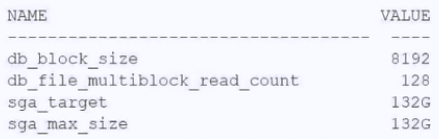
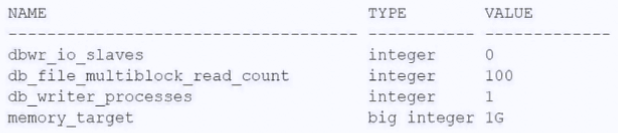
A database supporting a mixed workload is hosted on a server with 64 CPUs.
A large number of free buffer waits and buffer busy waits occur affecting performance.
The buffer cache size was then increased but after a few hours, the same wait events occur more often than before the change.
Which two actions can help reduce the number of these waits? (Choose two.)
Aincreasing the value of DB_FILE_MULTIBLOCK_READ_COUNT to 128
Bincreasing the size of MEMORY_TARGET
Csetting dbwr_io_slaves to 64
Dincreasing the value of DB_WRITER_PROCESSES to 64
Ereducing the value of DB_FILE_MULTIBLOCK_READ_COUNT to 64
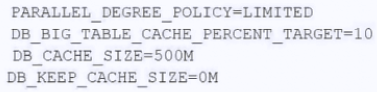
A database instance is suffering poor I/O performance on two frequently accessed large tables.
No Big Table caching occurs in the database.
Examine these parameter settings:
Which are two actions either one of which will allow Big Table caching to occur?
Aincreasing DB_BIG_TABLE_CACHE_PERCENT_TARGET to at least 50
Bsetting DB_KEEP_CACHE_SIZE to at least 50M
Cincreasing DB_BIG_TABLE_CACHE_PERCENT_TARGET to at least 25
Dincreasing DB_CACHE_SIZE to 1G
Esetting PARALLEL_DEGREE_POLICY=ADAPTIVE
Fsetting PARALLEL_DEGREE_POLICY=AUTO
You use SQL Tuning Advisor to tune a given SQL statement.
The analysis eventually results in the implementation of a SQL Profile.
You then generate the new SQL Profile plan and enforce it using a SQL Plan Baseline but forget to disable the SQL Profile and a few days later you find out that the SQL Profile is generating a new execution plan.
Which two statements are true? (Choose two.)
AThe SQL Profiles as well as SQL Plan Baseline are implemented using hints, so they both generate the same plan.
BThe execution plan is the one enforced by the SQL Profile.
CThe execution plan is the one enforced by the SQL Plan Baseline.
DThe SQL Plan Baseline must be accepted in order to be used for the execution plan.
EThe conflict between the two plan stability methods results in an error.
FThe existence of two concurrent plan stability methods generates a child cursor for every execution.
This error occurred more than four hours ago in the database:
ORA-04036 PGA memory used by the instance exceeds PGA_AGGREGATE_LIMIT
You want to know which process and query were at fault.
Which two views should you use for this purpose? (Choose two.)
ADBA_HIST_ACTIVE_SESS_HISTORY
BDBA_HIST_SQLSTAT
CDBA_HIST_SQLTEXT
DDBA_HIST_PGASTAT
EDBA_HIST_PROCESS_MEM_SUMMARY
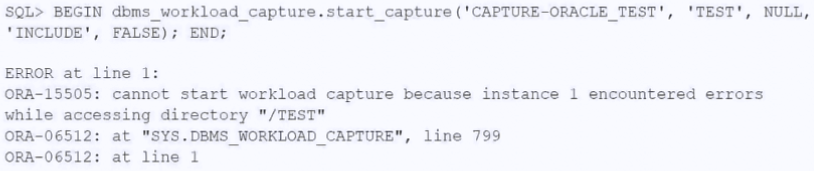
Examine this statement and output:
Which two situations can trigger this error? (Choose two.)
AThe user lacks the required privileges to execute the DBMS_WORKLOAD_CAPTURE package or the directory.
BThere is a file in the capture directory.
CThe syntax is incomplete.
DThe capture directory is part of the root file system.
EThe instance is unable to access the capture directory.