Which two statements are true about setting the FAST_ START_ MTTR_ TARGET initialization parameter to a nonzero value?
AThe MTTR advisor will be disabled.
BAutomatic checkpoint tuning will be enabled.
CThe value for the LOG_CHECKPIONT_INTERVAL initialization parameter will be override the value for FAST_START_MTTR_TARGET.
DThe time taken to recover the instance after the crash is always exactly the same as the value given for the FAST_START_MTTR_TARGET initialization
Which options would you consider while configuring a flash recovery area (fast recovery area in 11g Release 2) for your production database that is running in
ARCHIEVELOG mode? (Choose all that apply.) (Choose all that apply.)
Asetting the FAST_START_MTTR_TARGET to set the mean time to recover
Bsetting the RECOVERY_PARALLELISM parameter to twice the number of CPUs
Cusing the DB_RECOVERY_FILE_DEST parameter to set the location for flash recovery area
Dusing the DB_RECOVERY_FILE_DEST_SIZE parameter to define the disk space limit for the recovery files created in the flash recovery area.
Examine the following RMAN command:
RMAN> CONFIGURE ENCRYPTION FOR DATABASE ON; RMAN> BACKUP DATABASE PLUS ARCHIVELOG;
Which perquisite must be met before accomplishing the backup?
AProvide a password for the encryption.
BSet up an Oracle wallet for the encryption.
CNo setup is required as it is a default encryption method.
DBoth Oracle wallet and password must be set up for the encryption.
Examine these Data Pump commands to import objects to non-existent users hr1 and oe1.
S expdp system/manager -
Schemas =hr,oe -
directory =EXP_ DIR
include = table
$ impdp system/manager
Schemas = hr1,oe1 -
Directory = EXP_DIR -
Dumpfile = export.dat -
Remap_schema =hr:hr1,oe :oe1 -
What would be achieved by running the above commands?
Aexpdp will fail because no path has been defined for the dumpfile.
Bexpdp will succeed but Impdp will fail because users do not exist.
Cimpdp will create two users called hrl and oe1 and import all objects to the new schemas
Dimpdp will create two users called hrl and oe1 and import tables owned by hr and oe schemas to hr1 and oe1 schemas, respectively.
The database is configured in ARCHIEVELOG mode and regular complete database backups are taken. The loss of which two types of files may require a recovery with the RESETLOGS option?
AControl files
BPassword file
CInactive online redo log file
DArchived log files required to perform recovery
ENewly created tablespace which is not backed up
User SCOTT wants to back out the transactions on the REGIONS table in his schema. As a DBA, which commands must you execute to enable SCOTT to flash back the transactions?
AALTER DATABASE FLASHBACK ON;
BGRANT SELECT ANY TRANSACTION TO scott;
CGRANT EXECUTE ON dbms_flashback TO scott;
DALTER DATABASE ADD SUPPLEMENTAL LOG DATA;
EALTER TABLESPACE undots1 RETENTION GUARANTEE;
FALTER DATABASE ADD SUPPLEMENTAL LOG DATA (PRIMARY KEY) COLUMNS;
The DB_BLOCK_CHECKING parameter is set to FULL.
What checks occur each time the DBWnprocess(es) writes?
AThe Oracle database will check all data blocks by going through the data on each block, making sure the data is self-consistent.
BThe DBWn and the direct loader will calculate a checksum and store it in the cache header of every data block when writing it to disk.
CThe Oracle database will check data blocks belonging to the SYSTEM tablespace only, by going through the data on each block, making sure the data is self- consistent.
DThe Oracle database will check data blocks belonging to the SYSAUX tablespace only, by going through the data on each block, making sure the data is self- consistent.
EThe Oracle database will check data blocks in the SYSTEM and SYSAUX tablespaces only, by going through the data on each block, making sure the data is
You are managing a 24*7 database. The backup strategy for the database is to perform user-managedbackups.
Identify two prerequisites to perform the backups. (Choose two.)
AThe database must be opened in restricted mode.
BThe database must be configured to run in ARCHIVELOG mode.
CThe tablespaces are required to be in backup mode before taking the backup.
DThe tablespaces are required to be in read-only mode before taking the backup
You need to configure fine-grained access control to external network resources from within your database. You create an access control list (ACL) using the
DBMS_NETWORK_ACL_ADMIN package.
Which statement is true regarding the ACL created?
AIt is a list of remote database links stored in the XML file that are available to the users of the database.
BIt is a list of users and network privileges stored in the XML file according to which a group of users canconnect to one or more hosts.
CIt is a list of users and network privileges stored in the data dictionary according to which a group of userscan connect to one or more hosts.
DIt is the list of the host names or the IP addresses stored in the data dictionary that can connect to yourdatabase through PL/SQL network utility packages such
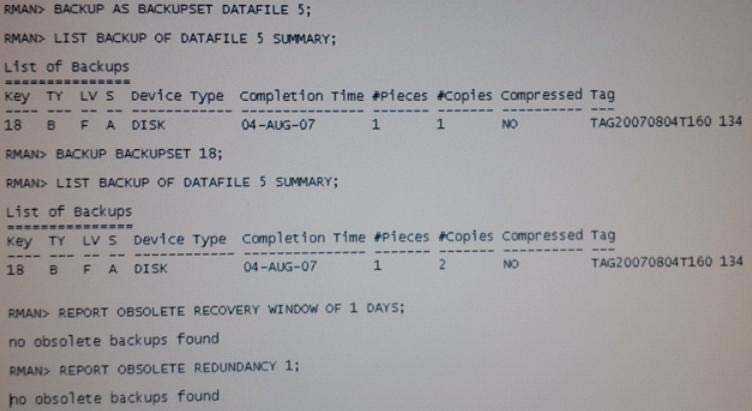
View the Exhibit and examine the RMAN commands.
Which statement describes the effect of a backup retention policy on the backup of a backup set?
AEither all the copies of a backup set are obsolete or none of them are as per the retention policy.
BThe copies of the backup will be reported as obsolete under a redundancy-based backup retention policy.
CThe copies of the backup will be reported as obsolete under a recovery window-based backup retentionpolicy.
DAll the copies of the backup set are counted as one instance of a backup and will deleted in backup setexceeds the redundancy-based backup retention policy.
Which four resources can directives be specified by using the Oracle Resource Manager?
ACPU usage
Bdegree of parallelism
Cnumber of open cursors
Dnumber of sorts performed
Eidle time for blocking sessions
Fnumber of I/Os requests
You are using the control file to maintain information about the database backups that are being performed by Recovery Manager (RMAN).
Identify two scenarios in which you must have a recovery catalog.
ATo store the backup information of multiple database
BTo restrict the amount of space that is used by the backups
CTo maintain a backup for a certain time is set by the CONTROL_FILE_RECORD_KEEP_TIME parameter.
DTo list the data files that were in a target database at a given time by using the AT option of REPORTSCHEMA command.
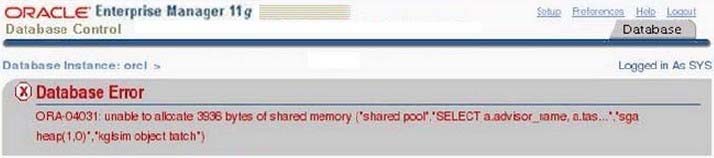
View the Exhibit to observe the error.
You receive this error regularly and have to shutdown the database instance to overcome the error. AutomaticShared Memory Management is configured for the instance.
What can you do to reduce the chance of this error in the future?
AIncrease the value of SGA_MAX_SIZE
BEnable automatic memory management
CSet the PRE_PAGE_SGA parameter to true
DLock the System Global Area (SGA) in memory
Which are the two prerequisites before setting up Flashback Data Archive? (Choose two.)
AFlash recovery area must be defined
BUndo retention guarantee must be enabled.
CDatabase must be running in archivelog mode.
DAutomatic undo management must be enabled.
EThe tablespace in which the Flashback Data Archive is created must have automatic segment spaceManagement (ASSM).
Given below are RMAN commands to enable backup optimization and set the retention policy:
RMAN> CONFIGURE DEFAULT DEVICE TYPE TO sbt;
RMAN> CONFIGURE BACKUP OPTIMIZATION ON;
RMAN> CONFIGURE RETENTION POLICY TO REDUNDANCY 2;
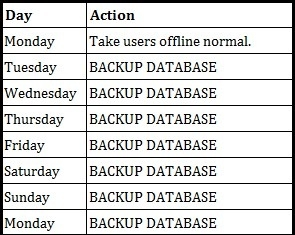
The USERS tablespace has never been backed up. You take the USERS tablespace offline on Monday. Viewthe Exhibit to examine the operations performed by using RMAN.
Which two statements are true about the backup of the USERS tablespace? (Choose two.)
AIt will be backed up as a part of database backup on Friday.
BIt will be backed up as a part of database backup on Tuesday.
CIt will not be backed up as a part of database backup on Wednesday.
DThe command on Sunday deletes the backup of the USERS tablespace taken on Tuesday.
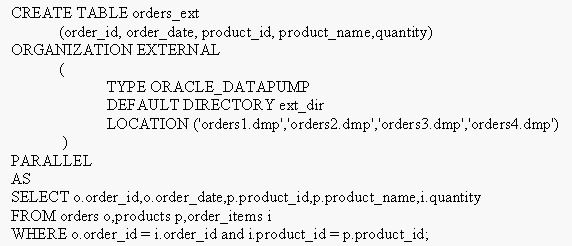
View the Exhibit.
You must unload data from the ORDERS, ORDER_ITEMS, and products database tables to four files using the External Table Population method.
You execute the command shown on the exhibit, but only two files have been created.
Which parameter must be changed so that four files are created?
ATYPE
BLOCATION
CPARALLEL
DDEFAULT DIRECTORY
EORGANIZATION EXTERNAL
Which option must you configure while performing an automated Tablespace Point-in-Time Recovery (TSPITR) by using Recovery Manager (RMAN)?
ANew channels for restore and recovery tasks
BNew name for the data files of the tablespace
CAuxiliary name for the data files of the tablespace
DAuxiliary destinations for an auxiliary set of data files
Which three statements are true about windows?
AOnly one window can be open at any given time
BConsumer groups are associated with windows
CWindows work with job classes to control resource allocation
DThe database service name must be provided during windows creation
EWindows can automatically start job or change resource allocation among jobs for various time periods.
Note the following statements that use flashback technology:
FLASHBACK TABLE <table> TO SCN <scn>;
SELECT * FROM <table> AS OF SCN 123456;
FLASHBACK TABLE <table> TO BEFORE DROP;
FLASHBACK DATABASE TO TIMESTAMP <timestamp>;
SELECT * FROM <table> VERSIONS AS OF SCN 123456 AND 123999;
Which of these statements will be dependent on the availability of relevant undo data in the undo segment?
A1, 2, and 5
B1, 3, and 4
C2, 3, 4, and 5
D1, 2, 3, 4, and 5
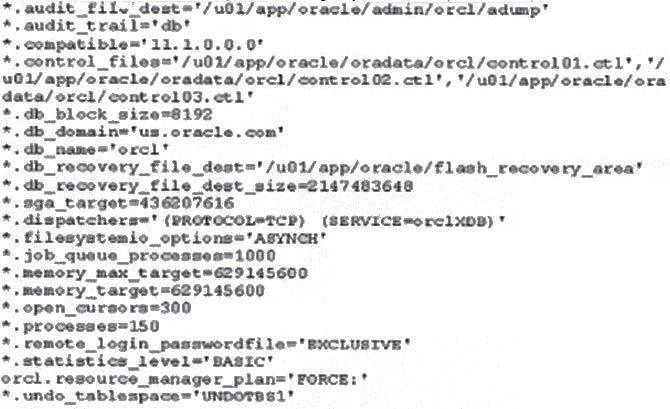
View the Exhibit and examine the parameter settings in your server-side parameter file (SPFILE). When you tried to start the database instance, you received the following error:
SQL> startup -
ORA-00824: cannot set SGA_TARGET or MEMORY_TARGET due to existing internal settings, see alert log for more information
Why did the instance fail to start?
Exhibit:
ABecause the PGA_AGGREGATE_TARGET parameter is not set
BBecause the STATISTICS_LEVEL parameter is set to BASIC
CBecause MEMORY_TARGET and MEMORY_MAX_TARGET cannot be equal
DBecause both the SGA_TARGET and MEMORY_TARGET parameters are set.
Which two statements are true regarding an Automatic Storage Management (ASM) instance? (Choose two.)
AAn ASM instance mounts an ASM control file
BAn ASM instance uses the ASMB process for rebalancing of disks within a disk group
CAutomatic Memory Management is enabled in an ASM instance even when the MEMORY_TARGET parameters not set explicitly
DAn RDBMS instance gets connected to an ASM instance using ASMB as a foreground process when the database instance is started

 Preview