An administrator must expand an AHV-based cluster running on Nutanix G5 hardware by adding a new Nutanix G7 system. The cluster runs AOS 5.10, but the cluster-expansion operation fails. AOS is running on the new system, and node discovery succeeds without issues.
Why does the operation fail?
AAOS version running on G7 is older than the version on the cluster.
BFoundation software has not been updated on the cluster.
CG7 hardware cannot be added to a G5 cluster.
DEVC needs to be configured before cluster expansion
0
Community Discussion
No comments yet. Be the first to start the discussion!
While creating an image placement policy on the organization's AOS 5.15-based Nutanix cluster, the administrator wants to ensure that using the selected images on clusters outside the identified set is unrestricted. Which Policy Enforcement type must the administrator select?
ASoft
BInternal
CHard
DExternal
0
Community Discussion
No comments yet. Be the first to start the discussion!
An administrator receives reports of poor VDI desktop performance in an 8-node Nutanix VDI environment. Applications take between 1 and 2 minutes to open. During the investigation, the following conditions are identified:
Cluster memory utilization: 80%
Cluster SSD utilization: 70%
Average VM CPU Wait Time: 11%
CVM CPU utilization: 75%
Which action should be taken to improve VDI performance?
AIncrease the amount of SSD storage in the cluster.
BAdd memory to the nodes in the cluster.
CAdd CPU resources to the cluster.
DIncrease the number of vCPU cores allocated to the CVM.
0
Community Discussion
No comments yet. Be the first to start the discussion!
Save question
0
Community Discussion
No comments yet. Be the first to start the discussion!
Save question
0
Community Discussion
No comments yet. Be the first to start the discussion!
Save question
0
Community Discussion
No comments yet. Be the first to start the discussion!
Save question
0
Community Discussion
No comments yet. Be the first to start the discussion!
Save question
0
Community Discussion
No comments yet. Be the first to start the discussion!
Save question
0
Community Discussion
No comments yet. Be the first to start the discussion!
Save question
0
Community Discussion
No comments yet. Be the first to start the discussion!
Save question
0
Community Discussion
No comments yet. Be the first to start the discussion!
Save question
0
Community Discussion
No comments yet. Be the first to start the discussion!
Save question
0
Community Discussion
No comments yet. Be the first to start the discussion!
Save question
0
Community Discussion
No comments yet. Be the first to start the discussion!
Save question
0
Community Discussion
No comments yet. Be the first to start the discussion!
Save question
0
Community Discussion
No comments yet. Be the first to start the discussion!
Save question
0
Community Discussion
No comments yet. Be the first to start the discussion!
Save question
0
Community Discussion
No comments yet. Be the first to start the discussion!
Save question
0
Community Discussion
No comments yet. Be the first to start the discussion!
Save question
0
Community Discussion
No comments yet. Be the first to start the discussion!
Save question
0
Community Discussion
No comments yet. Be the first to start the discussion!
An administrator knows the disks in a cluster are outdated and that new firmware is available. For security reasons, these clusters do not have Internet access.
Which two steps must be completed to update the firmware?
Choose two
AConfigure LCM with a URL to access the firmware bundle.
BDownload a dark site bundle and stage it on an internal webserver.
CDownload the updated firmware .tgz file from the Nutanix portal.
DSelect Upgrade Software, then select disks and upload the updated firmware.
A CEO asks the IT administrator for a list of resources required to protect the current workloads and the two new SQL servers from a disaster. The Nutanix environment is managed through Prism Central.
Which option describes how to fulfill the CEO’s request?
ACreate a new Recovery policy by selecting the VM that needs to be protected and get hardware requirements.
BIn Capacity Runway, select Optimize Resources and select all VMs that must be protected.
CCreate a new project and assign the VMs to it to get compute and storage requirements.
DCreate a new scenario based on a new cluster based on a VM Profile and select Recommend.
An administrator plans to deploy a Nutanix cluster to support a small number of high-performance VMs. The deployment has these considerations:
Individual VMs will probably generate network throughput of 90–100 Mbps.
Because of the VM configuration, a node is unlikely to host more than one or two of them at a time.
Individual VMs will communicate with only a few—one or two—remote hosts at a time.
Multicast will not be used in the environment.
The hosts are connected through two 1GbE network connections.
How should the administrator configure the network bonds to satisfy this requirement while keeping the switch configuration as simple as possible?
AConfigure bond0 as balance-sib
BConfigure bond0 as active-backup
CConfigure bond0 as balance-tcp
DConfigure bond0 as balance-lacp
A customer requires a DR solution that meets the following requirements:
There is 8 ms of latency between Sites A and B.
The administrator requires the shortest possible RPO/RTO.
Application-consistent snapshots are required.
Nutanix VSS must be used.
Which Data Protection Method should be used?
AAsync
BMetro Availability
CNear Sync
DCloud Connect
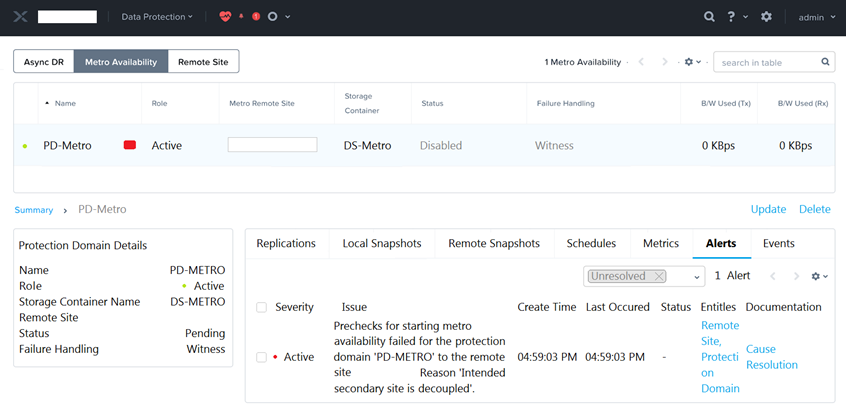
Refer to the exhibit.
An administrator observes a critical alert on the Metro Availability Protection Domain.
What is the cause of this alert?
AVMware Site Recovery Manager is handling a failover event.
BvSphere moved VMs to the remote container, and the VMs must be moved back.
CMetro Availability did not fail over and caused an outage.
DMetro Availability Protection domain is active on the remote site.
An administrator is notified that storage in a Nutanix cluster is unavailable. The cluster has five nodes and is configured with a Fault-Tolerance level of 1 (FT-1).
During the investigation, the administrator determines the following:
All AHV hosts are powered on, and the CVMs are running.
Nodes A, B, and C connect to one top-of-rack switch.
Nodes D and E connect to a second top-of-rack switch.
The cluster status command run on Node A indicates that CVM services on Nodes D and E are down.
Which issue is causing the storage outage?
AThe default gateway for the CVMs and AHV hosts is down.
BThe switch connecting Nodes D and E is down.
CThe genesis process is down on both Nodes D and E.
DNodes D and E are in maintenance mode.
An administrator configures authentication in Prism Central (PC) for the NTNX-Admins group. Users report that they are unable to log in, even though the administrator confirms that the Active Directory (AD) settings in PC are correct.
Which condition could result in this behavior?
AA role mapping needs to be associated with the AD group.
BThe users must be added to the Domain Admins AD group.
CThe Local authentication type must also be selected in PC.
DA client chap certificate must also be added in PC.
An administrator identifies several slow VMs. While investigating the issue, the administrator observes that the slow VMs have high CPU Ready Time.
Which definition of CPU Ready Time is accurate?
AThe ratio of VM wait time to the total CPU time allotted to the VM in percentage
BThe ratio of VM idle time to the total CPU time allotted to the VM in percentage
CThe ratio of VM run time to the total CPU time allotted to the VM in percentage
DThe ratio of VM swap time to the total CPU time allotted to the VM in percentage
An administrator discovers that certain security settings in a cluster have been modified. The environment no longer complies with the required policies.
Which function should be used to restore settings that have changed from their defaults and prevent additional violations?
ACluster Lockdown with strong password enforcement
DDefense Information Systems Agency STIG enforcement
An administrator is deploying an application that needs maximum I/O throughput for scratch data. The administrator is concerned that the required throughput exceeds what a single cluster node can provide. What should the administrator do to satisfy this requirement?
ACreate a volume group with several virtual disks and attach to the VM
BCreate a volume group with one virtual disk attached to the VM
CCreate a virtual disk attached to the VM's PCI interface
DCreate several virtual disks attached to the VM's virtual SCSI controller
A three-node cluster contains a Nutanix Files instance with three FSVMs.
What occurs after a node failure?
AThe affected FSVM will get live-migrated to another node.
BThe affected FSVM will not be restarted on another node due to its agent VM setting.
CThe affected FSVM will not be restarted on another node due to its VM-to-VM anti-affinity settings.
DThe affected FSVM will be restarted on another node.
An administrator is concerned that Prism could become inaccessible if Active Directory cannot process logins. Which method should the administrator use to access the cluster during this type of outage?
AManage the cluster by using the "nutanix" user on the Prism leader CVM
BCreate and use an emergency local account on the cluster
CDeploy an Active Directory server locally on the cluster
DManage the cluster remotely by downloading ncli to a remote workstation
An administrator has a VM that consumes a large amount of storage and has these characteristics:
It creates large, sequential writes.
Its data must be retained for years.
The data is normally accessed only at the end of each year to run a report.
The administrator decides to use Erasure Coding to conserve space. Which feature should the administrator use to save space for this VM?
AInline Compression
BFlash Mode
CCache Dedup
DPost-Process Compression
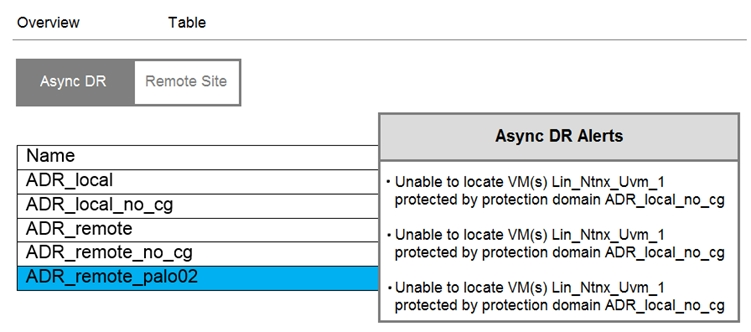
Refer to the exhibit.
After converting a cluster from ESXi to AHV, the alerts shown in the exhibit appear in Prism. What should the administrator do to resolve the issue efficiently?
ARemove the VMs. create a new Protection Domain, and add VMs to it.
BRemove VMs from the Protection Domain and add them back in.
CDelete the Protection Domain, create a new Protection Domain, and add the VMs to it.
DCreate a new Protection Domain and add the VMs to rt.
An administrator has an existing seven-node Nutanix cluster operating at RF2 that must be changed to provide the following capabilities:
RF3 configured for the cluster
Performance-tier deduplication
What is the minimum CVM memory required to support these capabilities?
A24GB
B28GB
C32GB
D20GB
An administrator has recently added VLAN 205 CRM in Prism Element. Workloads connected to the associated NICs cannot establish network connectivity.
Which Layer 2 protocol lets the administrator troubleshoot this issue from Prism Element?
AHDLC
BSUP
CLACP
DLLDP
Refer to the exhibit.
A Nutanix host is connected as illustrated, with br0-up configured for active/backup. Physical Switch 1 has a power outage, causing br0-up to fail over to eth2. The CVM and host become inaccessible. User VMs restart on other hosts in the cluster, disrupting those VMs.
Which configuration issue most likely caused this outage?
AThe CVM should have eth1 connected to the OVS.
BBridge br0-up should be configured to use balance-tcp rather than active/backup.
CThe user VMs only have one NIC.
DThe upstream port for eth2 is missing a VLAN.
A Nutanix cluster is deployed with the following configuration:
Three four-node blocks: A, B, and C
All Flash Redundancy Factor 2
What is the impact of simultaneous disk failures on two nodes in block A?
AVMs are migrated of the nodes with disk failures.
BEach node with a failed disk is marked as degraded.
CVM read and write operations continue normally.
DVMs on the nodes with failed disks are unable to write data
A VM lacks enough resources to meet demand, resulting in performance bottlenecks. Based on the previous 30 days, the VM shows one or more of these baseline values:
CPU usage > 90% (moderate), 95% (high)
CPU ready time > 5%, 10%
Memory usage > 90%, 95%
Memory swap rate > 0 Kbps (no moderate value)
Which VM type is being described?
AConstrained VM
BBully VM
CInactive VM
DOver-provisioned VM
An administrator removes a large quantity of data from a Volume Group presented to a Linux VM. The administrator observes that the removed data has not been reclaimed as available storage.
Which action should be taken to reclaim the storage capacity?
AShrink the Volume Group that is associated with the Linux VM
BUnmount the Volume Group and then Remount the Volume Group
CEnable the unman operation on the Linux VMD. Run Defrag on the Linux VM
Community Discussion