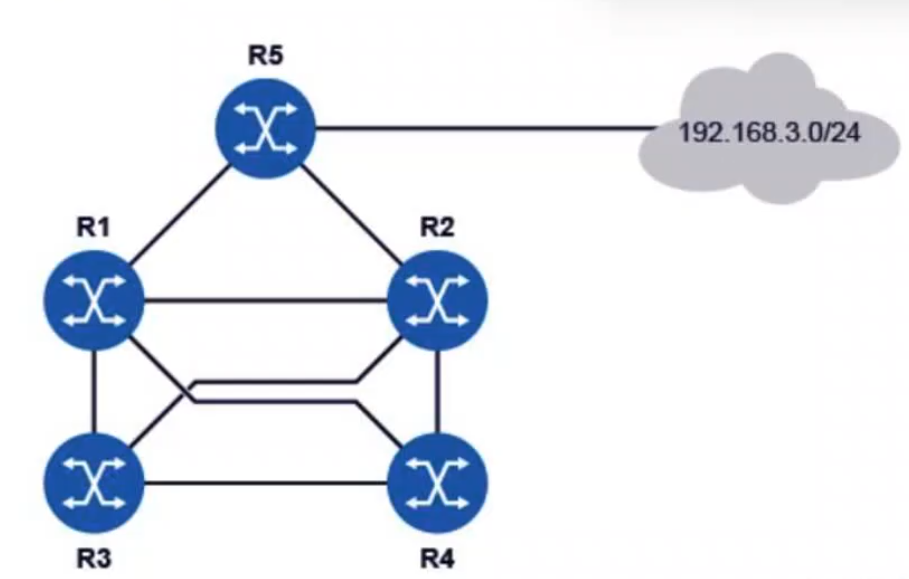
All routers in the diagram are running an interior gateway protocol (IGP) and have been configured with an ECMP value of 4. Router R5 advertises the prefix 192.168.3.0/24 using the IGP. Assuming all links have the same cost, how many entries for prefix 192.168.3.0/24 will be in router R3’s routing table?
A1
B2
C3
D4
0
Question 2
Introduction to Security
0
Question 3
Introduction to Security
0
Question 4
SR OS Data Plane Security
0
Question 5
Introduction to Security
0
That's the end of the Preview
This exam has 59 community-verified practice questions. Create a free account to access all questions, comments, and explanations.
Topics covered:
Introduction to SecuritySR OS Management Plane SecuritySR OS Control Plane SecuritySR OS Data Plane Security
Which of the following is a valid alternative representation of the IPv6 address
2001:0da8:0000:0000:0024:0000:4ab9:0300?
A2001:0da8::0024:0000:4ab9:03
B2001:da8::0:24::4ab9:300
C2001:da8::24::4ab9:300
D2001:da8::24:0:4ab9:300
Static routing is to be used in a network between a corporate head office and a branch office. The head office has many connected subnetworks, whereas the branch office has one subnetwork and a single connection to the head office. Which of the following is the most likely configuration on the head office and branch office routers?
AThe head office has a default route and the branch office has a specific static route.
BThe head office and the branch offices both have specific static routes.
CThe head office and the branch office both have default routes.
DThe head office has a specific static route and the branch office has a default route.
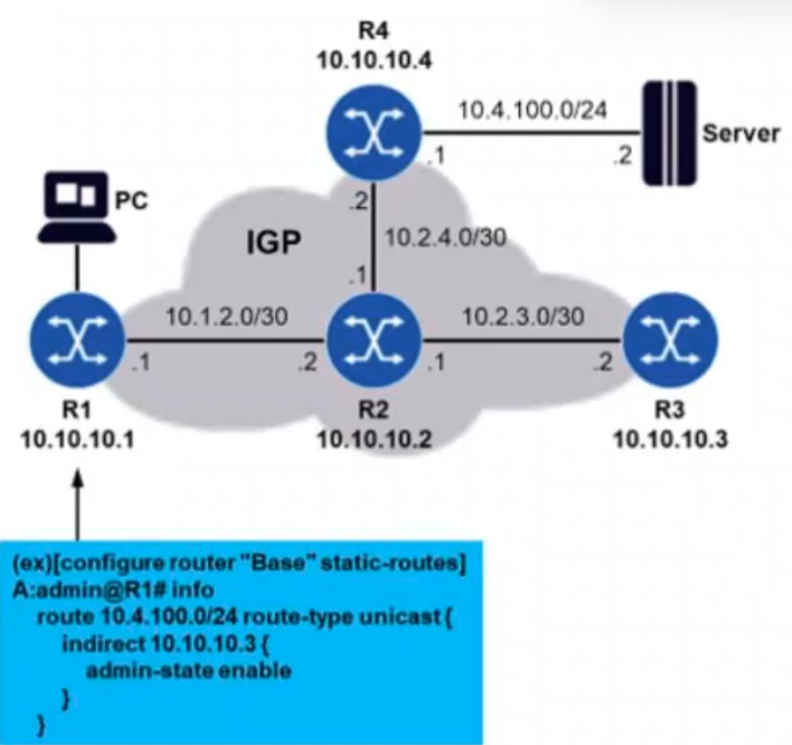
Routers R1 through R4 are running an IGP in such a way that they have each other’s system IP addresses in their routing tables. A static route is configured on router R1 so that it can reach subnetwork 10.4.100.0/24. The network administrator decides to use an indirect static route, as shown in the diagram. However, pinging the server from router R1 fails. What may be the problem in this case?
ARouter R1 drops the echo request because address 10.10.10.3 does not belong to an adjacent router.
BRouter R2 drops the echo request because it does not have subnet 10.4.100.0/24 in its routing table.
CRouter R3 drops the echo request because it does not have subnet 10.4.100.0/24 in its routing table.
DThe echo request arrives at the server but there is no path for the echo response to return to router R1.
In the diagram, all routers are using IS-IS as their routing protocol. The number next to each link is its metric value.
What path will traffic follow from router R6 to router R3, and from router R3 to router R6?
ARouter R6 to router R3 will follow (R6-R5-R2-R3). Router R3 to router R6 will follow (R3-R2-R5-R6).
BRouter R6 to router R3 will follow (R6-R5-R2-R3). Router R3 to router R6 will follow (R3-R4-R2-R5-R6).
CRouter R6 to router R3 will follow (R6-R5-R2-R3). Router R3 to router R6 will follow (R3-R4-R7-R5-R6).
DRouter R6 to router R3 will follow (R6-R5-R7-R4-R3). Router R3 to router R6 will follow (R3-R4-R7-R5-R6).
Question 6
Introduction to Security
0
Question 7
SR OS Control Plane Security
Question 8
SR OS Control Plane Security
Question 9
Introduction to Security
Question 10
SR OS Control Plane Security
Question 11
SR OS Control Plane Security
Question 12
SR OS Control Plane Security
Question 13
Introduction to Security
Question 14
SR OS Data Plane Security
Question 15
Introduction to Security
Question 16
SR OS Control Plane Security
Question 17
SR OS Control Plane Security
Question 18
SR OS Control Plane Security
Question 19
SR OS Control Plane Security
Question 20
SR OS Data Plane Security
Question 21
SR OS Control Plane Security
Question 22
SR OS Control Plane Security
Question 23
SR OS Data Plane Security
Question 24
SR OS Control Plane Security
Ask AstroTutor
0
Ask AstroTutor
0
Ask AstroTutor
0
Ask AstroTutor
0
Ask AstroTutor
0
Ask AstroTutor
0
Ask AstroTutor
0
Ad
Want a break from the ads?
Become a Supporter and enjoy a completely ad-free experience, plus unlock Learn Mode, Exam Mode, AstroTutor AI, and more.
Ask AstroTutor
0
Ask AstroTutor
0
Ask AstroTutor
0
Ask AstroTutor
0
Ask AstroTutor
0
Ask AstroTutor
0
Ask AstroTutor
0
Ask AstroTutor
0
Ask AstroTutor
0
Ask AstroTutor
0
Ask AstroTutor
0
In the diagram, all routers are using IS-IS as their routing protocol. The number next to each link is its metric value.
What path will traffic follow from router R1 to router R7, and from router R7 to router R1?
ARouter R1 to router R7 will follow (R1-R2-R4-R6-R7). Router R7 to router R1 will follow (R7-R6-R4-R2-R1).
BRouter R1 to router R7 will follow (R1-R2-R4-R6-R7). Router R7 to router R1 will follow (R7-R6-R5-R3-R1).
CRouter R1 to router R7 will follow (R1-R3-R5-R6-R7). Router R7 to router R1 will follow (R7-R6-R4-R2-R1).
DRouter R1 to router R7 will follow (R1-R3-R5-R6-R7). Router R7 to router R1 will follow (R7-R6-R5-R3-R1).
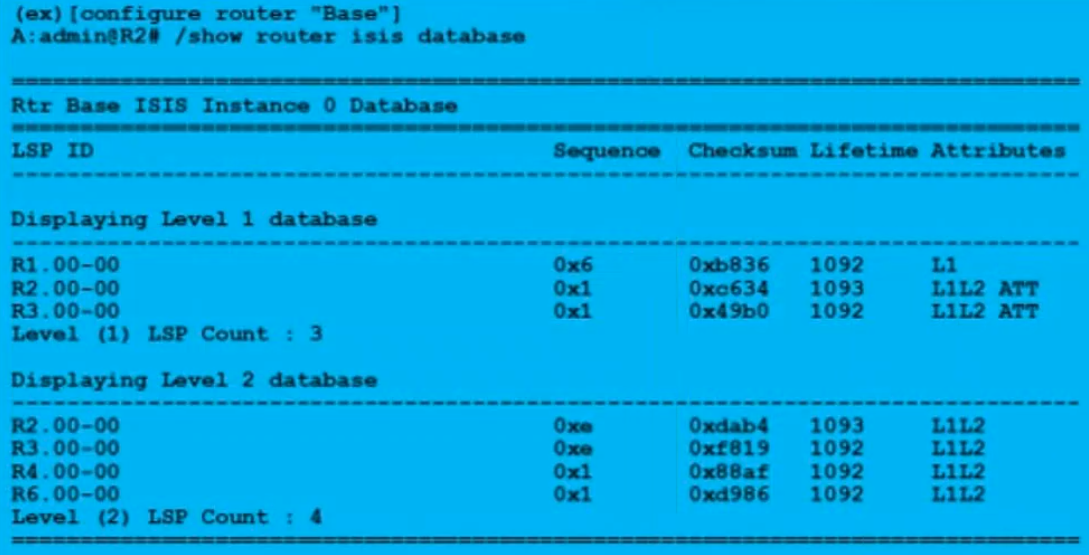
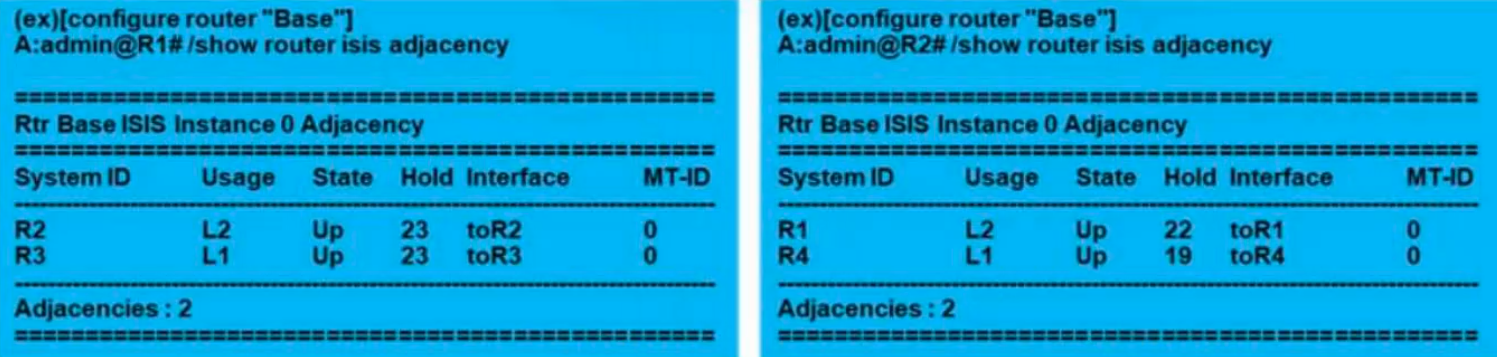
Which of the following statements best describes the IS-IS domain to which the command output corresponds?
ASingle-area IS-IS domain with no broadcast interfaces.
BMulti-area IS-IS domain with no broadcast interfaces.
CSingle-area IS-IS domain with broadcast interfaces.
DMulti-area IS-IS domain with broadcast interfaces.
There are several differences between IS-IS Hello packets used on broadcast interfaces and on point-to-point interfaces.
Which of the following statements is FALSE?
AOn broadcast interfaces there are different Hello packet types for level-1 and level-2 adjacencies, whereas on point-to-point interfaces there is a single Hello packet type.
BThe multicast MAC addresses to which the Hello messages are sent are different on broadcast interfaces and on point-to-point interfaces.
CThe neighbors are identified using their interface MAC addresses on broadcast Hello messages and using their system IDs on point-to-point Hello messages.
DBroadcast Hello messages identify the elected designed IS (DIS) and point-to-point Hello messages do not.
For a link-state routing protocol, which of the following statements about link-state updates is FALSE?
AWhen a link-state update reaches its maximum age on a router, the router will flood that update to its neighbors.
BWhen a router detects that a link-state update has reached its maximum age, it will request a new update from the source router.
CAging helps ensure that routers that are no longer part of the topology will eventually get removed from the link-state database.
DThe age value is updated as the link-state update is flooded throughout the network and when it is in the link-state database
Routers R1, R2, R3, and R4 are running IS-IS. Assuming all interfaces are added to IS-IS as point-to-point and no commands are issued at the interface level to restrict adjacencies, which of the following statements is TRUE?
ARouters R1 and R2 are L2 routers. Routers R3 and R4 are L1 routers.
BRouters R1 and R2 are L2 routers. Routers R3 and R4 are L1/L2 routers.
CRouters R1 and R2 are L1/L2 routers. Routers R3 and R4 are L1 routers.
DAll four routers are L1/L2.
Which of the following is NOT a function of the control plane a router?
ATo exchange signaling messages with other routers.
BTo determine the best way to forward packets.
CTo establish routing paths to deliver packets from source to destination and to reestablish them in case of failure.
DTo utilize the forwarding tables to forward data packets towards their destination.
When using IS-IS in native mode for routing in a dual-stack IPv4/IPv6 environment, which of the following statements is FALSE?
AAll links are assumed to be IPv4- and IPv6-capable.
BThe same topology information is used to calculate the shortest path tree for both IPv4 and IPv6.
CIn a multi-area environment, the SPF algorithm needs to be run four times on each L1/L2 router.
DIt may lead to traffic black-holing if not properly designed.
Which of the following statements regarding the databases used by a link-state routing protocol in a single-are routing domain is FALSE?
AThe link-state database has the local topology and IP reachability information advertised by all the routers.
BThe adjacency database contains information about all the links interconnecting the domain’s routers.
CThe forwarding database contains the optimum next hop for each known prefix.
DThe link-state database is the same for all routers.
What is the replacement for ARP in IPv6?
ADuplicate address detection procedures.
BRouter discovery procedures.
CNeighbor discovery procedures.
DStateless address auto-configuration procedures.
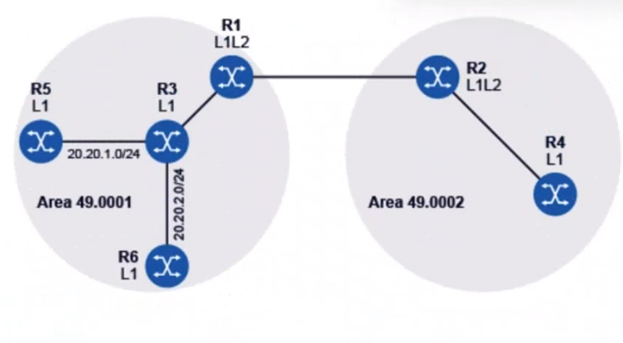
In the IS-IS network shown, router R1 has been configured to summarize subnetworks 20.20.1.0/24 and 20.20.2.0/24 as 20.20.0.0/16. Which routers’ routing tables will be reduced, compared to their routing tables before the summarization?
ARouter R1
BRouter R2
CRouters R1 and R2
DRouters R2 and R4
Which of the following is NOT a required configuration step to successfully run IS-IS on a router?
AThe router needs to be associated with an IS-IS area ID.
BLayer-3 interfaces that will participate in IS-IS need to be identified.
CA reference bandwidth needs to be configured to calculate link costs.
DThe IS-IS context needs to be enabled.
Routers R1 through R4 in the diagram have established IS-IS adjacencies. Router R1 is L1/L2 and is the DIS of its two broadcast interfaces. How many LSPs will it generate?
A2
B3
C4
D5
An IS-IS router receives a CSNP that references an older LSP than the one in its local database. What action is taken?
AThe router sends a copy of the referenced LSP from its database to its neighbor.
BThe router sends a CSNP to its neighbor describing the newer LSPs in its database.
CThe router updates its database with the new sequence number and floods a copy of the LSP to its other neighbors.
DThe router sends a PSNP to its neighbor to request a copy of the LSP.
Two IS-IS routers are exchanging Hello packets. One is configured to use authentication and the other is not. Which of the following statements is TRUE?
AAn adjacency will be established with authentication using the default parameters defined for IS-IS routers.
BThe two routers will negotiate the authentication parameters and the establish an adjacency.
CAn adjacency will be established without authentication.
DAn adjacency will not be established.
Which component of the Nokia 7750 SR is in charge of performing the longest prefix match lookup on packets that arrive on the physical interfaces?
AControl Processing Module (CMP)
BMedia Dependent Adapter (MDA)
CSwitch Fabric (SF)
DInput/Output Module (IOM)
A router is trying to establish an IS-IS adjacency with the DIS on a broadcast link. What event causes the adjacency to change from “Initializing” to “UP”?
AReceiving a Hello packet from the DIS that contains the local router’s own MAC address in the neighbor list.
BReceiving the first CSNP packet from the DIS that lists the LSPs in the DIS’s link-state database.
CReceiving a CSNP packet from the DIS acknowledging the last transmitted LSP.
DReceiving the last LSP requested from the DIS.
Which of the following definitions best describes route redistribution?
AIt is the process of deciding at line-rate speed which packets will be dropped and which ones will be forwarded.
BIt is the process of redirecting packets to be processed by an intermediate network function before allowing them to be forwarded to their intended final destination.
CIt is the process of passing routing information from one routing domain to another, which usually means from one routing protocol to another.
DIt is the process of controlling which route advertisements received from routing peers are accepted and/or deciding which locally known prefixes are advertised to routing peers.
Which of the following statements about router interfaces on a Nokia 7750 SR is FALSE?
AThey can be used in pairs on the same subnet for redundancy.
BThey can be assigned IPv4 and/or IPv6 addresses.
CThey can be logical or physical.
DThe system interface exists by default.
When a router performs the SPF calculation, which router is used as the root of the shortest path tree?