Loading provider exams...
Sign Up & unlock 100% of Exam Questions
No Strings Attached!
Updated
You have an Azure SQL database.
You deploy Data API builder (DAB) to Azure Container Apps by using the mcr.microsoft.com/azure-databases/data-api-builder:latest image.
You have the following Container Apps secrets:
MSSQL_CONNECTION_STRING that maps to the SQL connection string
DAB_CONFIG_BASE64 that maps to the DAB configuration
You need to initialize the DAB configuration to read the SQL connection string.
Which command should you run?
This exam has 59 community-verified practice questions. Create a free account to access all questions, comments, and explanations.
Log In / Sign UpYou have a SQL database in Microsoft Fabric that contains a nvarchar (max) column named MessageText. An ID is always contained within the first paragraph of MessageText.
You need to write a Transact-SQL query that uses REGEXP_SUBSTR to extract the ID from MessageText.
What should you include in the query?
You have an Azure SQL database that contains database-level Data Definition Language (DDL) triggers, including a trigger named ddl_Audit.
You need to prevent ddl_Audit from firing during the next deployment. The trigger object must remain in place.
Which Transact-SQL statement should you use?
Your development team uses GitHub Copilot Chat in Microsoft SQL Server Management Studio (SSMS) to generate and run Transact-SQL queries against an Azure SQL database named DB1. DB1 contains tables that store sensitive customer data.
You need to ensure that any Transact-SQL queries that run from GitHub Copilot Chat in SSMS are restricted by the same permissions as the developer’s database login.
What prevents the GitHub Copilot Chat-run queries from accessing data beyond the developer’s access?
You have an Azure SQL database named AdventureWorksDB that contains a table named dbo.Employee.
You have a C# Azure Functions app that uses an HTTP-triggered function with an Azure SQL input binding to query dbo.Employee.
You are adding a second function that will react to row changes in dbo.Employee and write structured logs.
You need to configure AdventureWorksDB and the app to meet the following requirements:
Changes to dbo.Employee must trigger the new function within five seconds.
Each invocation must process no more than 100 changes.
Which two database configurations should you perform? Each correct answer presents part of the solution.
NOTE: Each correct selection is worth one point.
Want a break from the ads?
Become a Supporter and enjoy a completely ad-free experience, plus unlock Learn Mode, Exam Mode, AstroTutor AI, and more.
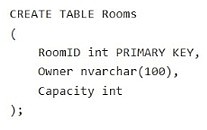
You have an Azure SQL database that contains a table named Rooms. Rooms was created by using the following Transact-SQL statement.

You discover that some records in the Rooms table contain NULL values for the Owner field.
You need to ensure that all future records have a value for the Owner field.
What should you add?
DRAG DROP -
You have a Microsoft SQL Server 2025 database that contains a table named dbo.CustomerMessages. dbo.CustomerMessages contains two columns named MessageID (int) and MessageRaw (nvarchar(max)).
MessageRaw can contain a phone number in multiple formats, and some rows do NOT contain a phone number.
You need to write a single SELECT query that meets the following requirements:
The query must return MessageID, RawNumber, DigitsOnly, and PhoneStatus.
RawNumber must contain the first substring that matches a phone-number pattern, or NULL if no match exists.
DigitsOnly must remove all non-digit characters from RawNumber, or return NULL.
PhoneStatus must return valid when a phone number exists in MessageRaw, otherwise return Missing.
How should you complete the Transact-SQL query? To answer, drag the appropriate values to the correct targets. Each value may be used once, more than once, or not at all. You may need to drag the split bar between panes or scroll to view content.
NOTE: Each correct selection is worth one point.

DRAG DROP -
You have a SQL database in Microsoft Fabric that contains a table named WebSite.Logs. WebSite.Logs stores application telemetry data. WebSite.Logs contains a nvarchar (max) column named log that stores JSON documents.
You have a daily report that filters by the $.severity JSON property and returns LogId, LogDateTime, and log. The report frequently causes full table scans.
You need to modify WebSite.Logs to support efficient filtering by $.severity and avoid key lookups for the columns returned by the report.
How should you complete the Transact-SQL code to avoid full table scans? To answer, drag the appropriate values to the correct targets. Each value may be used once, more than once, or not at all. You may need to drag the split bar between panes or scroll to view content.
NOTE: Each correct selection is worth one point.

Case Study -
This is a case study. Case studies are not timed separately. You can use as much exam time as you would like to complete each case. However, there may be additional case studies and sections on this exam. You must manage your time to ensure that you are able to complete all questions included on this exam in the time provided.
To answer the questions included in a case study, you will need to reference information that is provided in the case study. Case studies might contain exhibits and other resources that provide more information about the scenario that is described in the case study. Each question is independent of the other questions in this case study.
At the end of this case study, a review screen will appear. This screen allows you to review your answers and to make changes before you move to the next section of the exam. After you begin a new section, you cannot return to this section.
To start the case study -
To display the first question in this case study, click the Next button. Use the buttons in the left pane to explore the content of the case study before you answer the questions. Clicking these buttons displays information such as business requirements, existing environment and problem statements. If the case study has an All Information tab, note that the information displayed is identical to the information displayed on the subsequent tabs. When you are ready to answer a question, click the Question button to return to the question.
Existing Environment -
Azure Environment -
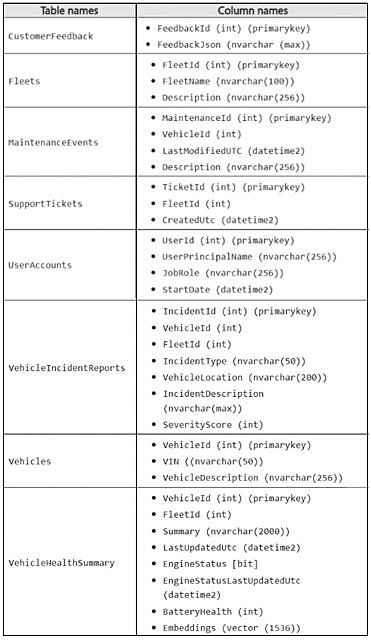
Contoso has an Azure subscription in North Europe that contains the corporate infrastructure. The current infrastructure contains a Microsoft SQL Server 2017 database. The database contains the following tables.

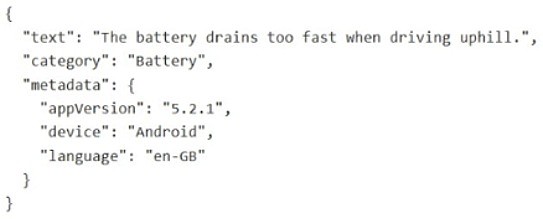
The FeedbackJson column has a full-text index and stores JSON documents in the following format.

The support staff at Contoso never has the UNMASK permission.
Problem Statements -
Contoso is deploying a new Azure SQL database that will become the authoritative data store for the following:
AI workloads -
Vector search -
Modernized API access -
Retrieval Augmented Generation (RAG) pipelines
Sometimes the ingestion pipeline fails due to malformed JSON and duplicate payloads.
The engineers at Contoso report that the following dashboard query runs slowly.

You review the execution plan and discover that the plan shows a clustered index scan.
VehicleIncidentReports often contains details about the weather, traffic conditions, and location. Analysts report that it is difficult to find similar incidents based on these details.
Requirements -
Planned Changes -
Contoso wants to modernize Fleet Intelligence Platform to support AI-powered semantic search over incident reports.
Security Requirements -
Contoso identifies the following security requirements:
Restrict the support staff from viewing Personally Identifiable Information (PII) data, which is full email addresses and phone numbers.
Enforce row-level filtering so that analysts see only incidents for the fleets to which they are assigned. The analysts can be assigned to multiple fleets.
Database Performance and Requirements
Contoso identifies the following telemetry requirements:
Telemetry data must be stored in a partitioned table.
Telemetry data must provide predictable performance for ingestion and retention operations. latitude, longitude, and accuracy JSON properties must be filtered by using an index seek.
Contoso identifies the following maintenance data requirements:
Ensure that any changes to a row in the MaintenanceEvents table updates the corresponding value in the LastModifiedUtc column to the time of the change.
Avoid recursive updates.
AI Search, Embeddings, and Vector Indexing
Contoso plans to implement semantic search over incident data to meet the following requirements:
Embeddings must be stored in dedicated Azure SQL Database tables.
Embeddings must be generated from rich natural language fields.
Chunking must preserve semantic coherence.
Hybrid search must combine the following:
Vector similarity -
Keyword filtering or boosting -
Development Requirements -
The development team at Contoso will use Microsoft Visual Studio Code and GitHub Copilot and will retrieve live metadata from the databases.
Contoso identifies the following requirements for querying data in the FeedbackJson column of the CustomerFeedback table:
Extract the customer feedback text from the JSON document.
Filter rows where the JSON text contains a keyword.
Calculate a fuzzy similarity score between the feedback text and a known issue description.
Order the results by similarity score, with the highest score first.
You need to recommend a solution to resolve the slow dashboard query issue.
What should you recommend?
Case Study -
This is a case study. Case studies are not timed separately. You can use as much exam time as you would like to complete each case. However, there may be additional case studies and sections on this exam. You must manage your time to ensure that you are able to complete all questions included on this exam in the time provided.
To answer the questions included in a case study, you will need to reference information that is provided in the case study. Case studies might contain exhibits and other resources that provide more information about the scenario that is described in the case study. Each question is independent of the other questions in this case study.
At the end of this case study, a review screen will appear. This screen allows you to review your answers and to make changes before you move to the next section of the exam. After you begin a new section, you cannot return to this section.
To start the case study -
To display the first question in this case study, click the Next button. Use the buttons in the left pane to explore the content of the case study before you answer the questions. Clicking these buttons displays information such as business requirements, existing environment and problem statements. If the case study has an All Information tab, note that the information displayed is identical to the information displayed on the subsequent tabs. When you are ready to answer a question, click the Question button to return to the question.
Existing Environment -
Azure Environment -
Contoso has an Azure subscription in North Europe that contains the corporate infrastructure. The current infrastructure contains a Microsoft SQL Server 2017 database. The database contains the following tables.

The FeedbackJson column has a full-text index and stores JSON documents in the following format.

The support staff at Contoso never has the UNMASK permission.
Problem Statements -
Contoso is deploying a new Azure SQL database that will become the authoritative data store for the following:
AI workloads -
Vector search -
Modernized API access -
Retrieval Augmented Generation (RAG) pipelines
Sometimes the ingestion pipeline fails due to malformed JSON and duplicate payloads.
The engineers at Contoso report that the following dashboard query runs slowly.

You review the execution plan and discover that the plan shows a clustered index scan.
VehicleIncidentReports often contains details about the weather, traffic conditions, and location. Analysts report that it is difficult to find similar incidents based on these details.
Requirements -
Planned Changes -
Contoso wants to modernize Fleet Intelligence Platform to support AI-powered semantic search over incident reports.
Security Requirements -
Contoso identifies the following security requirements:
Restrict the support staff from viewing Personally Identifiable Information (PII) data, which is full email addresses and phone numbers.
Enforce row-level filtering so that analysts see only incidents for the fleets to which they are assigned. The analysts can be assigned to multiple fleets.
Database Performance and Requirements
Contoso identifies the following telemetry requirements:
Telemetry data must be stored in a partitioned table.
Telemetry data must provide predictable performance for ingestion and retention operations. latitude, longitude, and accuracy JSON properties must be filtered by using an index seek.
Contoso identifies the following maintenance data requirements:
Ensure that any changes to a row in the MaintenanceEvents table updates the corresponding value in the LastModifiedUtc column to the time of the change.
Avoid recursive updates.
AI Search, Embeddings, and Vector Indexing
Contoso plans to implement semantic search over incident data to meet the following requirements:
Embeddings must be stored in dedicated Azure SQL Database tables.
Embeddings must be generated from rich natural language fields.
Chunking must preserve semantic coherence.
Hybrid search must combine the following:
Vector similarity -
Keyword filtering or boosting -
Development Requirements -
The development team at Contoso will use Microsoft Visual Studio Code and GitHub Copilot and will retrieve live metadata from the databases.
Contoso identifies the following requirements for querying data in the FeedbackJson column of the CustomerFeedback table:
Extract the customer feedback text from the JSON document.
Filter rows where the JSON text contains a keyword.
Calculate a fuzzy similarity score between the feedback text and a known issue description.
Order the results by similarity score, with the highest score first.
You need to recommend a solution that will resolve the ingestion pipeline failure issues.
Which two actions should you recommend? Each correct answer presents part of the solution.
NOTE: Each correct selection is worth one point.
You have an Azure SQL database named SalesDB that contains a table named dbo.Articles. dbo.Articles contains two million articles with embeddings. The articles are updated frequently throughout the day.
You query the embeddings by using VECTOR_SEARCH.
Users report that semantic search results do NOT reflect the updates until the following day.
You need to ensure that the embeddings are updated whenever the articles change. The solution must minimize CPU usage on SalesDB.
Which embedding maintenance method should you implement?
HOTSPOT -
Case Study -
This is a case study. Case studies are not timed separately. You can use as much exam time as you would like to complete each case. However, there may be additional case studies and sections on this exam. You must manage your time to ensure that you are able to complete all questions included on this exam in the time provided.
To answer the questions included in a case study, you will need to reference information that is provided in the case study. Case studies might contain exhibits and other resources that provide more information about the scenario that is described in the case study. Each question is independent of the other questions in this case study.
At the end of this case study, a review screen will appear. This screen allows you to review your answers and to make changes before you move to the next section of the exam. After you begin a new section, you cannot return to this section.
To start the case study -
To display the first question in this case study, click the Next button. Use the buttons in the left pane to explore the content of the case study before you answer the questions. Clicking these buttons displays information such as business requirements, existing environment and problem statements. If the case study has an All Information tab, note that the information displayed is identical to the information displayed on the subsequent tabs. When you are ready to answer a question, click the Question button to return to the question.
Existing Environment -
Azure Environment -
Contoso has an Azure subscription in North Europe that contains the corporate infrastructure. The current infrastructure contains a Microsoft SQL Server 2017 database. The database contains the following tables.

The FeedbackJson column has a full-text index and stores JSON documents in the following format.

The support staff at Contoso never has the UNMASK permission.
Problem Statements -
Contoso is deploying a new Azure SQL database that will become the authoritative data store for the following:
AI workloads -
Vector search -
Modernized API access -
Retrieval Augmented Generation (RAG) pipelines
Sometimes the ingestion pipeline fails due to malformed JSON and duplicate payloads.
The engineers at Contoso report that the following dashboard query runs slowly.

You review the execution plan and discover that the plan shows a clustered index scan.
VehicleIncidentReports often contains details about the weather, traffic conditions, and location. Analysts report that it is difficult to find similar incidents based on these details.
Requirements -
Planned Changes -
Contoso wants to modernize Fleet Intelligence Platform to support AI-powered semantic search over incident reports.
Security Requirements -
Contoso identifies the following security requirements:
Restrict the support staff from viewing Personally Identifiable Information (PII) data, which is full email addresses and phone numbers.
Enforce row-level filtering so that analysts see only incidents for the fleets to which they are assigned. The analysts can be assigned to multiple fleets.
Database Performance and Requirements
Contoso identifies the following telemetry requirements:
Telemetry data must be stored in a partitioned table.
Telemetry data must provide predictable performance for ingestion and retention operations. latitude, longitude, and accuracy JSON properties must be filtered by using an index seek.
Contoso identifies the following maintenance data requirements:
Ensure that any changes to a row in the MaintenanceEvents table updates the corresponding value in the LastModifiedUtc column to the time of the change.
Avoid recursive updates.
AI Search, Embeddings, and Vector Indexing
Contoso plans to implement semantic search over incident data to meet the following requirements:
Embeddings must be stored in dedicated Azure SQL Database tables.
Embeddings must be generated from rich natural language fields.
Chunking must preserve semantic coherence.
Hybrid search must combine the following:
Vector similarity -
Keyword filtering or boosting -
Development Requirements -
The development team at Contoso will use Microsoft Visual Studio Code and GitHub Copilot and will retrieve live metadata from the databases.
Contoso identifies the following requirements for querying data in the FeedbackJson column of the CustomerFeedback table:
Extract the customer feedback text from the JSON document.
Filter rows where the JSON text contains a keyword.
Calculate a fuzzy similarity score between the feedback text and a known issue description.
Order the results by similarity score, with the highest score first.
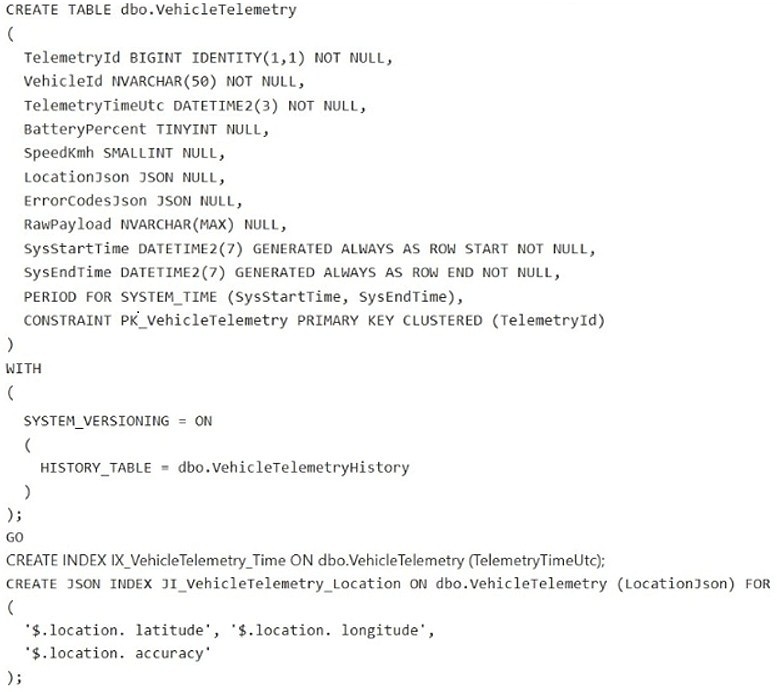
You need to create a table in the database to store the telemetry data.
You have the following Transact-SQL code.

For each of the following statements, select Yes if the statement is true. Otherwise, select No.
NOTE: Each correct selection is worth one point.

HOTSPOT -
Case Study -
This is a case study. Case studies are not timed separately. You can use as much exam time as you would like to complete each case. However, there may be additional case studies and sections on this exam. You must manage your time to ensure that you are able to complete all questions included on this exam in the time provided.
To answer the questions included in a case study, you will need to reference information that is provided in the case study. Case studies might contain exhibits and other resources that provide more information about the scenario that is described in the case study. Each question is independent of the other questions in this case study.
At the end of this case study, a review screen will appear. This screen allows you to review your answers and to make changes before you move to the next section of the exam. After you begin a new section, you cannot return to this section.
To start the case study -
To display the first question in this case study, click the Next button. Use the buttons in the left pane to explore the content of the case study before you answer the questions. Clicking these buttons displays information such as business requirements, existing environment and problem statements. If the case study has an All Information tab, note that the information displayed is identical to the information displayed on the subsequent tabs. When you are ready to answer a question, click the Question button to return to the question.
Existing Environment -
Azure Environment -
Contoso has an Azure subscription in North Europe that contains the corporate infrastructure. The current infrastructure contains a Microsoft SQL Server 2017 database. The database contains the following tables.

The FeedbackJson column has a full-text index and stores JSON documents in the following format.

The support staff at Contoso never has the UNMASK permission.
Problem Statements -
Contoso is deploying a new Azure SQL database that will become the authoritative data store for the following:
AI workloads -
Vector search -
Modernized API access -
Retrieval Augmented Generation (RAG) pipelines
Sometimes the ingestion pipeline fails due to malformed JSON and duplicate payloads.
The engineers at Contoso report that the following dashboard query runs slowly.

You review the execution plan and discover that the plan shows a clustered index scan.
VehicleIncidentReports often contains details about the weather, traffic conditions, and location. Analysts report that it is difficult to find similar incidents based on these details.
Requirements -
Planned Changes -
Contoso wants to modernize Fleet Intelligence Platform to support AI-powered semantic search over incident reports.
Security Requirements -
Contoso identifies the following security requirements:
Restrict the support staff from viewing Personally Identifiable Information (PII) data, which is full email addresses and phone numbers.
Enforce row-level filtering so that analysts see only incidents for the fleets to which they are assigned. The analysts can be assigned to multiple fleets.
Database Performance and Requirements
Contoso identifies the following telemetry requirements:
Telemetry data must be stored in a partitioned table.
Telemetry data must provide predictable performance for ingestion and retention operations. latitude, longitude, and accuracy JSON properties must be filtered by using an index seek.
Contoso identifies the following maintenance data requirements:
Ensure that any changes to a row in the MaintenanceEvents table updates the corresponding value in the LastModifiedUtc column to the time of the change.
Avoid recursive updates.
AI Search, Embeddings, and Vector Indexing
Contoso plans to implement semantic search over incident data to meet the following requirements:
Embeddings must be stored in dedicated Azure SQL Database tables.
Embeddings must be generated from rich natural language fields.
Chunking must preserve semantic coherence.
Hybrid search must combine the following:
Vector similarity -
Keyword filtering or boosting -
Development Requirements -
The development team at Contoso will use Microsoft Visual Studio Code and GitHub Copilot and will retrieve live metadata from the databases.
Contoso identifies the following requirements for querying data in the FeedbackJson column of the CustomerFeedback table:
Extract the customer feedback text from the JSON document.
Filter rows where the JSON text contains a keyword.
Calculate a fuzzy similarity score between the feedback text and a known issue description.
Order the results by similarity score, with the highest score first.
You are creating a table that will store customer profiles.
You have the following Transact-SQL code.

For each of the following statements, select Yes if the statement is true. Otherwise, select No.
NOTE: Each correct selection is worth one point.

DRAG DROP -
Case Study -
This is a case study. Case studies are not timed separately. You can use as much exam time as you would like to complete each case. However, there may be additional case studies and sections on this exam. You must manage your time to ensure that you are able to complete all questions included on this exam in the time provided.
To answer the questions included in a case study, you will need to reference information that is provided in the case study. Case studies might contain exhibits and other resources that provide more information about the scenario that is described in the case study. Each question is independent of the other questions in this case study.
At the end of this case study, a review screen will appear. This screen allows you to review your answers and to make changes before you move to the next section of the exam. After you begin a new section, you cannot return to this section.
To start the case study -
To display the first question in this case study, click the Next button. Use the buttons in the left pane to explore the content of the case study before you answer the questions. Clicking these buttons displays information such as business requirements, existing environment and problem statements. If the case study has an All Information tab, note that the information displayed is identical to the information displayed on the subsequent tabs. When you are ready to answer a question, click the Question button to return to the question.
Existing Environment -
Azure Environment -
Contoso has an Azure subscription in North Europe that contains the corporate infrastructure. The current infrastructure contains a Microsoft SQL Server 2017 database. The database contains the following tables.

The FeedbackJson column has a full-text index and stores JSON documents in the following format.

The support staff at Contoso never has the UNMASK permission.
Problem Statements -
Contoso is deploying a new Azure SQL database that will become the authoritative data store for the following:
AI workloads -
Vector search -
Modernized API access -
Retrieval Augmented Generation (RAG) pipelines
Sometimes the ingestion pipeline fails due to malformed JSON and duplicate payloads.
The engineers at Contoso report that the following dashboard query runs slowly.

You review the execution plan and discover that the plan shows a clustered index scan.
VehicleIncidentReports often contains details about the weather, traffic conditions, and location. Analysts report that it is difficult to find similar incidents based on these details.
Requirements -
Planned Changes -
Contoso wants to modernize Fleet Intelligence Platform to support AI-powered semantic search over incident reports.
Security Requirements -
Contoso identifies the following security requirements:
Restrict the support staff from viewing Personally Identifiable Information (PII) data, which is full email addresses and phone numbers.
Enforce row-level filtering so that analysts see only incidents for the fleets to which they are assigned. The analysts can be assigned to multiple fleets.
Database Performance and Requirements
Contoso identifies the following telemetry requirements:
Telemetry data must be stored in a partitioned table.
Telemetry data must provide predictable performance for ingestion and retention operations. latitude, longitude, and accuracy JSON properties must be filtered by using an index seek.
Contoso identifies the following maintenance data requirements:
Ensure that any changes to a row in the MaintenanceEvents table updates the corresponding value in the LastModifiedUtc column to the time of the change.
Avoid recursive updates.
AI Search, Embeddings, and Vector Indexing
Contoso plans to implement semantic search over incident data to meet the following requirements:
Embeddings must be stored in dedicated Azure SQL Database tables.
Embeddings must be generated from rich natural language fields.
Chunking must preserve semantic coherence.
Hybrid search must combine the following:
Vector similarity -
Keyword filtering or boosting -
Development Requirements -
The development team at Contoso will use Microsoft Visual Studio Code and GitHub Copilot and will retrieve live metadata from the databases.
Contoso identifies the following requirements for querying data in the FeedbackJson column of the CustomerFeedback table:
Extract the customer feedback text from the JSON document.
Filter rows where the JSON text contains a keyword.
Calculate a fuzzy similarity score between the feedback text and a known issue description.
Order the results by similarity score, with the highest score first.
You need to meet the database performance requirements for maintenance data.
How should you complete the Transact-SQL code? To answer, drag the appropriate values to the correct targets. Each value may be used once, more than once, or not at all. You may need to drag the split bar between panes or scroll to view content.
NOTE: Each correct selection is worth one point.

You have a GitHub Codespaces environment that has GitHub Copilot Chat installed and is connected to a SQL database in Microsoft Fabric named DB1. DB1 contains tables named Sales.Orders and Sales.Customers.
You use GitHub Copilot Chat in the context of DB1.
A company policy prohibits sharing customer Personally Identifiable Information (PII), secrets, and query result sets with any AI service.
You need to use GitHub Copilot Chat to write and review Transact-SQL code for a new stored procedure that will join Sales.Orders to Sales.Customers and return customer names and email addresses. The solution must NOT share the actual data in the tables with GitHub Copilot Chat.
What should you do?
You have an Azure SQL database that contains tables named dbo.ProductDocs and dbo.ProductDocsEmbeddings. dbo.ProductDocs contains product documentation and the following columns:
DocID (int)
Title (nvarchar(200))
Body (nvarchar(max))
LastModified (datetime2)
The documentation is edited throughout the day.
dbo.ProductDocsEmbeddings contains the following columns:
DocID (int)
ChunkOrder (int)
ChunkText (nvarchar(max))
Embedding (vector(1536))
The current embedding pipeline runs once per night.
You need to ensure that embeddings are updated every time the underlying documentation content changes. The solution must NOT require a nightly batch process.
What should you include in the solution?
HOTSPOT -
You have an Azure subscription. The subscription contains an Azure SQL database named SalesDB and an Azure App Service app named sales-api. sales-api uses virtual network integration to a subnet named vnet-prod/subnet-app and reads from SalesDB.
You need to configure authentication and network access to meet the following requirements:
Ensure that sales-api connects to SalesDB by using passwordless authentication.
Ensure that all the database traffic remains within the subscription.
The solution must minimize administrative effort.
What should you configure? To answer, select the appropriate options in the answer area.
NOTE: Each correct selection is worth one point.

You have a Microsoft SQL Server 2025 instance that contains a database named SalesDB. SalesDB supports a Retrieval Augmented Generation (RAG) pattern for internal support tickets. The SQL Server instance runs without any outbound network connectivity.
You plan to generate embeddings inside the SQL Server instance and store them in a table for vector similarity queries.
You need to ensure that only a database user account named AIApplicationUser can run embedding generation by using the model.
Which two actions should you perform? Each correct answer presents part of the solution.
NOTE: Each correct selection is worth one point.
DRAG DROP -
You have a database named DB1. The schema is stored in a GitHub repository as an SDK-style SQL database project.
You use a feature branch workflow to deploy changes to DB1.
You need to update the local feature branch with the latest changes to main, and then create a pull request to merge the feature branch into main for review.
How should you complete the GitHub CLI script? To answer, drag the appropriate values to the correct targets. Each value may be used once, more than once, or not at all. You may need to drag the split bar between panes or scroll to view content.
NOTE: Each correct selection is worth one point.

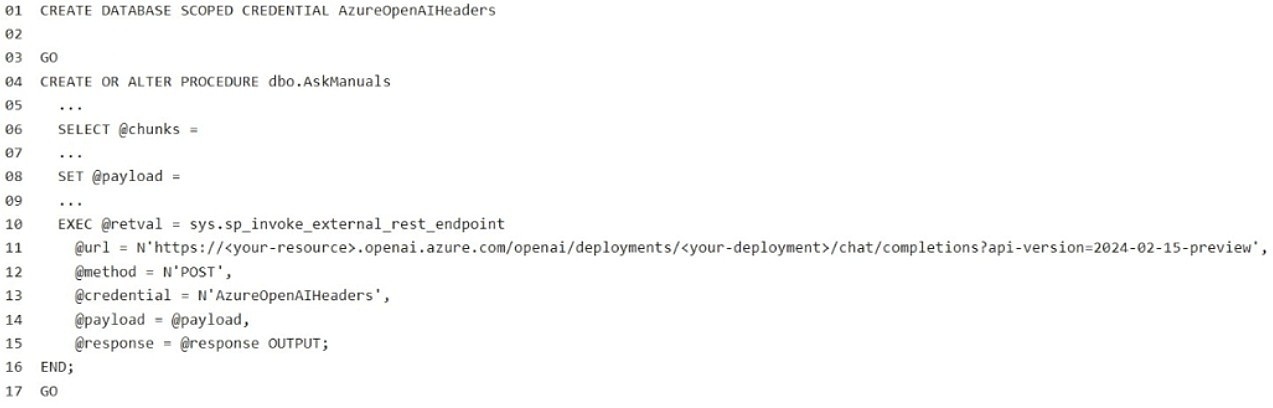
You have a Microsoft SQL Server 2025 instance that has a managed identity enabled.
You have a database that contains a table named dbo.ManualChunks. dbo.ManualChunks contains product manuals.
A retrieval query already returns the top five matching chunks as nvarchar(max) text.
You need to call an Azure OpenAI REST endpoint for chat completions. The solution must provide the highest level of security.
You write the following Transact-SQL code.

What should you insert at line 02?


You have an Azure SQL database that supports a customer-facing API. The API calls a stored procedure named dbo.GetCustomerOrders thousands of times per hour.
After a deployment that updated indexes and statistics, users report that the API endpoint backed by dbo.GetCustomerOrders is slower. In Query Store, the same query now has two persisted execution plans. During the last hour, the newer plan had a significantly higher average duration and CPU time than the older plan.
You need to restore the previous performance quickly, without changing the API code.
Which Transact-SQL command should you run?
HOTSPOT -
You have a database named db1. The schema is stored in a Git repository as an SDK-style SQL database project. The repository contains the following GitHub Action workflow.

For each of the following statements, select Yes if the statement is true. Otherwise, select No.
NOTE: Each correct selection is worth one point.

DRAG DROP -
You have an Azure SQL database that supports an OLTP application.
You need to write Transact-SQL code that returns blocking chain details. The output must return only sessions that are blocked or are blocking other sessions.
How should you complete the code? To answer, drag the appropriate values to the correct targets. Each value may be used once, more than once, or not at all. You may need to drag the split bar between panes or scroll to view content.
NOTE: Each correct selection is worth one point.

You have an Azure SQL database that supports the OLTP workload of an order-processing application.
During a 10-minute incident window, you run a dynamic management view query and discover the following:
Session 72 is sleeping with open_transaction_count = 1.
Multiple other sessions show blocking_session_id = 72 in sys.dm_exec_requests. sys.dm_exec_input_buffer(72, NULL) returns only BEGIN TRANSACTION UPDATE Sales.Orders.
Users report that updates to Sales.Orders intermittently time out during the incident window. The timeouts stop only after you manually terminate session 72.
What is a possible cause of the blocking?