Loading provider exams...

Loading provider exams...

Sign Up & unlock 100% of Exam Questions
No Strings Attached!
Updated
HOTSPOT -
You have an Azure subscription that contains the virtual networks shown in the following table.
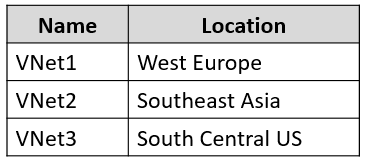
The subscription contains the subnets shown in the following table.
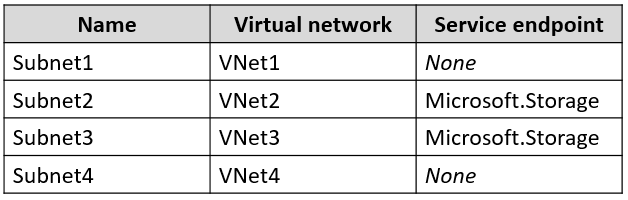
The subscription contains the storage accounts shown in the following table.
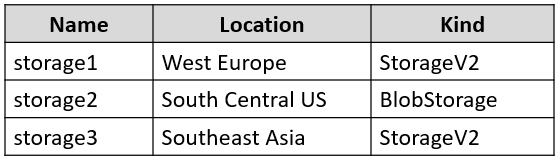
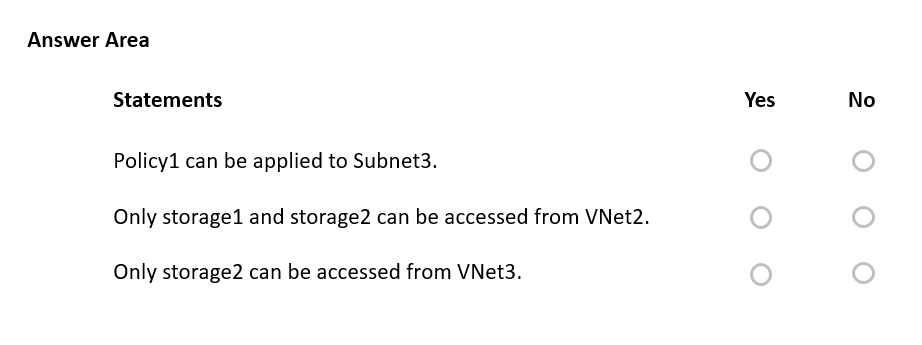
You create a service endpoint policy named Policy1 in the South Central US Azure region to allow connectivity to all the storage accounts in the subscription.
For each of the following statements, select Yes if the statement is true. Otherwise, select No.
NOTE: Each correct selection is worth one point.
You have an Azure subscription that contains an Azure Stream Analytics job named Job1.
You need to monitor input events for Job1 to identify the number of events that were NOT processed.
Which metric should you use?
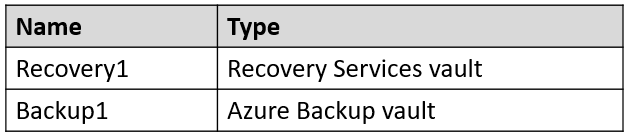
You have an Azure subscription that contains the vaults shown in the following table.
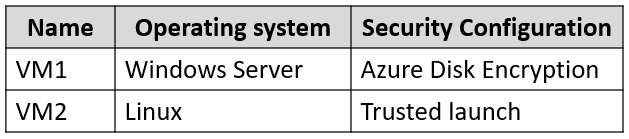
You deploy the virtual machines shown in the following table.
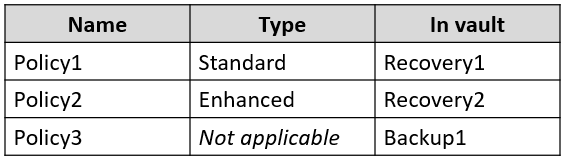
You have the backup policies shown in the following table.
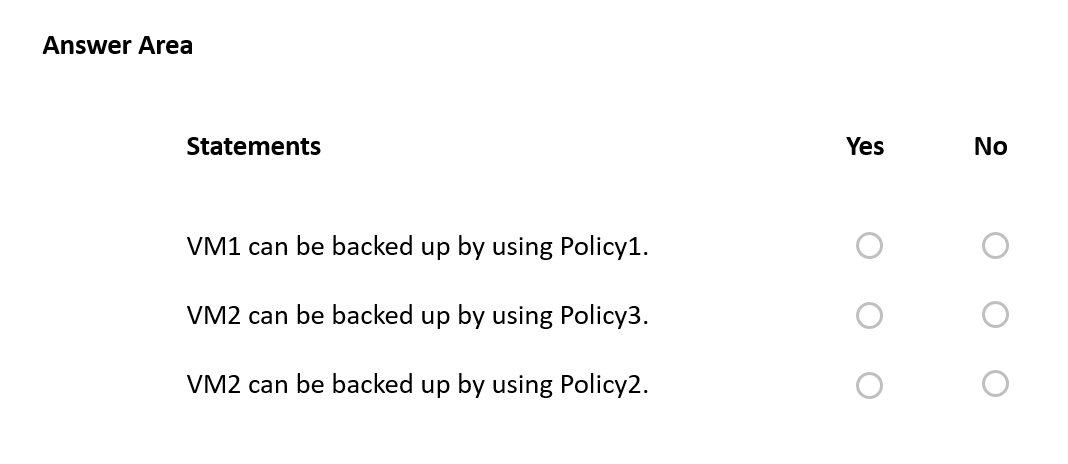
For each of the following statements, select Yes if the statement is true. Otherwise, select No.
NOTE: Each correct selection is worth one point.
You have an Azure subscription. The subscription contains virtual machines that run Windows Server.
You have a data collection rule (DCR) named Rule1.
You plan to use the Azure Monitor Agent to collect events from Windows System event logs.
You only need to collect system events that have an ID of 1001.
Which type of query should you use for the data source in Rule1?
You have an Azure subscription that contains a virtual machine named VM1.
You have an on-premises datacenter that contains a domain controller named DC1. ExpressRoute is used to connect the on-premises datacenter to Azure.
You need to use Connection Monitor to identify network latency between VM1 and DC1.
What should you install on DC1?
Want a break from the ads?
Become a Supporter and enjoy a completely ad-free experience, plus unlock Learn Mode, Exam Mode, AstroTutor AI, and more.
You have an Azure subscription that has Traffic Analytics configured.
You deploy a new virtual machine named VM1 that has the following settings:
• Region: East US
• Virtual network: VNet1
• NIC network security group: NSG1
You need to monitor VM1 traffic by using Traffic Analytics.
Which settings should you configure?
You have an Azure subscription. The subscription contains 10 virtual machines that run Windows Server. Each virtual machine hosts a website in IIS and has the Azure Monitor Agent installed.
You need to collect the IIS logs from each virtual machine and store them in a Log Analytics workspace.
What should you configure first?
HOTSPOT -
You purchase a new Azure subscription.
You create an Azure Resource Manager (ARM) template named deploy.json as shown in the following exhibit.
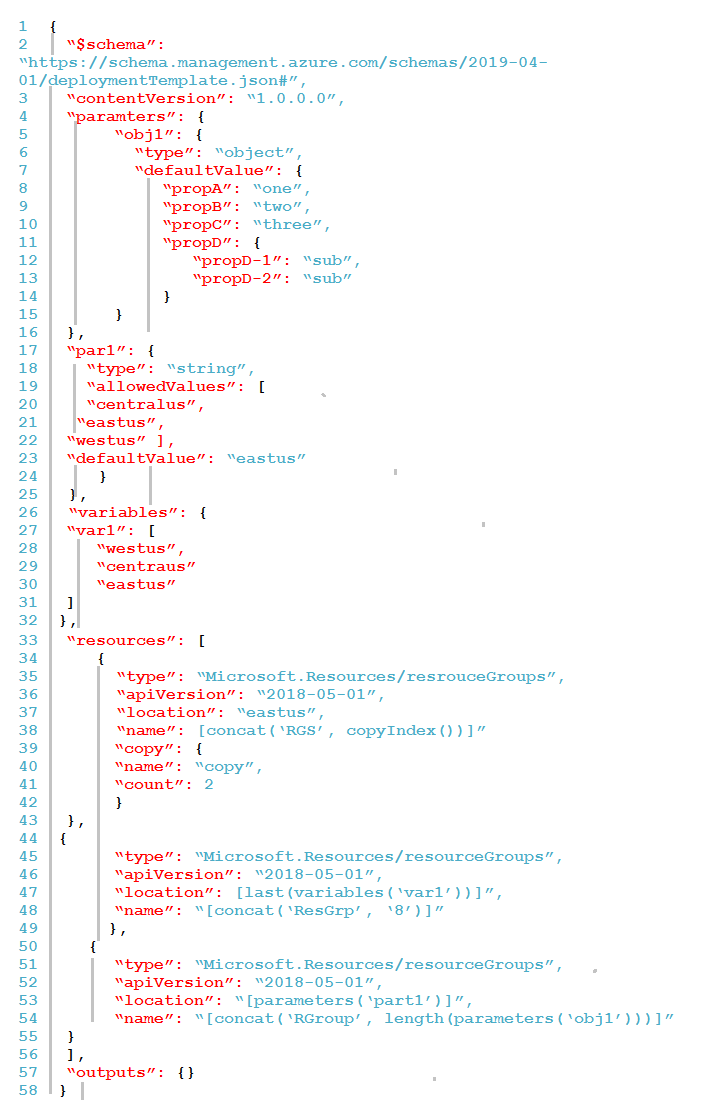
You connect to the subscription and run the following command.
New-AzDeployment –Location westus –TemplateFile “deploy.json”
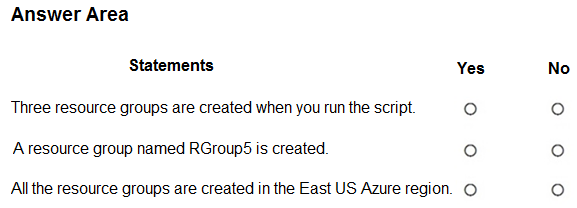
For each of the following statements, select Yes if the statement is true. Otherwise, select No.
NOTE: Each correct selection is worth one point.
You have an Azure subscription.
You plan to deploy the resources shown in the following table.

You need to create a single Azure Resource Manager (ARM) template that will be used to deploy the resources.
Which resource should be added to the dependsOn section for VM1?
You need to create an Azure Storage account named storage1. The solution must meet the following requirements:
• Support Azure Data Lake Storage.
• Minimize costs for infrequently accessed data.
• Automatically replicate data to a secondary Azure region.
Which three options should you configure for storage1? Each correct answer presents part of the solution.
NOTE: Each correct answer is worth one point.
You have an Azure subscription that contains a storage account named storage1. The storage1 account contains a container named container1.
You need to configure access to container1. The solution must meet the following requirements:
• Only allow read access.
• Allow both HTTP and HTTPS protocols.
• Apply access permissions to all the content in the container.
What should you use?
You have an Azure subscription that contains an Azure SQL database named DB1.
You plan to use Azure Monitor to monitor the performance of DB1. You must be able to run queries to analyze log data.
Which destination should you configure in the Diagnostic settings of DB1?
You have an Azure subscription that contains a policy-based virtual network gateway named GW1 and a virtual network named VNet1.
You need to ensure that you can configure a point-to-site connection from an on-premises computer to VNet1.
Which two actions should you perform? Each correct answer presents part of the solution.
NOTE: Each correct selection is worth one point.
Note: This question is part of a series of questions that present the same scenario. Each question in the series contains a unique solution that might meet the stated goals. Some question sets might have more than one correct solution, while others might not have a correct solution.
After you answer a question in this section, you will NOT be able to return to it. As a result, these questions will not appear in the review screen.
You have an Azure subscription that contains 10 virtual networks. The virtual networks are hosted in separate resource groups.
Another administrator plans to create several network security groups (NSGs) in the subscription.
You need to ensure that when an NSG is created, it automatically blocks TCP port 8080 between the virtual networks.
Solution: You assign a built-in policy definition to the subscription.
Does this meet the goal?
You recently created a new Azure subscription that contains a user named Admin1.
Admin1 attempts to deploy an Azure Marketplace resource by using an Azure Resource Manager template. Admin1 deploys the template by using Azure
PowerShell and receives the following error message: User failed validation to purchase resources. Error message: Legal terms have not been accepted for this item on this subscription. To accept legal terms, please go to the Azure portal (http://go.microsoft.com/fwlink/?LinkId=534873) and configure programmatic deployment for the Marketplace item or create it there for the first time.`
You need to ensure that Admin1 can deploy the Marketplace resource successfully.
What should you do?
You have an Azure Active Directory (Azure AD) tenant that contains 5,000 user accounts.
You create a new user account named AdminUser1.
You need to assign the User administrator administrative role to AdminUser1.
What should you do from the user account properties?
You have an Azure Active Directory (Azure AD) tenant named contoso.onmicrosoft.com that contains 100 user accounts.
You purchase 10 Azure AD Premium P2 licenses for the tenant.
You need to ensure that 10 users can use all the Azure AD Premium features.
What should you do?
Your on-premises network contains an SMB share named Share1.
You have an Azure subscription that contains the following resources:
✑ A web app named webapp1
✑ A virtual network named VNET1
You need to ensure that webapp1 can connect to Share1.
What should you deploy?
You have an Azure web app named webapp1.
Users report that they often experience HTTP 500 errors when they connect to webapp1.
You need to provide the developers of webapp1 with real-time access to the connection errors. The solution must provide all the connection error details.
What should you do first?
Note: This question is part of a series of questions that present the same scenario. Each question in the series contains a unique solution that might meet the stated goals. Some question sets might have more than one correct solution, while others might not have a correct solution.
After you answer a question in this section, you will NOT be able to return to it. As a result, these questions will not appear in the review screen.
You have an Azure subscription named Subscription1. Subscription1 contains a resource group named RG1. RG1 contains resources that were deployed by using templates.
You need to view the date and time when the resources were created in RG1.
Solution: From the Subscriptions blade, you select the subscription, and then click Programmatic deployment.
Does this meet the goal?
You have an Azure subscription named Subscription1 and an on-premises deployment of Microsoft System Center Service Manager.
Subscription1 contains a virtual machine named VM1.
You need to ensure that an alert is set in Service Manager when the amount of available memory on VM1 is below 10 percent.
What should you do first?
You sign up for Azure Active Directory (Azure AD) Premium P2.
You need to add a user named [email protected] as an administrator on all the computers that will be joined to the Azure AD domain.
What should you configure in Azure AD?
You have a deployment template named Template1 that is used to deploy 10 Azure web apps.
You need to identify what to deploy before you deploy Template1. The solution must minimize Azure costs.
What should you identify?
You have an Azure subscription that contains a virtual machine named VM1. VM1 hosts a line-of-business application that is available 24 hours a day. VM1 has one network interface and one managed disk. VM1 uses the D4s v3 size.
You plan to make the following changes to VM1:
✑ Change the size to D8s v3.
✑ Add a 500-GB managed disk.
✑ Add the Puppet Agent extension.
✑ Enable Desired State Configuration Management.
Which change will cause downtime for VM1?
Note: This question is part of a series of questions that present the same scenario. Each question in the series contains a unique solution that might meet the stated goals. Some question sets might have more than one correct solution, while others might not have a correct solution.
After you answer a question in this section, you will NOT be able to return to it. As a result, these questions will not appear in the review screen.
You have an Azure subscription that contains 10 virtual networks. The virtual networks are hosted in separate resource groups.
Another administrator plans to create several network security groups (NSGs) in the subscription.
You need to ensure that when an NSG is created, it automatically blocks TCP port 8080 between the virtual networks.
Solution: From the Resource providers blade, you unregister the Microsoft.ClassicNetwork provider.
Does this meet the goal?