Loading questions...

Loading questions...
 Preview
Updated
Want a break from the ads?
Become a Supporter and enjoy a completely ad-free experience, plus unlock Learn Mode, Exam Mode, AstroTutor AI, and more.
Support Examcademy
Your support keeps this platform running. Become a Supporter to remove all ads and unlock exclusive study tools.
Create a free account to unlock all questions for this exam.
Log In / Sign UpYou are using Microsoft Visual Studio 2012.
A requirement has been removed and you need to update the five corresponding test cases to reflect this by changing their state.
You need to simultaneously update the state of these five test cases.
What are two possible ways to accomplish this goal? (Each correct answer presents a complete solution. Choose two.)
You are running a manual test using Microsoft Test Manager (MTM). You have chosen to create an action recording.
You want to pause the test run and exit the test runner.
Before you exit the test runner, you need to mark the test case as being in progress.
Which action should you perform in the test runner?
You are using Microsoft Test Manager (MTM). You are using the Microsoft Solution Framework (MSF) for Agile Software Development process template. Your
TFS environment includes SharePoint Server 2010 Enterprise Edition and reporting integration.
You need to identify the number of bugs that are open and assigned to you.
What should you do?
DRAG DROP -
You are using Microsoft Test Manager (MTM) to manage your testing efforts.
You need to produce a list of manual test runs over the past week.
What should you do? (To answer, move the three appropriate actions from the list of actions to the answer area and arrange them in the correct order.)
Select and Place:
DRAG DROP -
You are using Microsoft Test Manager (MTM) to manage your testing efforts.
You want to see which work items have changed since the last time you assigned a build to the test plan.
You need to assign a new build to the test plan and create a list of the bugs that have been fixed and the features that have been associated with the new build.
What should you do? (To answer, move the three appropriate actions from the list of actions to the answer area and arrange them in the correct order.)
Select and Place:
You use Microsoft Test Manager (MTM) to manage your test environments.
You plan to test an ASP.NET website on various topologies (such as one-tier, two-tier, three-tier, and n-tier) to ensure that the website supports scalability.
You need to be able to deploy copies of predefined environments based on templates.
What should you do?
You are using Microsoft Test Manager (MTM) to manage test cases.
You want to review all test cases with shared steps.
You need to build a direct links query that will generate a list of all test cases in the team project that use a shared step.
Which three actions should you perform? (Each correct answer presents part of the solution. Choose three.)
You are using Microsoft Test Manager (MTM) to run manual tests.
Testers reported a bug during a test run on the V1.0 build. A build for V2.0 has been created. Testers are still running tests against the V1.0 build.
You need to verify that the bug has been fixed in build V2.0.
What should you do?
You are using Microsoft Test Manager (MTM). You are using the Microsoft Solution Framework (MSF) for Agile Software Development process template.
SharePoint integration and reporting are enabled.
You want to assess the progress of your teams testing effort.
To do this, you need to:
Identify gaps in test coverage.
Monitor test progress for each requirement, and.
Identify how many test cases are passing or failing for each requirement.
What should you do?
DRAG DROP -
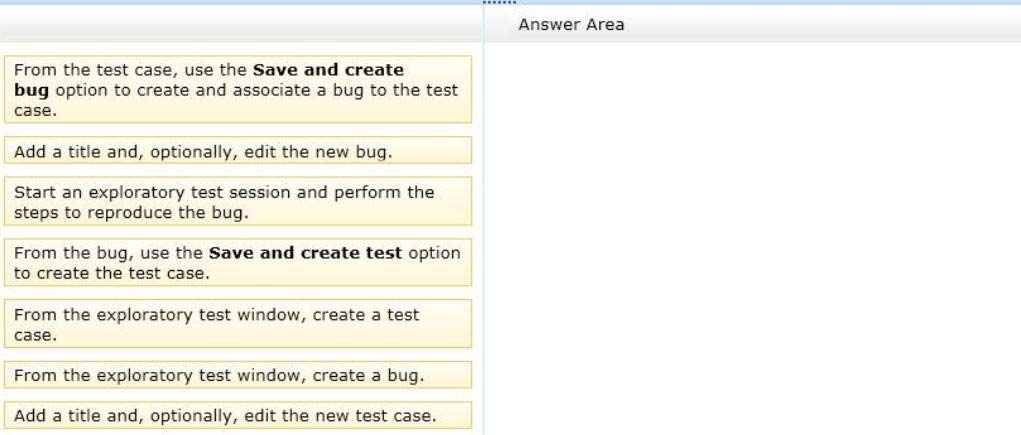
You are using Microsoft Test Manager (MTM) to manage customer service bug reports.
A customer has reported a problem and provided documentation of the steps to reproduce the problem.
You need to use exploratory testing to create a bug and associate the bug to a new test case.
What should you do? (To answer, move the five appropriate actions from the list of actions to the answer area and arrange them in the correct order.)
Select and Place:
DRAG DROP -
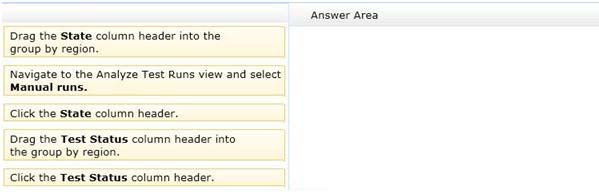
You are using Microsoft Test Manager (MTM) to manage your testing efforts.
You want to see how manual testing is going for the current plan.
You need to see a list of manual test runs grouped first by Test Status and then by State.
What should you do? (To answer, move the three appropriate actions from the list of actions to the answer area and arrange them in the correct order.)
Select and Place:
You are using Microsoft Test Manager (MTM) to run a test case. During the previous run of the same test case, a bug was filed. The developer could not reproduce the bug. The test settings assigned to the test plan do not include an adapter to collect IntelliTrace data.
You have created a test setting that includes the IntelliTrace data adapter.
You need to re-run the test with the settings that have the IntelliTrace data adapter.
What should you do?
You are using Microsoft Test Manager (MTM) to run an automated test suite with 240 long-running tests.
In your test environment, you have set up four client machines to run these tests. You have assigned the Client role to all four machines.
You need to make sure that when you run the test suite, the tests are distributed equally over all four client machines.
What should you do?
You are a managing test cases by using Microsoft Test Manager (MTM).
You create a new configuration.
You need to select the new configuration for all test cases in a test suite.
What are two possible ways to achieve this goal? (Each correct answer presents a complete solution. Choose two.)
You use Microsoft Test Manager (MTM) to conduct a manual test for an ASP.NET web application. You have created a test plan named Release 2.0.
The test plan needs to meet the following requirements:
✑ Test runs should be able to capture event log data for the server role.
✑ Test runs should be able to collect exceptions and specific diagnostic tracing information to isolate bugs that are difficult to reproduce.
You need to configure the Release 2.0 test plan by creating new test settings for the requirements and assigning the test settings to the test plan.
How should you configure the new test settings?
You are using Microsoft Test Manager (MTM) to create a test plan for testing an ASP.NET website.
Your test plan needs to validate a set of critical business functionalities for the current sprint. All business functionalities are documented in the requirements document published to the project portal.
You need to associate your test plan with the requirements document.
What should you do?
DRAG DROP -
You are using Microsoft Test Manager (MTM).
Your company would like to support the Windows Server 2008 operating system for the application being tested.
You need to add Windows Server 2008 as a new value to the operating system configuration variable.
What should you do? (To answer, move the four appropriate actions from the list of actions to the answer area and arrange them in the correct order.)
Select and Place:
You plan to roll out Microsoft Test Manager (MTM). Phase 1 testing will include manual testing only. In Phase 2, you will introduce automated test suites to complement manual testing.
You plan to use diagnostic data adapters for each phase.
You need to provide the correct diagnostic data adapters.
Which data diagnostic adapter is only applicable to manual testing and would accomplish this goal?
You run a manual test on an application by using Microsoft Test Manager (MTM). You have the following testing requirements:
✑ Collect the diagnostic data from the local machine, and
✑ Collect the diagnostic data from a remote SQL Server.
You need to identify the components required to configure the test environment to comply with these requirements.
Which two components should you choose? (Each correct answer presents part of the solution. Choose two.)
You are using Microsoft Test Manager (MTM) to manually test for an ASP.NET website. You have previously created a test plan named QA Release 1.0 that contains 115 test cases, and you are now planning the testing for Release 2.0.
The QA Release 2.0 test plan must meet the following requirements:
✑ All the test cases in QA Release 1.0 should be available in QA Release 2.0.
✑ Testers should be able to change, add, or remove test cases from either the QA Release 1.0 test plan or the QA Release 2.0 test plan as required, without affecting the other test plan.
✑ Shared steps and test configuration from the QA Release 1.0 test plan need to be reflected in QA Release 2.0 test plan.
You need to facilitate simultaneous testing of the website by creating the QA Release 2.0 test plan according to the stated requirements.
What should you do?