You are asked to configure your IP fabric with OSPF as the underlay routing protocol.
Which two statements are correct about this implementation? (Choose two.)
AEach host-connected interface of the leaf node is included as passive in the OSPF configuration.
BEach host-connected interface of the leaf node is included in the OSPF configuration.
CEach spine-connected interface of the leaf node is included as passive in the OSPF configuration.
DEach spine-connected interface of the leaf node is included in the OSPF configuration.
You are deploying a 3-stage Clos IP fabric in your data center.
In this scenario, which statement is correct?
AThere is an eight-spine node limitation.
BEach spine node must be physically connected to all other spine nodes.
CNo direct physical connections exist between leaf nodes.
DEach server-facing interface on a leaf node is always three hops away from other server-facing interfaces.
Which two Juniper Networks products provide protection against zero-day attacks? (Choose two.)
AJuniper Identity Management Service
BJuniper Secure Analytics
CJuniper ATP Cloud
DSRX Series device
Which IP fabric underlay protocol provides the highest degree of scalability?
AIS-IS
BRIP
CBGP
DOSPF
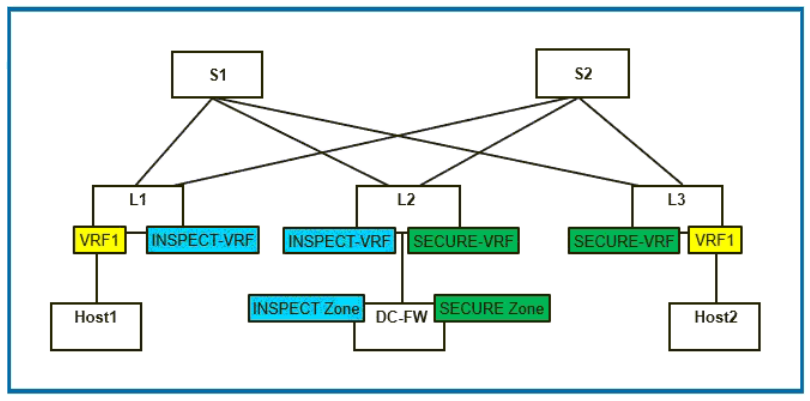
You are attempting to configure filter-based forwarding in your data center. All traffic from Host1 that is going to Host2 should be inspected by the data center firewall. You have verified that the traffic is being forwarded from router leaf L1's VRF-1 to its INSPECT-VRF, however, the traffic is not reaching service L2.
Referring to the exhibit, which two steps should you take to troubleshoot the problem? (Choose two.)
AEnsure that VRF-1 and INSPECT-VRF route targets on L1 and L2 match.
BEnsure that the route target in the INSPECT-VRF of L1 matches the route target of the INSPECT-VRF of L2.
CExamine the INSPECT-VRF.inet.0 route table on L1 for a default route that will direct the traffic to L2.
DExamine the INSPECT-VRF.evpn.0 route table on L1 for a default route that will direct the traffic to L2.
Question 6
Data Center Interconnect
0
Question 7
EVPN-VXLAN Signaling
Question 8
EVPN-VXLAN Signaling
Question 9
Data Center Multitenancy and Security
Question 11
EVPN-VXLAN Signaling
Question 13
VXLAN
Question 14
EVPN-VXLAN Signaling
Question 15
EVPN-VXLAN Signaling
Question 17
EVPN-VXLAN Signaling
Question 18
EVPN-VXLAN Signaling
Question 19
EVPN-VXLAN Signaling
Question 20
EVPN-VXLAN Signaling
Question 21
VXLAN
Question 22
EVPN-VXLAN Signaling
Question 23
Layer 3 Fabrics
Question 24
EVPN-VXLAN Signaling
Question 25
Layer 3 Fabrics
Question 26
EVPN-VXLAN Signaling
Question 27
Data Center Deployment and Management
Question 28
Layer 3 Fabrics
Ask AstroTutor
0
Ask AstroTutor
0
Ask AstroTutor
0
Ask AstroTutor
0
Ask AstroTutor
0
Ask AstroTutor
0
Ask AstroTutor
0
Ad
Want a break from the ads?
Become a Supporter and enjoy a completely ad-free experience, plus unlock Learn Mode, Exam Mode, AstroTutor AI, and more.
Ask AstroTutor
0
Ask AstroTutor
0
Ask AstroTutor
0
Ask AstroTutor
0
Ask AstroTutor
0
Ask AstroTutor
0
Ask AstroTutor
0
Ask AstroTutor
0
Ask AstroTutor
0
Ask AstroTutor
0
Ask AstroTutor
0
Ask AstroTutor
0
Which two statements about an over-the-top (OTT) data center interconnect architecture are correct? (Choose two.)
AFor a Layer 2 stretched network between data centers, a full mesh of VXLAN tunnels between leaf switches is required.
BIBGP or EBGP is required for the underlay.
CMulticast is supported.
DOTT is ideal for small and medium data center designs.
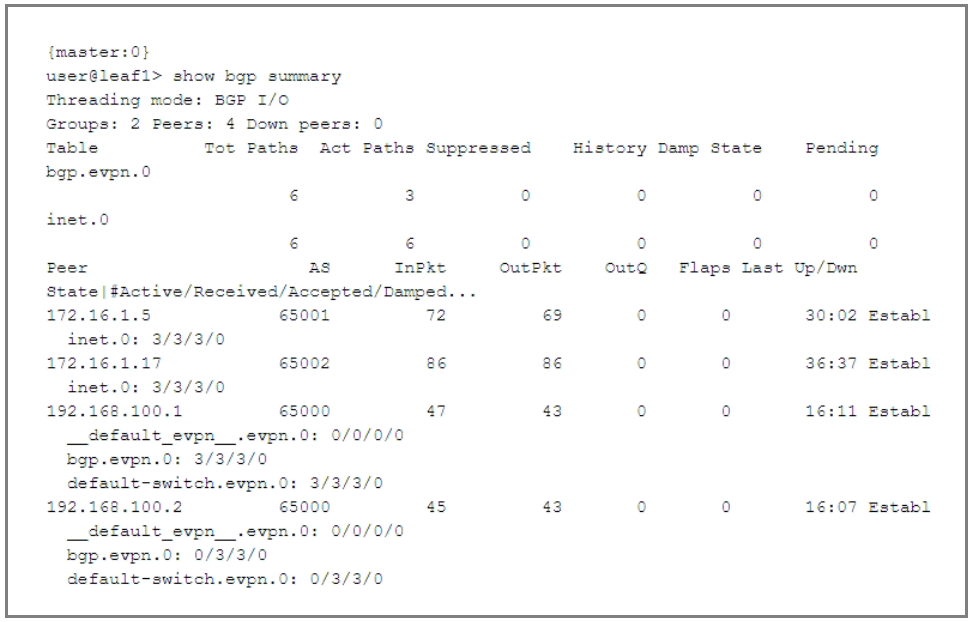
Referring to the exhibit, which two statements are correct about the EVPN//VXLAN fabric? (Choose two.)
AAS 65001 is part of the fabric underlay.
BAS 65000 is part of the fabric underlay.
CAS 65001 is part of the fabric overlay.
DAS 65000 is part of the fabric overlay.
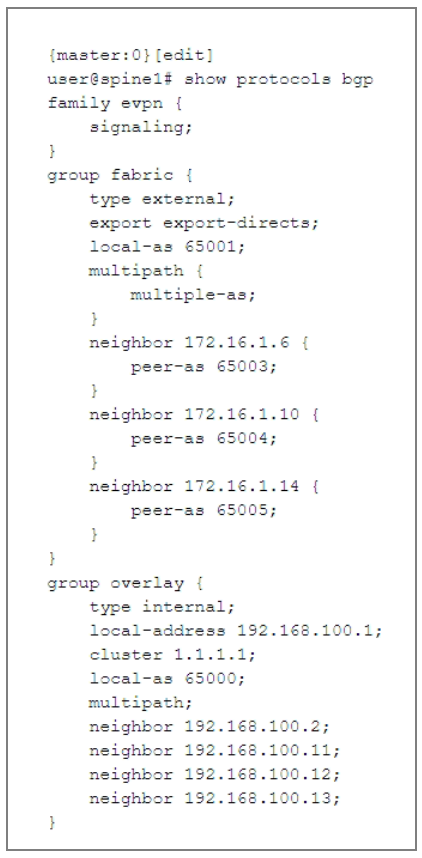
You are implementing an EVPN overlay in your IP fabric data center. The IP fabric was stable before configuring the overlay group and EVPN-related settings. After committing the configuration shown in the exhibit on your spine device, you are no longer exchanging any routes in your underlay fabric.
In this scenario, what will solve this problem?
AYou must move the EVPN NLRI family declaration to be applied under the overlay BGP group.
BYou must remove the export policy applied to your fabric group.
CYou must remove the multipath parameter from the overlay group.
DYou must change the overlay group to establish an EBGP peering instead of IBGP.
You have a data center design with multiple tenants using routing instances.
In this scenario, what are two ways to provide inter-tenant communications? (Choose two.)
AUse EVPN type-7/8 routes.
BUse RIB groups.
CUse filter-based forwarding.
DUse EVPN type-6 routes.
You want to improve network convergence within a data center during link failures.
In this scenario, which EVPN-VXLAN feature will accomplish this task?
AMAC mass withdrawal
Bstorm control
CMAC filtering
DEthernet segment auto discovery
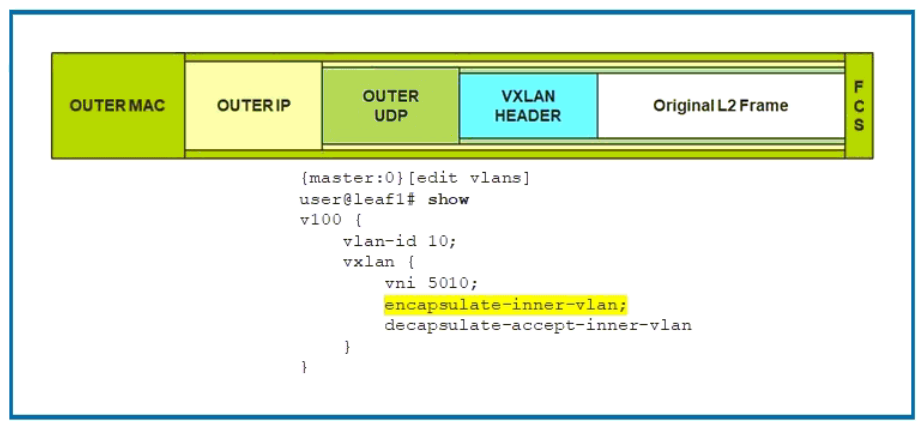
Which statement is correct about the highlighted code segment and VXLAN frame shown in the exhibit?
AThis statement is optional and keeps the VLAN header in the Original L2 Frame, if included.
BThis statement is optional and removes the VLAN header in the Original L2 Frame, if included.
CThis statement is required and removes the VLAN header in the Original L2 Frame, if included.
DThis statement is required and keeps the VLAN header in the Original L2 Frame, if included.
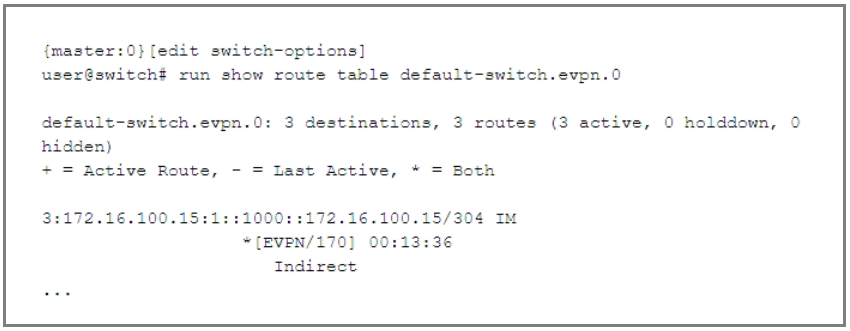
Which statement is true about the route shown in the exhibit?
AThe route is an EVPN type-1 route.
BThe route target on this route is 1000.
CThe route uses a type-1 route distinguisher.
DThe VNI for this route is 304.
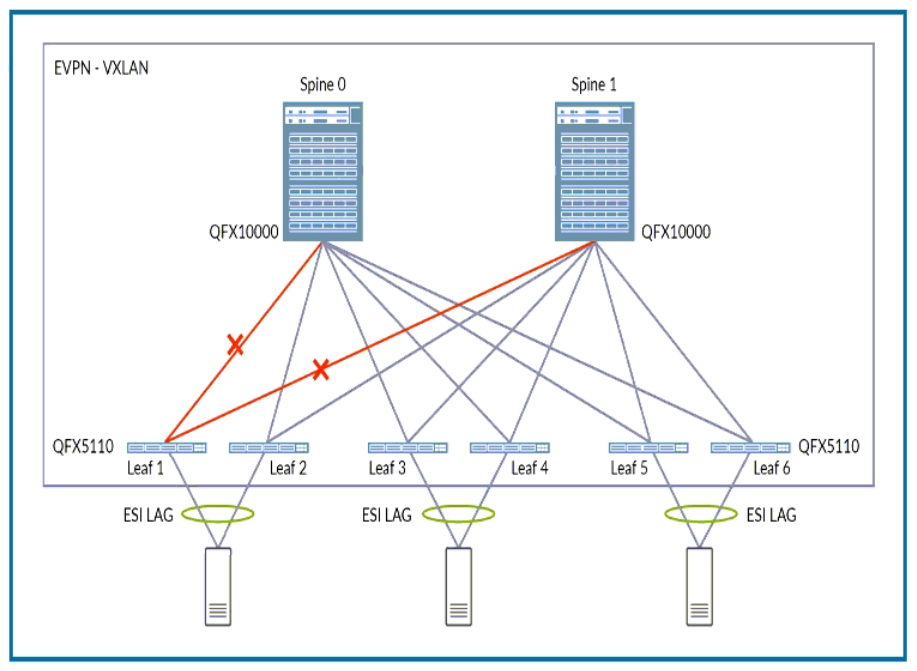
Referring to the exhibit, what effect does EVPN core isolation have?
ALeaf 1 will send a pause frame to each connected host.
BSpine 1 will block all traffic.
CLeaf 1 will place the interfaces to connected hosts into LACP passive mode.
DLeaf 1 will take down all revenue interfaces.
You are considering deploying a MAC-VRF type routing instance with a VLAN-bundle service type.
In this scenario, which two statements are correct? (Choose two.)
AIt can be implemented in an ERB architecture.
BVLAN normalization is supported.
CIt can be implemented in a bridge overlay architecture.
DMultiple VLAN IDs per EVI are supported.
In an EVPN multicast environment, which two route types facilitate IGMP join and IGMP leave behavior for multihomed sites? (Choose two.)
Atype-7
Btype-4
Ctype-8
Dtype-3
You are asked to deploy an Ethernet bridging design in a data center with the criteria shown below.
– Routing must occur on the spine devices.
– VTEPs must terminate on the leaf devices.
– Facilitate inter-VLAN communication.
– Layer 2 gateways must be present on spine and leaf devices.
Which architecture should you use in this scenario?
Abridge overlay architecture
Bedge-routed bridging architecture
Ccentrally-routed bridging architecture
Dcollapsed spine architecture
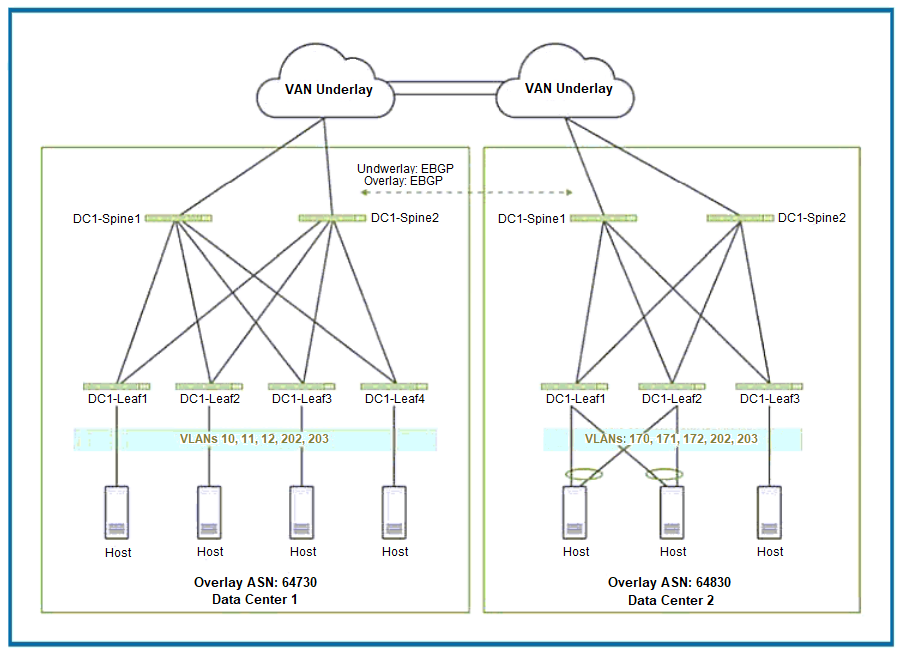
The two data centers shown in the exhibit need to be connected using EVPN.
Which two statements are correct in this situation? (Choose two.)
AHosts in VLAN 10 can communicate with hosts in Data Center 2 using Layer 2.
BHosts in VLAN 10 can communicate with hosts in Data Center 2 using Layer 3.
CHosts in VLAN 202 can communicate using Layer 2 between data centers.
DHosts in VLAN 202 can communicate using Layer 3 between data centers.
You are troubleshooting a problem with traffic not reaching a remote VTEP.
Referring to the exhibit, what is the reason for the problem?
AThe remote VTEP does not have the correct VNI configured.
BA conflict exists with the VLAN-to-VNI mapping
CThe local VTEP is misconfigured with the wrong VNI.
DNo VTEP is configured on peer 192.0.2.20.
You have a two spine and a four leaf CRB topology and you want to ensure the hosts connected to the leaf devices have reachability to all local spine IRB interface addresses.
Which configuration parameters must be used to accomplish this task?
AConfigure proxy-macip-advertisement under the IRB interface.
BConfigure a spine-to-spine EVPN peering as part of the routing instance.
CConfigure a spine-to-spine BGP peering as part of the overlay.
DConfigure virtual-gateway-accept-data under the IRB interface.
You are building an IP fabric underlay for your data center. You are asked to ensure that the two spine devices are in the same AS (65000) while the six leaf devices are in a different AS (65512).
In this scenario, which two statements are correct by default? (Choose two.)
AA leaf device will accept all BGP routes received from the spine that were originated from another leaf device.
BAll BGP routes advertised by a leaf device will be accepted on the spine devices.
CAll BGP routes advertised by a leaf device will be rejected on the spine devices.
DA leaf device will reject all BGP routes received from the spine that were originated from another leaf device.
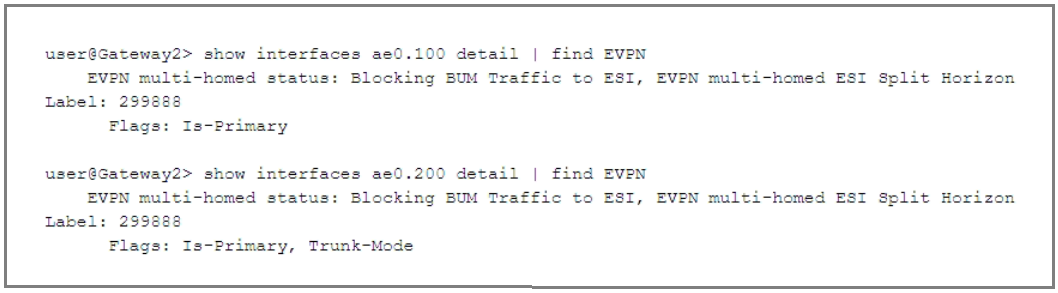
Referring to the output shown in the exhibit, which two statements are correct? (Choose two.)
AGateway2 is the backup forwarder.
BGateway2 drops unknown unicast traffic from the core destined to the edge device.
CGateway2 is responsible for sending unknown unicast traffic from the core to the edge device.
DGateway2 is the designated forwarder.
You are deploying an EBGP IP fabric.
In this scenario, which statement is true?
AEach spine should peer with every other spine using physical addresses.
BEach spine should peer with each leaf using physical addresses.
CEach spine should peer with every other spine using loopback addresses.
DEach spine should peer with each leaf using loopback addresses.
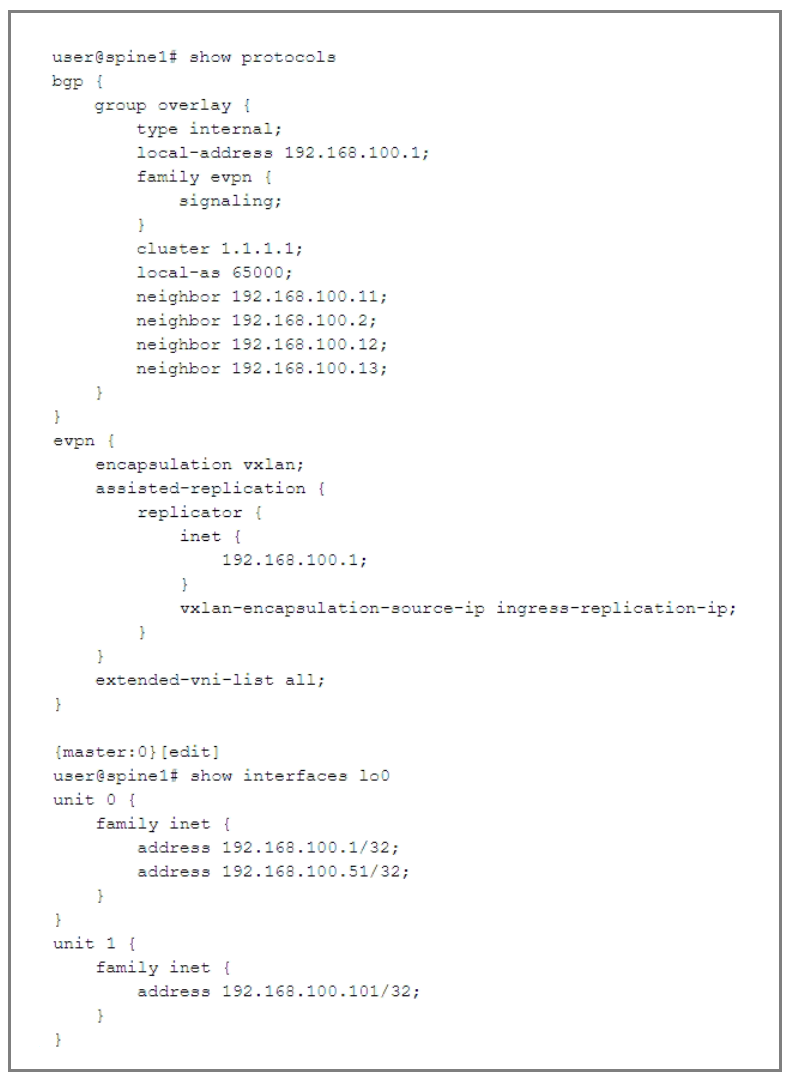
The configuration shown in the exhibit is intended to set up assisted replication but will not commit.
Which action will create a valid configuration in this situation?
AChange the replicator inet address to 192.168.100.51.
BDelete replicator inet 192.168.100.1.
CChange the lo0.0 address to 192.168.100.1 primary.
DChange the replicator inet address to 192.168.100.101.
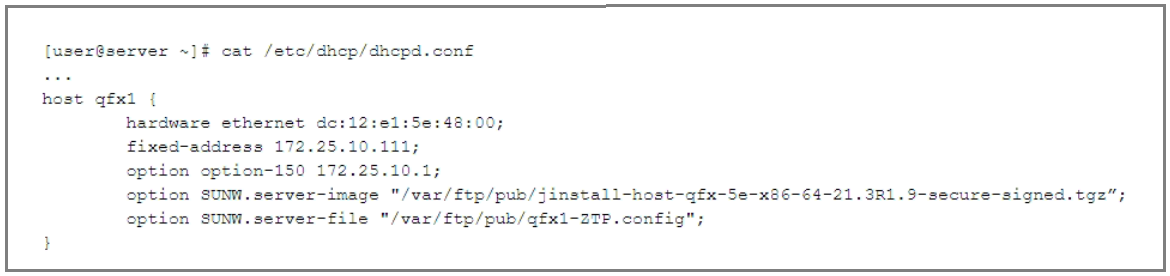
Referring to the exhibit, what happens when you initiate ZTP on a QFX5120 switch running Junos 21.3R1.9?
AZTP performs the Junos installation but skips the configuration.
BZTP skips the Junos installation but applies the configuration.
CZTP performs both the Junos installation and the configuration.
DZTP skips both the Junos installation and the configuration.
You are asked to increase the overall throughput of an existing IP fabric.
Which two tasks would accomplish this goal? (Choose two.)
AAdd one more leaf node to the fabric.
BAdd one uplink to all existing spine nodes from the newly added leaf node.
CAdd one more uplink from each leaf node to the newly-added spine node.