You want to converse IP address space and reduce your fabric management overhead. For these reasons, you decided to use unnumbered Ethernet interfaces for your IP Fabric.
Which statement is correct in this scenario?
AThe donor interface for an unnumbered interface must have only one configured IP address.
BPIM is not supported on upstream unnumbered interfaces in the PIM topology.
COSPF is supported on unnumbered interfaces configured as a point-to-point connection.
DOnly the IPv4 address family is supported on the interfaces.
You are building an EVPN Data Center Interconnect. You must support multiple VLANs in a single EVPN instance.
Which parameter provides this functionality?
Ainstance-type evpn
Binstance-type no-forwarding
Cinstance-type virtual-switch
Dinstance-type 12vpn
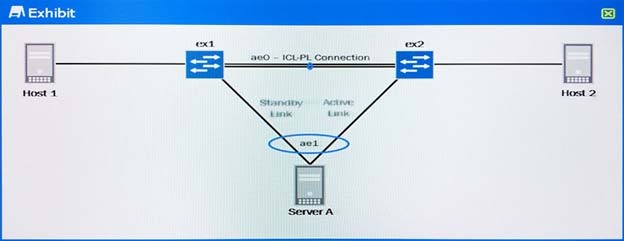
You are deploying MC-LAG as shown in the exhibit.
Which statement is correct when using active/standby mode?
AA spanning tree protocol should be used to avoid Layer 2 loops between Server A and both switches.
BVCCP is used to exchange MAC addresses between MC-LAG peers.
CAll traffic from Server A to Host 1 will traverse the link between Server A and ex2.
DOnly ICCP control traffic is allowed through the ICL-PL connection.
You are building a DCI solution and need both a Layer 2 solution and a Later 3 solution for different workloads within your data centers.
What are two reasons why MPLS would be used a transport for this DCI solution? (Choose two.)
AThe fast failover capabilities of MPLS nodes can be accomplished in a recovery time that is equivalent to 50 ms or better.
BMPLS allows you to natively runnel your own Layer 2 traffic through the service provided L3VPN.
CMPLS allows you to interconnect multiple data centers over a public IP network.
DMPLS allows for any-to-any connectivity allowing for both Layer 2 and Layer 3 DCIs.
You are configuring VXLAN on a network of QFX5100s, and are using the set vlans vlan100 vxlan unreachable-vtep-aging-timer 600 command.
What does this command do?
AThis command ages out a remotely learned VTEP address after 600 seconds of inactivity.
BThis command ages out the address of the remote VTEP 600 seconds after the last learned MAC address expires.
CThis command ages out all learned MAC addresses assigned to the VTEP after 600 seconds of inactivity.
DThis command ages out a locally learned MAC address assigned to the VTEP after 600 seconds of inactivity.
Question 8
EVPN-VXLAN Signaling
0
Question 12
Data Center Deployment and Management
Question 13
Data Center Deployment and Management
Question 14
EVPN-VXLAN Signaling
Question 15
VXLAN
Question 16
Data Center Deployment and Management
Question 17
EVPN-VXLAN Signaling
Question 18
Data Center Deployment and Management
Question 19
EVPN-VXLAN Signaling
Question 20
EVPN-VXLAN Signaling
Question 21
Data Center Deployment and Management
Question 22
Data Center Interconnect
Question 23
Data Center Deployment and Management
Question 24
EVPN-VXLAN Signaling
Question 25
Data Center Deployment and Management
Question 26
EVPN-VXLAN Signaling
Question 27
Layer 3 Fabrics
Question 28
Data Center Deployment and Management
Question 29
Data Center Deployment and Management
Question 30
VXLAN
Ask AstroTutor
0
Ask AstroTutor
0
Ask AstroTutor
0
Ask AstroTutor
0
Ask AstroTutor
0
Ask AstroTutor
0
Ask AstroTutor
0
Ad
Want a break from the ads?
Become a Supporter and enjoy a completely ad-free experience, plus unlock Learn Mode, Exam Mode, AstroTutor AI, and more.
Ask AstroTutor
0
Ask AstroTutor
0
Ask AstroTutor
0
Ask AstroTutor
0
Ask AstroTutor
0
Ask AstroTutor
0
Ask AstroTutor
0
Ask AstroTutor
0
Ask AstroTutor
0
Ask AstroTutor
0
Ask AstroTutor
0
Ask AstroTutor
0
A customer has built a VXLAN using an EVPN signaling infrastructure with remote facilities with VXLAN using EVPN signaling connected to the Internet. The customer notices that the network is completely stable with no protocol errors in the underlay or overlay. The customer, however, cannot pass any application data across the network.
Which statement would explain the intermittent loss?
AThere is an LACP key mismatch.
BThe MTU is exceeded.
CThe routing protocol authentication has failed.
DThe BPDU protection is invoked.
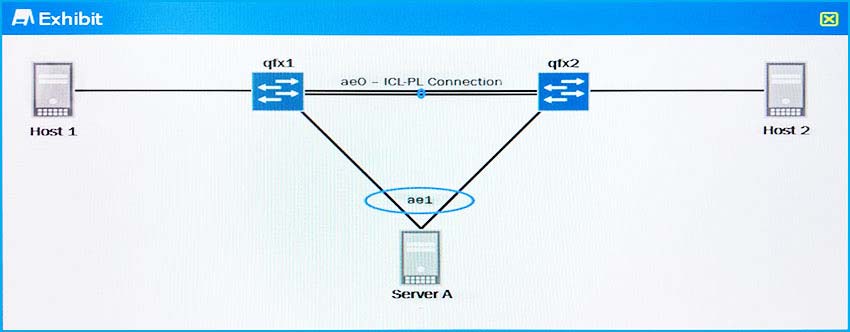
You are deploying MC-LAG as shown in the exhibit.
Which statement is correct when using active/active mode?
AOnly ICCP control traffic is allowed through the ICL-PL connection
BICCP and block filters are used to avoid Layer 2 loops.
CVRRP must be used to ensure MAC addresses are shared between peers.
DVCCP is used to exchange MAC addresses between MC-LAG peers.
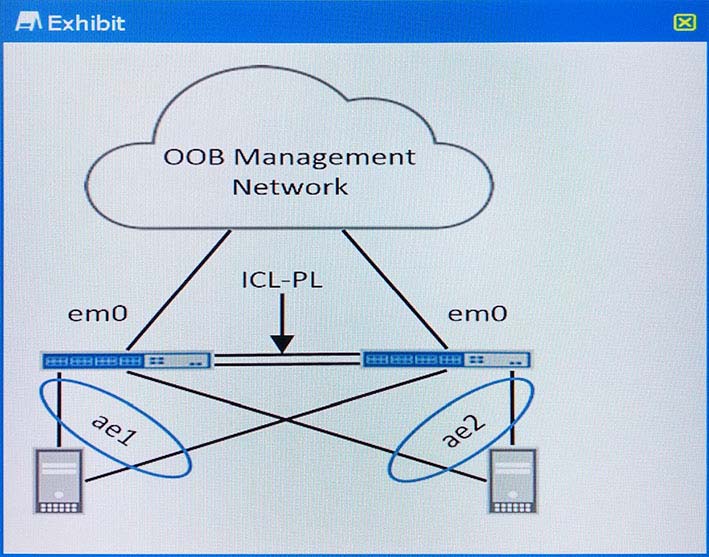
The MC-LAG group shown in the exhibit is providing high availability services for the directly connected servers.
Where does Juniper Networks recommend you provide the backup liveness detection?
Aon the ae2 interface
Bon the ICL-PL connection
Con the ae1 interface
Don the management interfaces
Which EVPN service consists of a single broadcast domain per EVPN instance?
Aa VLAN bundle service interface
Ba VLAN-based service interface
Ca port-based VLAN-aware service interface
Da port-based service interface
You have deployed a multicast server attached to a QFX5100 Series device serving as a VTEP.
Which two statements are correct in this scenario? (Choose two.)
ABy default, the QFX5100 will send copies of the multicast packets to all locally attached devices in the same VLAN.
BBy default, the QFX5100 will send copies of the multicast packets to locally attached devices in the same VLAN that are interested receivers only.
CBy default, the QFX5100 will encapsulate the multicast packets in VXLAN and forward them to all remotely connected VTEPs.
DBy default, the QFX5100 will encapsulate the multicast packets in VXLAN and forward them to remotely connected VTEPs with interested receives only.
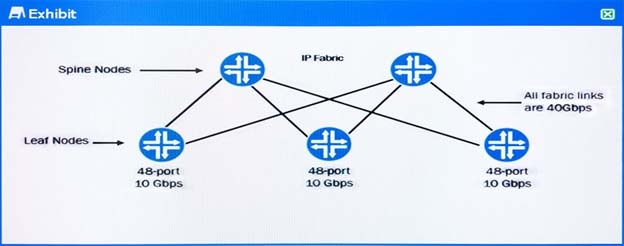
Referring to the exhibit, which hardware change would be made to the IP Fabric to ensure an exact 4:1 oversubscription ratio?
AUpgrade the fabric links to 100GbE.
BAdd two leaf nodes to the IP Fabric.
CAdd three leaf nodes to the IP Fabric.
DAdd a spine node to the IP Fabric.
Which protocol is used between VCF member devices to create a loop-free topology?
ALLDP
BMSTP
CRSTP
DVCCP
You have built a mixed-mode VCF consisting of two QFX5100-24Qs as spines, two QFX5100-48S as leaf nodes, and one EX4300 as a leaf node. The VCF is working for all devices, except the EX4300 40GbE fabric links will not join the VCF.
In this scenario, what must be corrected to solve the connectivity problem?
AReboot all of the VCF members.
BPower off all of the VCF members and power up the spines before powering up the leafs.
CZeroize the EX4300, cleat all the tables with the clear ethernet-switching tables command on all members, and reissue the request virtual- command. chassis mixed-mode
DTurn off authonegotiation on the EX4300 and the attached spine interfaces, and then use the request virtual-chassis vc-port set command on the spine ports connected to the EX4300.
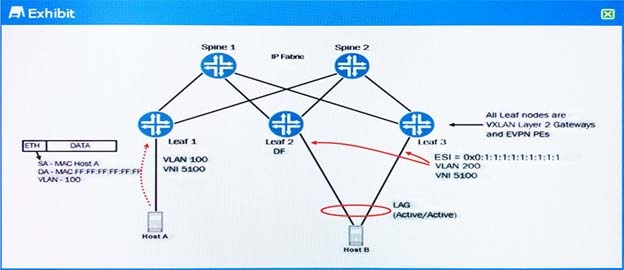
Referring to the exhibit, each leaf node is a QFX5100 acting as a VXLAN Layer 2 Gateway using EVPN signaling. Leaf 2 and Leaf 3 are both attached to the same
EVPN Ethernet segment. Leaf 2 has been elected the designated forwarder for VLAN 200 on that Ethernet segment.
In this scenario, which two actions will Leaf 1 perform with the broadcast Ethernet frame received from Host A? (Choose two.)
ALeaf 1 will strip the VLAN tag from the Ethernet frame before encapsulating it in VXLAN.
BLeaf 1 will send a VXLAN encapsulated copy of the Ethernet frame to both Leaf 2 and Leaf 3.
CLeaf 1 will change the VLAN tag of the Ethernet frame to 200 before encapsulating it in VXLAN.
DLeaf 1 will send a VXLAN encapsulated copy of the Ethernet frame to Leaf 2 only.
Your server administrator asks you to preserve the inner VLAN tags of the frames coming from a Layer 2 VXLAN Gateway of the EVPN-enabled segment.
Which two parameters must you add to the configuration to allow the VLAN tag to be passed? (Choose two.)
Alayer2-protocol-tunneling
Bdecapsulate-accept-inner-vlan
Cdotlq-tunneling
Dencapsulate-inner-vlan
Which two statements are correct when performing a unified ISSU? (Choose two.)
AThe master Routing Engine and backup Routing Engine must be running the same software version before you can perform a unified ISSU.
BUnicast RPF-related statistics are not saved across a unified ISSU, and the unicast RPF counters are reset to zero during a unified ISSU.
CUnicast RPF-related statistics are saved across a unified ISSU, and the unicast RPF counters are not reset to zero during a unified ISSU.
DThe backup Routing Engine must be running the most recent software version before you can perform a unified ISSU.
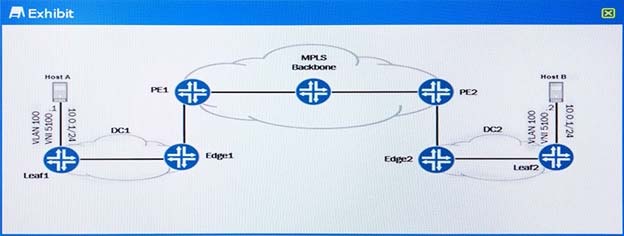
Referring to the exhibit, PE1 and PE2 are acting as MPLS Layer 3 VPN PEs to provide the DCI between DC1 and DC2, which are IP Fabrics. Leaf 1 and Leaf 2 are QFX5100 Series devices acting as VXLAN Layer 2 Gateways using EVPN signaling for the same VXLAN segment.
Which statement is correct about the Edge1 device in this scenario?
AEdge1 must be configured for MP-BGP using EVPN signaling.
BEdge1 must be configured for MP-BGP using L3VPN signaling.
CEdge1 must be configured for BGP labeled unicast on its PE1-facing interface.
DEdge1’s routing table must contain an IP route to both Leaf1 and Leaf2.
In a preprovisioned mixed Virtual Chassis, which statement is correct about converting a 40Gbps QSFP+ to a Virtual Chassis port in an EX4300?
ALLDP is enabled on that interface.
BLLDP is disabled on that interface.
COne end of the link is configured as a Virtual Chassis port.
DBoth ends of the link have the default configuration.
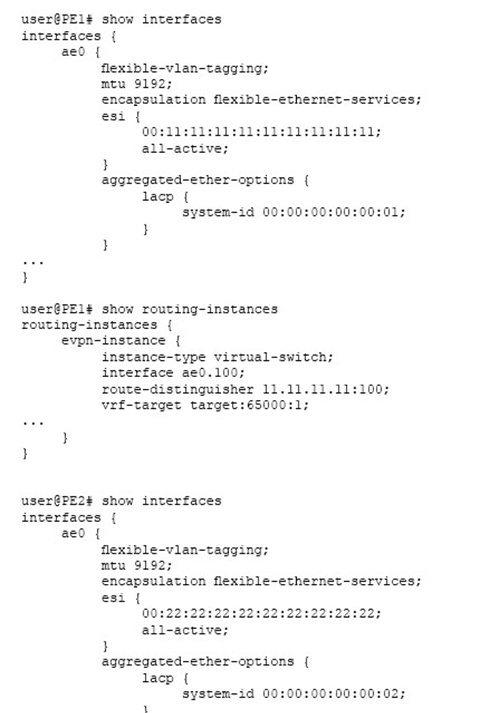
You are deploying a VXLAN using EVPN signaling overlay network. PE1 and PE2 are multihomed to the connected CE device. You notice that the traffic is not load-balancing as expected.
Referring to the exhibit, which two actions will solve this problem? (Choose two.)
ASet the route distinguisher on PE2 to 11.11.11.11:100.
BSet the LACP system ID on PE2 to 00:00:00:00:00:01.
CSet the ESI on both devices to 00:00:00:00:00:00:00:00:00:00.
DSet the ESI on PE2 to 00:11:11:11:11:11:11:11:11:11.
You are implementing a Virtual Chassis using QFX5100s and EX4300s in your data center.
In this scenario, which three hardware capabilities are affected? (Choose three.)
Ausable VCP connections limited to 10GbE
BMAC table size
Cnumber of usable ports per member
Dnumber of supported routing instances
Emaximum number of firewall filters
You are developing an EVPN service between your data centers to enable Layer 2 stretch and Virtual Machine Traffic Optimization (VMTO) operations.
In this scenario, which action must be performed on the IRB interface to accomplish this task?
AConfigure the same IP address and let the MAC address be dynamically assigned on each PE.
BConfigure the same IP address and the same MAC address on each PE.
CConfigure different IP addresses but the same MAC address on each PE.
DConfigure different IP addresses and different MAC addresses on each PE.
What are two methods used to scale an IBGP IP Fabric? (Choose two.)
Aspanning tree
Bredundant trunk groups
Croute reflection
Dconfederations
You are building a mixed-mode Virtual Chassis with two QFX5100-24Qs, four QFX3500-48s, two EX4600-40Fs and two EX4300-48Ts. The Virtual Chassis will not provision.
In this scenario, which statement is correct?
AQFX3500s are not allowed in mixed mode.
BEX4600s are only allowed with EX4300s.
CEX4600s must be preprovisioned as the master and backup.
DMixed-mode Virtual Chassis only allows for eight members.
You are deploying 50 QFX5100 switches in your data center. You are asked to explain the benefits of using ZTP during your deployment of these devices.
What is a benefit of this deployment?
AYou must use DHCP options to provide Junos installation packages to all devices.
BYou must use DHCP options to provide the transfer mode used for pulling files from a storage server.
CYou can use DHCP options to push the configuration files to all devices.
DYou can use DHCP options to indicate which Junos version the switches should be running.
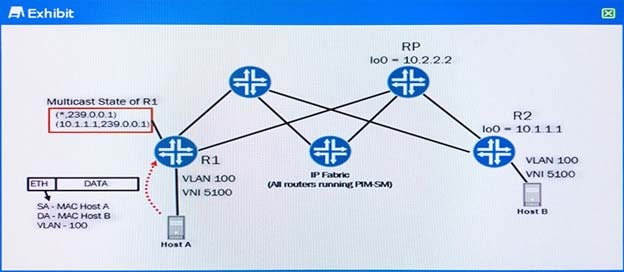
Referring to the exhibit, R1 and R2 are QFX5100 Series devices acting as VXLAN Layer 2 Gateways using PIM-SM signaling for the same VXLAN segment (VNI
5100). The multicast group assigned to VNI 5100 is 239.0.0.1. R1 currently has an entry in its MAC table for Host B.
In this scenario, how will R1 react to receiving the Ethernet frame from Host A?
AR1 will send a VXLAN encapsulated Ethernet frame using 10.1.1.1 as the destination address.
BR1 will send a VXLAN encapsulated Ethernet frame along the source-based multicast tree using 239.0.0.1 as the destination address.
CR1 will send a VXLAN encapsulated Ethernet frame using 10.2.2.2 as the destination address.
DR1 will send a VXLAN encapsulated Ethernet frame along the RP-based multicast tree using 239.0.0.1 as the destination address.