About the Exam

This written exam assessed advanced routing technologies and related platform configuration and troubleshooting for Juniper enterprise routing and switching platforms. It was intended for experienced networking professionals with advanced knowledge of Junos OS and required JNCIS-ENT as a prerequisite. Juniper’s official news page says JN0-649 reached end of life on November 9, 2025.

Exam Topics

  • Interior Gateway Protocols (IGPs)0%
  • BGP0%
  • IP Multicast0%
  • Ethernet Switching and Spanning Tree0%
  • Layer 2 Authentication and Access Control0%
  • IP Telephony Features0%
  • Class of service (CoS)0%
  • EVPN0%

How to Use This Practice Exam

  1. Browse — Read each question, select your answer, and reveal the explanation.
  2. Exam Mode — Simulate real exam conditions with a timed session and score report.
  3. Learn Mode — Spaced repetition schedules questions you struggle with for long-term retention.

Download the Full Exam PDF

Get every question and answer in a clean, printable PDF built for offline study. Purchase once, keep permanent access, and re-download the latest version anytime.

Last updated September 9, 2023 at 11:23 PM

Topic filter
Retired questions
Question sort

QuestionQ1

Ethernet Switching and Spanning Tree

Which three MSTP parameters must be identical on every switch within the same MST region?

Choose three
  • A forwarding delay
  • B bridge priority
  • C revision number
  • D MSTI-to-VLAN mapping
  • E configuration name
Explanation

MST region membership requires switches to use the same MST configuration name, revision number, and MSTI-to-VLAN mapping. These values form the MST configuration identifier used to determine whether switches belong to the same region.

Community Discussion

No comments yet. Be the first to start the discussion!

QuestionQ2

Layer 2 Authentication and Access Control

You are implementing an 802.1X solution and must establish what happens if clients cannot reauthenticate with the RADIUS server.

In this scenario, which configuration would retain network access for a supplicant that is already authenticated?

  • A move
  • B permit
  • C deny
  • D sustain
Explanation

The sustain server-fail fallback action preserves LAN access for end devices that were already authenticated when RADIUS becomes unavailable during reauthentication, while denying unauthenticated devices.

Learn more

Community Discussion

No comments yet. Be the first to start the discussion!

Which three statements regarding EVPN route types are correct?

Choose three
  • A Type 3 routes carry replication information.
  • B Type 2 routes carry endpoint MAC address information.
  • C Type 2 routes carry endpoint IP address information.
  • D Type 5 routes carry replication information.
  • E Type 1 routes carry endpoint MAC address information.
Explanation

EVPN Type 3 Inclusive Multicast Ethernet Tag routes advertise the information needed for broadcast, unknown-unicast, and multicast replication. EVPN Type 2 MAC/IP Advertisement routes distribute endpoint MAC addresses and associated IP addresses. Type 1 is an Ethernet Auto-Discovery route, and Type 5 is an IP Prefix route.

Learn more

Community Discussion

No comments yet. Be the first to start the discussion!

QuestionQ4

Class of service (CoS)

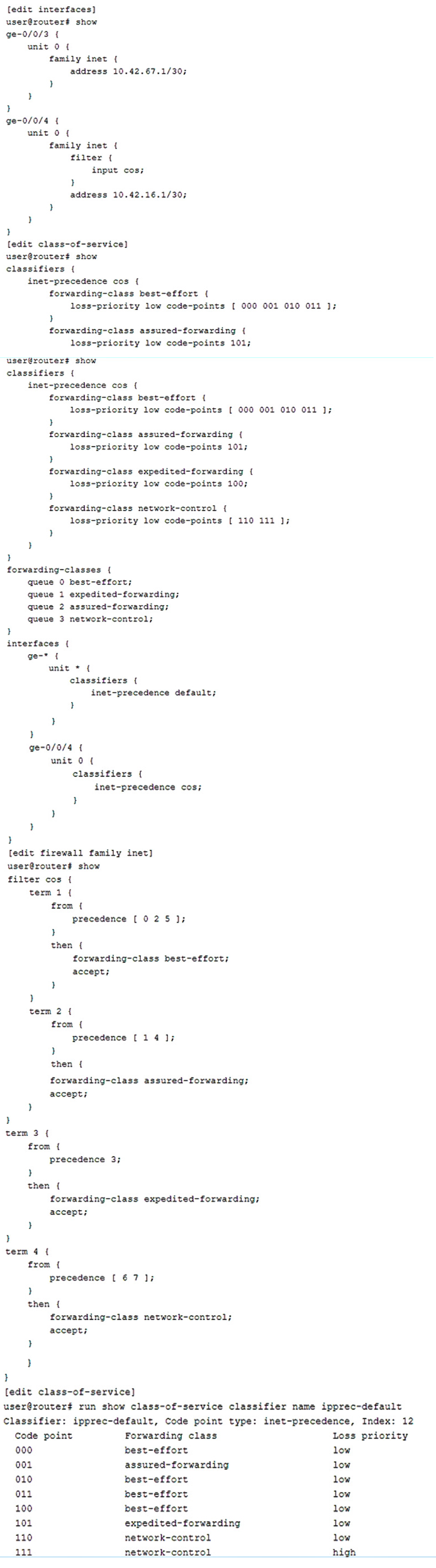
Click the Exhibition button.

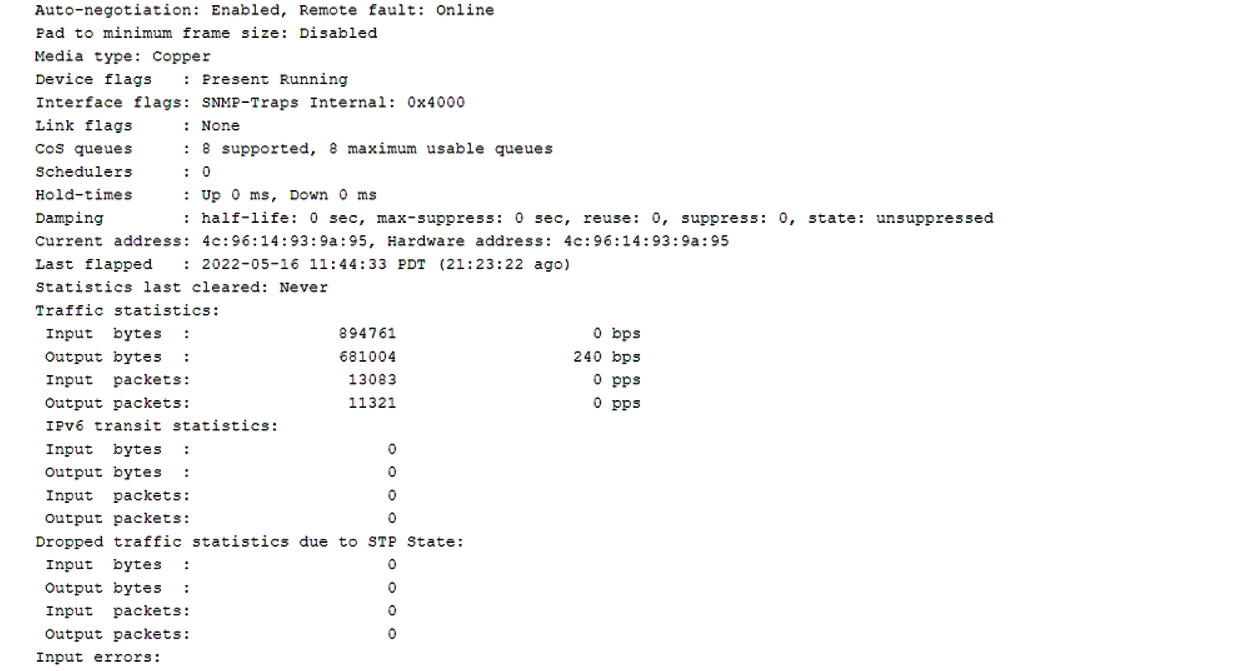
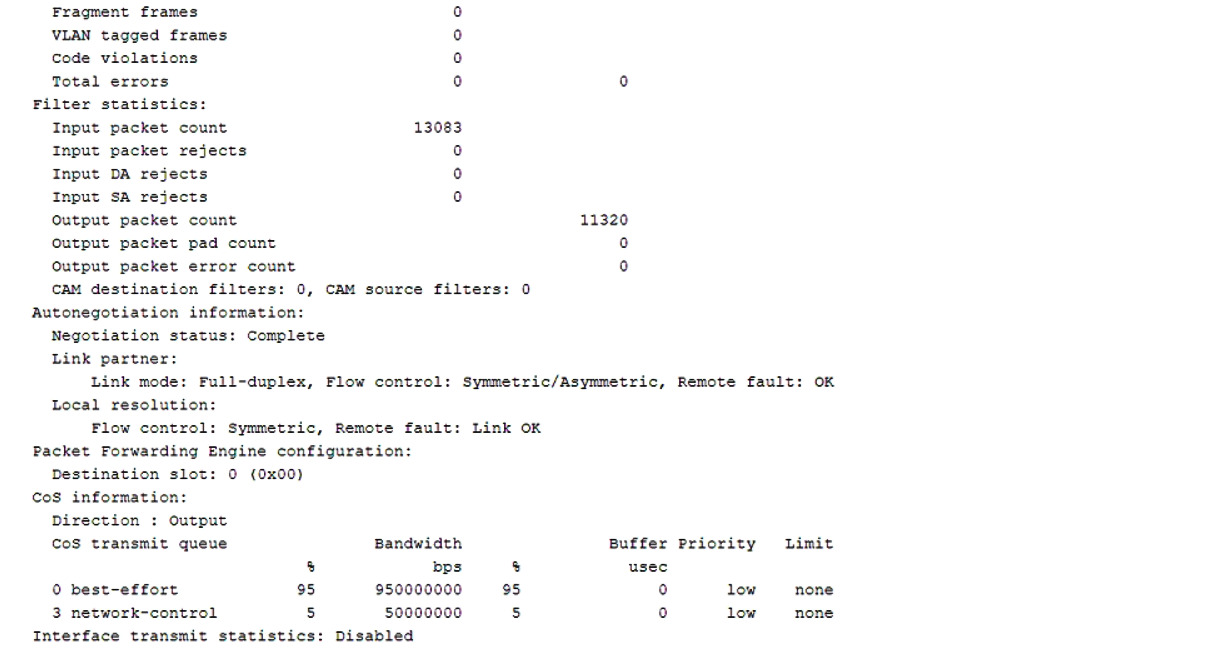
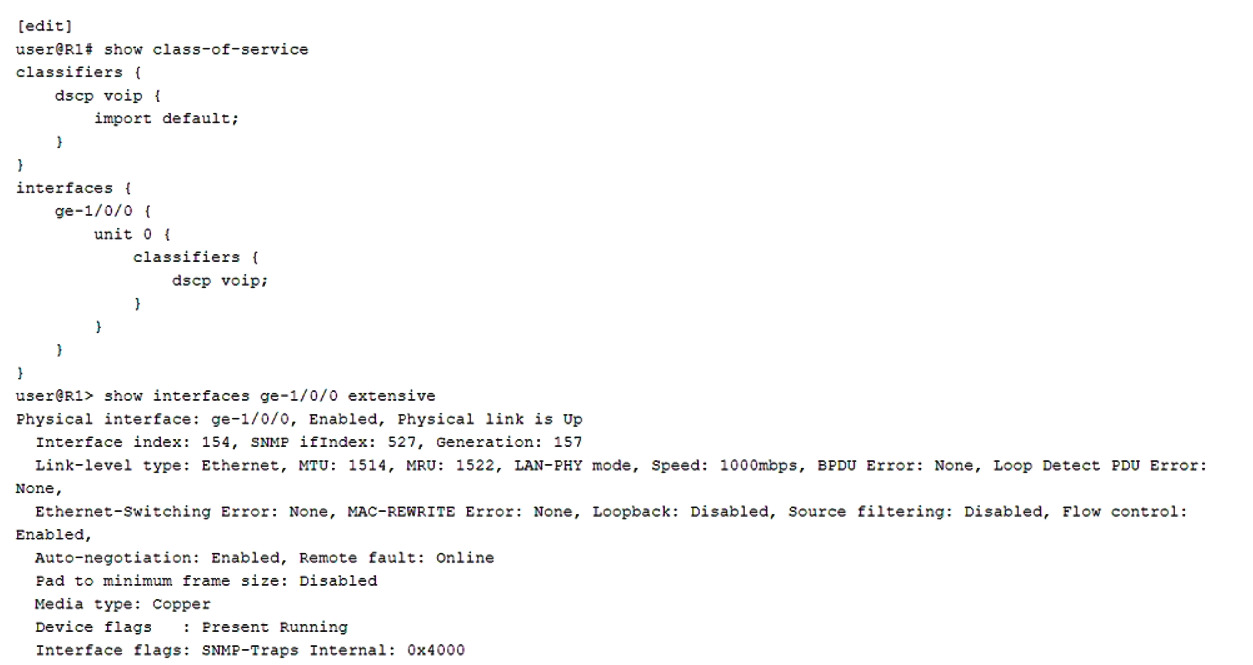
You are asked to troubleshoot voice-quality issues on your newly implemented VoIP network. You notice that voice packets are being dropped. You have verified that the packets are correctly marked for the expedited-forwarding queue.

Referring to the exhibit, what must you configure to solve the problem?
Question Image

Question Image

Question Image

  • A You must configure a multifield classifier to put the VoIP traffic in the correct queue.
  • B You must configure a rewrite rule to ensure that the traffic is scheduled properly in the device.
  • C You must configure a scheduler to allocate bandwidth to the expedited forwarding queue.
  • D You must configure a policer to ensure that the queue is not being starved.
Explanation

Junos default scheduling reserves output-link bandwidth and buffer space only for best-effort and network-control traffic; the expedited-forwarding queue has no reserved resources by default. A scheduler, mapped to the expedited-forwarding forwarding class and applied to the interface, allocates the required bandwidth and queue resources for VoIP traffic.

Learn more

Community Discussion

No comments yet. Be the first to start the discussion!

QuestionQ5

Ethernet Switching and Spanning Tree

Click the Exhibit button.

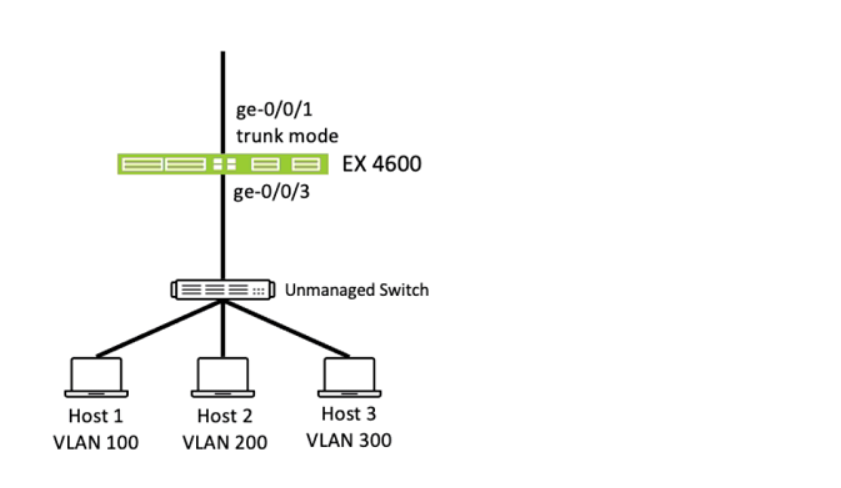
An unmanaged switch is installed between the hosts and the EX Series switch. After traffic enters the EX Series switch, each host must belong to a separate VLAN. How can this task be accomplished?
Question Image

  • A Configure an input firewall filter on interface ge-0/0/3 to match the source MAC or IP address of the hosts to assign the VLANs.
  • B Configure an output firewall filter on interface ge-0/0/1 to match the destination MAC or IP address of the hosts to assign the VLANs.
  • C Configure interface ge-0/0/3 to a mode trunk to assign the VLANs.
  • D Configure VSTP on interface ge-0/0/1 to assign the VLANs.
Explanation

An input Ethernet-switching firewall filter on ge-0/0/3 can match each host’s source MAC or IP address as frames enter the EX4600 and assign the corresponding VLAN. Because the intermediate switch is unmanaged, it does not provide VLAN tags that would distinguish the hosts on the shared uplink; classification must occur at ingress on the EX switch. Juniper documents source MAC and source IP address as EX Series firewall-filter match conditions and supports a VLAN action for ingress VLAN filtering.

Learn more

Community Discussion

No comments yet. Be the first to start the discussion!
Know a question that should be here? Contribute to this exam
Back home