About the Exam

This Juniper specialist-level security exam is for networking professionals with intermediate knowledge of Junos OS for SRX Series devices. It covers security technologies and related platform configuration and troubleshooting skills. The objectives include IDP, IPsec VPNs, Juniper ATP Cloud, HA clustering, identity-aware security policies, SSL proxy, and Security Director. Passing demonstrates competence with configuring, monitoring, and troubleshooting Juniper security features on SRX platforms.

Exam Topics

  • Intrusion Detection and Prevention (IDP)0%
  • IPsec VPN0%
  • Juniper Advanced Threat Prevention (ATP) Cloud0%
  • High Availability (HA) Clustering0%
  • Identity-Aware Security Policies0%
  • SSL Proxy0%
  • Security Director0%

How to Use This Practice Exam

  1. Browse — Read each question, select your answer, and reveal the explanation.
  2. Exam Mode — Simulate real exam conditions with a timed session and score report.
  3. Learn Mode — Spaced repetition schedules questions you struggle with for long-term retention.

Download the Full Exam PDF

Get every question and answer in a clean, printable PDF built for offline study. Purchase once, keep permanent access, and re-download the latest version anytime.

Last updated September 3, 2026 at 7:56 AM

Topic filter
Retired questions
Question sort
Questions per page

QuestionQ1

High Availability (HA) Clustering

An administrator chooses to designate a node as the primary node of a chassis cluster.

Which statement is correct for this scenario?

Explanation

In a Juniper chassis cluster, the eligible node with the highest configured priority is elected primary. A priority of 1 is a valid configured value; it is not excluded from the election process.

Learn more

Community Discussion

No comments yet. Be the first to start the discussion!

QuestionQ2

Identity-Aware Security Policies

What is one function of the Juniper Identity Management Service?

Explanation

Juniper Identity Management Service centralizes user identity data and IP-address-to-user mappings for SRX firewalls. The firewalls use this identity information to populate authentication entries and apply user- or group-based security policies.

Learn more

Community Discussion

No comments yet. Be the first to start the discussion!

QuestionQ3

Intrusion Detection and Prevention (IDP)

You need to ensure that traffic matching an IDP policy is unaffected until administrators can evaluate it.

In this scenario, which IP action should be configured for the policy?

Explanation

ip-notify records the event but does not take action against future matching traffic, allowing administrators to assess the activity without disrupting it. Juniper Junos OS ip-action reference

Learn more

Community Discussion

No comments yet. Be the first to start the discussion!

QuestionQ4

SSL Proxy

You need to configure a forward proxy on your SRX Series device.

Which two statements are correct in this scenario?

Choose two
Explanation

An SRX SSL forward proxy acts as a client when communicating with destination servers. It terminates the client-side TLS session and presents a replacement certificate that is signed by the SRX-configured root CA; client devices must trust that CA. The original server certificate is intercepted rather than forwarded unchanged.

Learn more

Community Discussion

No comments yet. Be the first to start the discussion!

QuestionQ5

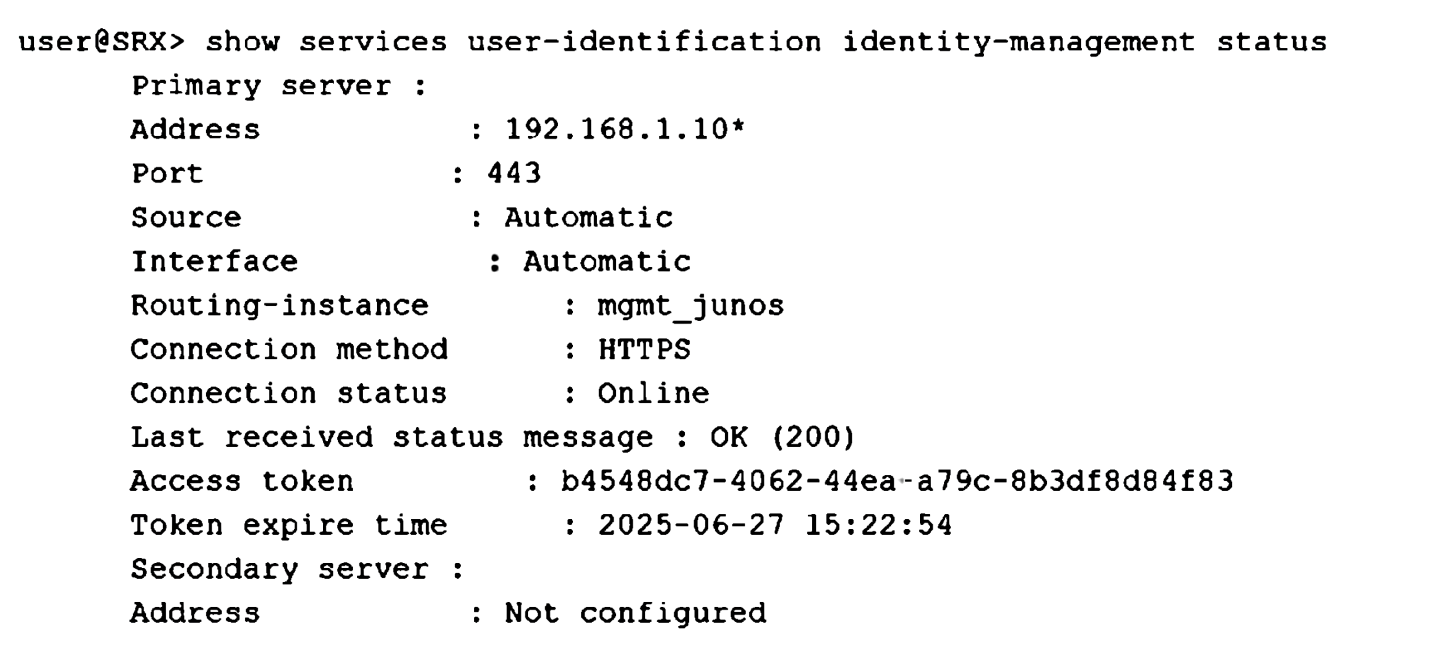
Identity-Aware Security Policies
Question Image

Referring to the exhibit, which two statements are accurate?

Choose two
Explanation

The primary-server address is 192.168.1.10, and its connection status is Online. The connection-status field represents connectivity from the SRX Series Firewall to the Juniper Identity Management Service (JIMS) server. It does not report JIMS connectivity to a domain controller.

Learn more

Community Discussion

No comments yet. Be the first to start the discussion!
Know a question that should be here? Contribute to this exam
Back home