Loading provider exams...

Loading provider exams...

Sign Up & unlock 100% of Exam Questions
No Strings Attached!
Updated
A tablet manufacturer offers the following options for its customers:
Colour – Black, White, Silver, Gold
Model – Standard, Mini, Pro -
Gigabytes – 32, 64, 128, 256 -
Connectivity – Wifi only, Wifi+Cellular
When applying the pairwise test technique, how many TEST CASES would be needed to ensure that ALL pair combinations are tested?
A tablet manufacturer offers the following options for its customers:
Colour – Black, White, Silver, Gold
Model – Standard, Mini, Pro -
Gigabytes – 32, 64, 128, 256 -
Connectivity – Wifi only, Wifi+Cellular
When considering the pairwise test technique, how many pair combinations are there to be tested?
When would the Test Analyst’s involvement in an Agile project normally start?
Which statement BEST describes the activities performed by the Test Analyst during the TEST ANALYSIS stage of the test process?
Which TWO of the following BEST explain why stakeholders should review and understand test conditions and test cases?
To make sure that the requirements have been understood by the testers.
To ensure that adequate coverage of the test basis has been achieved by the tests.
To ensure that the project remains on schedule, as testing is a key activity.
To assess the skills and talent of the test analysts.
To enable the test manager to select the best test approaches in the project test plan.
Want a break from the ads?
Become a Supporter and enjoy a completely ad-free experience, plus unlock Learn Mode, Exam Mode, AstroTutor AI, and more.
You work for an insurance company that is running several parallel projects. You have been asked to advise on the best approach for test case design for each project.
Project A has recently been delivered into production and is planning for its first maintenance release of several minor changes to the user interface. The testers in the maintenance team were involved throughout the development project and will design and manually execute the test cases.
Project B is the development of a new algorithm to improve risk assessment. The testers are experienced in algorithm testing. Test automation is critical as the risk of regression is perceived as high. An audit of the project will be undertaken by an external auditor after the first release into production.
What level of test case design would you recommend for these projects?
You work for an insurance company that is running several parallel projects. You have been asked to advise on the best approach for test case design for each project.
Project C has been experiencing quality issues with the requirements documentation. In previous releases, the requirements were perceived to be vague and inconsistent, prompting many time-consuming questions from the test analysts during analysis and design. For the current release, more formal requirements reviews have been introduced to try and improve quality.
Project D has recognised the need for better regression testing and it is expected that 80% of the test cases created in the next release will form part of the regression pack. The regression tests will be run manually with a plan to introduce automation for future releases.
What should your recommendation be with respect to the level of test case design for projects C and D?
Which task is NOT considered the responsibility of the Test Analyst as part of the test Implementation activities?
A software component for a game application calculates a player’s trophy level based on the following three input parameter values and their associated rules:
Time to Complete Game - Maximum 180 seconds. If the input value exceeds this amount, then the component outputs error message TIME1
Points Earned - minimum 5 to a maximum of 25. If the input value is outside this range the component outputs error message EM1
Level of Difficulty - from 1 to a maximum of 4. If the input value is outside this range the component outputs error message EM2
Assuming there are no error messages, a total score is then calculated by the component as (Points Earned * Level of Difficulty)
The trophy levels are:
Blue - total score equal to or less than 40
Silver - total score > 40 -
Gold - total score > 70 -
Diamond - total score > 80 -
Platinum - total score > 90 -
The component then outputs the correct trophy level
Applying the Equivalence Partition test design technique to this component and assuming that each error message and each trophy level represents a separate output partition, what percentage of the total output partitions have been exercised by the following suite of test cases?
Player 1 - Points earned 25, level of difficulty 2, time 60 seconds.
Player 2 - Points earned 20, level of difficulty 3, time 120 seconds.
Player 3 - Points earned 30, level of difficulty 1, time 200 seconds.
You work for company who are pioneers in smart energy technology. One of their core products is their home energy monitor that displays current and historic energy consumption data to many thousands of customers in their own homes. It has been designed to integrate with their other smart home products, including domestic lighting control systems via their HomeHub.
The company is planning to launch a new application for smartphones and tablets that will allow customers to view their energy readings remotely and also view their daily budget usage based on seasonal historic data. The application must support customers with disabilities.
The application is being delivered using a hybrid mix of agile and V-model methodologies over three iterations:
Iteration 1 - Development of the new application to work on the IOS operating system only.
Iteration 2 - Enhancement to the application to also work on the Android operating system.
Iteration 3 - Enhancement to the application to provide daily budget usage.
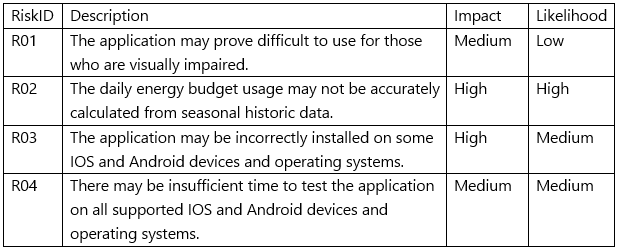
As the test analyst, you have been asked to review the risk register and design test conditions for the highest priority product risks that fall into your area of responsibility, relating to Iterations 1 and 2 only. Which of the following product risks would you design test conditions for first?
Sell-It-Cheap salesrooms organises general and specialist sales where items are sold to the highest bidder. There is a sliding scale of commission charges, based on the price of items sold, with lower-priced items attracting a higher percentage. All items sold have a price in multiples of £1.
Items sold for £150 or less attract a flat-rate fee of £7.00, items otherwise sold for less than £500 have a fee of 6% of the price realised. Items otherwise sold for less than £1000 have a 4.5% fee, with items otherwise sold for less than £5000 having a 3.5% fee. Any items sold for £5000 or more have a 3% fee.
Following customer feedback, Sell-It-Cheap have decided to change one of the existing commission bandings, with items sold between £500 and £749 having a 5.5% fee, and items otherwise less than £1,000 having a 4.5% fee.
What tests would be appropriate to test this change in commission bandings, using the 2-point boundary value analysis technique?
When applying for health insurance from Health4You, applicants are categorised according to their age, sex, the number of units of alcohol they consume in an average week, Body Mass Index (BMI), whether in full-time work and whether a smoker.
Insurance is offered and the premium is calculated according to the following rules:
Insurance cover is NOT given to those aged 70 or more, or below 18.
Those who consume on average more than 14 units of alcohol a week have an additional premium of £25 per month.
Those with a BMI greater than 35 are NOT given insurance cover.
Smokers have an additional premium of £20 per month.
Those in full-time employment have a premium reduction of £20 per month.
How many test cases are required to give full coverage for the above rules when using a decision table that excludes rules containing infeasible combinations of condition values?
When applying for health insurance from Health4You, applicants are categorised according to their age, sex, the number of units of alcohol they consume in an average week, Body Mass Index (BMI), whether in full-time work and whether a smoker.
Insurance is supplied and the premium calculated according to the following rules
Insurance cover is NOT given to those aged 70 or more, or below 18.
Those who consume on average more than 14 units of alcohol a week have an additional premium of £25 per month.
Those with a BMI greater than 35 are NOT given insurance cover.
Smokers have an additional premium of £20 per month.
Those in full-time employment have a premium reduction of £20 per month.
How many test cases are required to give full coverage for the above rules when applying collapsed decision table testing and excluding rules that either have infeasible combinations of condition values or have conflicting condition values?
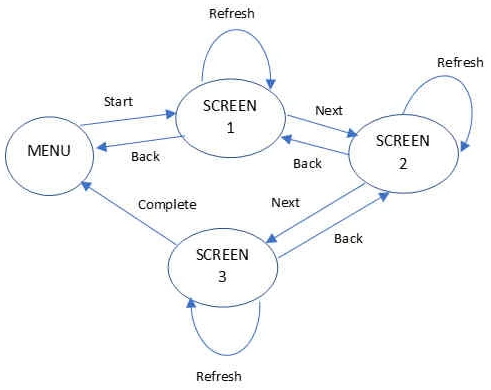
Applying the State Transition test technique to the State Transition diagram above, how many invalid transitions are there to test?
A web-based system is being developed to support the administration of tennis tournaments.
The system provides advice on how much money to offer each player as their individual attendance fee. The amount depends on a COMBINATION of the following factors:
Overall attendance fund (divided into five numeric ranges).
Player’s current world ranking (divided into ten numeric ranges).
Whether it is a local tournament for the player (i.e. YES or NO)
Their relationship with the tournament sponsors (i.e. clothing, equipment, or endorsement).
Their previous attendance history at this event (i.e. finalist, played, withdrew before event or withdrew during event)
The new system needs to be ready for the next tournament in just a few months’ time, so testing schedules will be severely challenged.
Which specification-based technique would be the BEST choice in the circumstances?
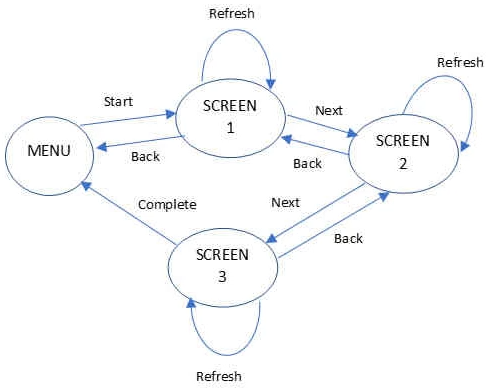
When applying the StateTransition test technique to the State Transition diagram above, and assuming that screen refreshes can be applied multiple times, how many 1-switch transitions are there starting from the state ‘Screen 1’?
The following depicts a main path through the use case, ‘Return Item’:
USE CASE: Return Item -
Use case ID: UC14 -
Purpose: Customer selects an item for return and prints return label
Actors: Customer, System -
Pre-conditions: Customer has opened shopping site home page
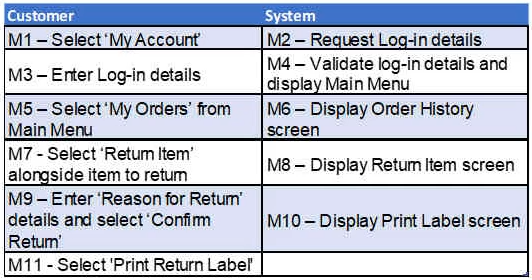
The following Exceptions have been defined:
E1. Customer is already logged-in to account, therefore Main Menu displayed. Occurs at step M2.
E2. Invalid Log-in details entered, prompt for re-try. Occurs at step M4.
E3. Third invalid log-in attempt, account frozen for 24 hours and process ended. Occurs at step M4.
E4. Go-Back requested. Occurs at steps M7 (to go back to ‘Main Menu’) and M9 (to go back to ‘Order History’ screen).
You are to apply the Use Case test technique, where the following coverage rules have been defined in the test plan:
One test case should be designed for the basic behaviour.
Multiple alternate behaviours may be incorporated into a single test case provided they are mutually compatible.
Nested alternate behaviours, where there are termination versus non-termination alternate behaviours within a “retry” exception behaviour, should be amalgamated into single test case.
Applying these rules to the Return Item Use Case, how many test cases should be designed?
A web-based system is being developed to support the administration of tennis tournaments.
The system provides advice on how much money to offer each player as their individual attendance fee. The amount depends on a COMBINATION of the following factors:
Overall attendance fund (divided into five numeric ranges).
Player’s current world ranking (divided into ten numeric ranges (i.e. top 10, top 20, top 30, other).
Whether it is a local tournament for the player (i.e. YES or NO)
Their relationship with the tournament sponsors (i.e. clothing, equipment, or endorsement).
Their previous attendance history at this event (i.e. finalist, played, withdrew before event or withdrew during event)
It has been noted that the attendance fee calculation does not take account of ‘last minute’ invitations that are made to replace a player who withdraws close to the tournament start date. In this case enhanced attendance fees are offered depending on whether the invitation is made within a week, a fortnight, or a month of the tournament start date.
Which of the following specification-based techniques would be the BEST choice for testing that the appropriate fees are calculated for the ‘last minute’ scenario, and what type of defect is being targeted by the testing?
Which of the following statements BEST describes checklist based and black-box test techniques?
You have been asked to set up a session-based test management (SBTM) approach for exploratory testing on your current project. Which of the options below describes a correct sequence of steps for the first exploratory test session?
Which of the following statements about defect based techniques is TRUE?
You work for a software testing consultancy firm, SOFTEST, that specialises in the travel industry. It has built up a portfolio of clients across two main travel sectors; the airline and rail sectors. SOFTEST has an established test process, an experienced team of testers and maintains comprehensive organizational defect taxonomies for both sectors.
Two new projects are underway –
Project A is for a new cruise sector client. It will deliver a new user interface allowing its customers to search for cruises using several drop-down fields, each with many values, providing a much greater range of combinations than customers previously had. The project is using a SCRUM methodology with 2 week sprints and well specified user stories.
Project B is an existing airline sector client, who is upgrading the business rules engine that determines how air miles are allocated to its customers. Regression testing must also be performed to ensure the rules engines does not introduce defects in other areas, however, time is limited and there is no existing regression pack. Experienced cruise sector testers have been recruited by SOFTEST to support test effort on this project
Which option below describes the BEST test techniques to apply for each project?
A major upgrade of business software has been undertaken, with many new facilities added in response to the wishes of the (internal company) staff. There are now very different screens presented to users, depending on their roles within the business. Due to the nature of the business, computational accuracy is regarded as the area of greatest business risk.
Which of the following quality characteristics would you focus on the MOST when testing the system?
You are testing a significant enhancement to the user interface design for a mortgage approval program, used internally by mortgage lenders.
There are many user roles involved in the process of reviewing and approving new mortgage applications. You have completed the testing that ensures the enhancements are functionally correct and you must now ensure that the enhanced user interface meets the needs of all user roles in a way that will be considered acceptable by them.
Which test technique would be MOST suitable for this next stage of testing?
Which of the following is a TYPICAL defect found in functional completeness testing?