About the Exam

HCIE-Datacom (Written) covers advanced routing and switching technologies, enterprise network architecture, campus network planning, Huawei CloudCampus, WAN interconnection, Huawei SD-WAN, bearer WAN, CloudWAN, and network automation. It is intended for candidates pursuing HCIE-Datacom and for datacom network experts. Passing indicates professional knowledge and skills for multi-scenario datacom convergence solutions and the ability to plan, deploy, maintain, and optimize networks with Huawei Datacom products and solutions.

Exam Topics

  • 高级路由交换技术37%
  • 园区网络规划与部署23%
  • 广域互联网络规划与部署8%
  • 广域承载网络规划与部署15%
  • 网络自动化17%

How to Use This Practice Exam

  1. Browse — Read each question, select your answer, and reveal the explanation.
  2. Exam Mode — Simulate real exam conditions with a timed session and score report.
  3. Learn Mode — Spaced repetition schedules questions you struggle with for long-term retention.

Download the Full Exam PDF

Get every question and answer in a clean, printable PDF built for offline study. Purchase once, keep permanent access, and re-download the latest version anytime.

Last updated June 14, 2026 at 9:51 AM

Topic filter
Question status
Question sort
Questions per page

QuestionQ1

Verified高级路由交换技术

Which of the following BGP route attributes cannot be used to influence BGP route selection?

Explanation

ORIGINATOR_ID is carried by BGP route reflectors to prevent routing loops: a router discards a reflected route when its own BGP identifier appears as the ORIGINATOR_ID. It is not evaluated as a BGP best-path selection attribute.

Community Discussion

No comments yet. Be the first to start the discussion!

QuestionQ2

Verified高级路由交换技术

By default, an OSPF process’s domain ID is the same as its process ID. You can use the domain-id command in the OSPF process view to change the domain ID.

Explanation

The default OSPF domain ID is NULL. Although domain-id is configured in OSPF view to set a domain identifier, it does not default to the OSPF process ID.

Learn more

Community Discussion

No comments yet. Be the first to start the discussion!

QuestionQ3

Verified高级路由交换技术

VXLAN uses 24-bit VNIs to identify tenants. A tenant may have one or more VNIs, and VXLAN supports a maximum of 12 million tenants.

Explanation

A 24-bit VXLAN Network Identifier provides a namespace of approximately 16 million unique VXLAN segments, not a maximum of 12 million tenants. Cisco documentation identifies the VNI as a 24-bit segment identifier and states that it supports up to 16 million VXLAN segments.

Learn more

Community Discussion

No comments yet. Be the first to start the discussion!

QuestionQ4

Verified高级路由交换技术

During SSH algorithm negotiation, the SSH server and client exchange lists of the algorithms they support. The SSH server's list of symmetric encryption algorithms is: aes256-ctr, aes192-ctr, aes128-ctr, and aes256-cbc. The SSH client's list of symmetric encryption algorithms is: aes128-ctr, aes192-ctr, aes256-ctr, and aes256-cbc.

Which of the following symmetric encryption algorithms can be used by both the SSH server and client?

Explanation

SSH chooses the first symmetric encryption algorithm in the client’s preference list that is also supported by the server. Since aes128-ctr is first in the client list and is present in the server list, it is the negotiated cipher.

Learn more

Community Discussion

No comments yet. Be the first to start the discussion!

QuestionQ5

Verified高级路由交换技术

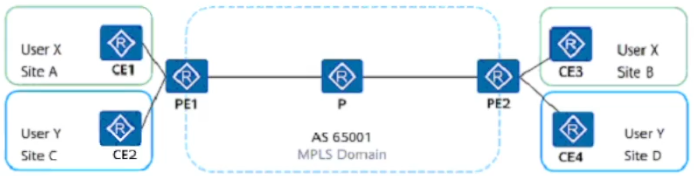
As illustrated, PE1 and PE2 exchange private-network route information with their respective CEs using OSPF, and PE1 and PE2 have the same domain ID configured. Which LSA type may be sent to CE2 when PE2 imports BGP routes into the OSPF process?

Question Image

Explanation

When the local OSPF domain ID matches the remote domain ID carried with a BGP VPN route, the PE advertises the route as an inter-area route using a Type 3 LSA. Type 5 or Type 7 LSAs are used when the domain IDs differ or are incompatible, depending on whether the receiving area is a normal area or an NSSA.

Learn more

Community Discussion

No comments yet. Be the first to start the discussion!
Know a question that should be here? Contribute to this exam
Back home