About the Exam

This HCIP-Datacom exam covers advanced routing and switching knowledge in Huawei's datacom track, including advanced IGP and BGP features, IPv6 routing, Ethernet technologies, MPLS, network O&M, troubleshooting, and cutover. It is intended for candidates aiming for senior datacom engineer roles and is recommended after HCIA-Datacom. Passing the certification pathway indicates you can plan, design, deploy, maintain, and troubleshoot medium-to-large enterprise networks using Huawei datacom devices.

Exam Topics

  • Cloud-based Architecture Design of Enterprises1%
  • Underlying Cloud Technologies10%
  • Cloud-based Architecture Design25%
  • Cloud Migration23%
  • Cloud O&M and Optimization11%
  • Cloud Service Enablement14%
  • Industry Best Practices of Huawei Cloud16%

How to Use This Practice Exam

  1. Browse — Read each question, select your answer, and reveal the explanation.
  2. Exam Mode — Simulate real exam conditions with a timed session and score report.
  3. Learn Mode — Spaced repetition schedules questions you struggle with for long-term retention.

Download the Full Exam PDF

Get every question and answer in a clean, printable PDF built for offline study. Purchase once, keep permanent access, and re-download the latest version anytime.

Last updated September 6, 2026 at 5:47 PM

Topic filter
Question status
Question sort
Questions per page

QuestionQ1

VerifiedUnderlying Cloud Technologies

While troubleshooting an EBGP neighbor relationship, you discover that two directly connected devices use Loopback ports to establish the connection. Run display current-configuration configuration bgp to view the configuration of peer ebgp-max-hop hop-count. Which statement is correct?

Explanation

For directly connected devices that establish an EBGP peer relationship through Loopback interfaces, peer ebgp-max-hop must specify a hop count greater than 1 (at least 2). A hop count of 1 permits only a directly connected physical-link EBGP session.

Learn more

Community Discussion

No comments yet. Be the first to start the discussion!

QuestionQ2

VerifiedUnderlying Cloud Technologies

Which of these statements about IS-IS (IPv6) is correct?

Choose three
Explanation

IS-IS IPv6 extensions use the IPv6 NLPID in the Protocols Supported TLV, define TLV 232 for IPv6 interface addresses, and define TLV 236 for IPv6 reachability. IPv6 support therefore is not implemented by adding only one TLV. Multi-topology is the default IPv6 operating mode in implementations that use independent IPv4 and IPv6 topologies by default.

Learn more

Community Discussion

No comments yet. Be the first to start the discussion!

QuestionQ3

VerifiedUnderlying Cloud Technologies

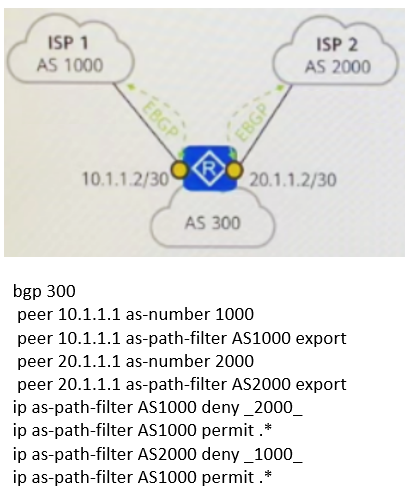
An enterprise leased lines from two operators. To optimize routing, it used the 6GP protocol to learn route entries from both operators. However, after this configuration, outbound-routing traffic increased significantly. Network-engineering investigation found that traffic between the two operators was being forwarded through the enterprise’s export router.
Question Image

Therefore, the enterprise plans to use routing policies to prevent traffic between different operators from transiting each other. Is the configuration shown correct?

Explanation

The AS-path filter applied when exporting to AS2000 has deny _1000_ but lacks a subsequent permit .* rule because the final permit rule is assigned to AS1000 instead. AS-path filters deny routes by default when no permit rule matches, so this suppresses all route advertisements to AS2000 instead of only routes learned from AS1000. A correct AS2000 filter must include ip as-path-filter AS2000 permit .* after its deny rule. Huawei documents that a filter containing only deny rules blocks all routes unless a permit rule is added.

Learn more

Community Discussion

No comments yet. Be the first to start the discussion!

QuestionQ4

VerifiedUnderlying Cloud Technologies

In OSPF, an ABR converts all Type 7 LSAs in an NSSA area into Type 5 LSAs.

Explanation

An NSSA ABR translates eligible Type 7 external LSAs into Type 5 external LSAs for propagation outside the NSSA; it does not translate all Type 7 LSAs unconditionally.

Community Discussion

No comments yet. Be the first to start the discussion!

QuestionQ5

VerifiedUnderlying Cloud Technologies

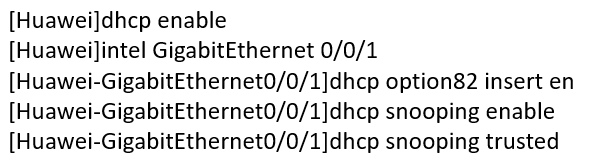
Concerning MP-BGP, which of the following statements is incorrect?
Explanation

The multiprotocol BGP attributes are MP_REACH_NLRI for reachable destinations and MP_UNREACH_NLRI for withdrawn or unreachable destinations. MP_UREACH_NLRI is not a defined MP-BGP attribute.

Learn more

Community Discussion

No comments yet. Be the first to start the discussion!
Know a question that should be here? Contribute to this exam
Back home