Loading provider exams...

Loading provider exams...

Sign Up & unlock 100% of Exam Questions
No Strings Attached!
Updated
Refer to the scenario.
A customer requires these rights for clients in the “medical-mobile” AOS firewall role on Aruba Mobility Controllers (MCs):
Permitted to receive IP addresses with DHCP
Permitted access to DNS services from 10.8.9.7 and no other server
Permitted access to all subnets in the 10.1.0.0/16 range except denied access to 10.1.12.0/22
Denied access to other 10.0.0.0/8 subnets
Permitted access to the Internet
Denied access to the WLAN for a period of time if they send any SSH traffic
Denied access to the WLAN for a period of time if they send any Telnet traffic
Denied access to all high-risk websites
External devices should not be permitted to initiate sessions with “medical-mobile” clients, only send return traffic.
The exhibits below show the configuration for the role.
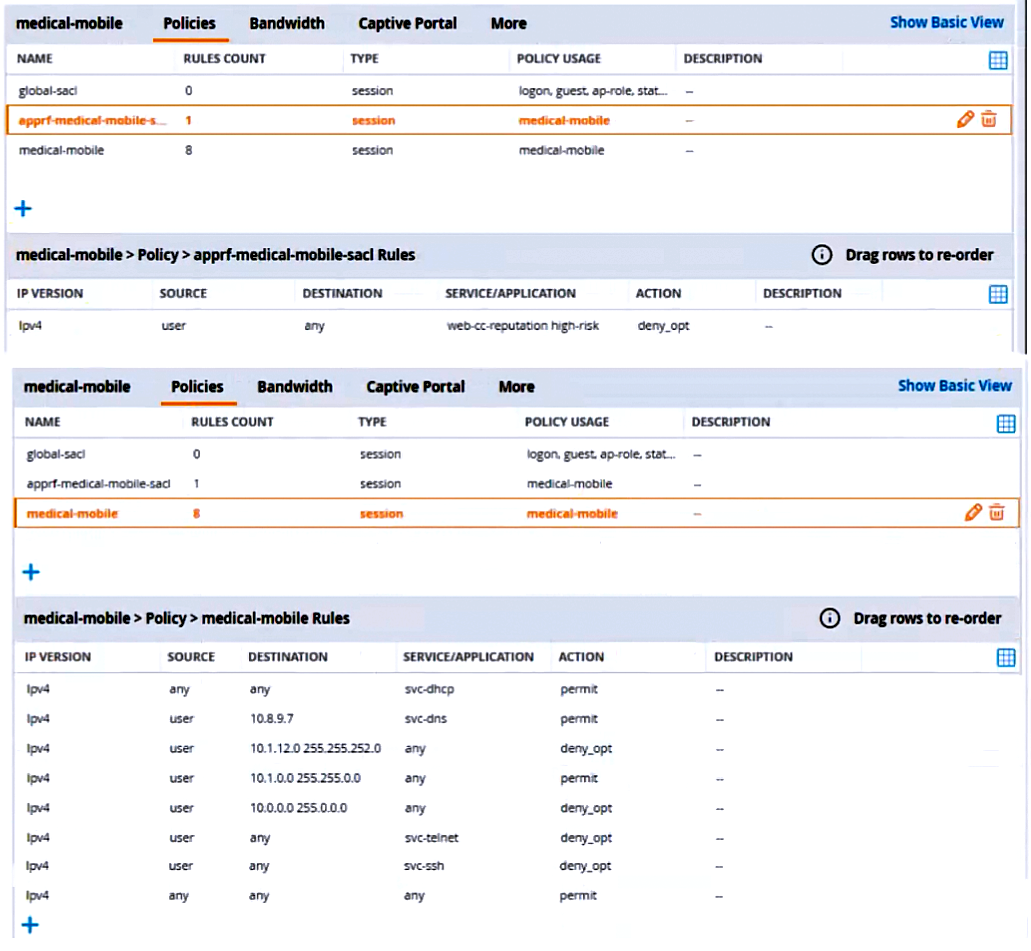
There are multiple issues with this configuration. What is one change you must make to meet the scenario requirements? (In the options, rules in a policy are referenced from top to bottom. For example, “medical-mobile” rule 1 is “ipv4 any any svc-dhcp permit,” and rule 8 is “ipv4 any any any permit”.)
This exam has 58 community-verified practice questions. Create a free account to access all questions, comments, and explanations.
Refer to the scenario.
A customer has an Aruba ClearPass cluster. The customer has AOS-CX switches that implement 802.1X authentication to ClearPass Policy Manager (CPPM).
Switches are using local port-access policies.
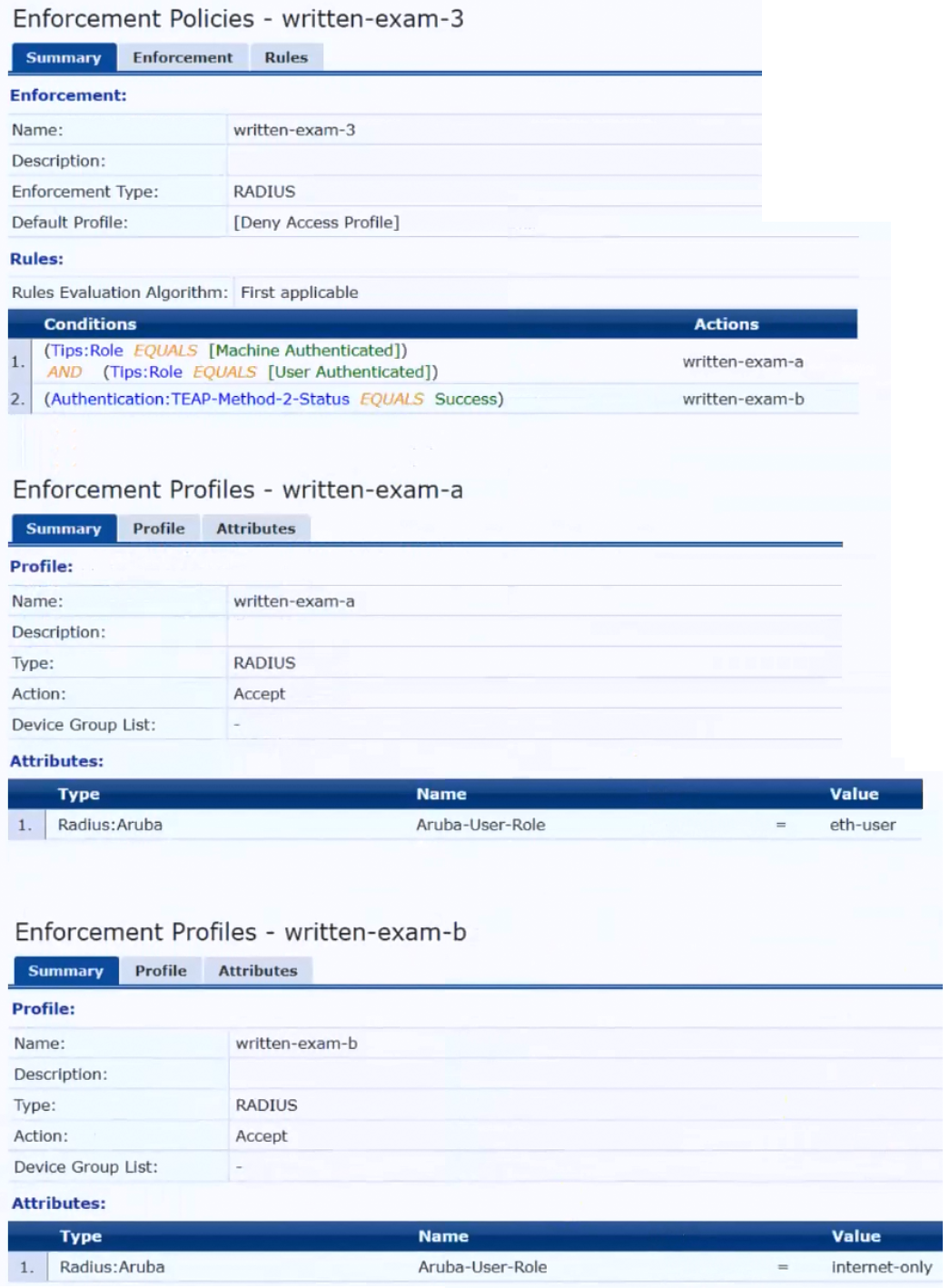
The customer wants to start tunneling wired clients that pass user authentication only to an Aruba gateway cluster. The gateway cluster should assign these clients to the “eth-internet" role. The gateway should also handle assigning clients to their VLAN, which is VLAN 20.
The plan for the enforcement policy and profiles is shown below:
The gateway cluster has two gateways with these IP addresses:
• Gateway 1
o VLAN 4085 (system IP) = 10.20.4.21
o VLAN 20 (users) = 10.20.20.1
o VLAN 4094 (WAN) = 198.51.100.14
• Gateway 2
o VLAN 4085 (system IP) = 10.20.4.22
o VLAN 20 (users) = 10.20.20.2
o VLAN 4094 (WAN) = 198.51.100.12
• VRRP on VLAN 20 = 10.20.20.254
The customer requires high availability for the tunnels between the switches and the gateway cluster. If one gateway falls, the other gateway should take over its tunnels. Also, the switch should be able to discover the gateway cluster regardless of whether one of the gateways is in the cluster.
You are setting up the UBT zone on an AOS-CX switch.
Which IP addresses should you define in the zone?
A company has an Aruba ClearPass server at 10.47.47.8, FQDN radius.acnsxtest.local. This exhibit shows ClearPass Policy Manager's (CPPM's) settings for an Aruba Mobility Controller (MC).
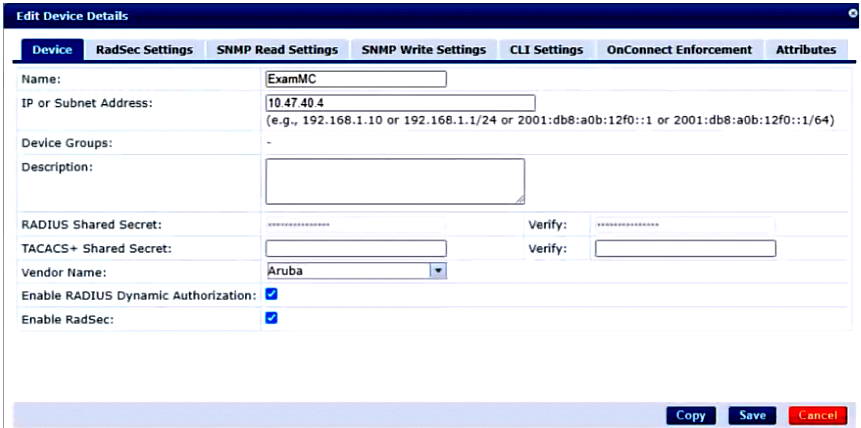
The MC is already configured with RADIUS authentication settings for CPPM, and RADIUS requests between the MC and CPPM are working. A network admin enters and commits this command to enable dynamic authorization on the MC: aaa rfc-3576-server 10.47.47.8
But when CPPM sends CoA requests to the MC, they are not working. This exhibit shows the RFC 3576 server statistics on the MC:
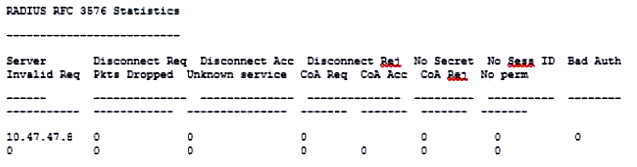
How could you fix this issue?
Refer to the scenario.
A customer has an Aruba ClearPass cluster. The customer has AOS-CX switches that implement 802.1X authentication to ClearPass Policy Manager (CPPM).
Switches are using local port-access policies.
The customer wants to start tunneling wired clients that pass user authentication only to an Aruba gateway cluster. The gateway cluster should assign these clients to the “eth-internet" role. The gateway should also handle assigning clients to their VLAN, which is VLAN 20.
The plan for the enforcement policy and profiles is shown below:
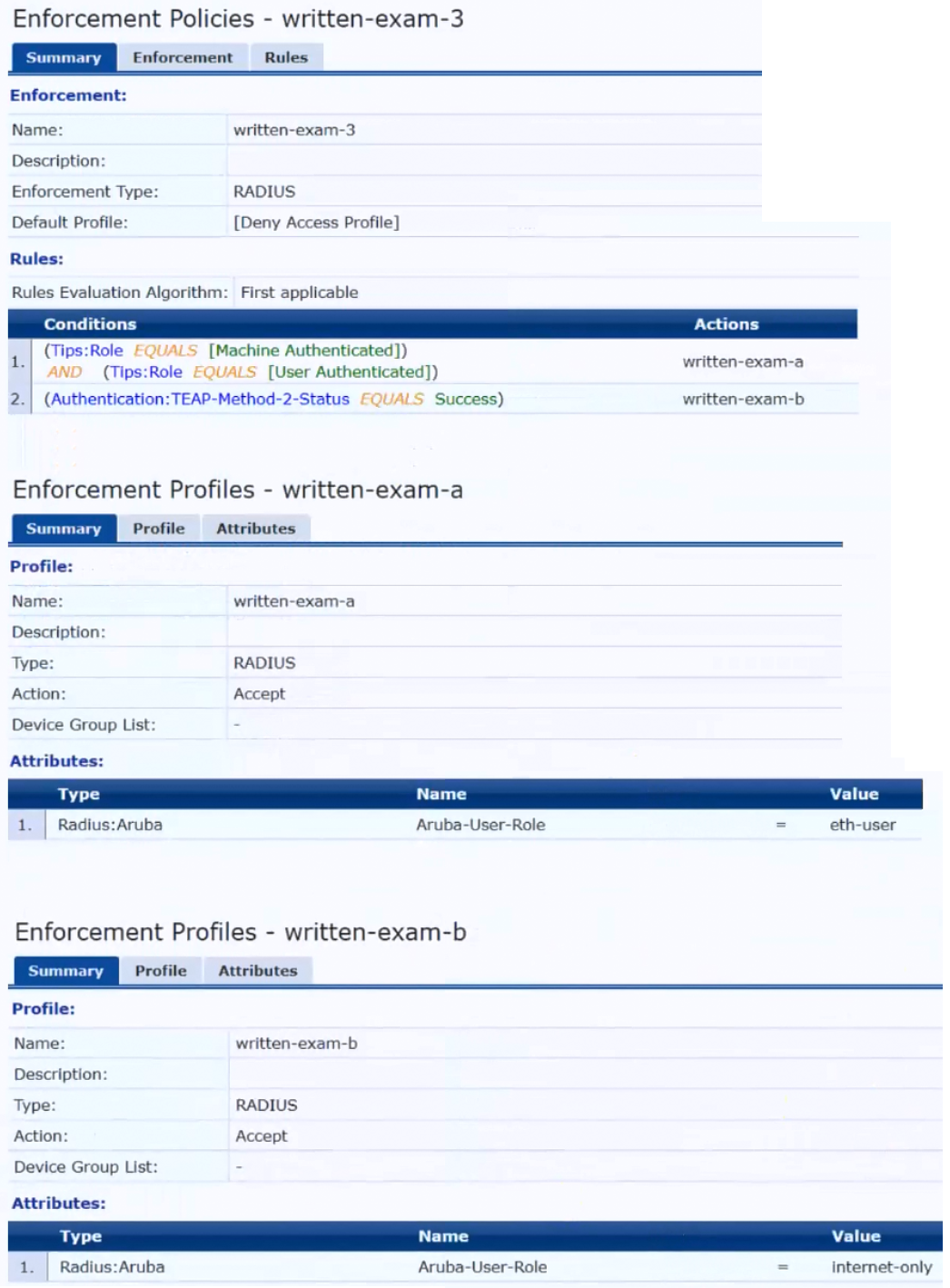
The gateway cluster has two gateways with these IP addresses:
• Gateway 1
o VLAN 4085 (system IP) = 10.20.4.21
o VLAN 20 (users) = 10.20.20.1
o VLAN 4094 (WAN) = 198.51.100.14
• Gateway 2
o VLAN 4085 (system IP) = 10.20.4.22
o VLAN 20 (users) = 10.20.20.2
o VLAN 4094 (WAN) = 198.51.100.12
• VRRP on VLAN 20 = 10.20.20.254
The customer requires high availability for the tunnels between the switches and the gateway cluster. If one gateway falls, the other gateway should take over its tunnels. Also, the switch should be able to discover the gateway cluster regardless of whether one of the gateways is in the cluster.
Assume that you have configured the correct UBT zone and port-access role settings. However, the solution is not working.
What else should you make sure to do?
Refer to the scenario.
A customer is migrating from on-prem AD to Azure AD as its sole domain solution. The customer also manages both wired and wireless devices with Microsoft Endpoint Manager (Intune).
The customer wants to improve security for the network edge. You are helping the customer design a ClearPass deployment for this purpose. Aruba network devices will authenticate wireless and wired clients to an Aruba ClearPass Policy Manager (CPPM) cluster (which uses version 6.10).
The customer has several requirements for authentication. The clients should only pass EAP-TLS authentication if a query to Azure AD shows that they have accounts in Azure AD. To further refine the clients’ privileges, ClearPass also should use information collected by Intune to make access control decisions.
The customer wants you to configure CPPM to collect information from Intune on demand during the authentication process.
What should you tell the Intune admins about the certificates issued to clients?
Want a break from the ads?
Become a Supporter and enjoy a completely ad-free experience, plus unlock Learn Mode, Exam Mode, AstroTutor AI, and more.
Refer to the scenario.
A customer is migrating from on-prem AD to Azure AD as its sole domain solution. The customer also manages both wired and wireless devices with Microsoft Endpoint Manager (Intune).
The customer wants to improve security for the network edge. You are helping the customer design a ClearPass deployment for this purpose. Aruba network devices will authenticate wireless and wired clients to an Aruba ClearPass Policy Manager (CPPM) cluster (which uses version 6.10).
The customer has several requirements for authentication. The clients should only pass EAP-TLS authentication if a query to Azure AD shows that they have accounts in Azure AD. To further refine the clients’ privileges, ClearPass also should use information collected by Intune to make access control decisions.
You are planning to use Azure AD as the authentication source in 802.1X services.
What should you make sure that the customer understands is required?
Refer to the exhibit.
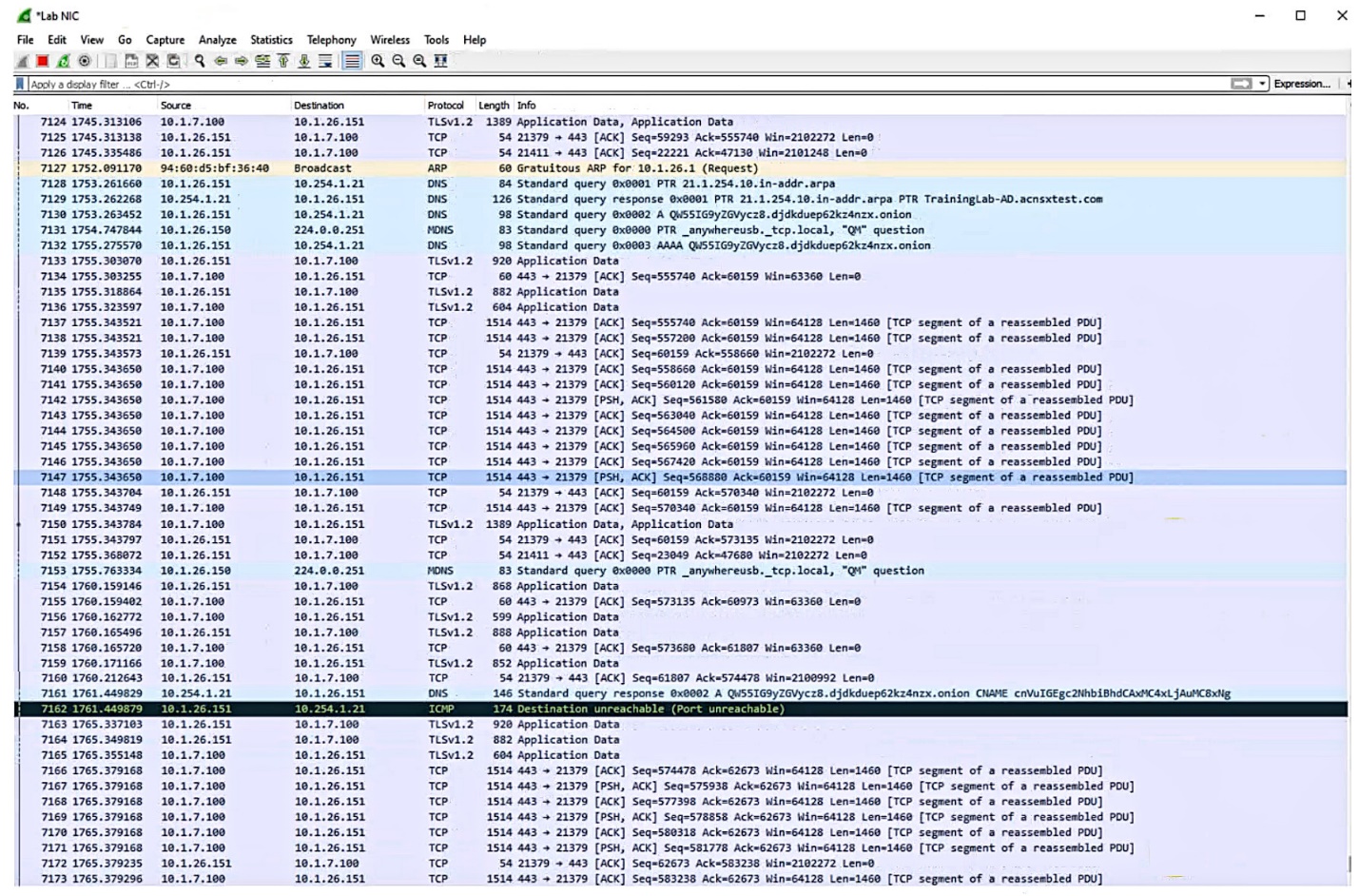
Which security issue is possibly indicated by this traffic capture?
A company has Aruba gateways and wants to start implementing gateway IDS/IPS. The customer has selected Block for the Fail Strategy.
What might you recommend to help minimize unexpected outages caused by using this particular fall strategy?
You are designing an Aruba ClearPass Policy Manager (CPPM) solution for a customer. You learn that the customer has a Palo Alto firewall that filters traffic between clients in the campus and the data center.
Which integration can you suggest?
Refer to the exhibit.
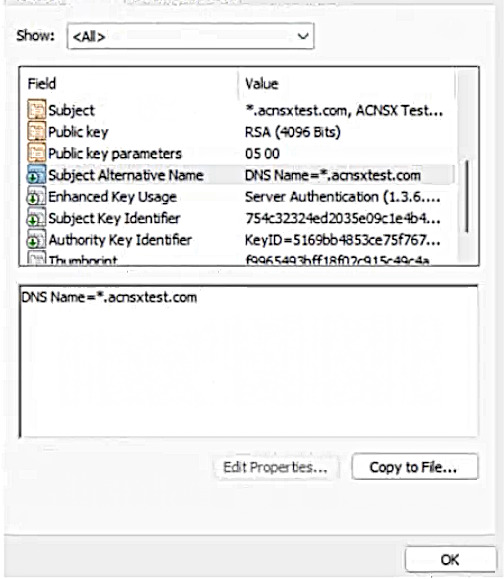
You have been given this certificate to install on a ClearPass server for the RADIUS/EAP and RadSec usages.
What is one issue?
Refer to the scenario.
You are helping a company add Aruba ClearPass to their network, which uses Aruba network infrastructure devices.
The company currently has a Windows domain and Windows CA. The Window CA issues certificates to domain computers, domain users, and servers such as domain controllers. An example of a certificate issued by the Windows CA is shown here.
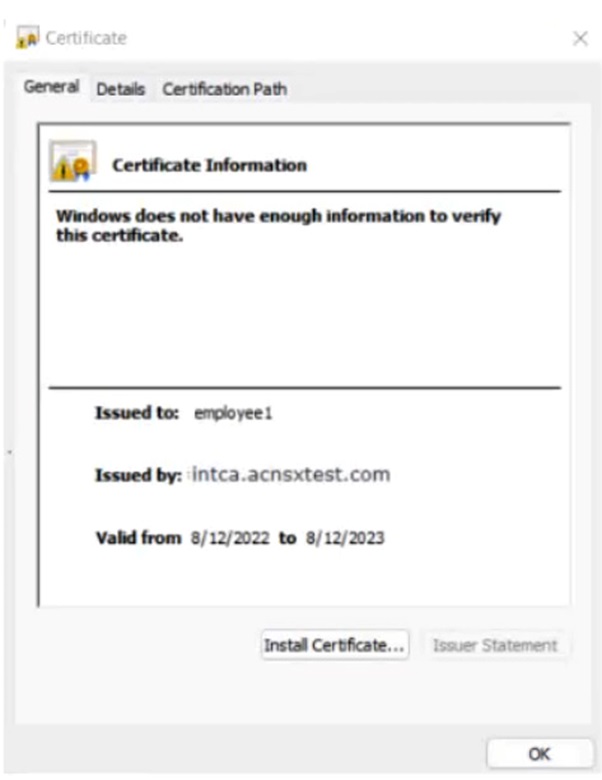
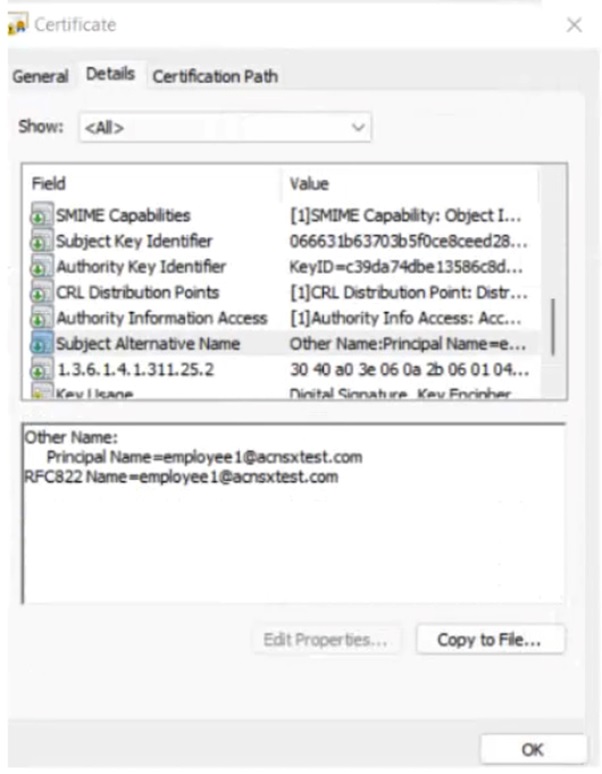
The company is in the process of adding Microsoft Endpoint Manager (Intune) to manage its mobile clients. The customer is maintaining the on-prem AD for now and uses Azure AD Connect to sync with Azure AD.
The company wants to use ClearPass Onboard to deploy certificates automatically to mobile clients enrolled in Intune. During this process, Onboard should communicate with Azure AD to validate the clients. High availability should also be provided for this scenario; in other words, clients should be able to get certificates from Subscriber 2 if Subscriber 1 is down.
The Intune admins intend to create certificate profiles that include a UPN SAN with the UPN of the user who enrolled the device.
The customer requires all types of clients to connect and authenticate on the same corporate SSID.
The company wants CPPM to use these authentication methods:
EAP-TLS to authenticate users on mobile clients registered in Intune
TEAR, with EAP-TLS as the inner method to authenticate Windows domain computers and the users on them
To succeed, EAP-TLS (standalone or as a TEAP method) clients must meet these requirements:
Their certificate is valid and is not revoked, as validated by OCSP
The client’s username matches an account in AD
After authentication, the customer wants the CPPM to assign clients to ClearPass roles based on the following rules:
Clients with certificates issued by Onboard are assigned the “mobile-onboarded” role
Clients that have passed TEAP Method 1 are assigned the “domain-computer” role
Clients in the AD group “Medical” are assigned the “medical-staff” role
Clients in the AD group “Reception” are assigned to the “reception-staff” role
The customer requires CPPM to assign authenticated clients to AOS firewall roles as follows:
Assign medical staff on mobile-onboarded clients to the “medical-mobile” firewall role
Assign other mobile-onboarded clients to the “mobile-other” firewall role
Assign medical staff on domain computers to the “medical-domain” firewall role
All reception staff on domain computers to the “reception-domain” firewall role
All domain computers with no valid user logged in to the “computer-only” firewall role
Deny other clients access -
Communications between ClearPass servers and on-prem AD domain controllers must be encrypted.
For the network infrastructure, this customer has Aruba APs and Aruba gateways, which are managed by Central. APs use tunneled WLANs, which tunnel traffic to the gateway cluster. The customer also has AOS-CX switches that are not managed by Central at this point.
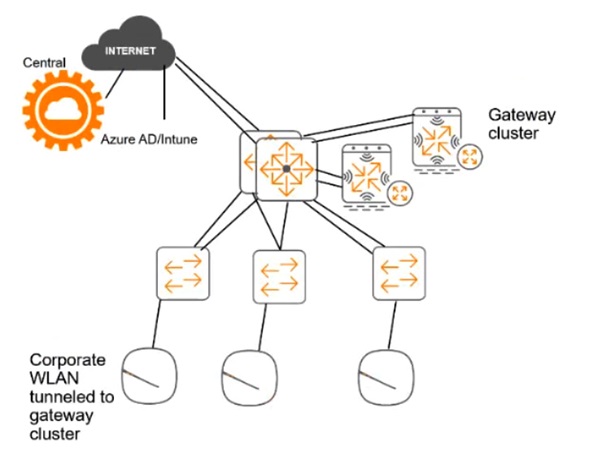
A customer’s ClearPass cluster has these IP addresses:
Publisher = 10.47.47.5 -
Subscriber 1 = 10.47.47.6 -
Subscriber 2 = 10.47.47.7 -
Virtual IP with Subscriber 1 and Subscriber 2 = 10.47.47.8
The customer’s DNS server has these entries
cp.acnsxtest.com = 10.47.47.5
cps1.acnsxtest.com = 10.47.47.6
cps2.acnsxtest.com = 10.47.47.7
radius.acnsxtest.com = 10.47.47.8
onboard.acnsxtest.com = 10.47.47.8
You cannot see flow attributes for wireless clients.
What should you check?
Several AOS-CX switches are responding to SNMPv2 GET requests for the public community. The customer only permits SNMPv3. You have asked a network admin to fix this problem. The admin says, “I tried to remove the community, but the CLI output an error.”
What should you recommend to remediate the vulnerability and meet the customer’s requirements?
Refer to the exhibit.
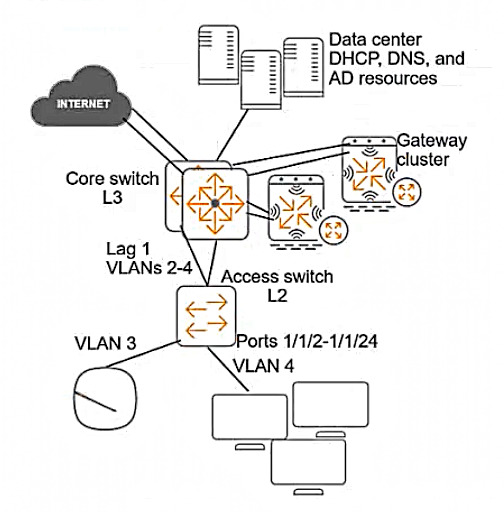
A customer requires protection against ARP poisoning in VLAN 4. Below are listed all settings for VLAN 4 and the VLAN 4 associated physical interfaces on the AOS-CX access layer switch:
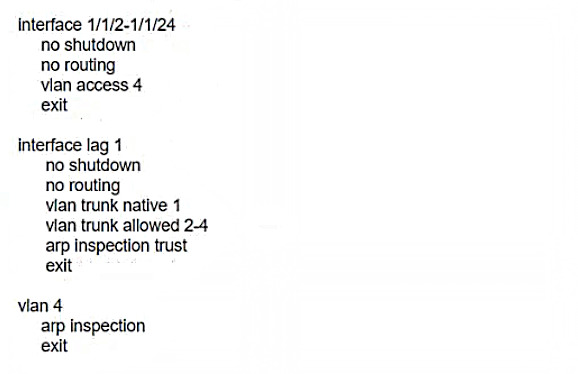
What is one issue with this configuration?
Refer to the scenario.
A customer has an Aruba ClearPass cluster. The customer has AOS-CX switches that implement 802.1X authentication to ClearPass Policy Manager (CPPM).
Switches are using local port-access policies.
The customer wants to start tunneling wired clients that pass user authentication only to an Aruba gateway cluster. The gateway cluster should assign these clients to the “eth-internet" role. The gateway should also handle assigning clients to their VLAN, which is VLAN 20.
The plan for the enforcement policy and profiles is shown below:
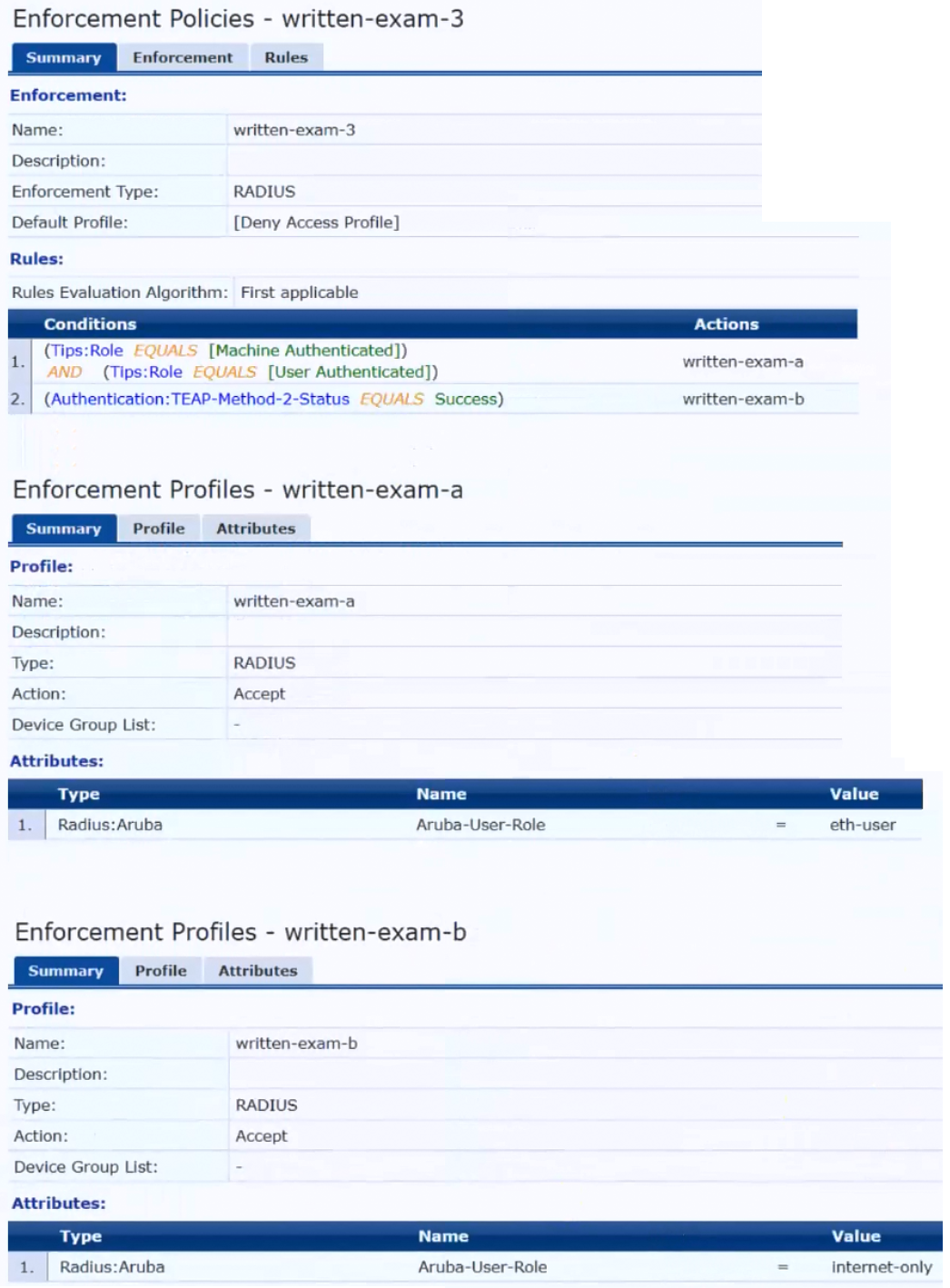
The gateway cluster has two gateways with these IP addresses:
• Gateway 1
o VLAN 4085 (system IP) = 10.20.4.21
o VLAN 20 (users) = 10.20.20.1
o VLAN 4094 (WAN) = 198.51.100.14
• Gateway 2
o VLAN 4085 (system IP) = 10.20.4.22
o VLAN 20 (users) = 10.20.20.2
o VLAN 4094 (WAN) = 198.51.100.12
• VRRP on VLAN 20 = 10.20.20.254
The customer requires high availability for the tunnels between the switches and the gateway cluster. If one gateway falls, the other gateway should take over its tunnels. Also, the switch should be able to discover the gateway cluster regardless of whether one of the gateways is in the cluster.
Assume that you are using the “myzone” name for the UBT zone.
Which is a valid minimal configuration for the AOS-CX port-access roles?
A customer needs you to configure Aruba ClearPass Policy Manager (CPPM) to authenticate domain users on domain computers. Domain users, domain computers, and domain controllers receive certificates from a Windows CA. CPPM should validate these certificates and verify that the users and computers have accounts in Windows AD. The customer requires encryption for all communications between CPPM and the domain controllers.
You have imported the root certificate for the Windows CA to the ClearPass CA Trust list.
Which usages should you add to it based on these requirements?
A company has Aruba gateways that are Implementing gateway IDS/IPS in IDS mode. The customer complains that admins are receiving too frequent of repeat email notifications for the same threat. The threat itself might be one that the admins should investigate, but the customer does not want the email notification to repeat as often.
Which setting should you adjust in Aruba Central?
Refer to the scenario.
A customer requires these rights for clients in the “medical-mobile” AOS firewall role on Aruba Mobility Controllers (MCs):
Permitted to receive IP addresses with DHCP
Permitted access to DNS services from 10.8.9.7 and no other server
Permitted access to all subnets in the 10.1.0.0/16 range except denied access to 10.1.12.0/22
Denied access to other 10.0.0.0/8 subnets
Permitted access to the Internet
Denied access to the WLAN for a period of time if they send any SSH traffic
Denied access to the WLAN for a period of time if they send any Telnet traffic
Denied access to all high-risk websites
External devices should not be permitted to initiate sessions with “medical-mobile” clients, only send return traffic.
The exhibits below show the configuration for the role.
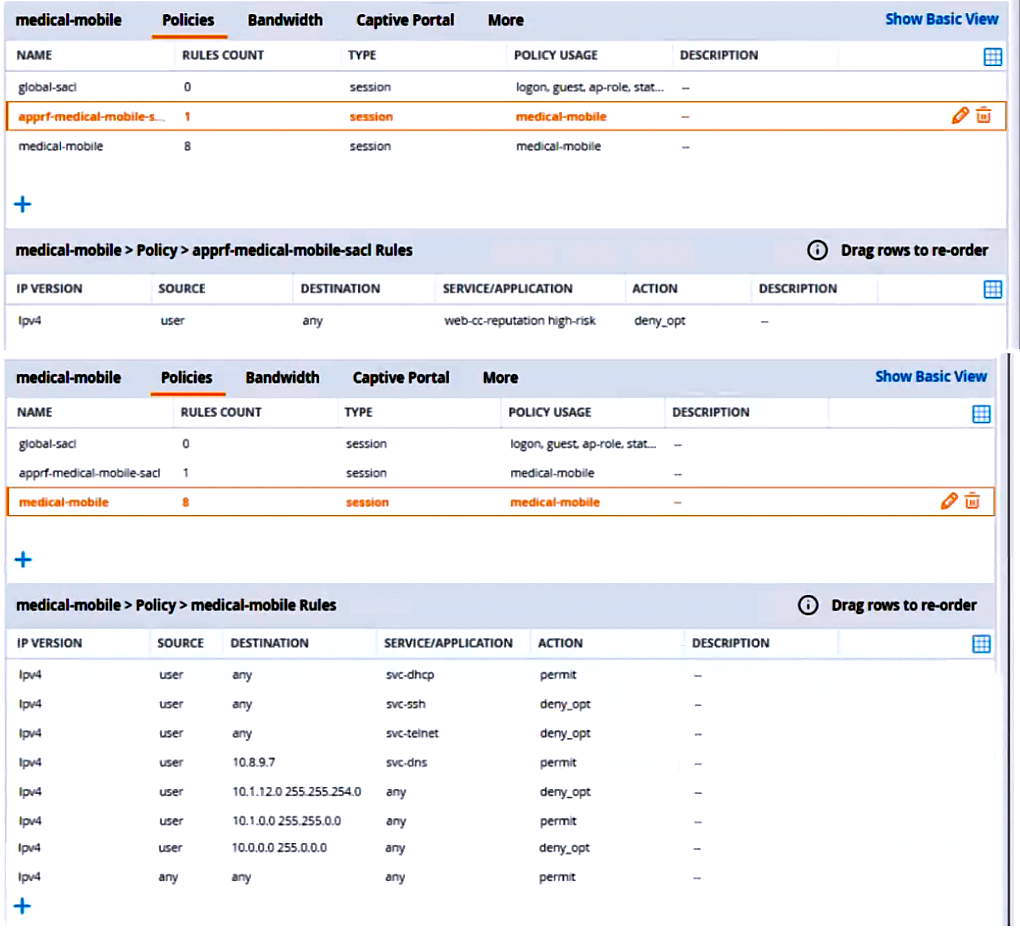
What setting not shown in the exhibit must you check to ensure that the requirements of the scenario are met?
Refer to the scenario.
A customer is migrating from on-prem AD to Azure AD as its sole domain solution. The customer also manages both wired and wireless devices with Microsoft Endpoint Manager (Intune).
The customer wants to improve security for the network edge. You are helping the customer design a ClearPass deployment for this purpose. Aruba network devices will authenticate wireless and wired clients to an Aruba ClearPass Policy Manager (CPPM) cluster (which uses version 6.10).
The customer has several requirements for authentication. The clients should only pass EAP-TLS authentication if a query to Azure AD shows that they have accounts in Azure AD. To further refine the clients’ privileges, ClearPass also should use information collected by Intune to make access control decisions.
Assume that the Azure AD deployment has the proper prerequisites established.
You are planning the CPPM authentication source that you will reference as the authentication source in 802.1X services.
How should you set up this authentication source?
What is a common characteristic of a beacon between a compromised device and a command and control server?
Refer to the scenario.
A hospital has an AOS10 architecture that is managed by Aruba Central. The customer has deployed a pair of Aruba 9000 Series gateways with Security licenses at each clinic. The gateways implement IDS/IPS in IDS mode.
The Security Dashboard shows these several recent events with the same signature, as shown below:
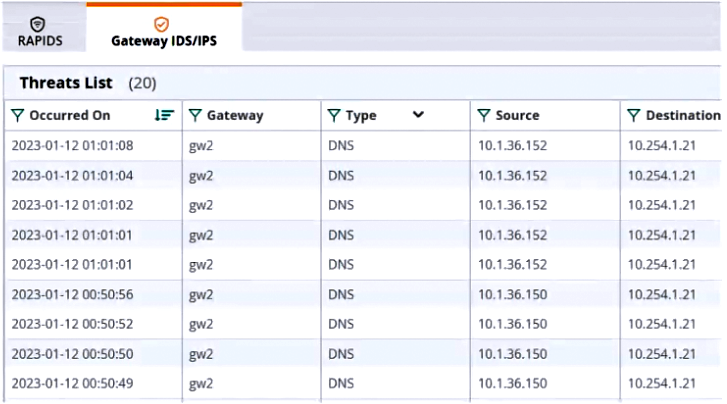
Which step could give you valuable context about the incident?
Refer to the scenario.
A customer has an Aruba ClearPass cluster. The customer has AOS-CX switches that implement 802.1X authentication to ClearPass Policy Manager (CPPM).
Switches are using local port-access policies.
The customer wants to start tunneling wired clients that pass user authentication only to an Aruba gateway cluster. The gateway cluster should assign these clients to the “eth-internet" role. The gateway should also handle assigning clients to their VLAN, which is VLAN 20.
The plan for the enforcement policy and profiles is shown below:
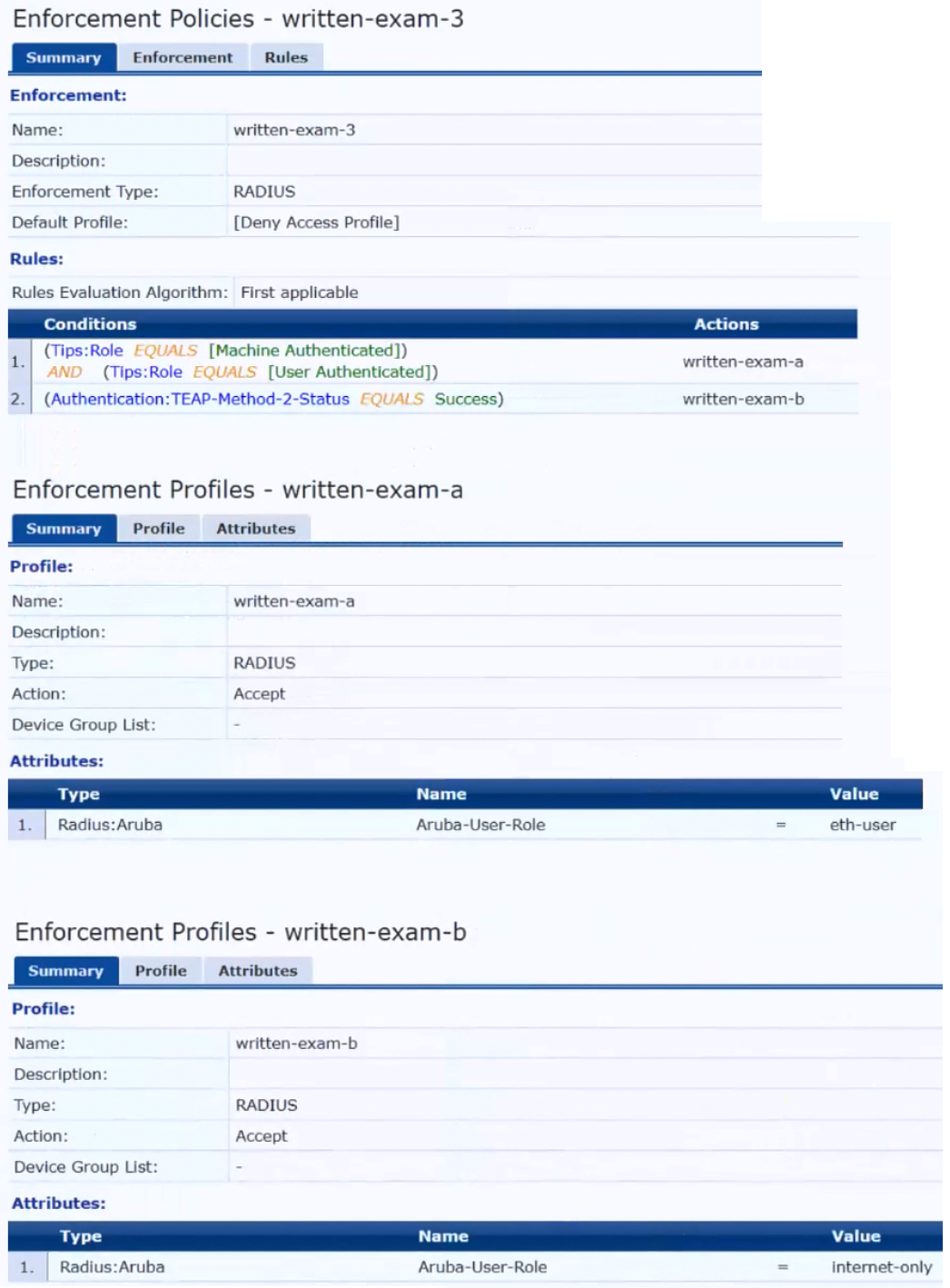
The gateway cluster has two gateways with these IP addresses:
• Gateway 1
o VLAN 4085 (system IP) = 10.20.4.21
o VLAN 20 (users) = 10.20.20.1
o VLAN 4094 (WAN) = 198.51.100.14
• Gateway 2
o VLAN 4085 (system IP) = 10.20.4.22
o VLAN 20 (users) = 10.20.20.2
o VLAN 4094 (WAN) = 198.51.100.12
• VRRP on VLAN 20 = 10.20.20.254
The customer requires high availability for the tunnels between the switches and the gateway cluster. If one gateway falls, the other gateway should take over its tunnels. Also, the switch should be able to discover the gateway cluster regardless of whether one of the gateways is in the cluster.
What is one change that you should make to the solution?
A customer requires a secure solution for connecting remote users to the corporate main site. You are designing a client-to-site virtual private network (VPN) based on Aruba VIA and Aruba Mobility Controllers acting as VPN Concentrators (VPNCs). Remote users will first use the VIA client to contact the VPNCs and obtain connection settings.
The users should only be allowed to receive the settings if they are the customer's “RemoteEmployees” AD group. After receiving the settings, the VIA clients will automatically establish VPN connections, authenticating to CPPM with certificates.
What should you do to help ensure that only authorized users obtain VIA connection settings?
You are configuring gateway IDS/IPS settings in Aruba Central.
For which reason would you set the Fail Strategy to Bypass?
How does Aruba Central handle security for site-to-site connections between AOS 10 gateways?