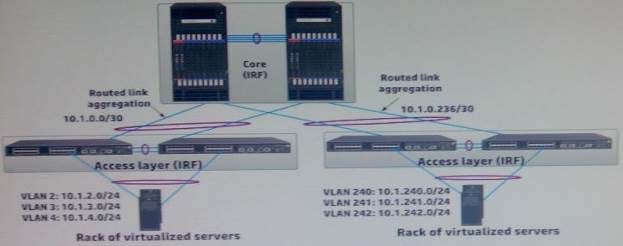
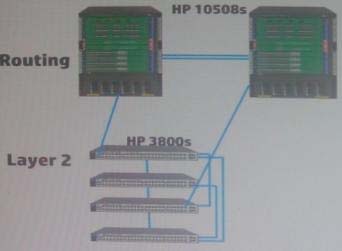
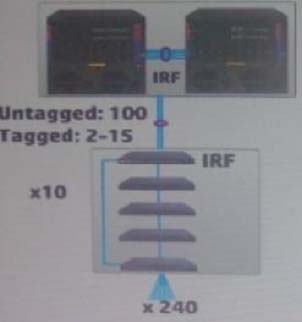
The exhibit shows a proposed design for a data center network infrastructure. The exhibit shows two racks for simplicity. The data center will actually include more racks.
The customer has these key requirements:
✑ The customer can scale any application and easily install new hardware that supports that application
✑ The network supports vMotion for live migration of virtual machine (VMs)
How should the network architect change the proposed design to meet the customer requirements?
AReplace the rack servers with blade enclosures
BAdd more links between the servers and the access layer
CRemove routing from the access layer and extend VLANs to multiple racks
DAdd a distribution layer between the access layer and the core
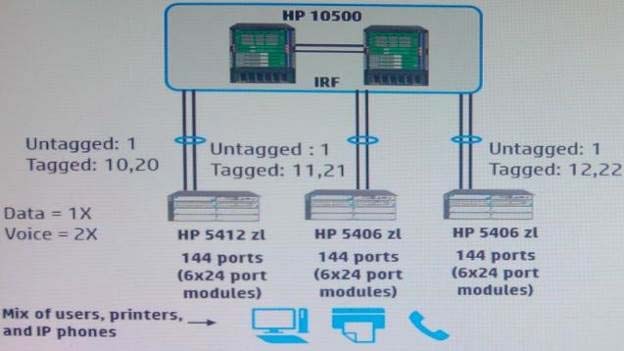
A customer has Voice IP (VoIP) phones that support Link Layer Discovery Protocol Media Endpoint Discovery (LLDP-MED). The phase need to receive their
VLAN ID using this protocol. The network architect is proposing HP 5500-48G-PoE+EI switches. Each user computer connects to the phone, which then connects to the Ethernet jack. LLDP is enabled on the switch. Each Edge port is trunk port that permits VLAN 10 (the user VLAN) and VLAN 20 (the voice VLAN).
Which other setting recommended on the edge port?
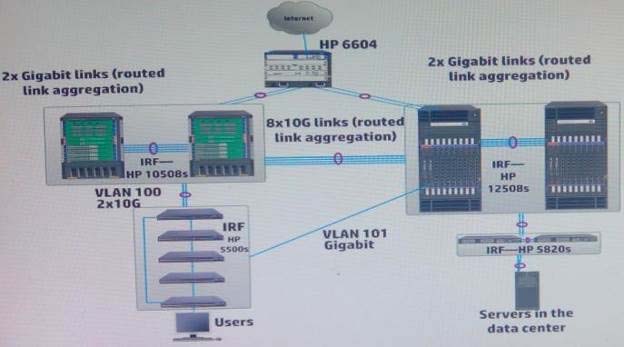
The exhibit shows the topology for an enterprise LAN with an on-site data center. The intelligent Resilient Framework (IRF) group of HP 5500 Series switches supports a group of computers that require very high availability to the data center. Therefore, the customer has requested a backup gigabit fiber link implement
Open Shortest Path First (OSPF) in a single area.
Which tasks should the network architect complete to ensure that the HP 5500 IRF group selects the correct path to the data center during normal operation?
AChange the reference bandwidth on the VLAN 100 interfaces to 20000
BSet the cost on the VLAN 100 interfaces to 2 Set the cost for the VLAN 101 interfaces to 80
CChange the reference bandwidth on the VLAN 101 interfaces to 1000
DChange the VLAN 101 interfaces as silent interfaces
EChange the reference bandwidth to 80000 on all routing devices
A customer wants a simple solution for deploying virtual services at a branch. Which devices support modules running a VMware ESXi hypervisor? (Select two)
AHP 2920 Switch Series
BHP MSR30 Router Series
CHP 5400 zl Switch Series
DHP 7500 Switch Series
EHP VSR1000 Virtual Services Routers
What correctly describes one trend that is changing how network architects must design the data center network infrastructure?
AApplications are drawing on more and more locally stored data, which causes customers to favor blade servers and blade enclosures
BApplications are considering on single, highly available mainframes, driving the need for 10G connections to the server edge
CApplications are increasingly virtualized, which requires architects to implement routing at the access layer to segment each rack into its own VLAN
DApplications are scaling out across multiple servers, increasing communications between servers distributed across the data center
A network architect is planning an intelligent Resilient Framework (IRF) group. What should the network architect implement to protect against a split IRF group?
ADistributed Trunking (DT)
BVirtual Router Redundancy Protocol (VRRP)
CMulti-Active Detections (MAD)
DRapid Ring Protection Protocol (RRPP)
What is the preferred time for completing racking and labeling of equipment for a new implementation?
AAfter the scheduled outage has begun and initial tests have indicated success
BBefore the scheduled outage
CAt any time between the beginning of the scheduled outage and the point of no return
DAt the beginning of the scheduled outage
A network architect has collected data on link utilization. When analyzing link utilization, what is the general guideline?
AYou upgrade a link that is often used at more than 50 percent utilization
BYou upgrade a link when it reaches 100 percent utilization
CYou upgrade a link if it sometimes peaks at more than 50 percent utilization
DYou upgrade a link when it reaches 25 to 30 percent utilization
What are information technology Service Management (ITSM) framework, such as the infrastructure Technology Infrastructure Library (ITILv3) and The Open
Group Architecture Framework (TOGAF)?
AThey are Internet Engineering Task Force (IETF) standards that provide evolving guidelines and best practices for IT design and management
BThey are high-level approaches that provide recommendations and best practices for IT design management
CThey are industry-wide standards that provide guidelines for enterprise design and management
DThey are Internet Engineering Task Force (IETF) standards that define proper network design
If a network architect is planning a secure device management policy, why would administrators need to generate SSH keys on network infrastructure devices?
ATo authenticate managers with a more secure method than passwords
BTo encrypt management traffic and also authenticate managers with asymmetric
CTo authenticate managers and assign them privileges according to their identity
DTo encrypt management traffic related to the CLI
A network architect is planning an update of the server access layer in a data center. Currently, the access layer switches have 10G links to distribution layer switches. In the new solution, HP 5930 Switches act as top of rack (ToR) switches with 40G links to core switches.
Which factor must the network architect consider when designing solution?
AWhether the data center cabling provides enough fiber strands to the racks to support the 40G links
BWhether the new switches 40G transceivers are on the chassis front or back, the transceivers must be on the same side as servers air outtakes
CWhether the servers connecting to the new switches use Ethernet Virtual Bridging (EVB)/Virtual Ethernet Port Aggregate (VEPA), which is not compatible with 40G
DWhether the servers connecting to the new switches have NICs that support Converged Enhanced Ethernet (CEE)
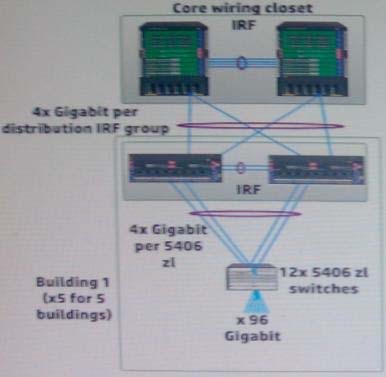
Refer to the exhibit.
A network architect has designed the topology shown in the exhibit. The Gigabit links between distribution layer and the core uses OM3 grade multi-mode fiber between 100m and 150m long.
The solution is for an enterprise customer whose employees use mostly HTTP-based applications and has medium utilization needs.
What should the network architect do to resolve a potential issue?
AAdd more bandwidth between each pair of distribution layer switches
BAdd more links between each modular switch at the access layer and its distribution layer switch
CReplace the modular switches at the access layer with switches that support stacked meshing
DRemove the distribution layer since it is not needed in this environment
A customer requires high availability, so the network architect is planning two area border (ABRs) for each non-backbone area in the Open Shortest Path First
(OSPF) solution. What ensures a loop-free routing environment that meets the customer needs?
AAll ABRs have at least one interface in area 0, and that interface has an IP address that is outside of the range of any summaries for area 0
BEach ABR in an area advertises the same summary routes for the area, and each ABR has a null route that matches those summaries
COnly one ABR advertise a summary route for each area. For areas with multiple ABRs, each area can include two summaries ranges, and each ABR is configured with one of those ranges
DAll ABRs in an area apply consistent path costs for their summary routes
Refer to the exhibit.
The network architect is planning network addresses for the VLANs shown. The company is using the private 10.0.0.0/8 space. Which guidelines should the network architect follow?
AUse a/22 subnet for each VLAN to ensure enough IP addresses for each large modular switch
BImplement the port isolation feature and apply several /30 subnets to each VLAN
CUse a/25 subnet for each VLAN to conserve the limited IP addressing space
DUse a /24 subnet for each VLAN for simplicity and scalability
A company is upgrading a data center network solution in phases. The first phase involves updating the top of rack (ToR) switches in one rack. Other switches will be updated in their phases.
What is one benefit of this approach?
AIt allows the through testing of the solution in real-world circumstances
BIt ensures that the network can be updated without any scheduled downtime
CIt removes the need to conduct connectivity and failover tests during the implementation
DIt removes the need for working with customer change management processes
Refer to the exhibit.
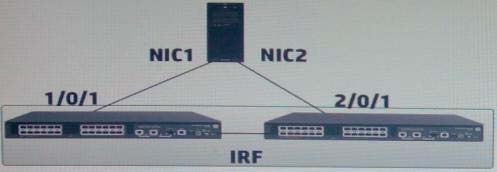
The exhibit shows how two NICs on a physical server connect to two HP 5820 switches. The server supports eight virtual machines (VMs) with VMware version
5.1. The VMware standard virtual switch is bound to NIC and NIC2. This switch implements source MAC load balancing for the NIC team.
What is the proper configuration for ports 1/0/1 and 2/0/1?
APlace the ports in a bridge aggregation group that does not use LACP
BPlace the ports in a bridge aggregation group that uses LACP
CEnable LACP on the individual ports
DDo not place the ports in a bridge aggregation group
Refer to the exhibit.
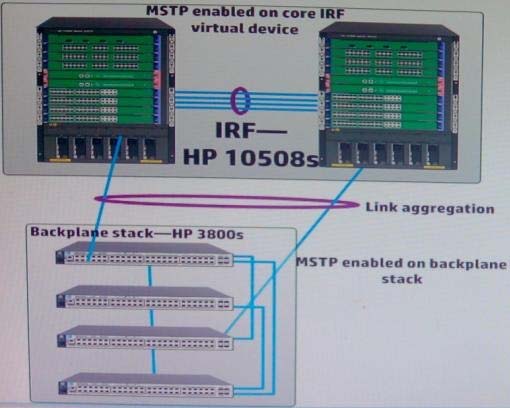
A network architect is proposing this solution to a customer. The customer network manager has a preference for Cisco VLAN Spanning Tree Plus (PVST+) because this protocol provides for fast convergence when a link fails and also provides per-VLAN load-sharing over links.
How would the network architect explain why the solution fits these requirements?
AThe MSTP component of the solution fulfills the same needs as PVST+ MSTP simply balances traffic per instance rather than per-VLAN
BThe redundant links between the switches are protected by MSTP and the built-in loop guard on HP-3800 switches. MSTP provides load-sharing and loop guard provides resiliency
CThe solution as shown provides the same load-sharing benefits as PVST+. To achieve the same resiliency benefits, the architect can add smart link to the meshed stack
DThe link aggregation between tiers provide even better resiliency and load-sharing than PVST+ while MSTP protects against accidental loops
A network architect is explaining the differences between deploying two switches in an HP Intelligent Resiliency Framework (IRF) virtual switch and deploying two switches that implement standard Virtual Routing Redundancy Protocol (VRRP). Which statement correctly describes an advantage of IRF?
AIRF failover occurs in 3 to 4 seconds, whereas VRPF failover occurs in 10 or more seconds
BUnlike VRRP, which requires as least two addresses to be listed. Dynamic Host Configuration Protocol (DHCP) scopes list a single IP address for the default gateway
CThe IRF virtual switch runs a separate routing in each member, which enhances the redundancy and reliability of the overall solution
DMultiple IRF members can actively route traffic for the same subnet and use the same IP address and routing control plane
Which data center characteristics should specifically make the architect consider switches that support Shortest Path Bridging (SPB) or Transparent
Interconnection of Lots of Links (TRILL)?
AThe customer requires redundancy and resiliency for the two data center routing switches
BThe customer requires high-speed routing between front-end servers and database servers in different subnets
CThe virtualized data center supports several thousand virtual machines (VMs) with a two-tier networking infrastructure topology
DThe data center requires many redundant links and must scale the tens of thousands of virtual (VMs)
A network architect is planning a complete access layer and core upgrade for customers campus LAN. The campus has four large buildings, each requiring between 1000 and 3000 edge ports. Which factor will play a primary role in determining whether the network architect needs to plan a two-tier or three-tier topology for the campus LAN?
AThe number of fiber links between each building and the building where the core switches reside
BWhether the customer requires a wireless solution
CThe high number of edge ports that the solution requires
DWhether the customer can afford core switches that support intelligent Resilient Framework (IRF)
Refer to the exhibit.
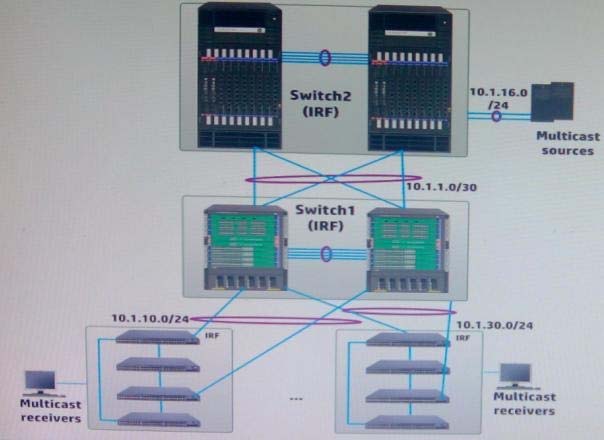
All connections between switches are 10 Gbps. Switch is an Intelligent Resilient Framework (IRF) group with two member. Switch2 is an IRF group with two members. Switch1 and Switch2 route all traffic.
A network architect is designing a solution for a finance company. One of the primary applications is a multicast application that delivers stock information to IP video screens across the site. The network architect is seeking a multicast solution that meets these needs:
✑ Simple configuration that the customers IT staff can manage and troubleshoot
✑ No single point of failure for the multicast traffic
What is the best solution for this environment and these needs?
BProtocol Independent Multicast (PIM) Sparse Mode (SM) with switch 1 and switch 2 configured as candidate Rendezvous Points (C-RPs), and switch1 and Switch2 also configured as Bootstrap Router (BSRs).
CProtocol Independent Multicast (PIM) Dense Mode (DM) with Switch1 and Switch2 set as the DM Master Router. Switch1 has a higher MR priority for an address associated with the multicast application.
DProtocol independent Multicast (PIM) Sparse Mode (SM) with switch1 and Switch2 set as the static Rendezvous Points (RPs). Switch1 has a higher RP priority
Refer to the exhibit.
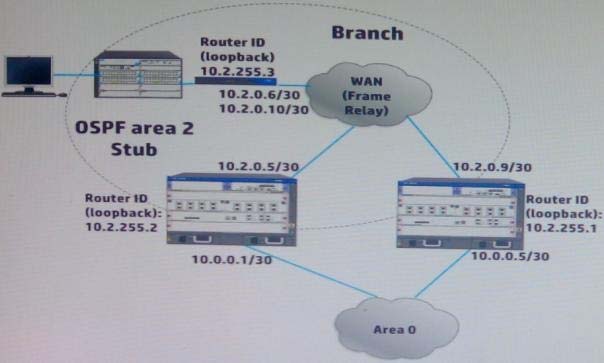
The branch routers have E1 lines into the Frame Relay Service provider network. The exhibit shows just one branch, but the network actually has 30 branches.
The HP 6600 Series routers, which are the area border routers (ABRs), have E2 lines into the Frame Relay network.
The routers in the exhibit Open Shortest Path First (OSPF). The enable OSPF on network follows:
✑ In area 2, OSPF is enabled on network 10.2.0.0/16
✑ In area 0, OSPF is enabled on network 10.0.0.0/16
The customer requires resilience at the WAN core. Which design change best supports that requirement?
AAdd additional links from the HP 6600 Series routers to the WAN
BOn each branch router, add a floating static route to one of the ABRs in case the OSPF solution fails
CAdd a Gigabit link between the HP 6600 Series router with a network in area 0 and area 2.
DAt each branch, add a redundant link between the switch and the router
Refer to the exhibit.
A network architect has planned redundant links as shown in the exhibit. What should the network architect do to ensure that the redundant link design is truly resilient?
AImplement the features such as link aggregation, backplane stacking, and intelligent Resilient Framework (IRF)
BAdd another link between the Layer 2 switches and the core so that up to the two links can fail
CImplement a feature such as bidirectional forwarding detection (BFO) on each redundant link
DMake sure that each HP 10508 switch is configured as a root in one Multiple Spanning Tree Protocol (MSTP) instance
A network architect is compiling information about the total cost ownership (TCO) for a proposal. Which factors play a role in TCO?
ACost of remediation due to a future security breach
BCost of regulatory fines associated with non-compliance
CCost of upgrading modules for the proposal
DCost of powering the solution
Refer to the exhibit.
A network architect is designing the logical topology for a campus LAN networking solution. The customer requires support for 2400 edge ports, which is provided by 10 intelligent Resilient Framework (IRF) groups at the access layer. This customer does not have a wireless network nor anticipants adding one in the next two years. However, the customer does want to authenticate users with 802.1X and use the network RADIUS server to divide users from different groups into different
VLANs. The customer has three user groups, each of which includes between 600 and 900 users.
Additionally, the customer understands that the RADIUS server will require several policies but wants to keep these policies as simple and easy to maintain as possible.
How can the network architect ensure that the solution meets the customer needs and also follows best practice?
AAssign a /23 subnet to each VLAN so that the VLAN can accommodate the required number of users, even if users connect multiple devices
BPlan a different VLAN ID and subnet address for each user group on each access layer IRF group. Either core or access layer routing will work for this solution
CUse access layer routing. Assign a different subnet to VLAN2 on one access layer IRF group then the VLAN2 on the another access layer group
DPlan a solution for designing dissolvable agents to the endpoints so that they can complete 802.1X authentication seamlessly

 Preview