Refer to the exhibit, which shows the port1 interface configuration on FortiGate and partial session information for ICMP traffic.
What happens to the session information if a routing change occurs that affects this session?
AOnly the interface and gateway information for dev=7 will be removed.
BThe session information will not change unless the current route has been removed from the routing table.
CThe session will be flagged as dirty but no route lookups will be performed.
DSessions involving port7 or port19 will not have their routing information flushed.
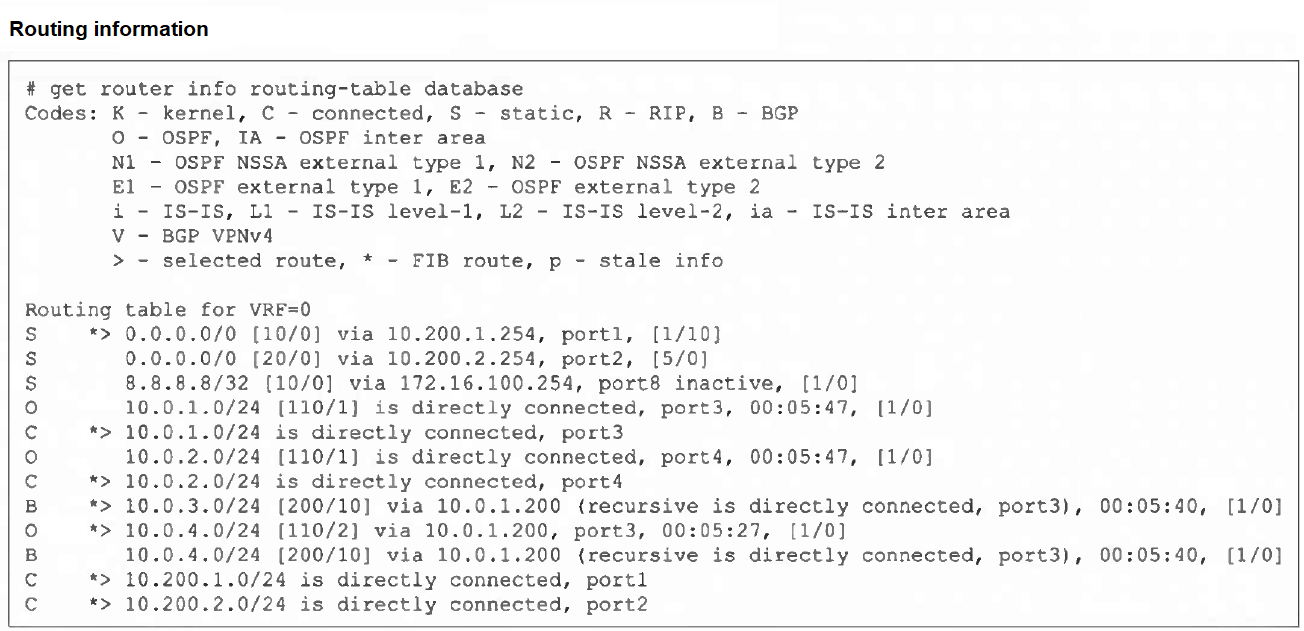
Refer to the exhibit, which shows the modified output of the routing kernel.
Which statement is true?
AThe egress interface associated with static route 8.8.8.8/32 is administratively up.
BThe default static route through 10.200.1.254 is not in the forwarding information base.
CThe default static route through port2 is in the forwarding information base.
DThe BGP route to 10.0.4.0/24 is not in the forwarding information base.
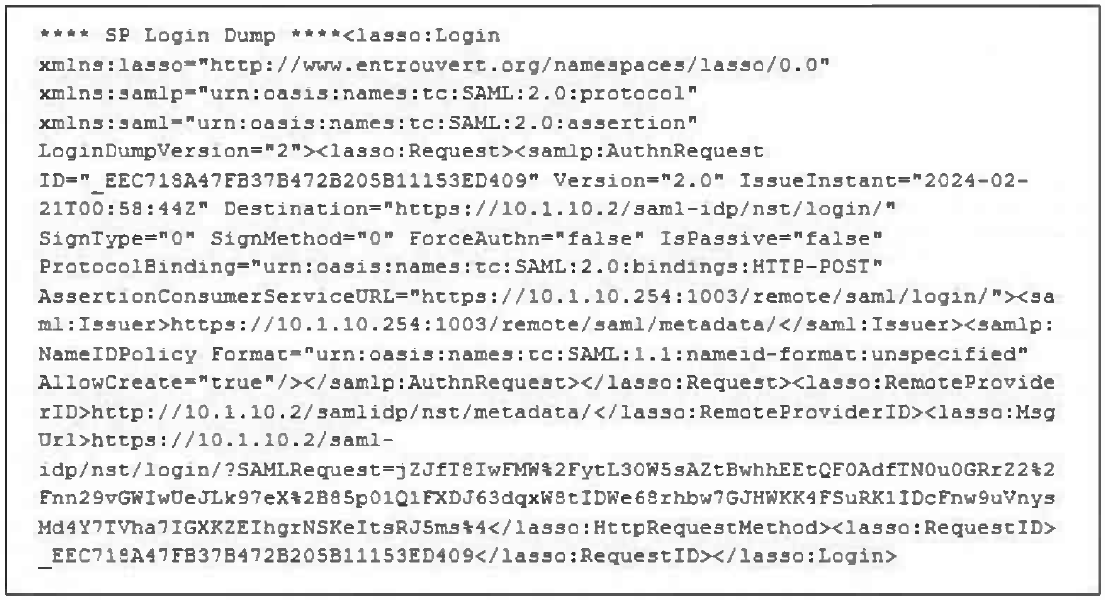
Refer to the exhibit.
The exhibit shows the output from using the command diagnose debug application samld -1 to diagnose a SAML connection.
Based on this output, what can you conclude?
AActive Directory is used for authentication.
BThe authentication request is for an SSL VPN connection.
CThe IdP IP address is 10.1.10.254.
DThe IdP IP address is 10.1.10.2.
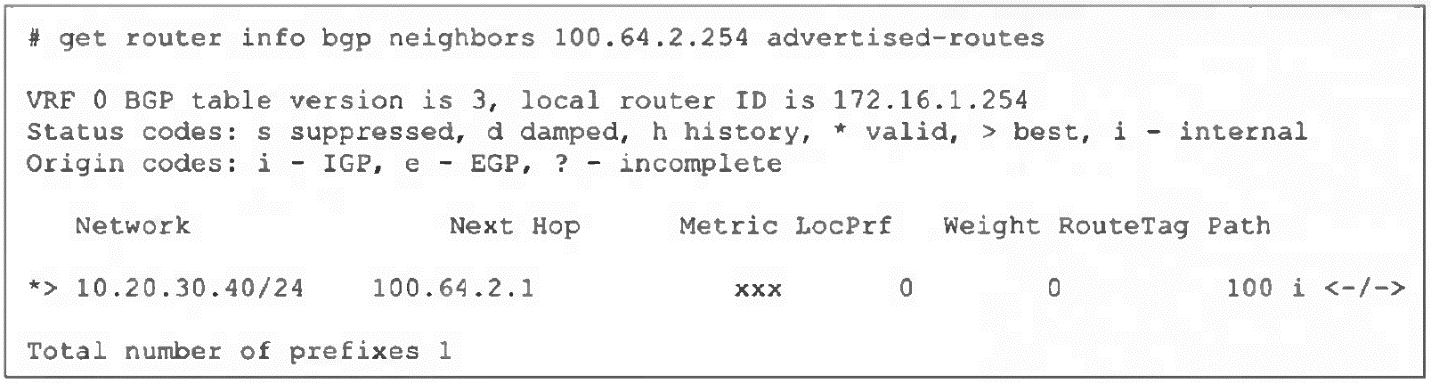
Refer to the exhibit, which shows the output of the command get router info bgp neighbors 100.64.2.254 advertised-routes.
What can you conclude from the output?
AThe BGP state of the two BGP participants is OpenConfirm.
BThe router ID of the neighbor is 100.64.2.254.
CThe BGP neighbor is advertising the 10.20.30.40/24 network to the local router.
DThe local router is advertising the 10.20.30.40/24 network to its BGP neighbor.
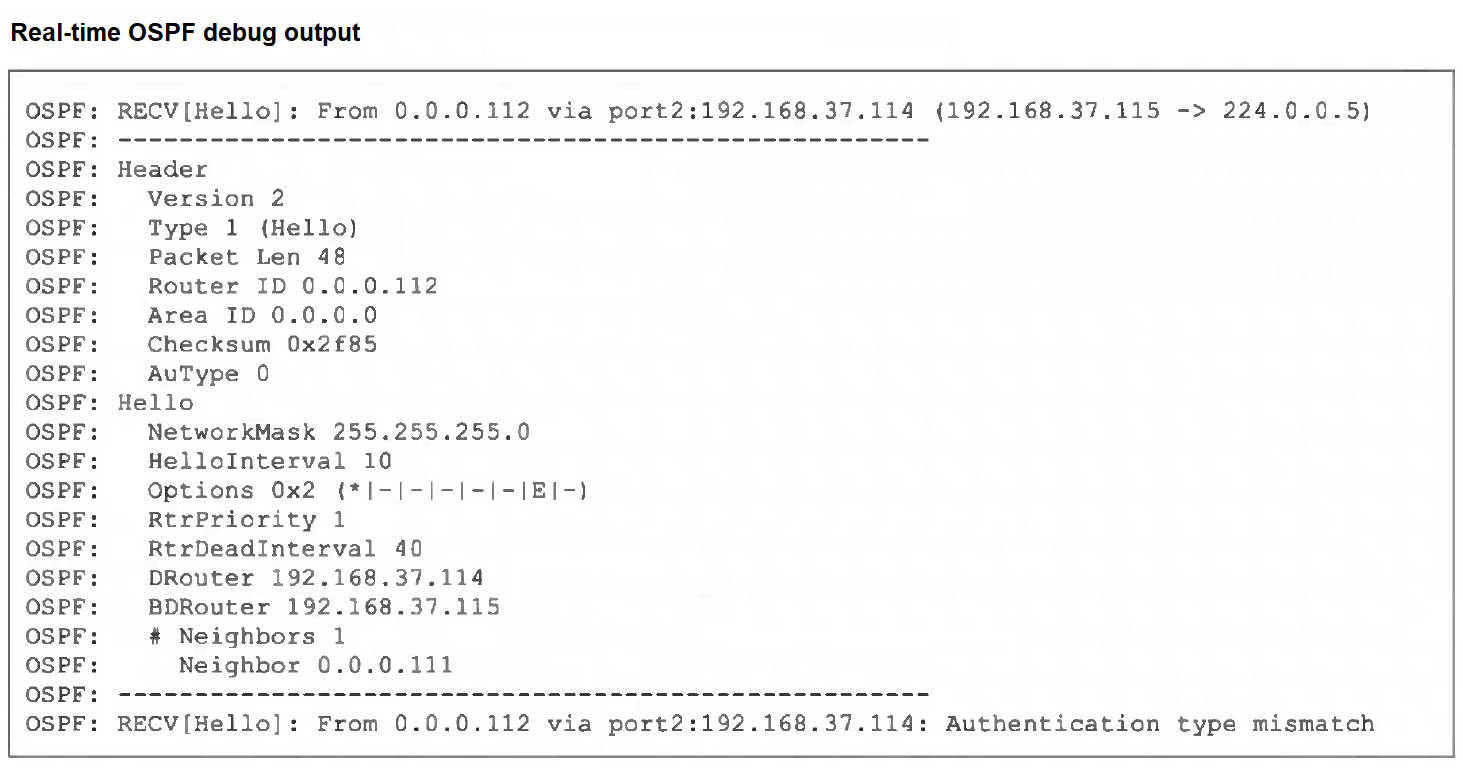
Refer to the exhibit, which shows the partial output of a real-time OSPF debug.
Why are the two FortiGate devices unable to form an adjacency?
AThe Hello packet is being sent from an OSPF router with ID 0.0.0.112.
BThe two FortiGate devices attempting adjacency are in area 0.0.0.0.
COne FortiGate device is configured to require authentication, while the other is not.
DThe passwords on the FortiGate devices do not match.
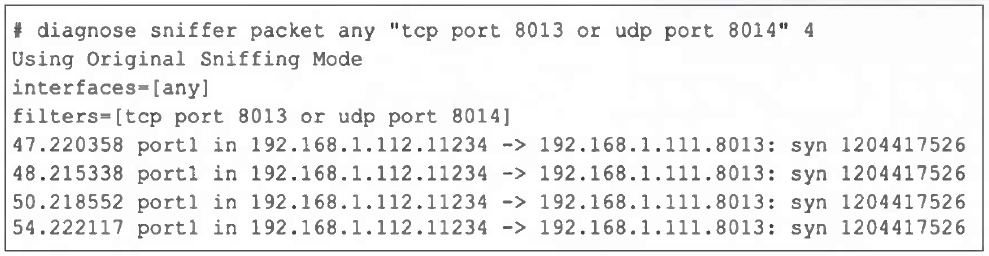
Refer to the exhibit, which shows one way communication of the downstream FortiGate with the upstream FortiGate within a Security Fabric.
What three actions must you take to ensure successful communication? (Choose three.)
AYou must authorize the downstream FortiGate on the root FortiGate.
BFortiGate must not be in NAT mode.
CEnsure TCP port 8013 is not blocked along the way.
DYou must enable Security Fabric/Fortitelemetry on the receiving interface of the upstream FortiGate.
EEnsure the port for Neighbor Discovery has been changed.
Refer to the exhibit, which shows the partial output of FortiOS kernel slabs.
Which statement is true?
AThe total slab size of the sctp_session slab is 0 kB and is associated with the user space.
BThe total slab size of the ip_session slab is 3600 kB and is associated with the user space.
CThe total slab size of the ip6_session slab is 1300 kB and is associated with the kernel.
DThe total slab size of the tcp_session slab is 7500 kB and is associated with the kernel.
What are two functions of automation stitches? (Choose two.)
AYou can configure automation stitches on any FortiGate device in a Security Fabric environment.
BYou can configure automation stitches to execute actions sequentially by taking parameters from previous actions as input for the current action.
CYou can set an automation stitch configured to execute actions in parallel to insert a specific delay between actions.
DYou can create automation stitches to run diagnostic commands and attach the results to an email message when CPU or memory usage exceeds specified thresholds.
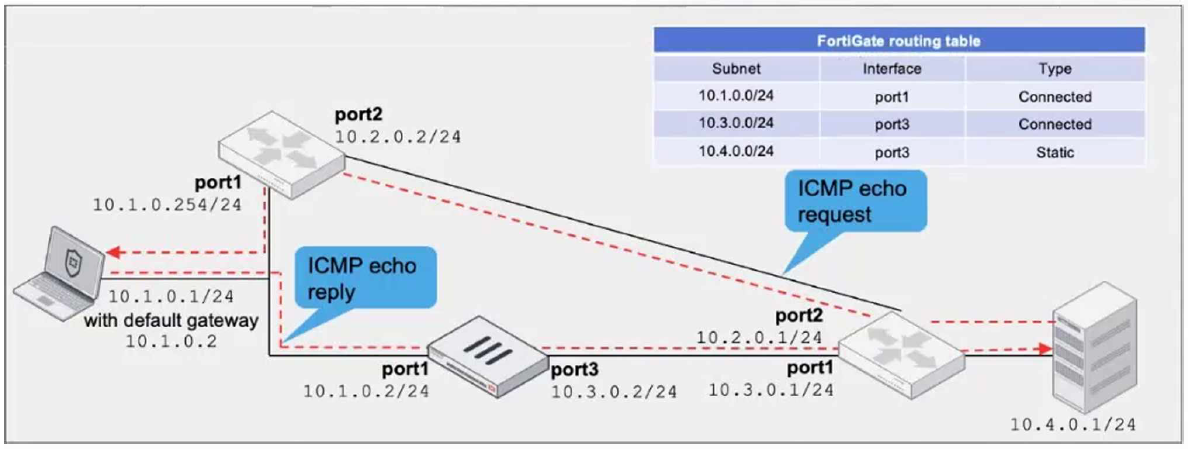
Refer to the exhibit, which a network topology and a partial routing table.
FortiGate has already been configured with a firewall policy that allows all ICMP traffic to flow from port1 to port3.
Which changes must the administrator perform to ensure the server at 10.4.0.1/24 receives the echo reply from the laptop at 10.1.0.1/24?
AEnable asymmetric routing under config system settings.
BChange the configuration from strict RPF check mode to feasible RPF check mode.
CA firewall policy that allows all ICMP traffic from port3 to port1.
DModify the default gateway on the laptop from 10.1.0.2 to 10.2.0.2.
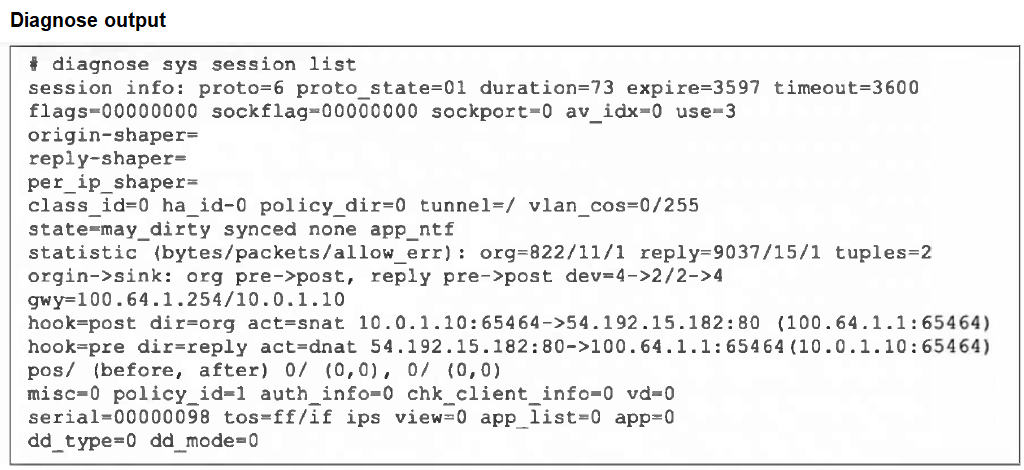
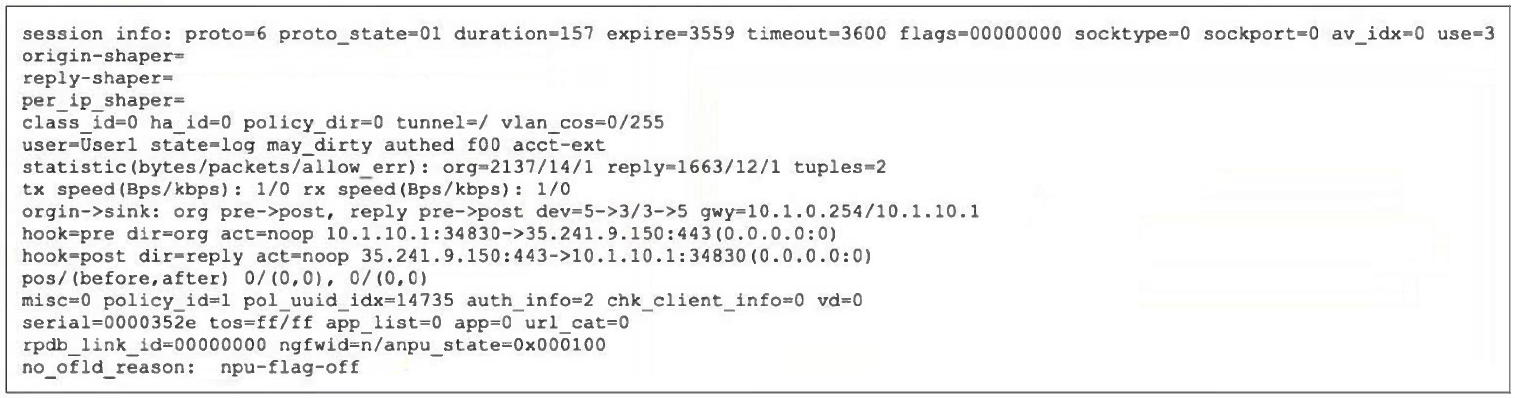
Refer to the exhibit, which shows the output of diagnose sys session list.
If the HA ID for the primary device is 0, what happens if the primary fails and the secondary becomes the primary?
AThe secondary device has this session synchronized; however, because application control is applied, the session is marked dirty and has to be re-evaluated after failover.
BTraffic for this session continues to be permitted on the new primary device after failover, without requiring the client to restart the session with the server.
CThe session will be removed from the session table of the secondary device because of the presence of allowed error packets, which will force the client to restart the session with the server.
DThe session state is preserved but the kernel will need to re-evaluate the session because NAT was applied.
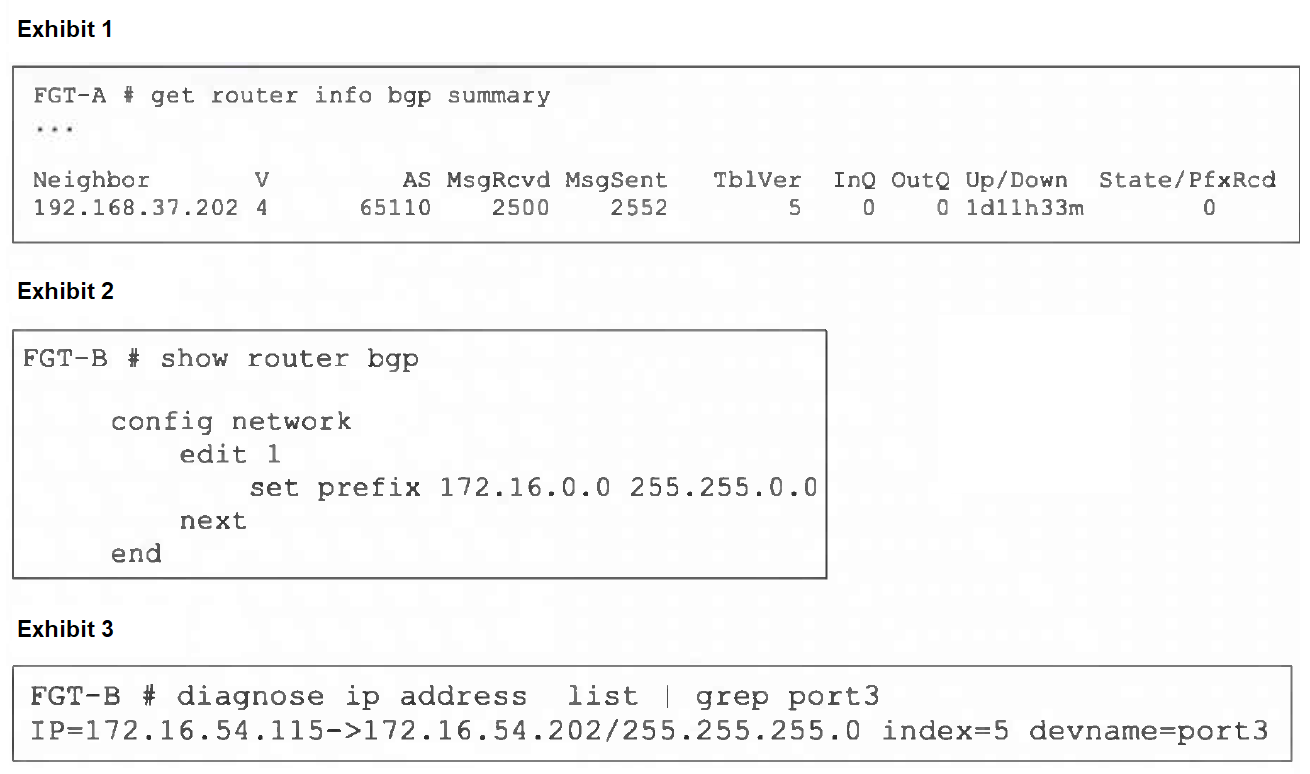
Refer to the exhibits.
An administrator is attempting to advertise the network configured on port3. However, FGT-A is not receiving the prefix.
Which two actions can the administrator take to fix this problem? (Choose two.)
AModify the prefix using the network command from 172.16.0.0/16 to 172.16.54.0/24.
BManually add the BGP route on FGT-A.
CRestart BGP using a soft reset to force both peers to exchange their complete BGP routing tables.
DUse the set network-import-check disable command.
Which two statements about Security Fabric communications are true? (Choose two.)
AFortiTelemetry and Neighbor Discovery both operate using TCP.
BThe default port for Neighbor Discovery can be modified.
CBy default, the downstream FortiGate establishes a connection with the upstream FortiGate using TCP port 8013.
DFortiTelemetry must be manually enabled on the FortiGate interface.
Refer to the exhibit showing a debug output.
An administrator deployed FSSO in DC Agent Mode but FSSO is failing on FortiGate. Pinging FortiGate from where the collector agent is deployed is successful.
The administrator then produces the debug output shown in the exhibit.
What could be causing this error message?
AThe TCP port 445 is blocked between FortiGate and collector agent.
BThe collector agent preshared password is mismatched.
CThe FortiGate cannot resolve the active directory server name.
DThe FortiGate and the collector agent are using different TCP ports.
Refer to the exhibit, which shows the output of a session.
Which two statements are correct? (Choose two.)
AThe session is being offloaded.
BThe session is being inspected using flow inspection.
CThe TCP session has been successfully established.
DThe session was initiated from an authenticated user.

 Preview