Which three HTTP headers enable an application server to identify the client's language compatibility, browser, operating-system type, and compression compatibility?
Choose three
AAccept
BAccept-Encoding
CAccept-Language
DHost
EUser-Agent
0
Community Discussion
No comments yet. Be the first to start the discussion!
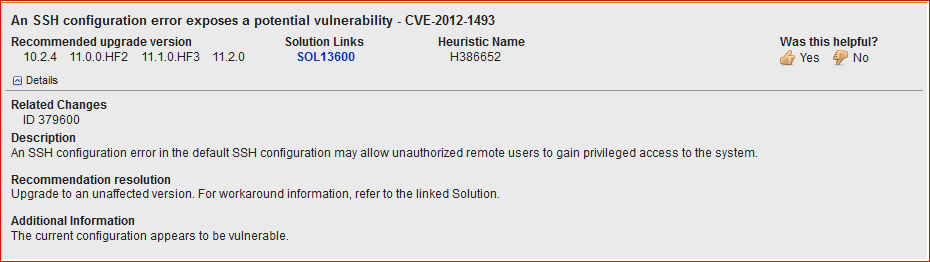
An LTM Specialist is working with an LTM 11.0.0 installation and has identified a security vulnerability, as shown in the exhibit. The LTM Specialist is assigned to apply the latest available hotfix to resolve the issue.
Which procedure resolves the issue?
ABrowse to System > Software Management > Hotfix List. Import TMOS 11.2.0 to the available hotfix images. Select the imported hotfix image and installation location and click Install.
BBrowse to System > Software Management > Hotfix List. Import 11.1.0.HF3 to the available hotfix images. Select the imported hotfix image and installation location and click Install.
CBrowse to System > Software Management > Image List. Import TMOS 11.2.0 to the available hotfix images. Select the imported hotfix image and installation location and click Install.
DBrowse to System > Software Management > Image List. Import 11.1.0.HF3 to the available hotfix images.
0
Community Discussion
No comments yet. Be the first to start the discussion!
An LTM device is running BIG-IP v10.2.0 software. The LTM Specialist must upgrade the LTM device to BIG-IP v11.2.0 HF1. The LTM Specialist begins the upgrade by selecting the uploaded Hotfix and installing it to an unused volume. After 10 minutes, the LTM Specialist checks the upgrade status and sees that the process is stalled at 0%.
What should the LTM Specialist verify?
Athe selected volume has sufficient space available
Bthe base software version exists on the LTM device
Cthe LTM device has been restarted into maintenance mode
Dthe LTM device has an available Internet connection via the management interface
0
Community Discussion
No comments yet. Be the first to start the discussion!
An LTM Specialist has configured a virtual server to load balance to a pool of FTP servers. File transfers are failing. The virtual server is configured as follows:
No comments yet. Be the first to start the discussion!
Save question
0
Community Discussion
No comments yet. Be the first to start the discussion!
Save question
0
Community Discussion
No comments yet. Be the first to start the discussion!
0
Community Discussion
No comments yet. Be the first to start the discussion!
0
Community Discussion
No comments yet. Be the first to start the discussion!
Save question
0
Community Discussion
No comments yet. Be the first to start the discussion!
Save question
0
Community Discussion
No comments yet. Be the first to start the discussion!
Save question
0
Community Discussion
No comments yet. Be the first to start the discussion!
Save question
0
Community Discussion
No comments yet. Be the first to start the discussion!
Save question
0
Community Discussion
No comments yet. Be the first to start the discussion!
Save question
0
Community Discussion
No comments yet. Be the first to start the discussion!
Save question
0
Community Discussion
No comments yet. Be the first to start the discussion!
Save question
0
Community Discussion
No comments yet. Be the first to start the discussion!
Save question
0
Community Discussion
No comments yet. Be the first to start the discussion!
Save question
0
Community Discussion
No comments yet. Be the first to start the discussion!
0
Community Discussion
No comments yet. Be the first to start the discussion!
Save question
0
Community Discussion
No comments yet. Be the first to start the discussion!
Save question
0
Community Discussion
No comments yet. Be the first to start the discussion!
Save question
0
Community Discussion
No comments yet. Be the first to start the discussion!
An LTM Specialist configures a receive string in an HTTP monitor and assigns it to an HTTP pool. The monitor interval is 5 seconds, and its timeout is 16 seconds.
If the receive string is not found in the HTTP payload after 20 seconds, how does the LTM device mark the monitor status?
Aoffline
Bunknown
Cavailable
Dunavailable
Eforced offline
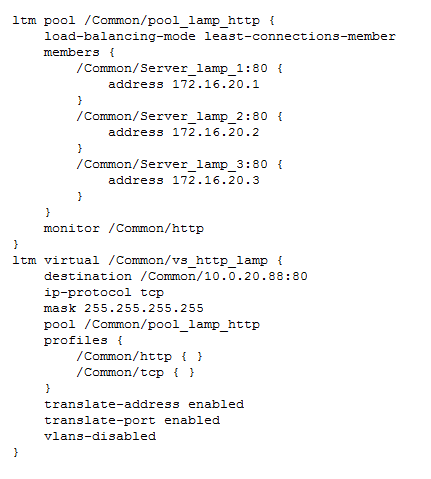
An LTM Specialist is diagnosing a problem with a new virtual server. When clients connect through the virtual server, their browser displays "Unable to connect", even though direct connections to the pool member confirm that the application is working correctly. The LTM device configuration is:
Although a stream profile has been added to the virtual server, the HTTP-response content is not being matched and therefore is not modified.
Which HTTP header should the LTM Specialist remove from the request so that the content can be matched and modified?
AConnection
BAccept
CCache-Control
DAccept-Encoding
The LTM device is configured to load balance a group of web servers that implement access control lists (ACLs) based on the client source IP address. The ACL operates at the network level, and the web server is configured to send a TCP reset to the client when it is not permitted to connect.
The virtual server uses the default OneConnect profile.
The ACL configured on the web server is:
Permit: 192.168.136.0/24
Deny: 192.168.116.0/24
A packet capture was taken for two separate client flows to a virtual server with IP address 192.168.136.100.
Client A - Src IP 192.168.136.1 - Virtual Server 192.168.136.100:
Clientside:
09:35:11.073623 IP 192.168.136.1.55684 > 192.168.136.100.80: S 869998901:869998901(0) win 8192 <mss 1460,nop,wscale 2,nop,nop,sackOK>
09:35:11.073931 IP 192.168.136.100.80 > 192.168.136.1.55684: S 2273668949:2273668949(0) ack 869998902 win 4380 <mss 1460,nop,wscale 0,sackOK,eol>
09:35:11.074928 IP 192.168.136.1.55684 > 192.168.136.100.80: . ack 1 win 16425
09:35:11.080936 IP 192.168.136.1.55684 > 192.168.136.100.80: P 1:299(298) ack 1 win 16425
09:35:11.081029 IP 192.168.136.100.80 > 192.168.136.1.55684: . ack 299 win 4678
Serverside:
09:35:11.081022 IP 192.168.136.1.55684 > 192.168.116.128.80: S 685865802:685865802(0) win 4380 <mss 1460,nop,wscale 0,sackOK,eol>
09:35:11.081928 IP 192.168.116.128.80 > 192.168.136.1.55684: S 4193259095:4193259095(0) ack 685865803 win 5840 <mss
1460,nop,nop,sackOK,nop,wscale 6>
09:35:11.081943 IP 192.168.136.1.55684 > 192.168.116.128.80: . ack 1 win 4380
09:35:11.081955 IP 192.168.136.1.55684 > 192.168.116.128.80: P 1:299(298) ack 1 win 4380
09:35:11.083765 IP 192.168.116.128.80 > 192.168.136.1.55684: . ack 299 win 108
Client B - Src IP 192.168.116.1 - Virtual Server 192.168.136.100:
Clientside:
09:36:11.244040 IP 192.168.116.1.55769 > 192.168.136.100.80: S 3320618938:3320618938(0) win 8192 <mss 1460,nop,wscale 2,nop,nop,sackOK>
09:36:11.244152 IP 192.168.136.100.80 > 192.168.116.1.55769: S 3878120666:3878120666(0) ack 3320618939 win 4380 <mss 1460,nop,wscale
0,sackOK,eol>
09:36:11.244839 IP 192.168.116.1.55769 > 192.168.136.100.80: . ack 1 win 16425
09:36:11.245830 IP 192.168.116.1.55769 > 192.168.136.100.80: P 1:299(298) ack 1 win 16425
09:36:11.245922 IP 192.168.136.100.80 > 192.168.116.1.55769: . ack 299 win 4678
Serverside:
09:36:11.245940 IP 192.168.136.1.55684 > 192.168.116.128.80: P 599:897(298) ack 4525 win 8904
09:36:11.247847 IP 192.168.116.128.80 > 192.168.136.1.55684: P 4525:5001(476) ack 897 win 142
Why did the web server allow the second client flow?
AA global SNAT is defined.
BSNAT automap was enabled on the virtual server.
CThe idle TCP session from the first client was re-used.
DA source address persistence profile is assigned to the virtual server.
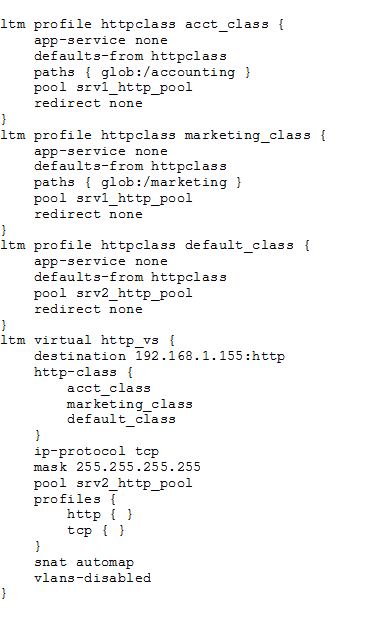
Refer to the exhibit.
An LTM Specialist is reviewing the virtual server configuration on an LTM device.
Which two actions should the LTM Specialist take to minimize the virtual server configuration?
Choose two
ARemove 'snat automap' from the virtual server.
BRemove the 'http' profile from the virtual server.
CRemove the 'default_class' from the virtual server.
DCombine 'acct_class' and 'marketing_class' into one class and update associations on the virtual server.
ECombine 'marketing_class' and 'default_class' into one class and update associations on the virtual server.
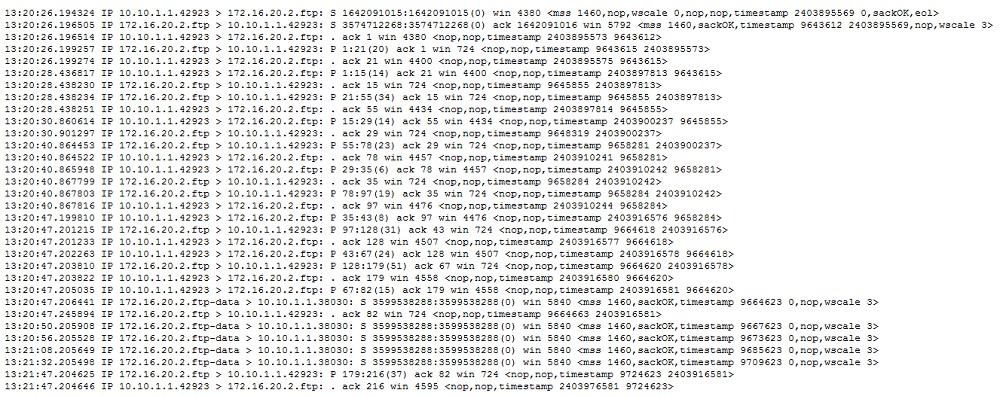
Refer to the exhibit.
The decoded TCPDump capture traces a failing health monitor. The health monitor sends the string displayed in the capture; however, the server response is not as expected. The receive string is set to SERVER IS UP.
What is the solution?
AThe GET request Host header field requires a host name.
BIncorrect syntax in send string. 'HTTP/1.1' should be 'HTTP1.1'.
CThe /test_page.html does NOT exist on the web server and should be added.
DIncorrect syntax in send string. 'Connection: Close' should be 'Connection: Open'.
An LTM Specialist needs to allow network access to Always On Management (AOM).
Which two methods should the LTM Specialist use to configure the AOM interface?
Choose two
AConfigure the AOM IP from the front panel buttons and LCD.
BChoose the network configurator in the AOM menu on the serial port.
CConfigure the AOM network address in the GUI under System>Platform.
DLog in to the Host via ssh, "ssh aom", and modify the network configuration file.
A device group consists of four members: LTM-A, LTM-B, LTM-C, and LTM-D. An LTM Specialist makes a configuration change on LTM-B. Later, another LTM Specialist sees a "changes pending" message on every device. While logged in to LTM-D, the LTM Specialist attempts to config-sync to the device group.
The synchronization operation fails. Why is the LTM Specialist on LTM-D unable to synchronize the configuration to the group?
AThe changes made on LTM-B are invalid.
BLTM-D has the lowest commit-id of the group.
CNTP is NOT configured on the devices in the group.
DLTM-B is the device eligible to initiate a config-sync.
A high-availability (HA) pair configuration relies only on the hardwired serial-cable connection to determine device state. A power outage affects the PDU that powers the active unit. The standby unit assumes the active role as expected.
How can the peer unit determine that the active unit is unavailable?
Avoltage loss on serial cable
Bno data stream received on serial port
Cno response on management interface
Dno heartbeat packets received on self IPs
Which command-line interface command checks whether the BIG-IP platform contains a Packet Velocity ASIC (PVA)?
Abigpipe platform show | grep -i pva
Btmsh show /sys hardware pva status
Ctmsh show /sys hardware | grep -i pva
Dtmsh show /ltm hardware | grep -i pva
An LTM Specialist is troubleshooting virtual server 10.0.0.1:443, which resides on VLAN vlan301. The web application is accessed through www.example.com. The LTM Specialist wants to save a packet capture containing the complete decrypted payload for external analysis.
Which command should the LTM Specialist run from the LTM device command-line interface?
Atcpdump -vvv -s 0 'host 10.0.0.1 and port 443' -w /var/tmp/trace.cap
Btcpdump -vvv -s 0 -ni vlan301 'host 10.0.0.1 and port 443' -w /var/tmp/trace.cap
A stand-alone LTM device will be paired with a second LTM device to form an active/standby pair. The existing stand-alone LTM device is in production and has several VLANs configured with floating IP addresses. The appropriate device service clustering (DSC) configurations are present on both LTM devices.
Which two non-specific DSC settings should the LTM Specialist configure on the second LTM device so that no errors are reported when the first synchronization is attempted?
Choose two
Apools
BVLANs
Cdefault route
Dself IP addresses
Which two alerting capabilities can be enabled within an application visibility reporting (AVR) analytics profile?
Choose two
AsFlow
BSNMP
Ce-mail
DLCD panel alert
Ehigh speed logging (HSL)
An LTM Specialist has configured a custom SNMP alert.
Which command-line utility should the LTM Specialist use to test the alert?
Alogger
Blogtest
Ctestlog
Dsnmptest
Refer to the exhibits.
While observing the AVR statistics for the HTTPS_VS, an LTM Specialist finds that HTTP status codes are not being recorded.
How should the LTM Specialist change the configuration to record the HTTP status codes?
Aassign a streaming profile to the virtual server
Bassign client SSL and server SSL profiles to the virtual server
Cenable Statistics Logging Type, External on the analytics profile
Denable Collected Entities, Response Codes on the analytics profile
Refer to the exhibit.
Users report that a web application behaves incorrectly. At times, contextual data displayed on the web pages is correct; at other times, it is incorrect.
The LTM administrator examines the connection table, filtering for one of the currently connected client IP addresses, with the command tmsh show sys connection cs-client-addr 10.0.20.1, and receives the following results:
ASynchronize the clock of the LTM device with NTP.
BModify the load balancing method attached to the pool.
CSet up an HTTP cookie insert profile in the virtual server.
DModify the setup of the monitor bound to the pool used by the application.
Refer to the exhibit.
A Layer 2 nPath routing configuration has been deployed. A packet capture contains a client-connection packet with these properties:
Source IP: <Virtual Server>
Destination IP: <Client A>
At which two locations could this packet capture have been taken?
Choose two
Athe network interface of web server
Bthe DMZ interface of the Internet firewall
Cthe internal interface of the Internet firewall
Dthe external VLAN interface of the LTM device
An LTM device pair is set up for failover and connection mirroring. The LTM devices have virtual servers configured for HTTP, HTTPS with SSL offload, and SSH. An event triggers a failover. HTTP and SSH sessions that were active during the failover stay active, but HTTPS sessions are dropped.
What is the root cause of this issue?
AThe SSL certificates on the LTM devices do NOT match.
BConnection mirroring is incompatible with clientssl profiles.
CSNAT automap was NOT enabled for the HTTPS virtual servers.
DConnection mirroring was NOT enabled for the HTTPS virtual servers.
An active/standby pair of LTM devices deployed with network failover is operating as intended. After external personnel perform network maintenance, the LTM devices are active/active instead of active/standby. No changes were made to the LTM devices during the network maintenance.
Which two actions would help identify the cause of the malfunction?
Choose two
Achecking that the configurations are synchronized
Bchecking the configuration of the VLAN used for failover
Cchecking the configuration of the VLAN used for mirroring
Dchecking the open ports in firewalls between the LTM devices
Echecking synchronization of system clocks among the network devices
Community Discussion