QuestionQ22

Identify and Resolve LTM Device Issues

Question Image

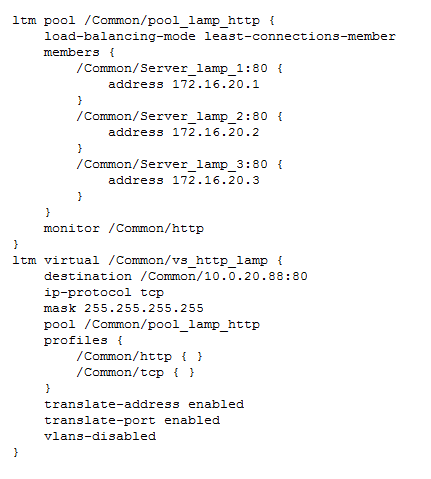
Refer to the exhibit.

Users report that a web application behaves incorrectly. At times, contextual data displayed on the web pages is correct; at other times, it is incorrect.

The LTM administrator examines the connection table, filtering for one of the currently connected client IP addresses, with the command tmsh show sys connection cs-client-addr 10.0.20.1, and receives the following results:
10.0.20.1:60048 10.0.20.88:80 10.0.20.1:60048 172.16.20.1:80 tcp 3 (tmm: 0)  
10.0.20.1:60050 10.0.20.88:80 10.0.20.1:60050 172.16.20.3:80 tcp 3 (tmm: 0)  
10.0.20.1:60047 10.0.20.88:80 10.0.20.1:60047 172.16.20.2:80 tcp 3 (tmm: 0)  
10.0.20.1:60049 10.0.20.88:80 10.0.20.1:60049 172.16.20.1:80 tcp 3 (tmm: 0)  

What is the solution to the problem?

  • A Synchronize the clock of the LTM device with NTP.
  • B Modify the load balancing method attached to the pool.
  • C Set up an HTTP cookie insert profile in the virtual server.
  • D Modify the setup of the monitor bound to the pool used by the application.
Explanation

The client’s connections are being distributed among multiple pool members, while the virtual server has no persistence profile. If the application stores contextual or session data locally on a pool member, later requests can reach a different member and return inconsistent data. An HTTP cookie-insert persistence profile maintains affinity by inserting server-selection information into a response cookie and returning the client to the same server. F5 documents that cookie persistence uses an HTTP cookie to reconnect a client to the same previously visited server, and that HTTP Cookie Insert is the default cookie method.

Learn more

Community Discussion

No comments yet. Be the first to start the discussion!