On Cisco IOS XR software, what are the four valid address-family configuration command options in static route configuration mode? (Choose four.)
Aaddress-family ipv4 unicast
Baddress-family ipv6 unicast
Caddress-family ipv4 multicast
Daddress-family ipv6 multicast
Eaddress-family vpnv4
Faddress-family vpnv6
When configuring an ACL entry, which network and wildcard mask matches only IP addresses 10.8.144.0 to 10.8.151.255?
A10.8.144.0 0.0.3.255
B10.8.144.0 0.0.7.255
C10.8.144.0 0.0.15.255
D10.8.144.0 0.0.252.255
E10.8.144.0 0.0.248.255
F10.8.144.0 0.0.240.255
Which IP addresses are matched by the permit 192.168.80.64 0.0.0.15 access-list entry?
A192.168.80.64 to 192.168.80.255
B192.168.80.64 to 192.168.80.96
C192.168.80.64 to 192.168.80.95
D192.168.80.64 to 192.168.80.80
E192.168.80.64 to 192.168.80.79
Which two statements about NAT444 are true? (Choose two.)
ANAT444 packets are translated three times.
BNAT packets traverse three IPv4 addressing domains.
CNAT444 needs to work together with DNS64.
DThere are two types of NAT444 (stateful or stateless).
ENAT is performed by the CPE and also by the service provider router.
Which two statements about NAT64 are true? (Choose two.)
ANAT64 packets traverse two IPv4 addressing domains.
BNAT64 packets are translated two times.
CThere are two types of NAT64 (stateful or stateless).
DNAT is performed by the CPE and also by the service provider edge router.
EThe DNS64 server embeds the IPv4 address from the DNS A record with a preconfigured IPv6 translation prefix.
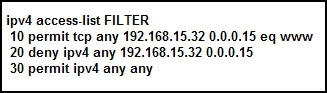
Refer to the exhibit.
The access list has been configured on the Gi0/0/0/0 interface in the inbound direction. Which four packets that are sourced from 10.1.1.1 TCP port 1060, if they are routed to the Gi0/0/0/0 interface, will be permitted? (Choose four)
Adestination IP address: 192.168.15.37, destination TCP port: 8080
Bdestination IP address: 192.168.15.41, destination TCP port: 8080
Cdestination IP address: 192.168.15.49, destination TCP port: 8080
Ddestination IP address: 192.168.15.36, destination TCP port: 80
Edestination IP address: 192.168.15.46, destination TCP port: 80
Fdestination IP address: 192.168.15.49, destination TCP port: 80
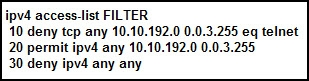
Refer to the exhibit.
The access list has been configured on the Gi0/0/0/0 interface in the inbound direction. Which two packets that are sourced from 172.16.1.1 TCP port 1050, if they are routed to the Gi0/0/0/0 interface, will be permitted? (Choose two)
Adestination IP address: 10.10.192.201, destination TCP port: 80
Bdestination IP address: 10.10.193.255, destination TCP port: 80
Cdestination IP address: 10.10.196.1, destination TCP port: 80
Ddestination IP address: 10.10.195.254, destination TCP port: 23
Edestination IP address: 10.10.193.145, destination TCP port: 23
Fdestination IP address: 10.10.197.32, destination TCP port: 23
Which first-hop router redundancy protocol uses the active virtual gateway to assign a virtual MAC address to the active virtual forwarders?
AHSRP
BVRRP
CGLBP
DFHRP
Which two statements about the BGP weight attribute on Cisco routers are true? (Choose two.)
AIt is a well-known discretionary attribute.
BIt is only locally significant.
CRoutes with higher weight are the preferred routes.
DIt is used to influence the inbound traffic from the upstream AS.
EIt is set to 100 by default.
Which BGP attribute is also used for loop prevention?
Aweight
Blocal preference
CMED
DAS path
The permit 172.16.32.0 0.0.15.255 access-list entry permits exactly which IP address range?
A172.16.32.0 to 172.16.47.255
B172.16.32.0 to 172.16.48.255
C172.16.32.0 to 172.16.62.255
D172.16.32.0 to 172.16.63.255
E172.16.32.0 to 172.16.64.255
F172.16.32.0 to 172.16.255.255
On the Cisco ME 3400 switch, spanning tree is enabled by default on which type of switch port?
AUNI
BENI
CNNI
DENI and NNI
EUNI, ENI, and NNI
During the BGP route selection process on Cisco routers, which BGP attribute is examined first, to determine the best path to use?
AAS path
BMED
Clocal preference
Dweight
Eorigin
Which type of service provider is responsible for offering backbone connectivity services to other service providers?
ACSP
BTSP
CNSP
DISP
EASP
Cisco IP NGN service providers can offer multiple services to their customers by using which type of technology in their core networks?
AATM
BSONET/SDH
CFrame Relay
DIP/MPLS
EPBB
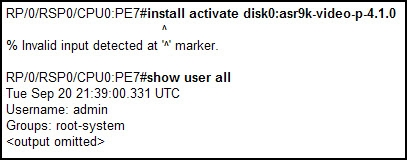
Refer to the Cisco IOS XR commands exhibit.
The router administrator is trying to activate a software package on the router but is not able to do so. Which statement about this problem is true?
AThe router needs to be in the global configuration mode.
BThe router needs to be in the admin global configuration mode.
CThe router needs to be in the admin EXEC mode.
DThe install activate command is not the correct command to use.
EThe administrator needs to log in as the "root" user instead of the "admin" user.
ISPs use which protocol to establish peering sessions in an Internet exchange point environment?
ALDP
BIS-IS
CBGP
DOSPF
You are enabling OSPF on a router and notice that all the Fast Ethernet and the Gigabit Ethernet interfaces have the same OSPF cost of 1. Which single configuration change can you make in router ospf configuration mode so that the Fast Ethernet interfaces have a higher OSPF cost than the Gigabit Ethernet interfaces?
AChange the OSPF interface cost globally.
BChange the OSPF default metric.
CChange the OSPF auto-cost reference bandwidth.
DChange the OSPF administrative distance.
EChange the OSPF metric type from E2 to E1.
On Cisco IOS XR software, which set of commands enables OSPF area 0 on the Gi0/0/0/0 interface that has an IPv4 IP address of 192.168.1.1/24?
Arouter ospf 1network 192.168.1.1 0.0.0.0 area 0
Brouter ospf 1network 192.168.1.1 255.255.255.255 area 0
Crouter ospf 1area 0interface gi0/0/0/0
Drouter ospfv3 1network 192.168.1.1 0.0.0.0 area 0
Erouter ospfv3 1network 192.168.1.1 255.255.255.255 area 0
Frouter ospfv3 1area 0network 192.168.1.0
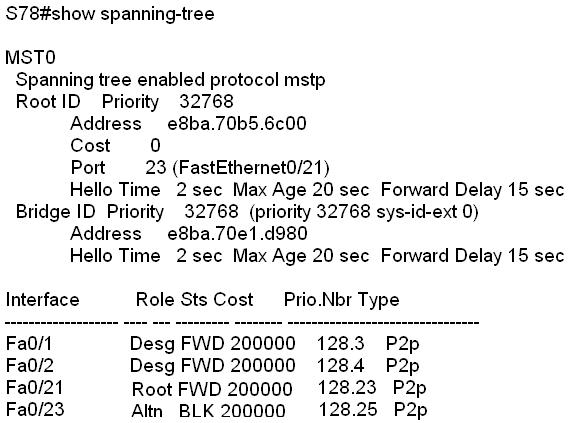
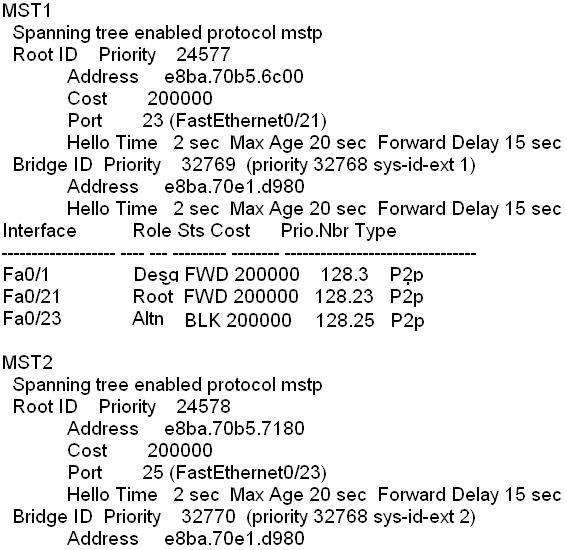
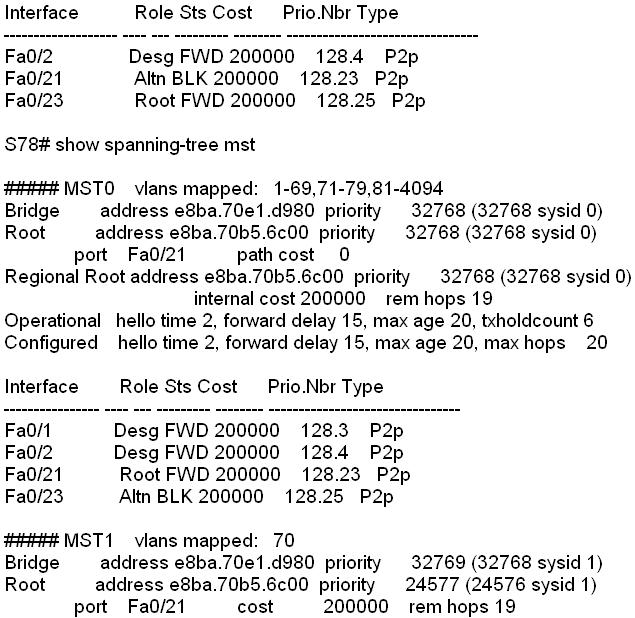
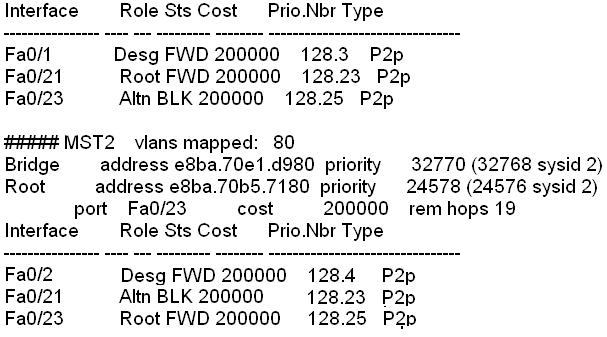
Refer to the two show output examples below. The switch with the e8ba.70b5.7180 MAC address is the root bridge for which VLAN or VLANs?
AVLAN 1
BVLAN 70
CVLAN 80
DVLANs 1, 70, and 80
EVLANs 1 and 70
FVLANs 1 and 80
Which three statements about OSPFv2 or OSPFv3 authentication are true? (Choose three.)
AOn Cisco IOS XR platforms, OSPFv3 authentication can be configured at the OSPF routing process, area, or interface level.
BOSPF authentication on Cisco IOS and IOS XE platforms can be configured per area or per interface.
COn Cisco IOS and IOS XE and IOS XR platforms, the authentication key can only be configured per interface.
DOSPFv3 uses IPsec for authentication and encryption.
EOn Cisco IOS XR platforms, the OSPF authentication that is configured for the area overrides the authentication that is configured for the interface.
FOn Cisco IOS and IOS XE platforms, the two OSPFv2 authentication methods that are supported are MD5 and SHA1.
Which statement is true about enabling IS-IS routing and using the net command to configure the NSAP address?
ANSAP addresses have a fixed size of 20 bytes.
BThe NSEL must always be 00 to identify the router.
CThe area address follows the system ID field before the NSEL field.
DAn AFI of 39 indicates that the AFI is a locally administered private address.
You have just enabled IS-IS on the lab testing network. You notice that IS-IS is not using the optimal path selection based on the interface bandwidth. Currently, the IS-IS routing process seems to be selecting the best path based on the hop count.
What configuration change can you make to cause IS-IS to select the optimal path based on the interface bandwidth?
AEnable a wide-style IS-IS metric.
BEnable a narrow-style IS-IS metric.
CChange the default auto-cost reference bandwidth to a higher value.
DChange the default IS-IS metric on each of the router interfaces to better correspond to the interface bandwidth.
EChange the interface bandwidth by using the bandwidth interface configuration mode command.
You have installed a new router and configured OSPF on it. However, this new router is not able to establish an OSPF neighbor relationship with the neighbor
OSPF router. Which four conditions could cause this problem? (Choose four.)
Amismatched OSPF hello/dead interval between the new router and the neighbor router
Bmismatched OSPF area ID between the new router and the neighbor router
Cmismatched OSPF authentication data between the new router and the neighbor router
Dmismatched OSPF router ID between the new router and the neighbor router
Emismatched interface MTU between the new router and the neighbor router
Fmismatched interface bandwidth between the new router and the neighbor router

 Preview