300-510 SPRI: Implementing Cisco Service Provider Advanced Routing SolutionsDemo
By Cisco · Browse Mode
//
300-510 SPRI: Implementing Cisco Service Provider… Practice Exam
QuestionQ1
MPLS and Segment Routing
Save question
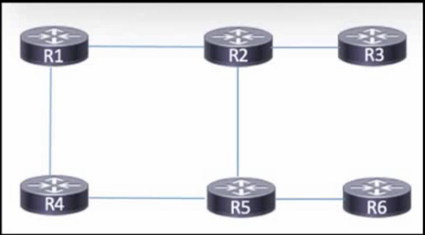
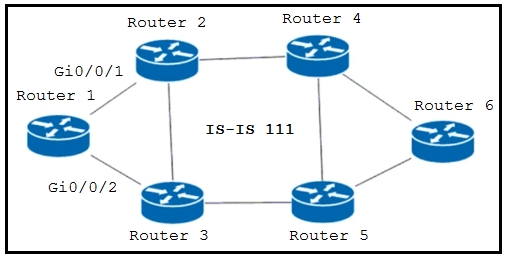
Refer to the exhibit. Router 1 is located in a different data center from Router 2 and Router 3. Router 1 runs the IS-IS routing protocol and is preconfigured with LDP and segment routing. Which configuration must an engineer apply under router isis 111 on Router 1 to implement TI-LFA on the link to Router 2 without disrupting traffic to Router 3?
Refer to the exhibit. The network is configured for multicast with PIM-SM. A server attached to R3 sends multicast data to hosts on R4. To accommodate anticipated network growth, the network engineer with employee ID 123456789 has decided to use Auto-RP to dynamically assign a rendezvous point (RP). Which action must be performed?
AConfigure the interfaces participating in multicast to be in sparse-dense mode
BConfigure R3 as the BSR mapping agent
CConfigure each router with a different loopback address to be used as the backup RP.
DConfigure R4 to be the RP and mapping agent
Drag and drop the BGP route-selection attributes from the left into the correct sequence on the right. Not all options are used.
Drag & Drop
lowest router ID
highest router ID
lowest local preference
if both paths are external, prefer the newest path
highest local preference
highest weight
eBGP over iBGP paths
if both paths are external, prefer the oldest path
lowest MED
Step 1
Step 2
Step 3
Step 4
Step 5
Step 6
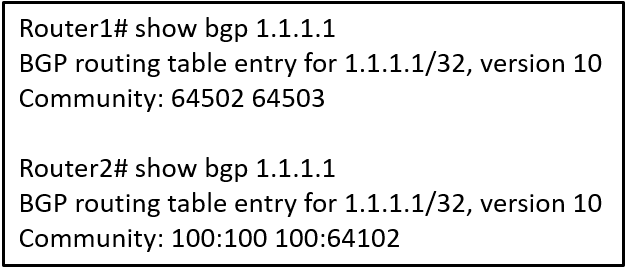
Refer to the exhibit.
An engineer working on a client’s network is trying to resolve the BGP community issue on the R1 and R2 routers. After displaying the BGP entries, the engineer notices that the two routers still produce different outputs. Which action must the engineer perform on either router to correct the problem and obtain the same output?
AExecute the lp bgp-community new-format command in Router1.
BRemove the lp bgp-community new-format command in Router1.
CAdvertise the route to Router2 as standard community.
DAdvertise the route to Router2 as extended community.
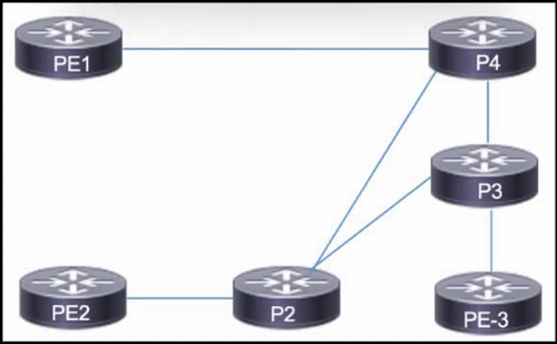
Refer to the exhibit. The service provider has deployed segment routing in its core. P2 connects to P3 and P4 through a point-to-multipoint link, as shown. The service provider supplies connectivity for a large enterprise with three primary offices in different geographic regions. Each office connects through one of the three PEs. The enterprise wants to implement multicast traffic across the service provider to stream mission-critical applications among sites. The applications are sourced from a server connected to the network through PE2. Which action must the network-engineering team take so that multicast traffic flows between the enterprise sites over the point-to-multipoint link?
AImplement MLDP to allow multicast traffic to f ow within the single AS.
BImplement SR Tree-SID to build a multicast replication tree over the point-to-multipoint link.
CImplement RSVP to reserve bandwidth on the link between PE2 and P2.
DImplement PIM-DM to flood multicast traffic from the enterprise into the service provider core.
QuestionQ6
Routing Policy and Manipulation
0
Community Discussion
No comments yet. Be the first to start the discussion!
QuestionQ7
MPLS and Segment Routing
QuestionQ8
MPLS and Segment Routing
QuestionQ9
MPLS and Segment Routing
QuestionQ10
MPLS and Segment Routing
QuestionQ12
Routing Policy and Manipulation
QuestionQ13
MPLS and Segment Routing
QuestionQ14
Routing Policy and Manipulation
QuestionQ15
Routing Policy and Manipulation
QuestionQ16
MPLS and Segment Routing
QuestionQ17
Unicast Routing
QuestionQ18
Unicast Routing
QuestionQ19
Unicast Routing
QuestionQ20
Routing Policy and Manipulation
QuestionQ21
Unicast Routing
QuestionQ22
Unicast Routing
QuestionQ23
MPLS and Segment Routing
QuestionQ24
Routing Policy and Manipulation
QuestionQ25
Multicast Routing
QuestionQ26
Routing Policy and Manipulation
Save question
0
Community Discussion
No comments yet. Be the first to start the discussion!
Save question
0
Community Discussion
No comments yet. Be the first to start the discussion!
Save question
0
Community Discussion
No comments yet. Be the first to start the discussion!
Save question
0
Community Discussion
No comments yet. Be the first to start the discussion!
Save question
0
Community Discussion
No comments yet. Be the first to start the discussion!
Save question
0
Community Discussion
No comments yet. Be the first to start the discussion!
Save question
0
Community Discussion
No comments yet. Be the first to start the discussion!
Ad
Want a break from the ads?
Go ad-free and unlock Learn Mode, Exam Mode, AstroTutor AI and every premium tool — everything you need to walk in prepared, and confident.
No comments yet. Be the first to start the discussion!
Save question
0
Community Discussion
No comments yet. Be the first to start the discussion!
Save question
0
Community Discussion
No comments yet. Be the first to start the discussion!
Save question
0
Community Discussion
No comments yet. Be the first to start the discussion!
Save question
0
Community Discussion
No comments yet. Be the first to start the discussion!
Save question
0
Community Discussion
No comments yet. Be the first to start the discussion!
Save question
0
Community Discussion
No comments yet. Be the first to start the discussion!
Save question
0
Community Discussion
No comments yet. Be the first to start the discussion!
Save question
0
Community Discussion
No comments yet. Be the first to start the discussion!
Save question
0
Community Discussion
No comments yet. Be the first to start the discussion!
Save question
0
Community Discussion
No comments yet. Be the first to start the discussion!
Save question
0
Community Discussion
No comments yet. Be the first to start the discussion!
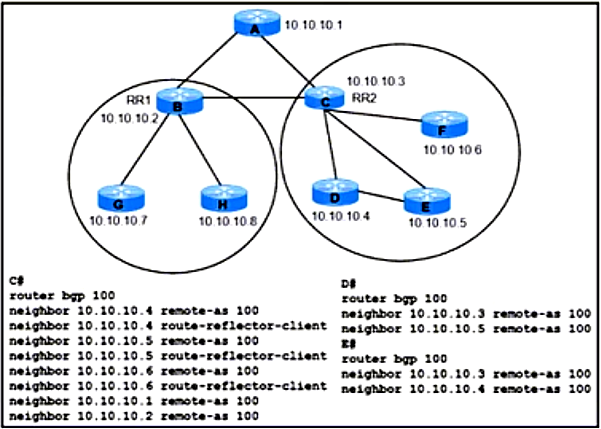
Refer to the exhibit. While troubleshooting a networking issue, an engineer identified suboptimal communication on route reflector RR2. In the current environment:
Router A is a non-route-reflector client for RR1 and RR2.
Routers D and E are directly connected iBGP peers.
Router F is not an iBGP peer of routers D and E.
Which action resolves the issue?
ARemove the route-reflector configuration on router RR2.
BDisable BGP client-to-client reflection on router RR2.
CEnable next-hop-self for BGP peering on router D.
DEnable next-hop-self for BGP peering on router C.
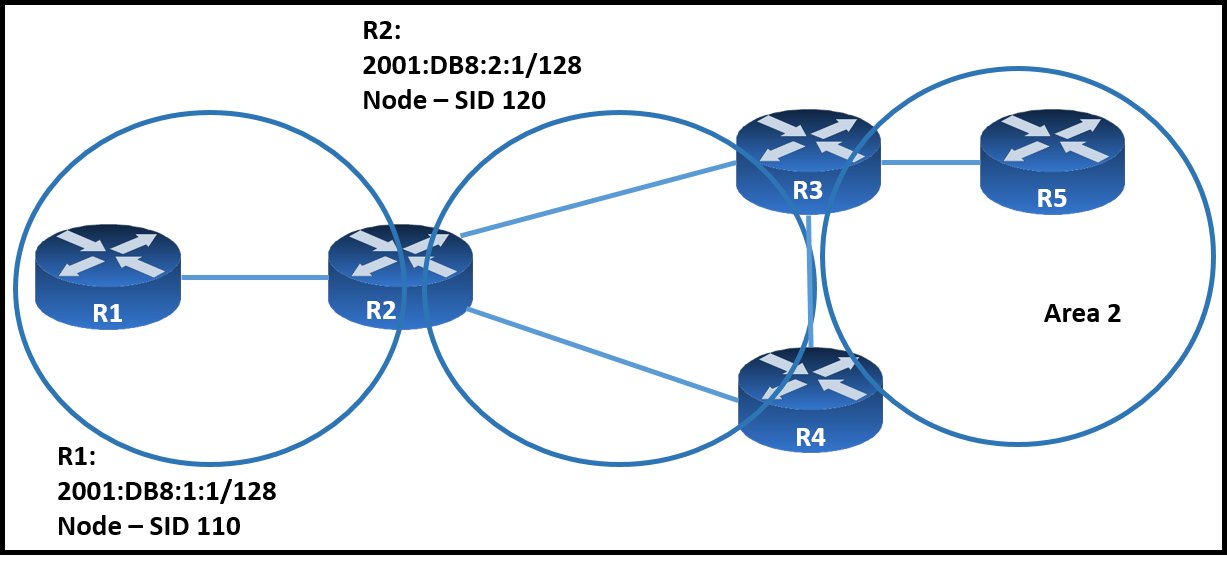
Refer to the exhibit.
When deploying SRv6, which SID does R2 advertise into area 0 for prefix 2001:DB8:1:1/128?
A120
B230
C110
D10
Which attribute instructs the router that packets must be processed by an ASA associated with the segment?
Aservice SID with service instructions
Badjacency SID with unidirectional adjacency instructions
Cnode SID that identifies a specific network device
Dprefix SID that represents a specific route prefix
How does the SRv6 IS-IS Flexible Algorithm operate in the data plane?
AIt applies path computation algorithms to learn the topology and compute a pair of disjoint LSPs.
BIt uses the TE metric in its path calculations to optimize the cumulative TE metric.
CIt automatically delivers traffic to the destination over an engineered path computed by the IGP.
DIt uses the IGP metric in its path calculations to optimize reachability.
An engineer is working to implement the segment routing protocol on the customer’s core network. Which step should the engineer take before segment routing is enabled and running with BGP?
ASegment routing must be configured with EIGRP
BSegment routing must be configured with ISIS
CMPLS must be configured
DExplicit-null must be configured for all neighbors
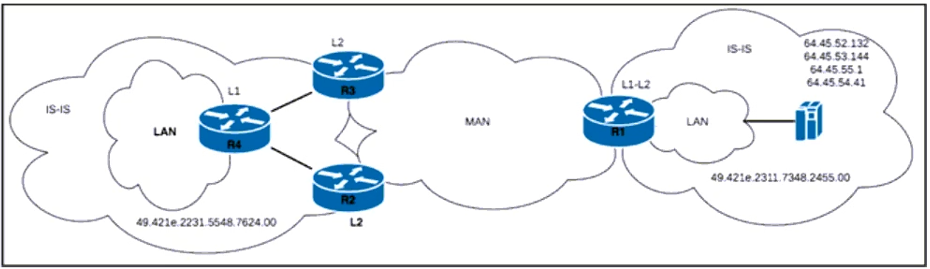
Refer to the exhibit. Company_A hosts multiple online VoD platforms. R3 connects to the MAN with a 100 Mbps link. R2 has only a 10 Mbps connection, but it has the lowest hop count to R1. A network engineer must allow users in area 49.421 e.2331.5548.7624.00 to access online library resources by using the best possible route toward the online platforms to guarantee the highest connection quality. After the engineer implements the requirements, they observe an excessive number of routes in the R4 routing table and high memory consumption on the router. Which two actions must the engineer take to resolve the issue?
Choose two
ACreate an access list on R2 and redistribute all routes from L1 into L2.
BConfigure summary-address level-2 64.45.52.0 0.0.3.255 on R2.
CConfigure summary-address area level-1-2 64.45.52.0 255.255.252.0 on R3.
DConfigure summary-address 64.45.52.0 255.255.252.0 level-1 on R3.
ECreate a route map on R3 and redistribute all routes from L2 into L1.
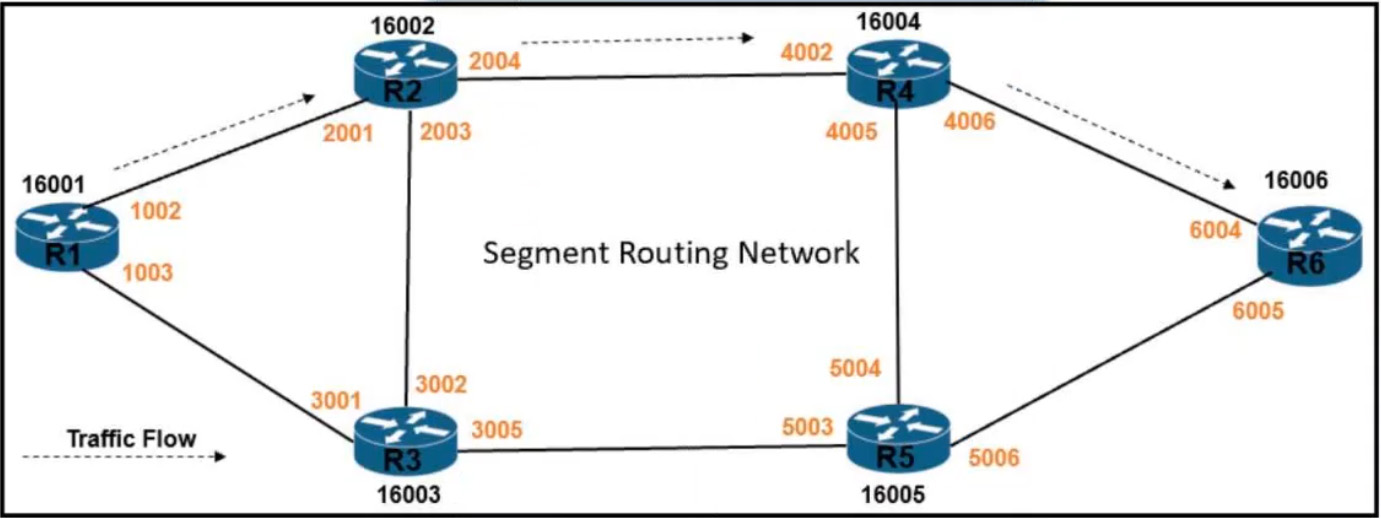
Refer to the exhibit.
R1 is sending data traffic to R6 using the same SRGB range as the other routers in the topology, but it is also using a non-default SRLB range. Which two configuration tasks must the engineer complete to enable normal SRGB and SRLB operations on this network?
Choose two
AConfigure router R2 with adjacency SID 4002 to enable it to reach R4.
BConfigure an adjacency SID from SRLB range 1002 to 6005.
CSet the SRGB range to 1002 to 6005.
DConfigure router R1 with adjacency SID 1003 to enable it to reach R2.
ESet the default SRGB range to 16000 to 23999.
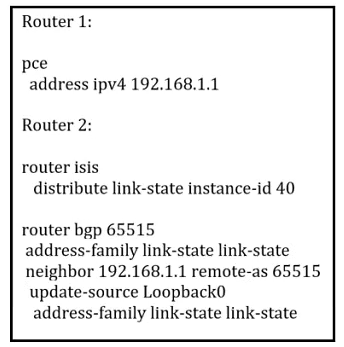
Refer to the exhibit. What relationship exists between Router 1 and Router 2?
ARouter 1 centrally learns the topology of the network to aid in SR-TE path selection, and Router 2 is a node that feeds Router 1 topology information
BRouter 1 and Router 2 are participating in SR-TE tunnels and are both head-end routers
CRouter 1 and Router 2 centrally learn the topology of the network to aid in SR-TE path selection for peers
DRouter 2 is the head-end router in an SR-TE tunnel, and it is learning topology of the network from the PCE enabled on Router 1
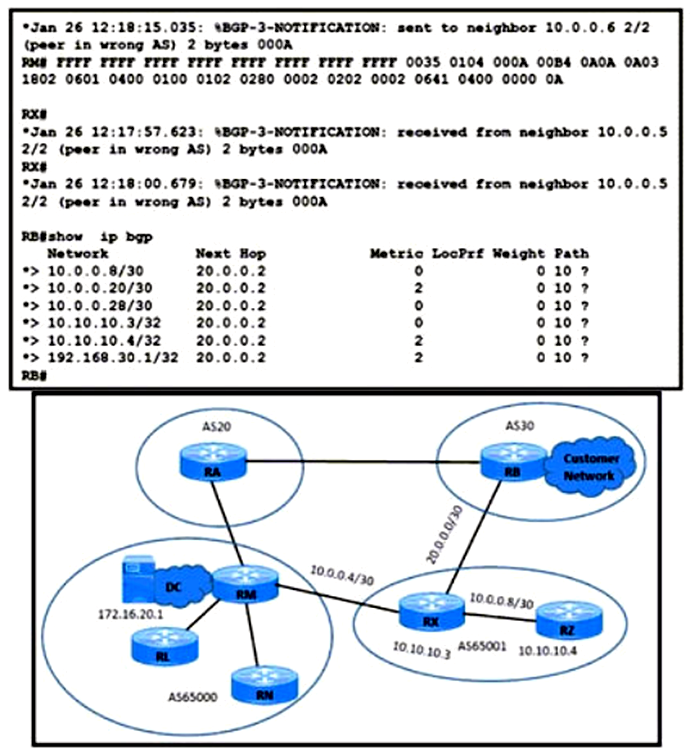
Refer to the exhibit. An engineer working for a private telecommunication company with employee ID 1234:56:789 notices that the customer network traversing AS30-AS65001-AS65000 experiences packet drops when accessing an application at 172.16.20.1/32 in the DC cloud. The BGP link between AS20 and AS30 is inaccessible because of a fiber cut. Routers RL, RN, and RZ are configured with confederation identifier 10. Which action resolves this issue?
DRX(config)#router bgp 65001 -RX(config-router)# no synchronizationRX(config-router)# bgp confederation identifier 10
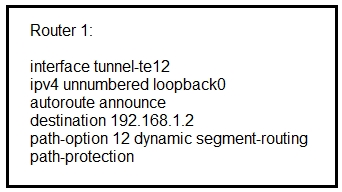
Refer to the exhibit. Router 1 has established an SR-TE tunnel to Router 2. Which statement describes this configuration?
ARouter 1 has a list of labels used to explicitly lay out a path to router 2.
BRouter 1 and router 2 have a bidirectional tunnel set up with dynamic path selection.
CRouter 1 is the head-end tunnel and has dynamically chosen a path to router 2.
DRouter 2 is the head-end tunnel and has explicitly set a path to router 1.
What are two major differences between OSPF and IS-IS routing protocols?
Choose two
AOSPF uses IP protocol 89 for encapsulation, and IS-IS uses an IEEE 802.3 standard-based protocol for encapsulation.
BOSPF partially refreshes the LSA database every 30 minutes, and IS-IS refreshes the complete database table every 60 minutes.
CAn OSPF-enabled router is part of only one area, but an IS-IS-enabled router is part of multiple areas.
DThe OSPF default administrative distance is 115, and the default administrative distance for IS-IS is 110.
EThe OSPF DR role can be pre-empted only when the active DR goes down, but the IS-IS DR role can be taken by a router with higher priority at any time.
Which IPv6 prefix format specifies the destination for a dynamic 6to4 tunnel?
A2001:db8::/32
B2002::/16
Cfe80::/10
Dff00::/8
Refer to the exhibit. Routers in the cluster are not receiving the required prefixes. What must be done to resolve the issue?
AClients in that cluster must have full mesh connectivity between eBGP peers
BNo client-to-client reflection must be enabled
CClients in that cluster must have full mesh connectivity between iBGP peers
DNo client-to-client must be disabled
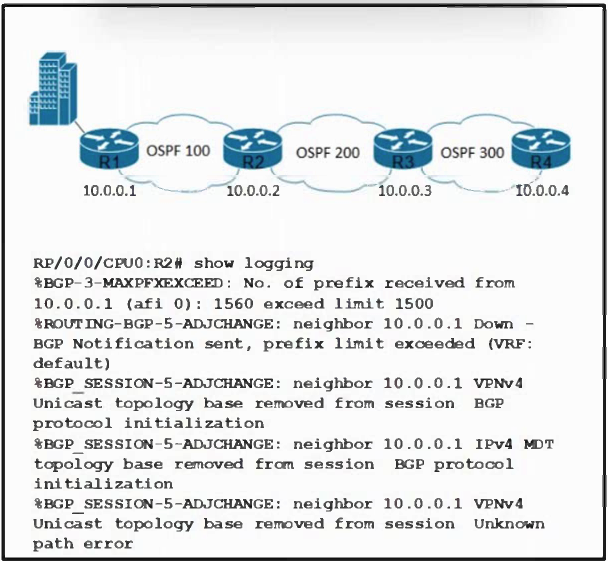
Refer to the exhibit. After maintenance activities to bring up BGP neighbors for a new data center attached to R1, L3VPN customers connected to OSPF domain 100 have lost connectivity to services located in OSPF domain 200 and OSPF domain 300. However, Unified MPLS services within OSPF domain 100 continue to be reachable. Which action must the network engineer take to resolve the outage?
AActivate BGP neighbors between the new data center and R2 and R3.
BReset the BGP session between R1 and R2.
CRaise the maximum prefix limit on R2 to 1560 or more
DEstablish new MPLS LSPs from R1 to R2. R3, and R4
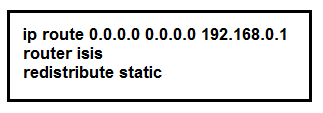
Refer to the exhibit. An administrator is troubleshooting Internet-access problems on a customer’s network. After applying this IS-IS configuration to R1, the administrator observes that it does not redistribute the default route into IS-IS. After verifying connectivity between the IS-IS router and the ISP router, the engineer confirmed Layer 3 connectivity between them. Which action should be taken to resolve the issue?
AConfigure R1 as a Layer 1 router
BAdd the default-information originate command to the configuration
CConfigure the default route under any routing protocol other than IS-IS
DAssociate the default route with a VRF
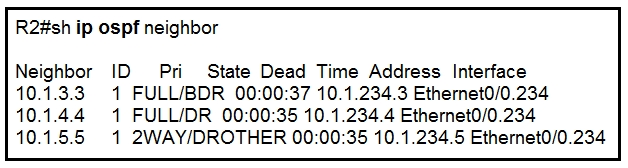
Using the exhibit, why is neighbor 10.1.5.5 remaining in the 2WAY state?
ARouter ID 10.1.5.5 is not reachable from R2
BOSPF authentication has failed between R2 and 10.1.5.5
CIt is an expected behavior when OSPF network type is broadcast
DOSPF parameters (Area ID or hello interval) are mismatched between R2 and 10.1.5.5
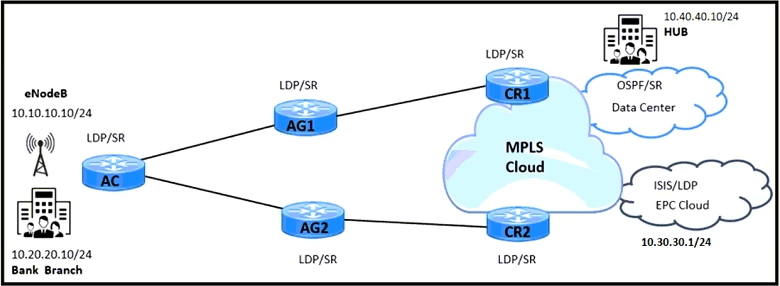
Refer to the exhibit. A service provider runs LDP and segment routing in the network. Mobility traffic is transported through LDP, while enterprise traffic is transported through segment routing. Which configuration must be implemented on the routers to connect the bank branch to the HUB site?
AConfigure segment-routing sr-prefer prefix-list on CR1 and CR2 routers for 10.20.20.10/24.
BEnable segment-routing Mpls sr-prefer on AG1 and AG2 routers for 10.0.0.0/8.
CConfigure segment-routing sr-prefer prefix-list on AG1 and AG2 router for 10.10.10.10/24.
DEnable segment-routing Mpls sr-prefer on CR1 and CR2 routers for 10.0.0.0/8.
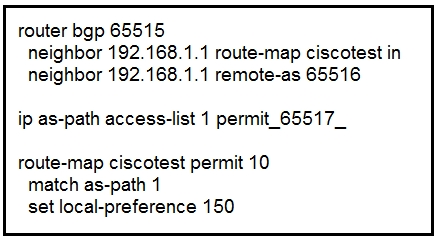
Refer to the exhibit. After troubleshooting a BGP traffic-steering issue, which action did the network operator take to obtain the correct effect from this configuration?
ARoutes that have passed through AS 65517 have the local preference set to 150.
BRoutes that have originated through AS 65517 have the local preference set to 150.
CRoutes directly attached to AS 65517 have the local preference set to 150.
DRoutes that have passed through AS 65517 have the local preference set to 150 and the traffic is denied.
An engineer whose employee ID is 4535:15:507 must deploy PIM-SSM in the network to support a new multicast messaging service. Every router in the network runs a distance-vector routing protocol. Unicast routing has been established and operates normally. What must the engineer enable to proceed with the implementation?
AIGMPv3 on all interfaces that participate in multicast
BPIM RP feature on the network
CPIM dense mode on all devices on the network
DPIM dense mode and IGMPv2 on all interfaces that participate in multicast
Refer to the exhibit. An engineer has successfully resolved a BGP peering issue. R1 has established eBGP peerings with R2 and R3. Which mechanism should the engineer apply to steer the traffic correctly?
AThe MED attribute can be applied on R2 to influence R1 to use it as the primary path.
BThe local preference attribute can be applied on R3 to influence AS 65513 to use AS 65515 as the secondary path.
CThe weight attribute can be applied on R2 to influence AS 65513 to use AS 65515 as the primary path.
DThe IGP metric can be manipulated on R1 to allow traffic to be load balanced between R2 and R3.
Community Discussion