About the Exam

This is a 90-minute Cisco cybersecurity concentration exam focused on forensic analysis and incident response fundamentals, techniques, and processes. It is intended for candidates pursuing Cisco cybersecurity professional certification and the associated specialist credential. Passing demonstrates knowledge of how to perform forensic analysis and incident response using Cisco technologies.

Exam Topics

  • Fundamentals20%
  • Forensics Techniques20%
  • Incident Response Techniques30%
  • Forensics Processes15%
  • Incident Response Processes15%

How to Use This Practice Exam

  1. Browse — Read each question, select your answer, and reveal the explanation.
  2. Exam Mode — Simulate real exam conditions with a timed session and score report.
  3. Learn Mode — Spaced repetition schedules questions you struggle with for long-term retention.

Download the Full Exam PDF

Get every question and answer in a clean, printable PDF built for offline study. Purchase once, keep permanent access, and re-download the latest version anytime.

Last updated July 13, 2026 at 5:07 AM

Topic filter
Retired questions
Question sort

QuestionQ1

Forensics Techniques

What is the anti-forensics technique known as steganography?

  • A hiding a section of a malicious file in unused areas of a file
  • B changing the file header of a malicious file to another file type
  • C sending malicious files over a public network by encapsulation
  • D concealing malicious files in ordinary or unsuspecting places
Explanation

Steganography conceals malicious files or data within ordinary-looking or unsuspecting places, reducing the likelihood that their presence will be noticed during examination.

Community Discussion

No comments yet. Be the first to start the discussion!

QuestionQ2

Incident Response Processes

An employee receives an email from a "trusted" person that contains a hyperlink involving malvertising. The employee clicks the link, and malware is downloaded. An information analyst notices an alert in the SIEM and engages the cybersecurity team to analyze the incident according to the incident response plan. Which event detail should be included in this root cause analysis?

  • A phishing email sent to the victim
  • B alarm raised by the SIEM
  • C information from the email header
  • D alert identified by the cybersecurity team
Explanation

A root cause analysis records the initiating event that enabled the incident. The phishing email containing the malicious hyperlink led to the employee’s click and subsequent malware download; SIEM alarms and team alerts are detection events rather than the underlying cause.

Community Discussion

No comments yet. Be the first to start the discussion!

QuestionQ3

Incident Response Processes

An incident response team recommends changes after reviewing a recent compromise in which:

  • A large number of events and logs were involved.
  • Team members could not identify anomalous behavior and escalate it promptly.
  • Several network systems were affected because detection was delayed.
  • Security engineers mitigated the threat and restored systems to a stable state.
  • The issue recurred shortly afterward and systems became unstable again because the correct information was not collected during the initial identification phase.

Which two recommendations should be made to improve the incident response process?

Choose two
  • A Formalize reporting requirements and responsibilities to update management and internal stakeholders throughout the incident-handling process effectively.
  • B Improve the mitigation phase to ensure causes can be quickly identified, and systems returned to a functioning state.
  • C Implement an automated operation to pull systems events/logs and bring them into an organizational context.
  • D Allocate additional resources for the containment phase to stabilize systems in a timely manner and reduce an attack's breadth.
  • E Modify the incident handling playbook and checklist to ensure alignment and agreement on roles, responsibilities, and steps before an incident occurs.
Explanation

Automated collection and contextualization of system events and logs helps analysts detect anomalous behavior promptly amid high event volumes. A revised incident-handling playbook and checklist establishes agreed roles, responsibilities, and identification steps before an incident, helping ensure the necessary information is gathered and reducing the risk of recurrence.

Community Discussion

No comments yet. Be the first to start the discussion!

QuestionQ4

Fundamentals

Question Image

Refer to the exhibit. Which encoding method does this HEX string represent?

  • A Unicode
  • B Binary
  • C Base64
  • D Charcode
Explanation

The hexadecimal byte values map to ASCII characters that form a Base64 string. Its restricted alphanumeric Base64 alphabet and trailing == padding are characteristic of Base64 encoding; Base64 uses = padding when required to complete the final encoded quantum.

Learn more

Community Discussion

No comments yet. Be the first to start the discussion!

QuestionQ5

Incident Response Processes

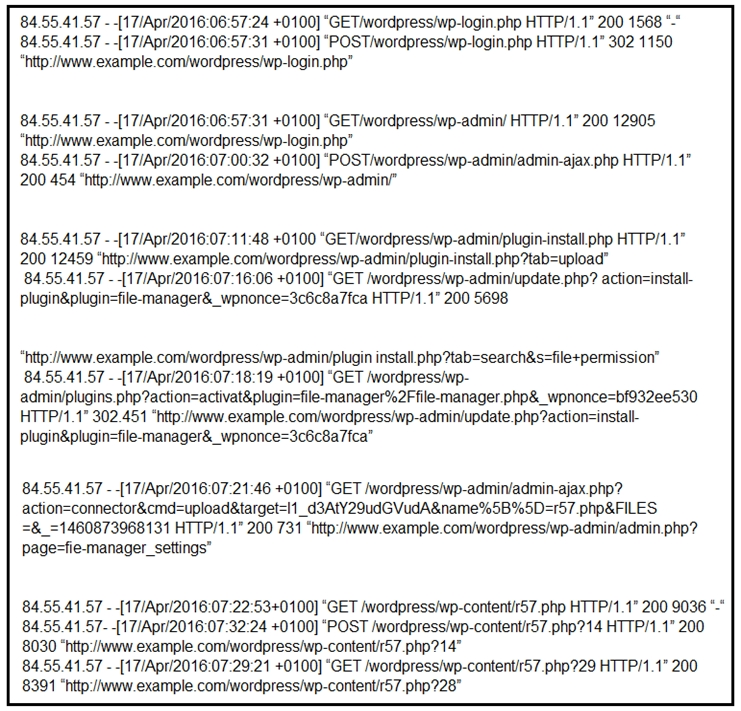
A security team identified an above-average number of inbound tcp/135 connection attempts from unidentified senders. The security team is responding according to its incident response playbook. Which two elements are included in the eradication phase for this incident?
Choose two
  • A anti-malware software
  • B data and workload isolation
  • C centralized user management
  • D intrusion prevention system
  • E enterprise block listing solution
Explanation

Eradication eliminates the incident’s underlying cause and removes the attacker’s ability to continue. Centralized user management supports disabling or correcting unauthorized or compromised access, while an intrusion prevention system actively blocks the malicious inbound TCP/135 attempts. Isolation is a containment measure intended to limit spread or impact.

Learn more

Community Discussion

No comments yet. Be the first to start the discussion!
Know a question that should be here? Contribute to this exam
Back home