A Security Administrator is configuring an Amazon S3 bucket and must meet the following security requirements:
✑ Encryption in transit
✑ Encryption at rest
✑ Logging of all object retrievals in AWS CloudTrail
Which of the following meet these security requirements? (Choose three.)
ASpecify ג€aws:SecureTransportג€: ג€trueג€ within a condition in the S3 bucket policy.
BEnable a security group for the S3 bucket that allows port 443, but not port 80.
CSet up default encryption for the S3 bucket.
DEnable Amazon CloudWatch Logs for the AWS account.
EEnable API logging of data events for all S3 objects.
The Security Engineer is managing a web application that processes highly sensitive personal information. The application runs on Amazon EC2. The application has strict compliance requirements, which instruct that all incoming traffic to the application is protected from common web exploits and that all outgoing traffic from the EC2 instances is restricted to specific whitelisted URLs.
Which architecture should the Security Engineer use to meet these requirements?
AUse AWS Shield to scan inbound traffic for web exploits. Use VPC Flow Logs and AWS Lambda to restrict egress traffic to specific whitelisted URLs.
BUse AWS Shield to scan inbound traffic for web exploits. Use a third-party AWS Marketplace solution to restrict egress traffic to specific whitelisted URLs.
CUse AWS WAF to scan inbound traffic for web exploits. Use VPC Flow Logs and AWS Lambda to restrict egress traffic to specific whitelisted URLs.
DUse AWS WAF to scan inbound traffic for web exploits. Use a third-party AWS Marketplace solution to restrict egress traffic to specific whitelisted URLs.
A company's database developer has just migrated an Amazon RDS database credential to be stored and managed by AWS Secrets Manager. The developer has also enabled rotation of the credential within the Secrets Manager console and set the rotation to change every 30 days.
After a short period of time, a number of existing applications have failed with authentication errors.
What is the MOST likely cause of the authentication errors?
AMigrating the credential to RDS requires that all access come through requests to the Secrets Manager.
BEnabling rotation in Secrets Manager causes the secret to rotate immediately, and the applications are using the earlier credential.
CThe Secrets Manager IAM policy does not allow access to the RDS database.
DThe Secrets Manager IAM policy does not allow access for the applications.
A company plans to move most of its IT infrastructure to AWS. They want to leverage their existing on-premises Active Directory as an identity provider for AWS.
Which combination of steps should a Security Engineer take to federate the company's on-premises Active Directory with AWS? (Choose two.)
ACreate IAM roles with permissions corresponding to each Active Directory group.
BCreate IAM groups with permissions corresponding to each Active Directory group.
CConfigure Amazon Cloud Directory to support a SAML provider.
DConfigure Active Directory to add relying party trust between Active Directory and AWS.
EConfigure Amazon Cognito to add relying party trust between Active Directory and AWS.
Which of the following minimizes the potential attack surface for applications?
AUse security groups to provide stateful firewalls for Amazon EC2 instances at the hypervisor level.
BUse network ACLs to provide stateful firewalls at the VPC level to prevent access to any specific AWS resource.
CUse AWS Direct Connect for secure trusted connections between EC2 instances within private subnets.
DDesign network security in a single layer within the perimeter network (also known as DMZ, demilitarized zone, and screened subnet) to facilitate quicker responses to threats.
Question 6
Identity and Access Management
0
Question 7
Infrastructure Security
Question 8
Detection
Question 9
Incident Response
Question 10
Detection
Question 11
Infrastructure Security
Question 13
Detection
Question 14
Incident Response
Question 15
Identity and Access Management
Question 16
Data Protection
Question 17
Identity and Access Management
Question 18
Identity and Access Management
Question 19
Detection
Question 20
Data Protection
Question 21
Infrastructure Security
Question 22
Data Protection
Question 23
Detection
Question 25
Identity and Access Management
Question 26
Identity and Access Management
Question 27
Infrastructure Security
Ask AstroTutor
0
Ask AstroTutor
0
Ask AstroTutor
0
Ask AstroTutor
0
Ask AstroTutor
0
Ask AstroTutor
0
Ask AstroTutor
0
Ad
Want a break from the ads?
Become a Supporter and enjoy a completely ad-free experience, plus unlock Learn Mode, Exam Mode, AstroTutor AI, and more.
Ask AstroTutor
0
Ask AstroTutor
0
Ask AstroTutor
0
Ask AstroTutor
0
Ask AstroTutor
0
Ask AstroTutor
0
Ask AstroTutor
0
Ask AstroTutor
0
Ask AstroTutor
0
Ask AstroTutor
0
Ask AstroTutor
0
Ask AstroTutor
0
A water utility company uses a number of Amazon EC2 instances to manage updates to a fleet of 2,000 Internet of Things (IoT) field devices that monitor water quality. These devices each have unique access credentials.
An operational safety policy requires that access to specific credentials is independently auditable.
What is the MOST cost-effective way to manage the storage of credentials?
AUse AWS Systems Manager to store the credentials as Secure Strings Parameters. Secure by using an AWS KMS key.
BUse AWS Key Management System to store a master key, which is used to encrypt the credentials. The encrypted credentials are stored in an Amazon RDS instance.
CUse AWS Secrets Manager to store the credentials.
DStore the credentials in a JSON file on Amazon S3 with server-side encryption.
A distributed web application is installed across several EC2 instances in public subnets residing in two Availability Zones. Apache logs show several intermittent brute-force attacks from hundreds of IP addresses at the layer 7 level over the past six months.
What would be the BEST way to reduce the potential impact of these attacks in the future?
AUse custom route tables to prevent malicious traffic from routing to the instances.
BUpdate security groups to deny traffic from the originating source IP addresses.
CUse network ACLs.
DInstall intrusion prevention software (IPS) on each instance.
A security team is responsible for reviewing AWS API call activity in the cloud environment for security violations. These events must be recorded and retained in a centralized location for both current and future AWS regions.
What is the SIMPLEST way to meet these requirements?
AEnable AWS Trusted Advisor security checks in the AWS Console, and report all security incidents for all regions.
BEnable AWS CloudTrail by creating individual trails for each region, and specify a single Amazon S3 bucket to receive log files for later analysis.
CEnable AWS CloudTrail by creating a new trail and applying the trail to all regions. Specify a single Amazon S3 bucket as the storage location.
DEnable Amazon CloudWatch logging for all AWS services across all regions, and aggregate them to a single Amazon S3 bucket for later analysis.
A Security Engineer received an AWS Abuse Notice listing EC2 instance IDs that are reportedly abusing other hosts.
Which action should the Engineer take based on this situation? (Choose three.)
AUse AWS Artifact to capture an exact image of the state of each instance.
BCreate EBS Snapshots of each of the volumes attached to the compromised instances.
CCapture a memory dump.
DLog in to each instance with administrative credentials to restart the instance.
ERevoke all network ingress and egress except for to/from a forensics workstation.
FRun Auto Recovery for Amazon EC2.
An application outputs logs to a text file. The logs must be continuously monitored for security incidents.
Which design will meet the requirements with MINIMUM effort?
ACreate a scheduled process to copy the component's logs into Amazon S3. Use S3 events to trigger a Lambda function that updates Amazon CloudWatch metrics with the log data. Set up CloudWatch alerts based on the metrics.
BInstall and configure the Amazon CloudWatch Logs agent on the application's EC2 instance. Create a CloudWatch metric filter to monitor the application logs. Set up CloudWatch alerts based on the metrics.
CCreate a scheduled process to copy the application log files to AWS CloudTrail. Use S3 events to trigger Lambda functions that update CloudWatch metrics with the log data. Set up CloudWatch alerts based on the metrics.
DCreate a file watcher that copies data to Amazon Kinesis when the application writes to the log file. Have Kinesis trigger a Lambda function to update Amazon CloudWatch metrics with the log data. Set up CloudWatch alerts based on the metrics.
The Information Technology department has stopped using Classic Load Balancers and switched to Application Load Balancers to save costs. After the switch, some users on older devices are no longer able to connect to the website.
What is causing this situation?
AApplication Load Balancers do not support older web browsers.
BThe Perfect Forward Secrecy settings are not configured correctly.
CThe intermediate certificate is installed within the Application Load Balancer.
DThe cipher suites on the Application Load Balancers are blocking connections.
A company has multiple production AWS accounts. Each account has AWS CloudTrail configured to log to a single Amazon S3 bucket in a central account. Two of the production accounts have trails that are not logging anything to the S3 bucket.
Which steps should be taken to troubleshoot the issue? (Choose three.)
AVerify that the log file prefix is set to the name of the S3 bucket where the logs should go.
BVerify that the S3 bucket policy allows access for CloudTrail from the production AWS account IDs.
CCreate a new CloudTrail configuration in the account, and configure it to log to the account's S3 bucket.
DConfirm in the CloudTrail Console that each trail is active and healthy.
EOpen the global CloudTrail configuration in the master account, and verify that the storage location is set to the correct S3 bucket.
FConfirm in the CloudTrail Console that the S3 bucket name is set correctly.
During a recent internal investigation, it was discovered that all API logging was disabled in a production account, and the root user had created new API keys that appear to have been used several times.
What could have been done to detect and automatically remediate the incident?
AUsing Amazon Inspector, review all of the API calls and configure the inspector agent to leverage SNS topics to notify security of the change to AWS CloudTrail, and revoke the new API keys for the root user.
BUsing AWS Config, create a config rule that detects when AWS CloudTrail is disabled, as well as any calls to the root user create-api-key. Then use a Lambda function to re-enable CloudTrail logs and deactivate the root API keys.
CUsing Amazon CloudWatch, create a CloudWatch event that detects AWS CloudTrail deactivation and a separate Amazon Trusted Advisor check to automatically detect the creation of root API keys. Then use a Lambda function to enable AWS CloudTrail and deactivate the root API keys.
DUsing Amazon CloudTrail, create a new CloudTrail event that detects the deactivation of CloudTrail logs, and a separate CloudTrail event that detects the creation of root API keys. Then use a Lambda function to enable CloudTrail and deactivate the root API keys.
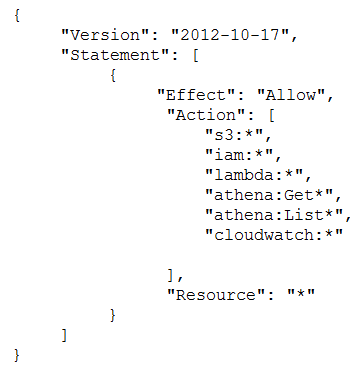
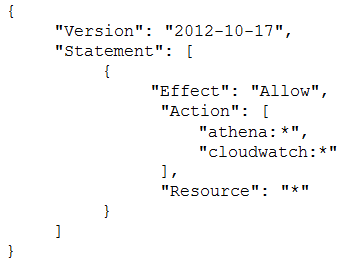
A Security Engineer has created an Amazon CloudWatch event that invokes an AWS Lambda function daily. The Lambda function runs an Amazon Athena query that checks AWS CloudTrail logs in Amazon S3 to detect whether any IAM user accounts or credentials have been created in the past 30 days. The results of the
Athena query are created in the same S3 bucket. The Engineer runs a test execution of the Lambda function via the AWS Console, and the function runs successfully.
After several minutes, the Engineer finds that his Athena query has failed with the error message: Insufficient Permissions. The IAM permissions of the Security
Engineer and the Lambda function are shown below:
Security Engineer -
Lambda function execution role -
What is causing the error?
AThe Lambda function does not have permissions to start the Athena query execution.
BThe Security Engineer does not have permissions to start the Athena query execution.
CThe Athena service does not support invocation through Lambda.
DThe Lambda function does not have permissions to access the CloudTrail S3 bucket.
An organization policy states that all encryption keys must be automatically rotated every 12 months.
Which AWS Key Management Service (KMS) key type should be used to meet this requirement?
AAWS managed Customer Master Key (CMK)
BCustomer managed CMK with AWS generated key material
CCustomer managed CMK with imported key material
DAWS managed data key
The Security Engineer for a mobile game has to implement a method to authenticate users so that they can save their progress. Because most of the users are part of the same OpenID-Connect compatible social media website, the Security Engineer would like to use that as the identity provider.
Which solution is the SIMPLEST way to allow the authentication of users using their social media identities?
AAmazon Cognito
BAssumeRoleWithWebIdentity API
CAmazon Cloud Directory
DActive Directory (AD) Connector
A financial institution has the following security requirements:
✑ Cloud-based users must be contained in a separate authentication domain.
✑ Cloud-based users cannot access on-premises systems.
As part of standing up a cloud environment, the financial institution is creating a number of Amazon managed databases and Amazon EC2 instances. An Active
Directory service exists on-premises that has all the administrator accounts, and these must be able to access the databases and instances.
How would the organization manage its resources in the MOST secure manner? (Choose two.)
AConfigure an AWS Managed Microsoft AD to manage the cloud resources.
BConfigure an additional on-premises Active Directory service to manage the cloud resources.
CEstablish a one-way trust relationship from the existing Active Directory to the new Active Directory service.
DEstablish a one-way trust relationship from the new Active Directory to the existing Active Directory service.
EEstablish a two-way trust between the new and existing Active Directory services.
Amazon CloudWatch Logs agent is successfully delivering logs to the CloudWatch Logs service. However, logs stop being delivered after the associated log stream has been active for a specific number of hours.
What steps are necessary to identify the cause of this phenomenon? (Choose two.)
AEnsure that file permissions for monitored files that allow the CloudWatch Logs agent to read the file have not been modified.
BVerify that the OS Log rotation rules are compatible with the configuration requirements for agent streaming.
CConfigure an Amazon Kinesis producer to first put the logs into Amazon Kinesis Streams.
DCreate a CloudWatch Logs metric to isolate a value that changes at least once during the period before logging stops.
EUse AWS CloudFormation to dynamically create and maintain the configuration file for the CloudWatch Logs agent.
During a recent security audit, it was discovered that multiple teams in a large organization have placed restricted data in multiple Amazon S3 buckets, and the data may have been exposed. The auditor has requested that the organization identify all possible objects that contain personally identifiable information (PII) and then determine whether this information has been accessed.
What solution will allow the Security team to complete this request?
AUsing Amazon Athena, query the impacted S3 buckets by using the PII query identifier function. Then, create a new Amazon CloudWatch metric for Amazon S3 object access to alert when the objects are accessed.
BEnable Amazon Macie on the S3 buckets that were impacted, then perform data classification. For identified objects that contain PII, use the research function for auditing AWS CloudTrail logs and S3 bucket logs for GET operations.
CEnable Amazon GuardDuty and enable the PII rule set on the S3 buckets that were impacted, then perform data classification. Using the PII findings report from GuardDuty, query the S3 bucket logs by using Athena for GET operations.
DEnable Amazon Inspector on the S3 buckets that were impacted, then perform data classification. For identified objects that contain PII, query the S3 bucket logs by using Athena for GET operations.
An application has a requirement to be resilient across not only Availability Zones within the application's primary region but also be available within another region altogether.
Which of the following supports this requirement for AWS resources that are encrypted by AWS KMS?
ACopy the application's AWS KMS CMK from the source region to the target region so that it can be used to decrypt the resource after it is copied to the target region.
BConfigure AWS KMS to automatically synchronize the CMK between regions so that it can be used to decrypt the resource in the target region.
CUse AWS services that replicate data across regions, and re-wrap the data encryption key created in the source region by using the CMK in the target region so that the target region's CMK can decrypt the database encryption key.
DConfigure the target region's AWS service to communicate with the source region's AWS KMS so that it can decrypt the resource in the target region.
A Security Engineer is trying to determine whether the encryption keys used in an AWS service are in compliance with certain regulatory standards.
Which of the following actions should the Engineer perform to get further guidance?
ARead the AWS Customer Agreement.
BUse AWS Artifact to access AWS compliance reports.
CPost the question on the AWS Discussion Forums.
DRun AWS Config and evaluate the configuration outputs.
The Security team believes that a former employee may have gained unauthorized access to AWS resources sometime in the past 3 months by using an identified access key.
What approach would enable the Security team to find out what the former employee may have done within AWS?
AUse the AWS CloudTrail console to search for user activity.
BUse the Amazon CloudWatch Logs console to filter CloudTrail data by user.
CUse AWS Config to see what actions were taken by the user.
DUse Amazon Athena to query CloudTrail logs stored in Amazon S3.
A company wants to control access to its AWS resources by using identities and groups that are defined in its existing Microsoft Active Directory.
What must the company create in its AWS account to map permissions for AWS services to Active Directory user attributes?
AAWS IAM groups
BAWS IAM users
CAWS IAM roles
DAWS IAM access keys
A company has contracted with a third party to audit several AWS accounts. To enable the audit, cross-account IAM roles have been created in each account targeted for audit. The Auditor is having trouble accessing some of the accounts.
Which of the following may be causing this problem? (Choose three.)
AThe external ID used by the Auditor is missing or incorrect.
BThe Auditor is using the incorrect password.
CThe Auditor has not been granted sts:AssumeRole for the role in the destination account.
DThe Amazon EC2 role used by the Auditor must be set to the destination account role.
EThe secret key used by the Auditor is missing or incorrect.
FThe role ARN used by the Auditor is missing or incorrect.
Compliance requirements state that all communications between company on-premises hosts and EC2 instances be encrypted in transit. Hosts use custom proprietary protocols for their communication, and EC2 instances need to be fronted by a load balancer for increased availability.
Which of the following solutions will meet these requirements?
AOffload SSL termination onto an SSL listener on a Classic Load Balancer, and use a TCP connection between the load balancer and the EC2 instances.
BRoute all traffic through a TCP listener on a Classic Load Balancer, and terminate the TLS connection on the EC2 instances.
CCreate an HTTPS listener using an Application Load Balancer, and route all of the communication through that load balancer.
DOffload SSL termination onto an SSL listener using an Application Load Balancer, and re-spawn and SSL connection between the load balancer and the EC2 instances.