A company uses AWS Secrets Manager to store a set of sensitive API keys that an AWS Lambda function uses. When the Lambda function is invoked the Lambda function retrieves the API keys and makes an API call to an external service. The Secrets Manager secret is encrypted with the default AWS Key Management Service (AWS KMS) key.
A DevOps engineer needs to update the infrastructure to ensure that only the Lambda function’s execution role can access the values in Secrets Manager. The solution must apply the principle of least privilege.
Which combination of steps will meet these requirements? (Choose two.)
AUpdate the default KMS key for Secrets Manager to allow only the Lambda function’s execution role to decrypt
BCreate a KMS customer managed key that trusts Secrets Manager and allows the Lambda function's execution role to decrypt. Update Secrets Manager to use the new customer managed key
CCreate a KMS customer managed key that trusts Secrets Manager and allows the account's root principal to decrypt. Update Secrets Manager to use the new customer managed key
DEnsure that the Lambda function’s execution role has the KMS permissions scoped on the resource level. Configure the permissions so that the KMS key can encrypt the Secrets Manager secret
ERemove all KMS permissions from the Lambda function’s execution role
A company plans to use Amazon CloudWatch to monitor its Amazon EC2 instances. The company needs to stop EC2 instances when the average of the NetworkPacketsIn metric is less than 5 for at least 3 hours in a 12-hour time window. The company must evaluate the metric every hour. The EC2 instances must continue to run if there is missing data for the NetworkPacketsIn metric during the evaluation period.
A DevOps engineer creates a CloudWatch alarm for the NetworkPacketsIn metric. The DevOps engineer configures a threshold value of 5 and an evaluation period of 1 hour.
Which set of additional actions should the DevOps engineer take to meet these requirements?
AConfigure the Datapoints to Alarm value to be 3 out of 12. Configure the alarm to treat missing data as breaching the threshold. Add an AWS Systems Manager action to stop the instance when the alarm enters the ALARM state.
BConfigure the Datapoints to Alarm value to be 3 out of 12. Configure the alarm to treat missing data as not breaching the threshold. Add an EC2 action to stop the instance when the alarm enters the ALARM state.
CConfigure the Datapoints to Alarm value to be 9 out of 12. Configure the alarm to treat missing data as breaching the threshold. Add an EC2 action to stop the instance when the alarm enters the ALARM state.
DConfigure the Datapoints to Alarm value to be 9 out of 12. Configure the alarm to treat missing data as not breaching the threshold. Add an AWS Systems Manager action to stop the instance when the alarm enters the ALARM state.
A company manages 500 AWS accounts that are in an organization in AWS Organizations. The company discovers many unattached Amazon Elastic Block Store (Amazon EBS) volumes in all the accounts. The company wants to automatically tag the unattached EBS volumes for investigation.
A DevOps engineer needs to deploy an AWS Lambda function to all the AWS accounts. The Lambda function must run every 30 minutes to tag all the EBS volumes that have been unattached for a period of 7 days or more.
Which solution will meet these requirements in the MOST operationally efficient manner?
AConfigure a delegated administrator account for the organization. Create an AWS CloudFormation template that contains the Lambda function. Use CloudFormation StackSets to deploy the CloudFormation template from the delegated administrator account to all the member accounts in the organization. Create an Amazon EventBridge event bus in the delegated administrator account to invoke the Lambda function in each member account every 30 minutes.
BCreate a cross-account IAM role in the organization's member accounts. Attach the AWSLambda_FullAccess policy and the AWSCloudFormationFullAccess policy to the role. Create an AWS CloudFormation template that contains the Lambda function and an Amazon EventBridge scheduled rule to invoke the Lambda function every 30 minutes. Create a custom script in the organization’s management account that assumes the role and deploys the CloudFormation template to the member accounts.
CConfigure a delegated administrator account for the organization. Create an AWS CloudFormation template that contains the Lambda function and an Amazon EventBridge scheduled rule to invoke the Lambda function every 30 minutes. Use CloudFormation StackSets to deploy the CloudFormation template from the delegated administrator account to all the member accounts in the organization
DCreate a cross-account IAM role in the organization's member accounts. Attach the AmazonS3FullAccess policy and the AWSCodeDeployDeployerAccess policy to the role. Use AWS CodeDeploy to assume the role to deploy the Lambda function from the organization's management account. Configure an Amazon EventBridge scheduled rule in the member accounts to invoke the Lambda function every 30 minutes.
A company's production environment uses an AWS CodeDeploy blue/green deployment to deploy an application. The deployment incudes Amazon EC2 Auto Scaling groups that launch instances that run Amazon Linux 2.
A working appspec.yml file exists in the code repository and contains the following text:
A DevOps engineer needs to ensure that a script downloads and installs a license file onto the instances before the replacement instances start to handle request traffic. The DevOps engineer adds a hooks section to the appspec.yml file.
Which hook should the DevOps engineer use to run the script that downloads and installs the license file?
AAfterBlockTraffic
BBeforeBlockTraffic
CBeforeInstall
DDownloadBundle
AnyCompany is using AWS Organizations to create and manage multiple AWS accounts. AnyCompany recently acquired a smaller company, Example Corp. During the acquisition process, Example Corp's single AWS account joined AnyCompany's management account through an Organizations invitation. AnyCompany moved the new member account under an OU that is dedicated to Example Corp.
AnyCompany's DevOps engineer has an IAM user that assumes a role that is named OrganizationAccountAccessRole to access member accounts. This role is configured with a full access policy. When the DevOps engineer tries to use the AWS Management Console to assume the role in Example Corp's new member account, the DevOps engineer receives the following error message: "Invalid information in one or more fields. Check your information or contact your administrator."
Which solution will give the DevOps engineer access to the new member account?
AIn the management account, grant the DevOps engineer's IAM user permission to assume the OrganizationAccountAccessRole IAM role in the new member account.
BIn the management account, create a new SCP. In the SCP, grant the DevOps engineer's IAM user full access to all resources in the new member account. Attach the SCP to the OU that contains the new member account.
CIn the new member account, create a new IAM role that is named OrganizationAccountAccessRole. Attach the AdministratorAccess AWS managed policy to the role. In the role's trust policy, grant the management account permission to assume the role.
DIn the new member account, edit the trust policy for the OrganizationAccountAccessRole IAM role. Grant the management account permission to assume the role.
Question 6
Resilient Cloud Solutions
0
Question 7
Monitoring and Logging
Question 8
Resilient Cloud Solutions
Question 9
Security and Compliance
Question 10
Monitoring and Logging
Question 11
SDLC Automation
Question 12
SDLC Automation
Question 13
Security and Compliance
Question 14
Configuration Management and IaC
Question 15
SDLC Automation
Question 16
SDLC Automation
Question 17
Resilient Cloud Solutions
Question 18
SDLC Automation
Question 19
Resilient Cloud Solutions
Question 20
Security and Compliance
Question 21
Security and Compliance
Question 22
Security and Compliance
Question 23
Security and Compliance
Question 24
Resilient Cloud Solutions
Question 25
Security and Compliance
Ask AstroTutor
0
Ask AstroTutor
0
Ask AstroTutor
0
Ask AstroTutor
0
Ask AstroTutor
0
Ask AstroTutor
0
Ask AstroTutor
0
Ad
Want a break from the ads?
Become a Supporter and enjoy a completely ad-free experience, plus unlock Learn Mode, Exam Mode, AstroTutor AI, and more.
Ask AstroTutor
0
Ask AstroTutor
0
Ask AstroTutor
0
Ask AstroTutor
0
Ask AstroTutor
0
Ask AstroTutor
0
Ask AstroTutor
0
Ask AstroTutor
0
Ask AstroTutor
0
Ask AstroTutor
0
Ask AstroTutor
0
Ask AstroTutor
0
A DevOps engineer is designing an application that integrates with a legacy REST API. The application has an AWS Lambda function that reads records from an Amazon Kinesis data stream. The Lambda function sends the records to the legacy REST API.
Approximately 10% of the records that the Lambda function sends from the Kinesis data stream have data errors and must be processed manually. The Lambda function event source configuration has an Amazon Simple Queue Service (Amazon SQS) dead-letter queue as an on-failure destination. The DevOps engineer has configured the Lambda function to process records in batches and has implemented retries in case of failure.
During testing, the DevOps engineer notices that the dead-letter queue contains many records that have no data errors and that already have been processed by the legacy REST API. The DevOps engineer needs to configure the Lambda function's event source options to reduce the number of errorless records that are sent to the dead-letter queue.
Which solution will meet these requirements?
AIncrease the retry attempts.
BConfigure the setting to split the batch when an error occurs.
CIncrease the concurrent batches per shard.
DDecrease the maximum age of record.
A company uses AWS and has a VPC that contains critical compute infrastructure with predictable traffic patterns. The company has configured VPC flow logs that are published to a log group in Amazon CloudWatch Logs.
The company's DevOps team needs to configure a monitoring solution for the VPC flow logs to identify anomalies in network traffic to the VPC over time. If the monitoring solution detects an anomaly, the company needs the ability to initiate a response to the anomaly.
How should the DevOps team configure the monitoring solution to meet these requirements?
ACreate an Amazon Kinesis data stream. Subscribe the log group to the data stream. Configure Amazon Kinesis Data Analytics to detect log anomalies in the data stream. Create an AWS Lambda function to use as the output of the data stream. Configure the Lambda function to write to the default Amazon EventBridge event bus in the event of an anomaly finding.
BCreate an Amazon Kinesis Data Firehose delivery stream that delivers events to an Amazon S3 bucket. Subscribe the log group to the delivery stream. Configure Amazon Lookout for Metrics to monitor the data in the S3 bucket for anomalies. Create an AWS Lambda function to run in response to Lookout for Metrics anomaly findings. Configure the Lambda function to publish to the default Amazon EventBridge event bus.
CCreate an AWS Lambda function to detect anomalies. Configure the Lambda function to publish an event to the default Amazon EventBridge event bus if the Lambda function detects an anomaly. Subscribe the Lambda function to the log group.
DCreate an Amazon Kinesis data stream. Subscribe the log group to the data stream. Create an AWS Lambda function to detect log anomalies. Configure the Lambda function to write to the default Amazon EventBridge event bus if the Lambda function detects an anomaly. Set the Lambda function as the processor for the data stream.
A company's DevOps engineer is creating an AWS Lambda function to process notifications from an Amazon Simple Notification Service (Amazon SNS) topic. The Lambda function will process the notification messages and will write the contents of the notification messages to an Amazon RDS Multi-AZ DB instance.
During testing, a database administrator accidentally shut down the DB instance. While the database was down the company lost several of the SNS notification messages that were delivered during that time.
The DevOps engineer needs to prevent the loss of notification messages in the future.
Which solutions will meet this requirement? (Choose two.)
AReplace the RDS Multi-AZ DB instance with an Amazon DynamoDB table.
BConfigure an Amazon Simple Queue Service (Amazon SQS) queue as a destination of the Lambda function.
CConfigure an Amazon Simple Queue Service (Amazon SQS) dead-letter queue for the SNS topic.
DSubscribe an Amazon Simple Queue Service (Amazon SQS) queue to the SNS topic. Configure the Lambda function to process messages from the SQS queue.
EReplace the SNS topic with an Amazon EventBridge event bus. Configure an EventBridge rule on the new event bus to invoke the Lambda function for each event.
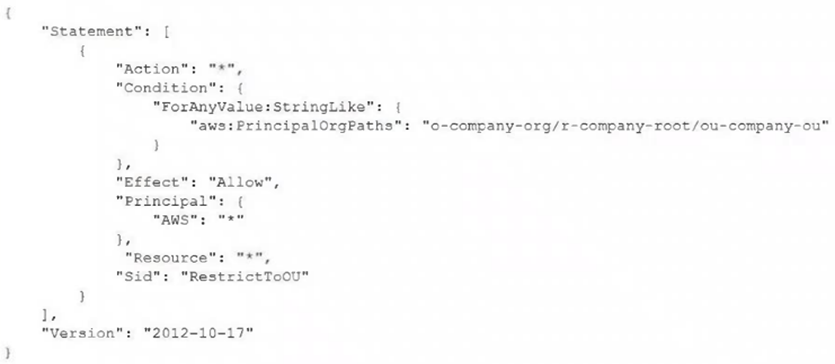
A company manages multiple AWS accounts in AWS Organizations. The company’s security policy states that AWS account root user credentials for member accounts must not be used. The company monitors access to the root user credentials.
A recent alert shows that the root user in a member account launched an Amazon EC2 instance. A DevOps engineer must create an SCP at the organization's root level that will prevent the root user in member accounts from making any AWS service API calls.
Which SCP will meet these requirements?
A
B
C
D
A company has an application that runs on Amazon EC2 instances. The company uses an AWS CodePipeline pipeline to deploy the application into multiple AWS Regions. The pipeline is configured with a stage for each Region. Each stage contains an AWS CloudFormation action for each Region.
When the pipeline deploys the application to a Region, the company wants to confirm that the application is in a healthy state before the pipeline moves on to the next Region. Amazon Route 53 record sets are configured for the application in each Region. A DevOps engineer creates a Route 53 health check that is based on an Amazon CloudWatch alarm for each Region where the application is deployed.
What should the DevOps engineer do next to meet the requirements?
ACreate an AWS Step Functions workflow to check the state of the CloudWatch alarm. Configure the Step Functions workflow to exit with an error if the alarm is in the ALARM state. Create a new stage in the pipeline between each Region deployment stage. In each new stage, include an action to invoke the Step Functions workflow.
BConfigure an AWS CodeDeploy application to deploy a CloudFormation template with automatic rollback. Configure the CloudWatch alarm as the instance health check for the CodeDeploy application. Remove the CloudFormation actions from the pipeline. Create a CodeDeploy action in the pipeline stage for each Region.
CCreate a new pipeline stage for each Region where the application is deployed. Configure a CloudWatch alarm action for the new stage to check the state of the CloudWatch alarm and to exit with an error if the alarm is in the ALARM state
DConfigure the CloudWatch agent on the EC2 instances to report the application status to the Route 53 health check. Create a new pipeline stage for each Region where the application is deployed. Configure a CloudWatch alarm action to exit with an error if the CloudWatch alarm is in the ALARM state.
A company has microservices running in AWS Lambda that read data from Amazon DynamoDB. The Lambda code is manually deployed by developers after successful testing. The company now needs the tests and deployments be automated and run in the cloud. Additionally, traffic to the new versions of each microservice should be incrementally shifted over time after deployment.
What solution meets all the requirements, ensuring the MOST developer velocity?
ACreate an AWS CodePipeline configuration and set up a post-commit hook to trigger the pipeline after tests have passed. Use AWS CodeDeploy and create a Canary deployment configuration that specifies the percentage of traffic and interval.
BCreate an AWS CodeBuild configuration that triggers when the test code is pushed. Use AWS CloudFormation to trigger an AWS CodePipeline configuration that deploys the new Lambda versions and specifies the traffic shift percentage and interval.
CCreate an AWS CodePipeline configuration and set up the source code step to trigger when code is pushed. Set up the build step to use AWS CodeBuild to run the tests. Set up an AWS CodeDeploy configuration to deploy, then select the CodeDeployDefault.LambdaLinear10PercentEvery3Minutes option.
DUse the AWS CLI to set up a post-commit hook that uploads the code to an Amazon S3 bucket after tests have passed Set up an S3 event trigger that runs a Lambda function that deploys the new version. Use an interval in the Lambda function to deploy the code over time at the required percentage.
A DevOps engineer is using AWS CodeDeploy across a fleet of Amazon EC2 instances in an EC2 Auto Scaling group. The associated CodeDeploy deployment group, which is integrated with EC2 Auto Scaling, is configured to perform in-place deployments with CodeDeployDefault.OneAtATime. During an ongoing new deployment, the engineer discovers that, although the overall deployment finished successfully, two out of five instances have the previous application revision deployed. The other three instances have the newest application revision.
What is likely causing this issue?
AThe two affected instances failed to fetch the new deployment.
BA failed AfterInstall lifecycle event hook caused the CodeDeploy agent to roll back to the previous version on the affected instances.
CThe CodeDeploy agent was not installed in two affected instances.
DEC2 Auto Scaling launched two new instances while the new deployment had not yet finished, causing the previous version to be deployed on the affected instances.
A security team is concerned that a developer can unintentionally attach an Elastic IP address to an Amazon EC2 instance in production. No developer should be allowed to attach an Elastic IP address to an instance. The security team must be notified if any production server has an Elastic IP address at any time.
How can this task be automated?
AUse Amazon Athena to query AWS CloudTrail logs to check for any associate-address attempts. Create an AWS Lambda function to disassociate the Elastic IP address from the instance, and alert the security team.
BAttach an IAM policy to the developers' IAM group to deny associate-address permissions. Create a custom AWS Config rule to check whether an Elastic IP address is associated with any instance tagged as production, and alert the security team.
CEnsure that all IAM groups associated with developers do not have associate-address permissions. Create a scheduled AWS Lambda function to check whether an Elastic IP address is associated with any instance tagged as production, and alert the security team if an instance has an Elastic IP address associated with it.
DCreate an AWS Config rule to check that all production instances have EC2 IAM roles that include deny associate-address permissions. Verify whether there is an Elastic IP address associated with any instance, and alert the security team if an instance has an Elastic IP address associated with it.
A company is using AWS Organizations to create separate AWS accounts for each of its departments. The company needs to automate the following tasks:
• Update the Linux AMIs with new patches periodically and generate a golden image
• Install a new version of Chef agents in the golden image, if available
• Provide the newly generated AMIs to the department's accounts
Which solution meets these requirements with the LEAST management overhead?
AWrite a script to launch an Amazon EC2 instance from the previous golden image. Apply the patch updates. Install the new version of the Chef agent, generate a new golden image, and then modify the AMI permissions to share only the new image with the department's accounts.
BUse Amazon EC2 Image Builder to create an image pipeline that consists of the base Linux AMI and components to install the Chef agent. Use AWS Resource Access Manager to share EC2 Image Builder images with the department's accounts.
CUse an AWS Systems Manager Automation runbook to update the Linux AMI by using the previous image. Provide the URL for the script that will update the Chef agent. Use AWS Organizations to replace the previous golden image in the department's accounts.
DUse Amazon EC2 Image Builder to create an image pipeline that consists of the base Linux AMI and components to install the Chef agent. Create a parameter in AWS Systems Manager Parameter Store to store the new AMI ID that can be referenced by the department's accounts.
A company has a mission-critical application on AWS that uses automatic scaling. The company wants the deployment lifecycle to meet the following parameters:
• The application must be deployed one instance at a time to ensure the remaining fleet continues to serve traffic.
• The application is CPU intensive and must be closely monitored.
• The deployment must automatically roll back if the CPU utilization of the deployment instance exceeds 85%.
Which solution will meet these requirements?
AUse AWS CloudFormation to create an AWS Step Functions state machine and Auto Scaling lifecycle hooks to move to one instance at a time into a wait state. Use AWS Systems Manager automation to deploy the update to each instance and move it back into the Auto Scaling group using the heartbeat timeout.
BUse AWS CodeDeploy with Amazon EC2 Auto Scaling Configure an alarm tied to the CPU utilization metric. Use the CodeDeployDefault OneAtAtime configuration as a deployment strategy. Configure automatic rollbacks within the deployment group to roll back the deployment if the alarm thresholds are breached.
CUse AWS Elastic Beanstalk for load balancing and AWS Auto Scaling. Configure an alarm tied to the CPU utilization metric. Configure rolling deployments with a fixed batch size of one instance. Enable enhanced health to monitor the status of the deployment and roll back based on the alarm previously created.
DUse AWS Systems Manager to perform a blue/green deployment with Amazon EC2 Auto Scaling. Configure an alarm tied to the CPU utilization metric. Deploy updates one at a time. Configure automatic rollbacks within the Auto Scaling group to roll back the deployment if the alarm thresholds are breached.
A company has a single developer writing code for an automated deployment pipeline. The developer is storing source code in an Amazon S3 bucket for each project. The company wants to add more developers to the team but is concerned about code conflicts and lost work. The company also wants to build a test environment to deploy newer versions of code for testing and allow developers to automatically deploy to both environments when code is changed in the repository.
What is the MOST efficient way to meet these requirements?
ACreate an AWS CodeCommit repository for each project, use the main branch for production code, and create a testing branch for code deployed to testing. Use feature branches to develop new features and pull requests to merge code to testing and main branches.
BCreate another S3 bucket for each project for testing code, and use an AWS Lambda function to promote code changes between testing and production buckets. Enable versioning on all buckets to prevent code conflicts.
CCreate an AWS CodeCommit repository for each project, and use the main branch for production and test code with different deployment pipelines for each environment. Use feature branches to develop new features.
DEnable versioning and branching on each S3 bucket, use the main branch for production code, and create a testing branch for code deployed to testing. Have developers use each branch for developing in each environment.
A DevOps engineer notices that all Amazon EC2 instances running behind an Application Load Balancer in an Auto Scaling group are failing to respond to user requests. The EC2 instances are also failing target group HTTP health checks.
Upon inspection, the engineer notices the application process was not running in any EC2 instances. There are a significant number of out of memory messages in the system logs. The engineer needs to improve the resilience of the application to cope with a potential application memory leak. Monitoring and notifications should be enabled to alert when there is an issue.
Which combination of actions will meet these requirements? (Choose two.)
AChange the Auto Scaling configuration to replace the instances when they fail the load balancer's health checks.
BChange the target group health check HealthCheckIntervalSeconds parameter to reduce the interval between health checks.
CChange the target group health checks from HTTP to TCP to check if the port where the application is listening is reachable.
DEnable the available memory consumption metric within the Amazon CloudWatch dashboard for the entire Auto Scaling group. Create an alarm when the memory utilization is high. Associate an Amazon SNS topic to the alarm to receive notifications when the alarm goes off.
EUse the Amazon CloudWatch agent to collect the memory utilization of the EC2 instances in the Auto Scaling group. Create an alarm when the memory utilization is high and associate an Amazon SNS topic to receive a notification.
An ecommerce company uses a large number of Amazon Elastic Block Store (Amazon EBS) backed Amazon EC2 instances. To decrease manual work across all the instances, a DevOps engineer is tasked with automating restart actions when EC2 instance retirement events are scheduled.
How can this be accomplished?
ACreate a scheduled Amazon EventBridge rule to run an AWS Systems Manager Automation runbook that checks if any EC2 instances are scheduled for retirement once a week. If the instance is scheduled for retirement, the runbook will hibernate the instance.
BEnable EC2 Auto Recovery on all of the instances. Create an AWS Config rule to limit the recovery to occur during a maintenance window only.
CReboot all EC2 instances during an approved maintenance window that is outside of standard business hours. Set up Amazon CloudWatch alarms to send a notification in case any instance is failing EC2 instance status checks.
DSet up an AWS Health Amazon EventBridge rule to run AWS Systems Manager Automation runbooks that stop and start the EC2 instance when a retirement scheduled event occurs.
A company runs applications in an Amazon Elastic Kubernetes Service (Amazon EKS) cluster. The EKS cluster uses an Application Load Balancer to route traffic to the applications that run in the cluster.
A new application that was migrated to the EKS cluster is performing poorly. All the other applications in the EKS cluster maintain appropriate operation. The new application scales out horizontally to the preconfigured maximum number of pods immediately upon deployment, before any user traffic routes to the web application.
Which solution will resolve the scaling behavior of the web application in the EKS cluster?
AImplement the Horizontal Pod Autoscaler in the EKS cluster.
BImplement the Vertical Pod Autoscaler in the EKS cluster.
CImplement the Cluster Autoscaler.
DImplement the AWS Load Balancer Controller in the EKS cluster.
A company has a new AWS account that teams will use to deploy various applications. The teams will create many Amazon S3 buckets for application-specific purposes and to store AWS CloudTrail logs. The company has enabled Amazon Macie for the account.
A DevOps engineer needs to optimize the Macie costs for the account without compromising the account's functionality.
Which solutions will meet these requirements? (Choose two.)
AExclude S3 buckets that contain CloudTrail logs from automated discovery.
BExclude S3 buckets that have public read access from automated discovery.
CConfigure scheduled daily discovery jobs for all S3 buckets in the account.
DConfigure discovery jobs to include S3 objects based on the last modified criterion.
EConfigure discovery jobs to include S3 objects that are tagged as production only.
A company uses an Amazon API Gateway regional REST API to host its application API. The REST API has a custom domain. The REST API's default endpoint is deactivated.
The company's internal teams consume the API. The company wants to use mutual TLS between the API and the internal teams as an additional layer of authentication.
Which combination of steps will meet these requirements? (Choose two.)
AUse AWS Certificate Manager (ACM) to create a private certificate authority (CA). Provision a client certificate that is signed by the private CA.
BProvision a client certificate that is signed by a public certificate authority (CA). Import the certificate into AWS Certificate Manager (ACM).
CUpload the provisioned client certificate to an Amazon S3 bucket. Configure the API Gateway mutual TLS to use the client certificate that is stored in the S3 bucket as the trust store.
DUpload the provisioned client certificate private key to an Amazon S3 bucket. Configure the API Gateway mutual TLS to use the private key that is stored in the S3 bucket as the trust store.
EUpload the root private certificate authority (CA) certificate to an Amazon S3 bucket. Configure the API Gateway mutual TLS to use the private CA certificate that is stored in the S3 bucket as the trust store.
A company has configured an Amazon S3 event source on an AWS Lambda function. The company needs the Lambda function to run when a new object is created or an existing object is modified in a particular S3 bucket. The Lambda function will use the S3 bucket name and the S3 object key of the incoming event to read the contents of the created or modified S3 object. The Lambda function will parse the contents and save the parsed contents to an Amazon DynamoDB table.
The Lambda function's execution role has permissions to read from the S3 bucket and to write to the DynamoDB table. During testing, a DevOps engineer discovers that the Lambda function does not run when objects are added to the S3 bucket or when existing objects are modified.
Which solution will resolve this problem?
AIncrease the memory of the Lambda function to give the function the ability to process large files from the S3 bucket.
BCreate a resource policy on the Lambda function to grant Amazon S3 the permission to invoke the Lambda function for the S3 bucket.
CConfigure an Amazon Simple Queue Service (Amazon SQS) queue as an OnFailure destination for the Lambda function.
DProvision space in the /tmp folder of the Lambda function to give the function the ability to process large files from the S3 bucket.
A healthcare services company is concerned about the growing costs of software licensing for an application for monitoring patient wellness. The company wants to create an audit process to ensure that the application is running exclusively on Amazon EC2 Dedicated Hosts. A DevOps engineer must create a workflow to audit the application to ensure compliance.
What steps should the engineer take to meet this requirement with the LEAST administrative overhead?
AUse AWS Systems Manager Configuration Compliance. Use calls to the put-compliance-items API action to scan and build a database of noncompliant EC2 instances based on their host placement configuration. Use an Amazon DynamoDB table to store these instance IDs for fast access. Generate a report through Systems Manager by calling the list-compliance-summaries API action.
BUse custom Java code running on an EC2 instance. Set up EC2 Auto Scaling for the instance depending on the number of instances to be checked. Send the list of noncompliant EC2 instance IDs to an Amazon SQS queue. Set up another worker instance to process instance IDs from the SQS queue and write them to Amazon DynamoDUse an AWS Lambda function to terminate noncompliant instance IDs obtained from the queue, and send them to an Amazon SNS email topic for distribution.
CUse AWS Config. Identify all EC2 instances to be audited by enabling Config Recording on all Amazon EC2 resources for the region. Create a custom AWS Config rule that triggers an AWS Lambda function by using the "config-rule-change -triggered" blueprint. Modify the Lambda evaluateCompliance() function to verify host placement to return a NON_COMPLIANT result if the instance is not running on an EC2 Dedicated Host. Use the AWS Config report to address noncompliant instances.
DUse AWS CloudTrail. Identify all EC2 instances to be audited by analyzing all calls to the EC2 RunCommand API action. Invoke an AWS Lambda function that analyzes the host placement of the instance. Store the EC2 instance ID of noncompliant resources in an Amazon RDS for MySQL DB instance. Generate a report by querying the RDS instance and exporting the query results to a CSV text file.
A DevOps engineer is planning to deploy a Ruby-based application to production. The application needs to interact with an Amazon RDS for MySQL database and should have automatic scaling and high availability. The stored data in the database is critical and should persist regardless of the state of the application stack.
The DevOps engineer needs to set up an automated deployment strategy for the application with automatic rollbacks. The solution also must alert the application team when a deployment fails.
Which combination of steps will meet these requirements? (Choose three.)
ADeploy the application on AWS Elastic Beanstalk. Deploy an Amazon RDS for MySQL DB instance as part of the Elastic Beanstalk configuration.
BDeploy the application on AWS Elastic Beanstalk. Deploy a separate Amazon RDS for MySQL DB instance outside of Elastic Beanstalk.
CConfigure a notification email address that alerts the application team in the AWS Elastic Beanstalk configuration.
DConfigure an Amazon EventBridge rule to monitor AWS Health events. Use an Amazon Simple Notification Service (Amazon SNS) topic as a target to alert the application team.
EUse the immutable deployment method to deploy new application versions.
FUse the rolling deployment method to deploy new application versions.
A company is using AWS CodePipeline to deploy an application. According to a new guideline, a member of the company's security team must sign off on any application changes before the changes are deployed into production. The approval must be recorded and retained.
Which combination of actions will meet these requirements? (Choose two.)
AConfigure CodePipeline to write actions to Amazon CloudWatch Logs.
BConfigure CodePipeline to write actions to an Amazon S3 bucket at the end of each pipeline stage.
CCreate an AWS CloudTrail trail to deliver logs to Amazon S3.
DCreate a CodePipeline custom action to invoke an AWS Lambda function for approval. Create a policy that gives the security team access to manage CodePipeline custom actions.
ECreate a CodePipeline manual approval action before the deployment step. Create a policy that grants the security team access to approve manual approval stages.