Loading questions...
Updated
Want a break from the ads?
Become a Supporter and enjoy a completely ad-free experience, plus unlock Learn Mode, Exam Mode, AstroTutor AI, and more.
Create a free account to unlock all questions for this exam.
Log In / Sign UpIn a custom module, an Architect wants to define a new xml configuration file. The module should be able to read all the xml configuration files declared in the system, merge them together, and use their values in PHP class.
Which two steps should the Architect make to meet this requirement? (Choose two.)
A third-party company needs to create an application that will integrate the Adobe Commerce system to get orders data for reporting. The integration needs access to the GET /V1/orders endpoint. It will call this endpoint automatically every hour around the clock. The merchant wants the ability to restrict or extend access to resources as well as to revoke the access using Admin Panel.
Which type of authentication available in Adobe Commerce should be used and implemented in a third-party system for this integration?
An Adobe Commerce Architect creates a stopword for the Italian locale named stopwordsJtJT.csv and changes the stopword directory to the following:
<magento_root>/app/code/CustomVendor/Elasticsearch/etc/stopwords/
What is the correct approach to change the stopwords directory inside the custom module?
While reviewing a newly developed pull request that refactors multiple custom payment methods, the Architect notices multiple classes that depend on \Magento\Framework\Encryption\EncryptorInterface to decrypt credentials for sensitive data. The code that is commonly repeated is as follows:

In each module, the user_secret config is declared as follows:

The Architect needs to recommend an optimal solution to avoid redundant dependency and duplicate code among the methods.
Which solution should the Architect recommend?
An Adobe Commerce store owner sets up a custom customer attribute “my_attribute”.
An Architect needs to display additional content on the home page, which should display only to Customers with “my_attribute” of a certain value and be the same content for all of them. The website is running Full Page Cache.
With simplicity in mind, which two steps should the Architect take to implement these requirements? (Choose two.)
An Adobe Commerce Architect designs and implements functionality that introduces a new Complex Product Type to the existing Adobe Commerce website. Besides visual demonstration of the new product type, the changes include adjustments to the price index.
The website utilizes a multi-dimensional indexer feature to store the price index. The Architect decides to cover it with integration tests. After creating and running one test, the Architect discovers that database storage is not being fully cleaned.
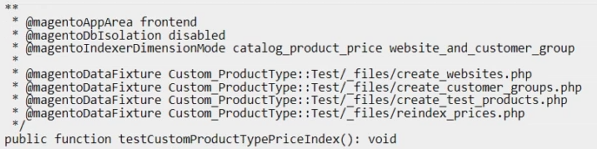
The test method has the following annotation declaration:

Which adjustment should the Architect make to fix this issue?
A client has multiple warehouses where orders can be fulfilled. The cost of shipping goods from each warehouse varies by day, due to the number of workers available. The Architect needs to make sure that when an order is shipped, it is shipped from the lowest cost warehouse that is open.
How should this functionality be implemented?
A merchant is using a unified website that supports native Adobe Commerce B2B and B2C with a single store view.
The merchant’s objective is to display the B2B account features, such as negotiable quotes and credit limits, in the header of the site on every page for logged-in users who belong to a B2B company account.
Each B2B company possesses its unique shared catalog and customer group, while numerous customer groups for non-B2B customers undergo changes. The merchant insists that this association should not be linked to customer groups.
Which two solutions should the Architect recommend for consideration, taking into account public data and caching? (Choose two.)
An Adobe Commerce Architect needs to customize the workflow of a monthly installments payment extension. The extension is from a partner who is contracted with the default website Payment Service Provider (PSP), which has its own legacy extension (a module using deprecated payment method).
The installment payment partner manages only initializing a payment, and then hands the capture to be executed by the PSP. Once the amount is successfully captured, the PSP notifies the website through a webhook. The goal of the webhook is only to create an “invoice” and save the “capture information” to be used later for refund requests through the PSP itself.
The Architect needs the most simple solution to capture the requested behavior.
Which solution should the Architect implement?
An existing Adobe Commerce website is moving to a headless implementation.
The existing website features an "All Brands" page, as well as individual pages for each brand. All brand-related pages are cached in Varnish using tags in the same manner as products and categories.
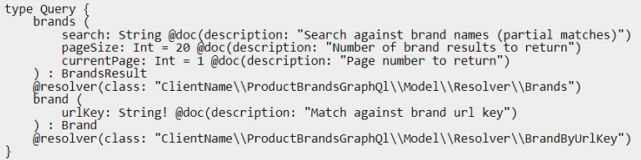
Two new GraphQL queries have been created to make this information available to the frontend for the new headless implementation:

During testing, the queries sometimes return out-of-date information.
How should this problem be solved while maintaining performance?