An IRB sub-interface that is being used to interconnect a MAC-VRF to an IP-VRF, is configured with anycast-gw set to true and anycast-gw enabled.
Which of the following statements is FALSE?
AThe last octet of the default virtual MAC assigned to the sub-interface is derived from the last octet of the chassis MAC.
BThe same IP address used on this sub-interface can be used by other IRB sub-interfaces on remote PEs participating in the IP-VRF.
CThe host IP address of the sub-interface appears in the IP-VRF route table along with the prefix for the entire sub-net.
DTwo MAC addresses associated to the sub-interface are shown in the forwarding table of the MAC-VRF that contains the IRB sub-interface.
Which of the following is always found in an extended community associated with an EVPN update?
AThe route target
BThe AFI/SAFI
CThe VXLAN network ID
DThe EVPN route type
Which EVPN route-type (RT) is used in multi-homing scenarios to support aliasing and fast convergence?
ART-1 Ethernet Auto-Discovery
BRT-2 MAC/IP Advertisement
CRT-3 Inclusive Multicast Ethernet Tag
DRT-4 Ethernet Segment
Which of the following is NOT part of the description of a BGP route-distinguisher?
AThe route-distinguisher is a unique identifier that is configured per PE and per EVI.
BIt is included in each EVPN route update advertisement.
CIt is used by MP-BGP to allow for overlapping addresses from multiple tenants.
DIt identifies the EVPN instance in the control plane.
Question 6
EVPN on SR Linux
0
Question 7
Layer 2 EVPN
Question 8
EVPN on SR Linux
Question 9
Layer 2 EVPN
Question 10
Layer 2 EVPN
Question 11
Layer 2 EVPN
Question 12
Layer 2 EVPN
Question 13
Layer 2 EVPN
Question 14
Layer 2 EVPN
Question 15
Layer 2 EVPN
Question 16
L3 EVPN
Question 17
L2 and L3 EVPN Multi-homing
Question 18
L3 EVPN
Question 19
L3 EVPN
Question 20
Layer 2 EVPN
Question 21
L3 EVPN
Question 22
L3 EVPN
Question 23
L3 EVPN
Ask AstroTutor
0
Ask AstroTutor
0
Ask AstroTutor
0
Ask AstroTutor
0
Ask AstroTutor
0
Ask AstroTutor
0
Ask AstroTutor
0
Ad
Want a break from the ads?
Become a Supporter and enjoy a completely ad-free experience, plus unlock Learn Mode, Exam Mode, AstroTutor AI, and more.
Ask AstroTutor
0
Ask AstroTutor
0
Ask AstroTutor
0
Ask AstroTutor
0
Ask AstroTutor
0
Ask AstroTutor
0
Ask AstroTutor
0
Ask AstroTutor
0
Ask AstroTutor
0
Ask AstroTutor
0
e-BGP is used as the routing protocol in the data center underlay.
When configuring the EVPN MP-BGP route reflector sessions, which of the following statements is FALSE?
AThe cluster-id that uniquely identifies the route reflector is only configured on the route reflector itself.
BThe leaf’s underlay autonomous system number is used for the route reflector EVPN peering sessions.
CA second route reflector can be deployed for redundancy purposes.
DIf redundant route reflectors are deployed, the client leaf routers will receive duplicated updates.
Consider the exhibit.
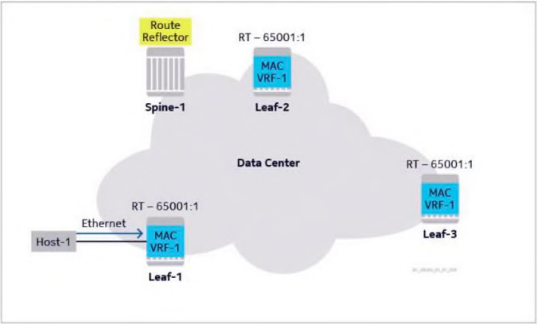
All three leafs have an EVPN MP-BGP session with the route reflector in Spine-1. Leaf-2 and Leaf-3 have existing instances of an L2 EVPN named MAC VRF-1. Leaf-1 has just enabled a new instance of MAC VRF-1.
Which of the following steps is NOT taken when this new instance is enabled?
ALeaf-1 generates an IMET route.
BLeaf-1 advertises the IMET route in a BGP EVPN update directly to Leaf-2 and Leaf-3.
CLeaf-2 and Leaf-3 auto-discover the new peer based on the route target in the received IMET route.
DLeaf-2 and Leaf-3 add Leaf-1 to their existing flooding list for BUM traffic.
Which of the following statements about utilizing VXLAN for the data plane in the data center is FALSE?
AIt allows the creation of a layer 2 overlay network that can span the entire data center.
BVXLAN was developed to support EVPN networks in the data center.
CIt may use ECMP to provide efficient utilization of the underlay interfaces within the data center.
DIt has the capability to isolate up to 16 million different overlays.
Which of the following GARP functions is FALSE?
AA host sends a GARP to update its own IP/MAC mapping to the other hosts in the subnet.
BAll other hosts within the subnet will update their ARP tables.
CThe GARP is sent as a broadcast.
DThe other hosts in the subnet will acknowledge the receipt with a reply.
Which of the following statements about a distributed layer 2 EVPN is FALSE?
AWhen a host connected to a layer 2 EVPN responds to an ARP request, it sends an ARP reply to the local leaf.
BThe local leaf replicates the ARP reply and sends it to all the leafs in the flooding list for that layer 2 EVPN.
CThe local leaf learns the source MAC address from the Ethernet frame and populates it into its MAC forwarding table.
DThe local leaf generates an EVPN route type 2 and sends it to all of its configured BGP EVPN neighbors.
Which of the following statements about the Layer 2 EVPN configuration/operation in a Nokia SR Linux is FALSE?
AThe layer 2 EVPN is implemented as a MAC-VRF.
BMAC-VRF is configured with a VXLAN-interface towards each remote VTEP.
CData plane MAC learning takes place on the local interfaces.
DRemote MAC addresses are learned from MP-BGP EVPN updates.
Which of the following statements about MAC mobility is TRUE?
AThe original PE advertises the locally learned MAC with the sequence number set to a maximum value.
BA PE advertising a local MAC that was previously learned through EVPN, will decrement the sequence number in its update.
CThe originating PE generates a withdraw message after the same locally learned MAC has aged out.
DThe originating PE and the destination PE must synchronize their MAC tables.
Consider the exhibit.
Which of the following statements is FALSE?
AThe remote host’s IP address is 100.0.2.3.
BThe MAC address 00:00:00:00:00:01 was learned through the data plane.
CThe MAC address associated to the vxlan-interface will not age out.
DThe VXLAN network identifier configured for this MAC-VRF is 100.
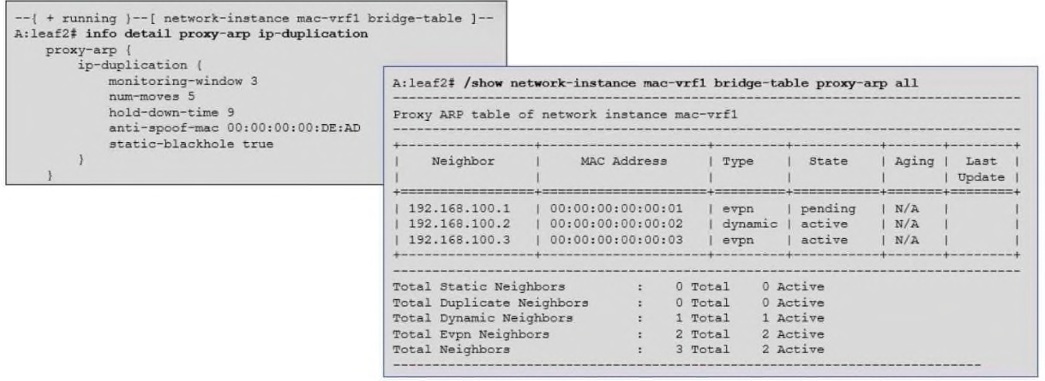
Consider the exhibit.
Which of the following statements about the proxy ARP entry for the neighbor IP 192.168.100.1 is FALSE?
AThe state is pending because this MAC address was originally associated with a different IP address.
BThe traffic will be forwarded to a blackhole if the state changes to duplicate.
CThe MAC address will be changed to 00:00:00:00:DE:AD if the state changes to duplicate.
DAll traffic destined to 192.168.100.1 will be discarded for 9 minutes if the state changes to duplicate.
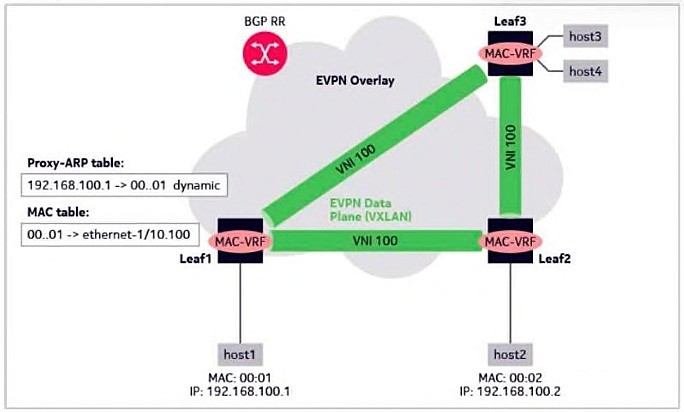
Consider the exhibit.
Leaf-1 has received an ARP request from host-1 for host-2. Leaf-1 has added host-1’s MAC address in its MAC table and host-1’s MAC/IP addresses in its proxy-ARP table.
Which of the following steps is FALSE?
ALeaf-1 sends a route-type 2 EVPN update with host-1’s MAC with the IP address set to 0.0.0.0 to the remote peers.
BLeaf-1 sends a route-type 2 EVPN update with host-1’s MAC with the IP address set to 192.168.100.1 to the remote peers.
CThe remote peers ignore the EVPN update with the IP address set to 0.0.0.0 and use the update with the IP address set to 192.168.100.1 to populate their MAC forwarding tables.
DThe remote peers generate a gratuitous ARP towards their directly connected hosts to announce the learned IP/MAC mapping information.
Which of the following statements about utilizing asymmetric routing in an L3 EVPN network is FALSE?
AIf a host interface’s has two IP addresses, it must send out two separate EVPN route-type 2 updates for the MAC-VRF.
BEach PE must have a full ARP table for all of the hosts in the L3 EVPN network.
CAll the MAC-VRFs connected to the L3 EVPN network must exist on each PE.
DThe ingress and egress PE routers will perform both MAC and IP forwarding.
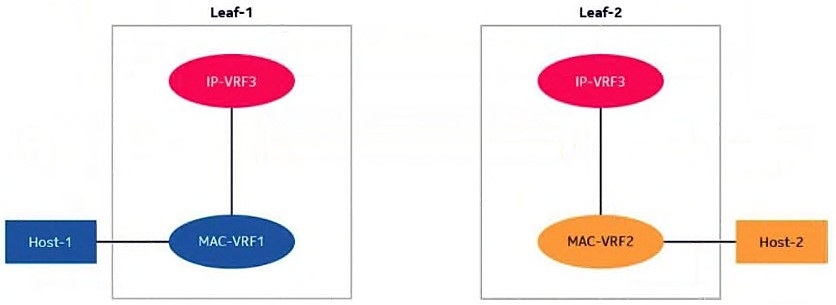
Consider the exhibit.
The two MAC-VRFs are inter-connected using IP-VRF3 which is to be deployed using asymmetric routing.
Which of the following statements is FALSE?
ALeaf-1 and Leaf-2 will advertise the IP prefixes to each other using EVPN route-type 5.
BLeaf-1 and Leaf-2 must both have instances of MAC-VRF1 and MAC-VRF2.
CLeaf-1 and Leaf-2 will advertise host MAC/IP address information using EVPN route-type 2.
DMAC-VRF1 and MAC-VRF2 will connect to IP-VRF3 using an IRB interface.
Which of the following statements about configuring and using an integrated routing and bridging (IRB) interface is TRUE?
AThe IRB sub-interface must be configured as either type bridge or routed.
BA MAC-VRF can be configured with multiple IRB sub-interfaces to support multi-homing.
CWhen the IRB sub-interface is configured with multiple IP addresses, one of them can be configured as the primary.
DWhen using an IRB interface to interconnect a MAC-VRF to an IP-VRF, one sub-interface is configured for the MAC-VRF and another one for the IP-VRF.
Consider the exhibit.
The network is going to be designed to use interface-less symmetric routing.
Which of the following statements is TRUE?
AAn instance of each mac-vrf is required on each leaf.
BThe ingress PE will perform layer 2 and layer 3 lookups while the egress PE will perform layer 2 lookup.
CThe IRB configuration does not require anycast gateway configuration on the ip-vrf.
DForwarding information will be exchanged between the PEs using EVPN route-type 2 updates.
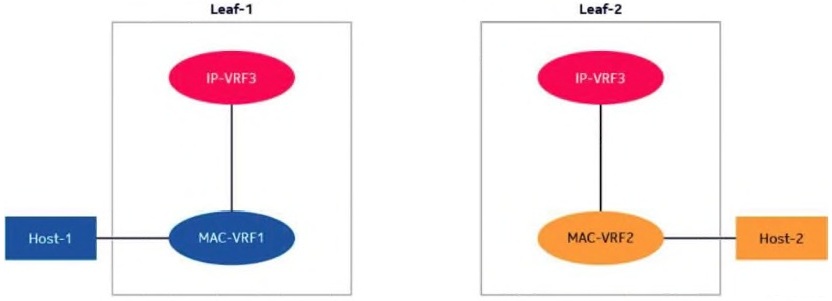
Consider the exhibit.
Host-2 is sending data to Host-1. The network is designed to use asymmetric routing.
Which of the following statements about the operation of the data plane is TRUE?
ALeaf-1 forwards the data for mac-vrf-2 towards Leaf-2 with a VNI of 2.
BLeaf-2 forwards the data for mac-vrf-2 towards the IP-VRF using its IRB interface.
CLeaf-2 IP-VRF consults the ARP table to learn Host-1 MAC address.
DLeaf-2 does a MAC look-up using mac-vrf-1 and forwards the data towards Host-1.
Which of the following four symmetric routing options does NOT require the use of an EVPN route-type 2?
AHost routing
BPrefix routing interface-less
CPrefix routing interface-ful numbered
DPrefix routing interface-ful unnumbered
Consider the exhibit.
The network is configured for interface-less symmetric routing with an ECMP of 4 enabled on all leaf routers.
Which of the following statements is FALSE?
AAnycast gateway is an optional configuration on the Leaf1 and Leaf2 IRB interfaces.
BThe IRB interfaces on Leaf1 and Leaf2 must be configured to advertise learned local host-routes.
CMAC-VRF100 on Leaf1 and Leaf2 must have BGP EVPN and BGP VPN configured.
DIP-VRF1 on Leaf1, Leaf2 and Leaf3 must be configured with a VXLAN-routed interface.
Which of the following statements about PE-CE routing is FALSE?
AThere are two methods to implement routing between the PE and CE, static and dynamic.
BBGP is the preferred option for PE-CE routing as it scales better than static routing.
CeBGP is preferred which means that the PE and CE are required to be in different autonomous systems.
DThe CE advertises BGP EVPN route type 5 updates to the PE and the PE forwards to other PEs.