About the Exam

This written exam covers modern data center networking fundamentals with Nokia SR Linux, including layer 3 and BGP routing, SR Linux architecture, 7220/7250 IXR routers, interfaces, underlay configuration, EVPN overlays, and logging and monitoring tools. It is intended for candidates working toward Nokia Data Center Fabric certifications such as Data Center Fabric Professional, Data Center Fabric Network Expert, and SR Linux Automation Expert. Passing demonstrates foundational knowledge of Nokia's data center fabric platform and the skills needed to continue in the certification track.

Exam Topics

  • Nokia DC Fabric solution0%
  • SR Linux Configuration and Routing0%
  • SR Linux Logging, Monitoring, and Filtering0%

How to Use This Practice Exam

  1. Browse — Read each question, select your answer, and reveal the explanation.
  2. Exam Mode — Simulate real exam conditions with a timed session and score report.
  3. Learn Mode — Spaced repetition schedules questions you struggle with for long-term retention.

Download the Full Exam PDF

Get every question and answer in a clean, printable PDF built for offline study. Purchase once, keep permanent access, and re-download the latest version anytime.

Last updated April 17, 2026 at 8:08 PM

Topic filter
Retired questions
Question sort
Questions per page

QuestionQ1

SR Linux Configuration and Routing

Which of these statements about IP-VRFs in Nokia SR Linux is false?

Explanation

An IP-VRF is a Layer 3 routing instance with separate route tables and a FIB. A shared Layer 2 subnet or broadcast domain is implemented by a mac-vrf, which can be associated with an IP-VRF through an IRB interface; an IP-VRF alone does not provide the shared-subnet connectivity described.

Learn more

Community Discussion

No comments yet. Be the first to start the discussion!

QuestionQ2

SR Linux Configuration and Routing

Which of these statements about next-hop groups is true?

Explanation

A configured next-hop group can be referenced by multiple static routes. SR Linux next-hop groups can contain one or more next hops, and referenced static routes use the group’s forwarding or blackhole behavior.

Learn more

Community Discussion

No comments yet. Be the first to start the discussion!

QuestionQ3

SR Linux Configuration and Routing

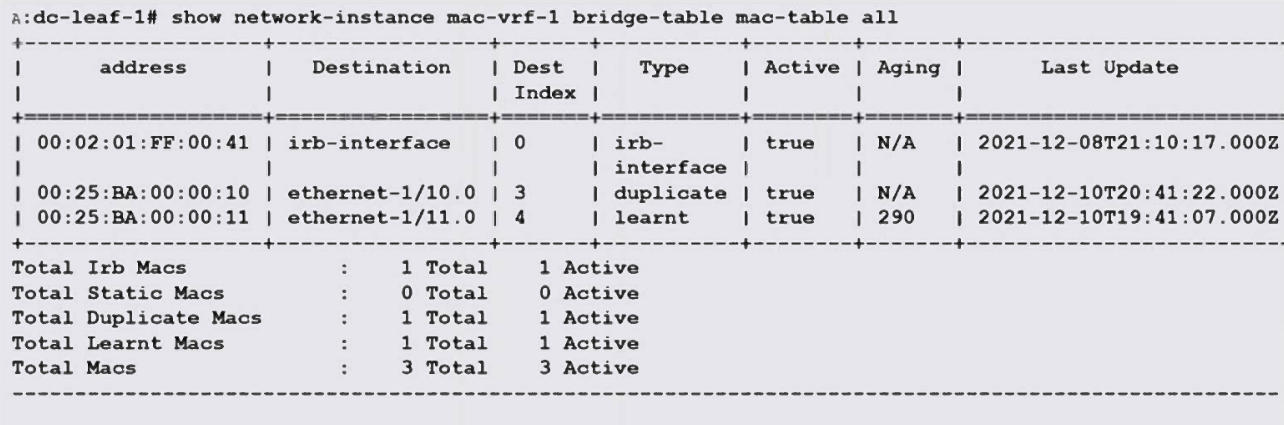
Which of the following statements regarding the MAC table displayed in the exhibit output is FALSE?
Question Image

Explanation

A MAC entry of type duplicate is created when the MAC moves across interfaces more times than the configured threshold during the configured monitoring window. The duplicate entry retains a learned destination, but that destination does not make the MAC a statically configured MAC on the interface. Static MACs are a separate bridge-table entry type.

Learn more

Community Discussion

No comments yet. Be the first to start the discussion!

QuestionQ4

SR Linux Configuration and Routing

Which of the following is NOT a reason BGP is used as the routing protocol in the data center?

Explanation

BGP does not automatically discover neighboring BGP speakers. Peering is established through explicit configuration, including the neighbor address and autonomous system details. Its maturity, dual IPv4/IPv6 support, and scalable control-plane characteristics are valid reasons it is commonly used in data-center networks.

Community Discussion

No comments yet. Be the first to start the discussion!

QuestionQ5

SR Linux Configuration and Routing

Which of the following is not a typical way prefixes are learned and advertised in a leaf-and-spine data center?

Explanation

Leaf routers normally peer with spine routers, not directly with other leaf routers. Locally connected server prefixes are advertised from each leaf to the spines, and the spines re-advertise those routes to other leaves; thus, remote server prefixes are learned through the spine layer.

Learn more

Community Discussion

No comments yet. Be the first to start the discussion!
Know a question that should be here? Contribute to this exam
Back home