About the Exam

This Nokia written exam covers Ethernet Virtual Private Network (EVPN) services, including EVPN Layer-2 and Layer-3 concepts, EVPN route types, ELAN, integrated routing and bridging, Eline services, and all-active and single-active multi-homing. It is one of the elective exams in Nokia's Service Routing Certification program. Passing earns credit toward the Nokia Service Routing Architect certification.

Exam Topics

  • Introduction to EVPN14%
  • EVPN for ELAN services14%
  • EVPN for Layer-3 services17%
  • Multi-Homing in EVPN17%
  • EVPN for ELINE services14%
  • EVPN and traditional MPLS services24%

How to Use This Practice Exam

  1. Browse — Read each question, select your answer, and reveal the explanation.
  2. Exam Mode — Simulate real exam conditions with a timed session and score report.
  3. Learn Mode — Spaced repetition schedules questions you struggle with for long-term retention.

Download the Full Exam PDF

Get every question and answer in a clean, printable PDF built for offline study. Purchase once, keep permanent access, and re-download the latest version anytime.

Last updated April 4, 2025 at 12:21 PM

Topic filter
Retired questions
Question sort

QuestionQ1

EVPN for Layer-3 services

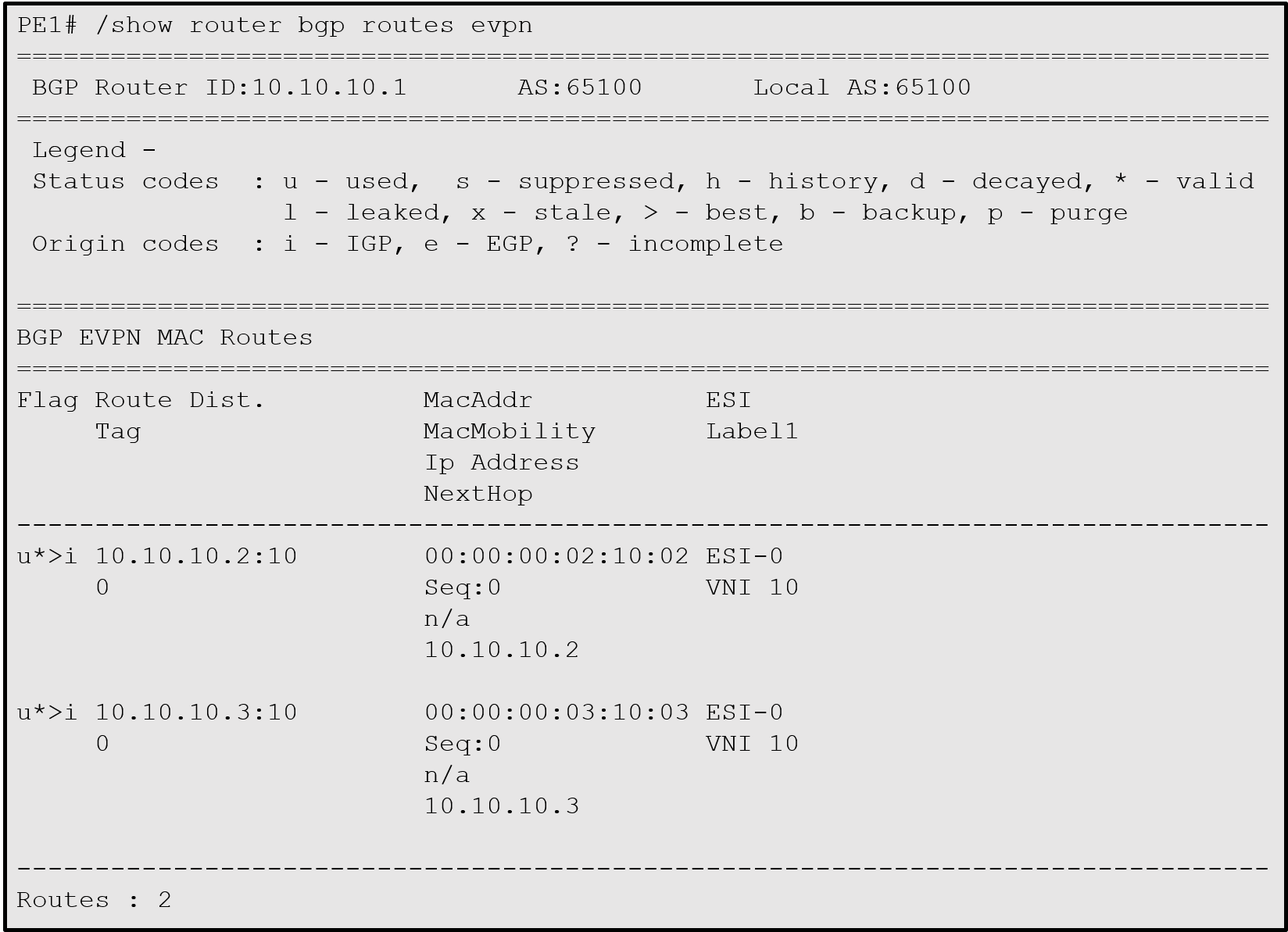
In the exhibit, EVPN-IRB is configured using the interface-ful unnumbered model. Which of the following statements about the route advertisement is FALSE?

Question Image

  • A PE1 advertises an EVPN IP-Prefix route for prefix 10.10.1.0/24 to PE3. The BGP update includes MAC-01 as an overlay index.
  • B PE1 advertises an EVPN MAC route for MAC-01 to PE3. The BGP update includes the route-target value configured for VPRN 15.
  • C PE3 advertises a VPN-IPv4 route for prefix 10.10.1.0/24 to PE4. The BGP update Includes an MPLS service label.
  • D PE4 advertises an EVPN IP-Prefix route for prefix 10.10.1.0/24 to PE2. The BGP update includes MAC-04 as an overlay index.
Explanation

In the interface-ful unnumbered EVPN-IRB model, EVPN Type-5 (IP-Prefix) routes are advertised under the route target(s) of the Layer-3 IP-VRF (VPRN) service, carrying the advertising PE's own IRB MAC address as the overlay index. However, the EVPN Type-2 MAC/IP route needed to resolve that MAC overlay index is generated and exported by the Layer-2 bridging instance (the R-VPLS/EVI) to which the IRB is bound — in this topology, R-VPLS 20 on PE1 — using that bridge instance's own configured route target, not the route target configured on VPRN 15. Therefore the claim that PE1's MAC route advertisement for MAC-01 carries the route target configured for VPRN 15 is incorrect, since the Layer-2 EVI and the Layer-3 VPRN are distinct services with independent route-target configuration.

Community Discussion

No comments yet. Be the first to start the discussion!

QuestionQ2

EVPN for ELAN services

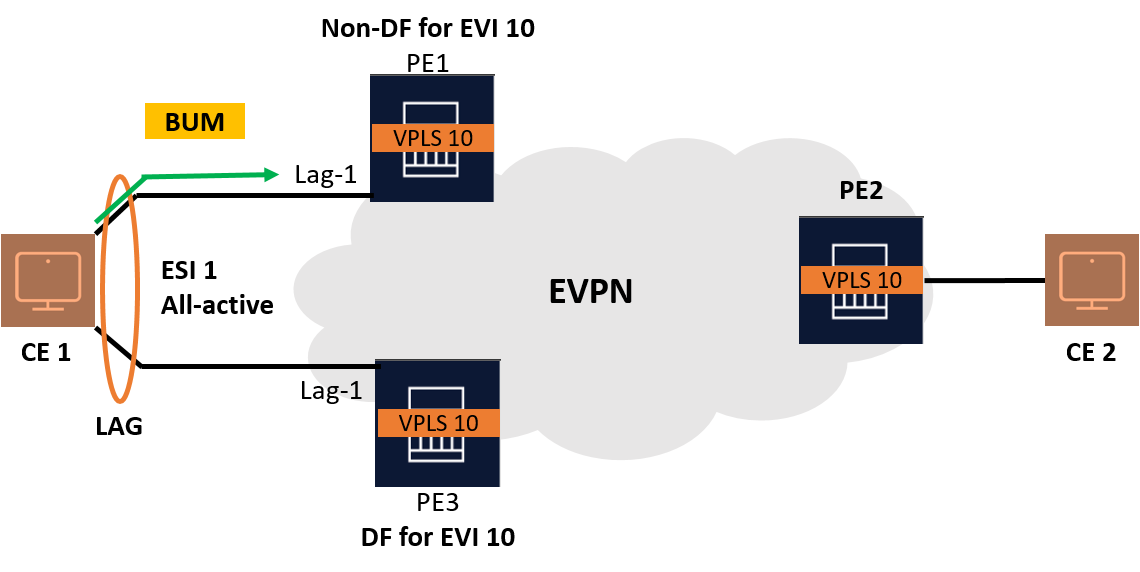
Review the exhibit. Which action does PE1 perform after receiving a BUM packet from CE1?
Question Image

  • A PE1 does not flood the packet because PE1 is acting as non-designated forwarder (non-DF) for VPLS 10.
  • B PE1 sends the packet to PE2 but not to PE3 because PE3 is connected to the originating ES.
  • C PE1 sends the packet to PE2 and to PE3. An ESI label is included only in the packet sent to PE2.
  • D PE1 sends the packet to PE2 and to PE3. An ESI label is included only in the packet sent to PE3.
Explanation

In all-active EVPN multihoming, a non-DF PE forwards BUM traffic received from a multihomed CE to the other PEs in the EVI, including the DF. For ingress-replication tunnels, the ingress PE attaches the ESI split-horizon label only to packets sent to PEs that are connected to the same Ethernet segment. Therefore, PE1 sends copies to PE2 and PE3, with the ESI label only on the copy to PE3; PE3 uses it to prevent flooding back to ESI1. Juniper EVPN Multihoming Overview

Learn more

Community Discussion

No comments yet. Be the first to start the discussion!

QuestionQ3

Multi-Homing in EVPN

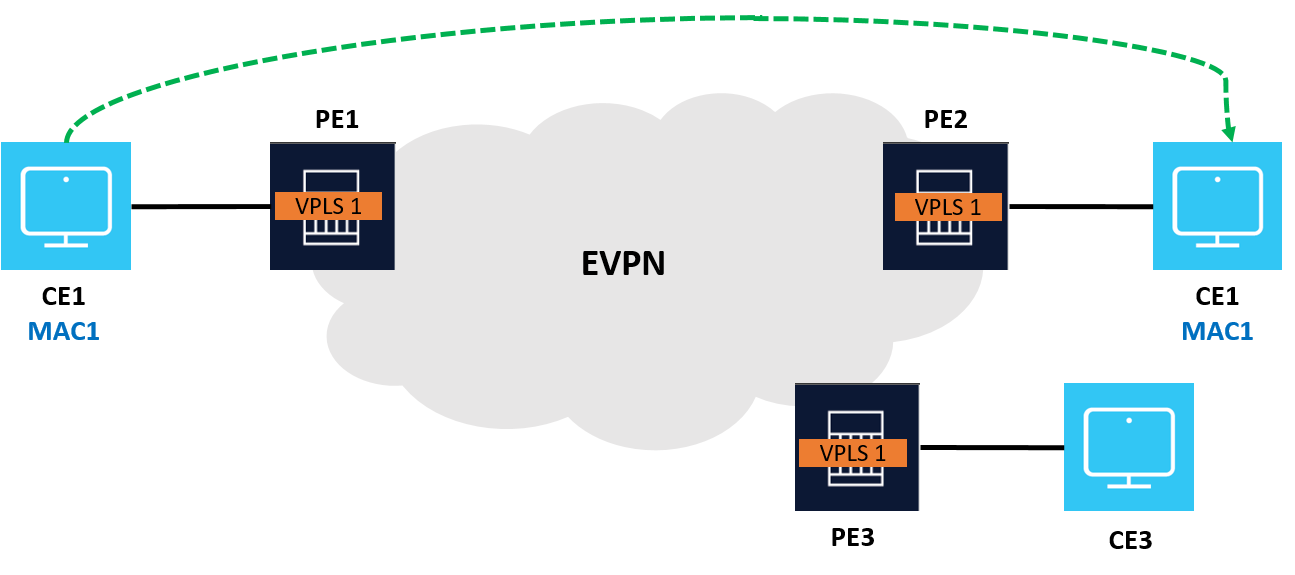
Referring to the exhibit, MAC1 moves from PE1 to PE2. Which of the following actions related to this MAC address mobility takes place?
Question Image

  • A CE1 generates an update message to PE1 withdrawing its MAC.
  • B PE1 generates an update message to remote PEs identifying the new location of CE1.
  • C PE2 advertises a MAC/IP route for MAC1 with a sequence number higher than that received from PE1.
  • D PE3 waits to receive a data packet from CE1 to update its FDB entry for MAC1.
Explanation

In EVPN (RFC 7432), MAC mobility is handled via the control plane using the MAC Mobility extended community attached to MAC/IP Advertisement routes. When PE2 detects that CE1 (and MAC1) has moved to its local segment, it advertises a MAC/IP route for MAC1 with a sequence number higher than the one previously advertised by PE1. This higher sequence number tells all other PEs in the EVPN instance that PE2's advertisement is the most current one, causing them to update their forwarding databases to point to PE2 and causing PE1 to withdraw its now-stale route for MAC1.

Learn more

Community Discussion

No comments yet. Be the first to start the discussion!

QuestionQ4

EVPN for ELAN services

Proxy-ARP/ND is operational for a VPLS. Which of the following statements is FALSE?

  • A The PE has proxy-ARP and dynamic-populate enabled for the VPLS.
  • B The proxy-ARP table is populated by snooping IP packets received from remote PEs.
  • C When the PE learns a local host IP address, it adds an entry into its proxy-ARP table.
  • D The PE advertises a MAC/IP route that includes the MAC and IP address of a local host.
Explanation

In a VPLS/EVPN deployment, proxy-ARP/ND table entries for locally attached hosts are created by snooping ARP, Gratuitous ARP, or IPv6 Neighbor Advertisement messages received on local SAPs/SDP bindings (i.e., from CEs directly attached to that PE), not by snooping IP data packets arriving from remote PEs over the core. Once a local entry is learned, the PE advertises that host's MAC and IP address to remote PEs via a BGP EVPN MAC/IP Advertisement (Route Type 2) route. Remote PEs then populate their own proxy-ARP/ND tables with these EVPN-learned entries by importing the received BGP routes — this is a control-plane mechanism, not data-plane snooping of IP traffic from remote PEs. Traffic arriving on core-facing/network interfaces from remote PEs is explicitly excluded from ARP/ND snooping in standard implementations. Therefore, the statement claiming the proxy-ARP table is populated by snooping IP packets received from remote PEs is incorrect.

Learn more

Community Discussion

No comments yet. Be the first to start the discussion!

QuestionQ5

EVPN for ELINE services

Which statement correctly describes how a single-homed EVPN VPWS operates?

  • A The same tag ID must be configured for the local attachment circuit (AC) at each PE.
  • B Each PE advertises a MAC route and an A-D per EVI route when its local AC becomes operationally UP.
  • C The advertised A-D per EVI route includes a non-zero tag ID and a non-zero MPLS label.
  • D Each PE verifies that the received tag ID matches its configured local AC tag ID.
Explanation

RFC 8214 specifies that EVPN-VPWS uses only Ethernet Auto-Discovery (A-D) per-EVI routes (Type 1) — it does not use MAC/IP Advertisement routes, since no MAC learning or lookup is required for a point-to-point VPWS service. When a PE advertises its per-EVI A-D route, the Ethernet Tag ID field must always be set to a non-zero value, representing the locally significant VPWS service instance identifier for that PE's attachment circuit, and the route also carries a non-zero MPLS label that the remote PE uses in the data plane to forward traffic to the correct egress AC. The two PEs' local AC tag/VLAN values do not need to match each other; EVPN-VPWS does not require tag translation or verification between PEs — the MPLS label, not the tag value, identifies the destination AC.

Learn more

Community Discussion

No comments yet. Be the first to start the discussion!

That's the end of the preview

It's free

100% of the questions are free for all users.
No strings attached.

Topics covered
Introduction to EVPNEVPN for ELAN servicesEVPN for Layer-3 servicesMulti-Homing in EVPNEVPN for ELINE servicesEVPN and traditional MPLS services
Know a question that should be here? Contribute to this exam
Back home