About the Exam

Validates knowledge of Nokia virtual private LAN services, including VPLS, management VPLS (M-VPLS), hierarchical VPLS (H-VPLS), loop avoidance, redundancy, and large-scale VPLS deployment topics. It is part of Nokia’s Service Routing Certification track and has no mandatory prerequisites. Passing this exam earns credit toward the Nokia Service Routing Architect (SRA) certification.

Exam Topics

  • Service fundamentals review17%
  • Introduction to Virtual Private LAN Services17%
  • VPLS Features17%
  • VPLS loop avoidance17%
  • VPLS redundancy techniques16%
  • Large scale VPLS deployments16%

How to Use This Practice Exam

  1. Browse — Read each question, select your answer, and reveal the explanation.
  2. Exam Mode — Simulate real exam conditions with a timed session and score report.
  3. Learn Mode — Spaced repetition schedules questions you struggle with for long-term retention.

Download the Full Exam PDF

Get every question and answer in a clean, printable PDF built for offline study. Purchase once, keep permanent access, and re-download the latest version anytime.

Last updated July 22, 2026 at 5:26 AM

Topic filter
Retired questions
Question sort

QuestionQ1

VPLS Features

Which of the following statements regarding VPLS is TRUE?

  • A It allows point-to-point connection of two sites in a single routed instance.
  • B It allows connection of multiple sites in a single routed instance.
  • C It allows point-to-point connection of two sites with no MAC learning.
  • D It allows connection of multiple sites in a single bridged domain.
Explanation

VPLS is a multipoint Layer 2 VPN that interconnects multiple sites as a single bridged Ethernet domain. It emulates LAN bridging functions, including MAC address learning, across the connected sites.

Learn more

Community Discussion

No comments yet. Be the first to start the discussion!

QuestionQ2

VPLS Features

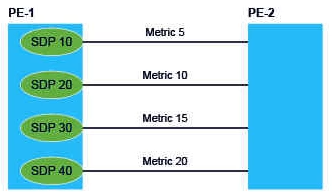
A BGP VPLS is configured between two Nokia 7750 SR routers, PE1 and PE2. Which of the following SDPs is selected to auto-bind the service?
Question Image

  • A SDP 10
  • B SDP 20
  • C SDP 30
  • D SDP 40
Explanation

For multiple active SDPs toward the far-end PE, SR OS selects the SDP template with the best metric. SDP 10 has metric 5, the lowest metric among the available SDPs.

Learn more

Community Discussion

No comments yet. Be the first to start the discussion!

QuestionQ3

Service fundamentals review

Which limitations are associated with a traditional Layer 2 switch?

Choose three
  • A Isolates collision domains.
  • B Requires layer 2 loop prevention.
  • C Slow response to topology changes.
  • D Limited to 4094 vlans per switch.
  • E Increased flooding.
Explanation

Traditional Layer 2 designs require loop prevention to avoid bridging loops, and their spanning-tree-based control plane can converge slowly after a topology change. VLAN scalability is also constrained by the 12-bit IEEE 802.1Q VLAN identifier, which supports VLAN IDs 1 through 4094; IDs 0 and 4095 are reserved.

Community Discussion

No comments yet. Be the first to start the discussion!

QuestionQ4

VPLS loop avoidance

For periodic traffic among hosts, which of the following statements about the use of remote and local age timers is true on the Nokia 7750 SR?

  • A The lower the age time, the higher the probability of flooding of unknown traffic.
  • B The higher the age time, the higher the probability of flooding of unknown traffic.
  • C The local and remote age timers are, by default, the same value.
  • D There is no relationship between the age timers and the probability of flooding of unknown traffic.
Explanation

Shorter MAC aging timers remove learned FDB entries sooner when traffic is intermittent. A destination whose entry has aged out is unknown and is normally flooded, so lowering the age time increases the likelihood of unknown-traffic flooding. Nokia recommends setting the remote-age timer longer than the local-age timer to reduce such flooding.

Learn more

Community Discussion

No comments yet. Be the first to start the discussion!

QuestionQ5

VPLS Features

How does an H-VPLS lessen the full-mesh requirement in a VPLS?

  • A It uses only spoke SDPs to connect the core network and to connect to the MDU.
  • B It uses spoke SDPs to connect the core network, and mesh SDPs to connect to the MDU.
  • C It uses mesh SDPs to connect the core network, and spoke SDPs to connect to the MDU.
  • D It uses spoke SDPs to connect within a metro VPLS, and mesh SDPs to connect the two or more metro VPLS together.
Explanation

H-VPLS scales VPLS by keeping PEs fully meshed within each metro VPLS domain and using point-to-point spoke SDPs to interconnect the metro domains. This eliminates the need for a single full mesh among all PEs across the combined network.

Learn more

Community Discussion

No comments yet. Be the first to start the discussion!
Know a question that should be here? Contribute to this exam
Back home