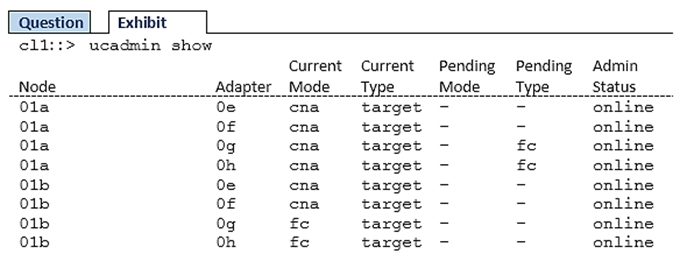
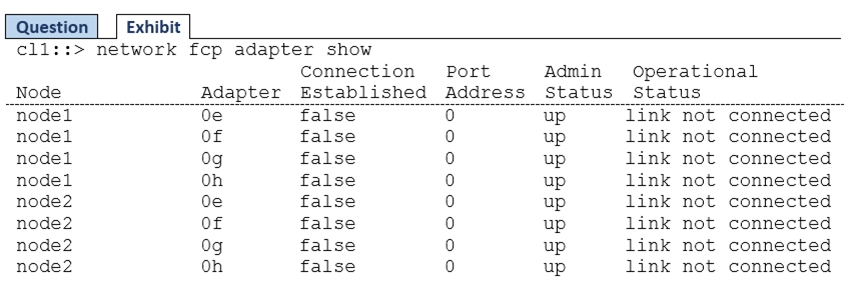
Referring to the exhibit, which two pairs of ports are currently configurable as FC SAN LIFs? (Choose two.)
A01b, 0h
B01a, 0g
C01a, 0h
D01b, 0g
0
Question 2
Hardware Universe
0
Question 3
Cisco MDS 9000 Family NX-OS Interfaces Configuration Guide Release 6.2
0
Question 4
Implementing and Configuring Modern SANs with NVMe/FC TR-4684
0
Question 5
ONTAP 9 SAN Configuration – Provisioning
0
That's the end of the Preview
This exam has 59 community-verified practice questions. Create a free account to access all questions, comments, and explanations.
Topics covered:
Industry/Product KnowledgeActive IQ… But Wait, There’s More!Active IQ User GuideBest Practices for Scalable SAN – TR4080 v8Brocade SAN HealthBrocade SAN Design and Best Practices GuidesConfig Adavisor V5.5Cluster Management Using OnCommand System ManagerCisco MDS 9000 Family NX-OS Interfaces Configuration Guide Release 6.2Cloud Manager and ONTAP Cloud DocumentationDisks and Aggregates Power GuideData Protection Power GuideEthernet Storage Best PracticesFlexArray Virtualization Implementation Guide for Third-Party StorageFC Configuration for ESXi® using VSC Express GuideFC Configuration for Red Hat Enterprise Linux Express GuideFC Configuration for Windows Express GuideFC SAN Optimized AFF Setup GuideHigh-Availability Configuration GuideHardware UniverseIMT FAQiSCSI Configuration for ESXi using VSC Express GuideiSCSI Configuration for Red Hat Enterprise Linux Express GuideiSCSI Configuration for Windows Express GuideImplementing and Configuring Modern SANs with NVMe/FC TR-4684ONTAP 9 docs.netapp.comONTAP 9 Protection Power GuideONTAP 9 SAN Administration – ProvisioningONTAP 9 SAN Configuration – ProvisioningONTAP 9 FlexArray Virtualization Implementation for Third-Party StorageONTAP 9 FC Express Configuration for ESXi – Provisioning for SAN protocolsONTAP 9 Express FC Configuration for Red Hat Enterprise Linux – Provisioning for SAN protocolsONTAP 9 Cluster AdministrationONTAP 90 FC Configuration for Windows ExpressONTAP 90 Logical Storage Management GuidePerformance Management Power GuidePerformance Monitoring Express GuidePlanning your ONTAP Cloud configurationSnapCenter Software 4.1 Installation and Setup GuideSystem Administration ReferenceSAN Migration Using Foreign LUN ImportSAN Administration GuideSAN Configuration GuideSAS Disk Shelves Installation and Cabling Guide For DS460C, DS224C, and DS212CT11 – Fiber Channel Interfaces
A customer has an existing 8-node cluster that consists of six FAS2650 nodes and two FAS2554 nodes. The customer wants to expand the cluster by adding two
AFF A220 nodes.
Which resource would be used to determine whether this configuration is supported?
AInteroperability Matrix Tool (IMT)
BConfig Advisor
COneCollect
DHardware Universe (HWU)
Click the Exhibit button.
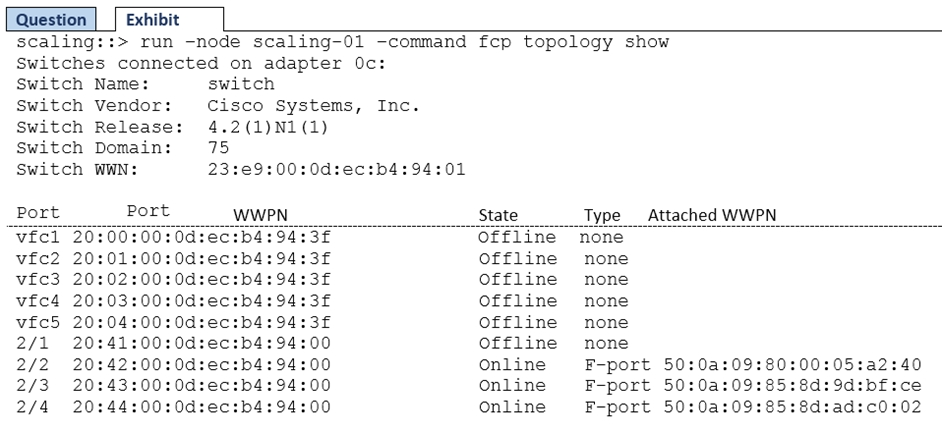
A customer has an AFF A700 connected to a Cisco switch and has verified connectivity but cannot see any LUNs. The customer issued the run -node scaling-01 -command fcp topology show command to verify the connection.
Referring to the exhibit, what needs to be enabled on the Cisco switch?
ATrunking needs to be enabled.
BVSAN needs to be enabled.
CNPIV needs to be enabled.
DVFC needs to be enabled.
Click the Exhibit button.
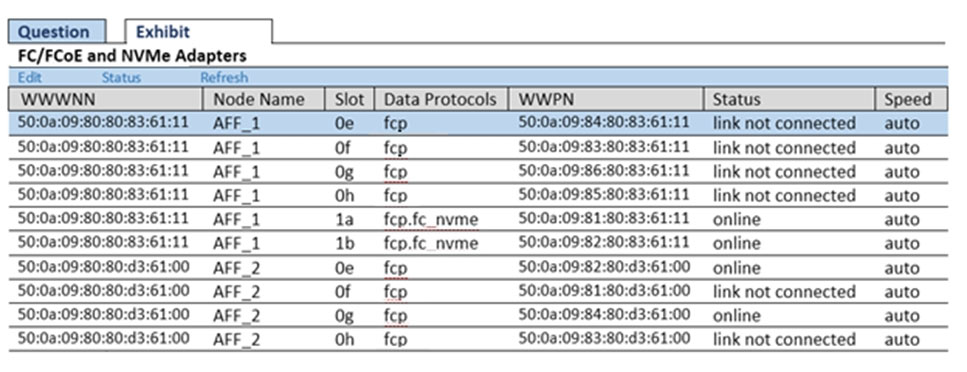
A customer is using both FC and NVMe in a cluster. The customer needs to do some work on AFF_1.
Referring to the exhibit, what will happen?
AThe NVMe namespaces on AFF_2 will be available after takeover of AFF_1.
BThe FC LUNs that use cluster interconnect to access the LUNs on AFF_1 will be unavailable after failover.
CThe FC LUNs on node AFF_2 will be unavailable after failover of AFF_1.
DThe NVMe namespaces on AFF_1 will be unavailable after takeover by AFF_2.
A customer that is using an AFF A220 has a problem with a host for a new FC LUN. Other LUNs on the same SVM are working properly. This LUN is not visible on the host.
Which configuration does the customer need to verify in their solution?
ALUN mapping with igroup
Bhost HBA speed settings
CFC target port setting on NetApp node
DFC switch zoning
Question 6
ONTAP 9 SAN Configuration – Provisioning
0
Question 7
iSCSI Configuration for Windows Express Guide
Question 8
Implementing and Configuring Modern SANs with NVMe/FC TR-4684
Question 9
Ethernet Storage Best Practices
Question 10
SAN Configuration Guide
Question 11
iSCSI Configuration for Red Hat Enterprise Linux Express Guide
Question 12
ONTAP 9 SAN Administration – Provisioning
Question 13
Ethernet Storage Best Practices
Question 14
iSCSI Configuration for ESXi using VSC Express Guide
Question 15
SAN Configuration Guide
Question 16
Industry/Product Knowledge
Question 17
Industry/Product Knowledge
Question 18
ONTAP 9 Protection Power Guide
Question 19
ONTAP 9 SAN Administration – Provisioning
Question 20
Implementing and Configuring Modern SANs with NVMe/FC TR-4684
Question 21
ONTAP 9 SAN Configuration – Provisioning
Question 22
FC Configuration for ESXi® using VSC Express Guide
Question 23
Implementing and Configuring Modern SANs with NVMe/FC TR-4684
Question 24
ONTAP 9 SAN Configuration – Provisioning
Ask AstroTutor
0
Ask AstroTutor
0
Ask AstroTutor
0
Ask AstroTutor
0
Ask AstroTutor
0
Ask AstroTutor
0
Ask AstroTutor
0
Ad
Want a break from the ads?
Become a Supporter and enjoy a completely ad-free experience, plus unlock Learn Mode, Exam Mode, AstroTutor AI, and more.
Ask AstroTutor
0
Ask AstroTutor
0
Ask AstroTutor
0
Ask AstroTutor
0
Ask AstroTutor
0
Ask AstroTutor
0
Ask AstroTutor
0
Ask AstroTutor
0
Ask AstroTutor
0
Ask AstroTutor
0
Ask AstroTutor
0
You deployed a new SVM for FC access, and you used the vserver fcr, create -vserver svm1 - status-admin up command to enable FC service on the SVM. You then created the LIFs for the FC protocol. When you review the status of the LIFs, they show that the admin status is up, but the operational status is down. You have already verified that the ports are physically connected.
In this scenario, what is the next step to bring the LIFs up?
AUse the network interface modify command to change the operational status of the LIFs.
BCreate at least one zone that contains your SVM LIF WWPNs and an initiator.
CVerify that an FC license is applied on your system.
DDisable the SAN switch port where your NetApp storage is connected.
You use iSCSI to present a LUN to a newly installed Windows 2016 Server. You have created the volume and LUN on the NetApp cluster. When you perform a hardware rescan on the Windows host, you cannot see the newly presented storage.
What are three reasons for this problem? (Choose three.)
AThe protocol has not been enabled on the NetApp cluster.
BYou need to add the IQN of the Windows host to the newly created LUN.
CThe IQN of the Windows host is not included in the igroup for the new LUN.
DThe wrong igroup has been associated with the new LUN.
EThe volume has not been enabled for iSCSI access.
Click the Exhibit button.
Referring to the exhibit, which two elements are required for NVMe host access with ONTAP 9.5 and using supported AFF nodes? (Choose two.)
AYou need 16 Gb FC HBAs installed in the AFF nodes.
BYou must have the license installed for NVMe support in the cluster.
CYou must have the license installed for FC support in the cluster.
DYou need 32 Gb FC HBAs installed in the AFF nodes.
An administrator is configuring their Ethernet switches to support an AFF A300 cluster that will be providing iSCSI LUNs to servers. The switches are also used for other traffic from various hosts.
In this scenario, which statement about the switch configuration is correct?
AUse a larger MTU size at the SAN connection rather than the host connections to allow for greater SAN bandwidth.
BUse network ports as access ports only.
CUse multiple VLANs to segregate iSCSI traffic from other traffic types
DUse a single VLAN to consolidate all data traffic on the switches.
You have three Windows servers and one Linux server, each with dual-ported HBAs that are connected into a dual fabric.
In this scenario, what is the minimum number of zones that you need to create within each fabric switch?
A8
B1
C4
D2
Which three components are required for NetApp iSCSI LUN access on Linux servers? (Choose three.)
Adevice-mapper-multipath
BNetApp SnapDrive
Cscsi-target-utils
Discsi-initiator-utils
ENetApp Host Utilities
While expanding a 200 GB LUN in an ONTAP 9.4 system, the following error is observed:
What is the cause of this error?
AThe volume auto-grow is disabled.
BThe LUN reached maximum capacity.
CThe LUN can be expanded up to 10 times its original size.
DSpace reservation is enabled.
You want to ensure maximum performance of iSCSI LUNs on an AFF A220.
In this scenario, which two actions will accomplish this task? (Choose two.)
ADisable flow control.
BConfigure virtual LAN (VLAN).
CEnable flow control.
DEnable jumbo frames.
You are provisioning storage to an ESX host that uses iSCSI.
According to NetApp best practice, which three actions accomplish this task? (Choose three.)
AEnable the iSCSI service.
BBind the iSCSI ports to the software iSCSI adapter.
CInstall Virtual Storage Console (VSC) for VMware.
DEnable BGP on the switch.
EConfigure MTU 1500 on the switch.
Click the Exhibit button.
You have a LUN owned by Node 01 and mapped using the default Selective LUN Map (SLM) configuration. You want to enable your host to access this LUN and facilitate future maintenance.
Which best-practice zone configuration accomplishes this task?
A.
Zone 1: HBA 0, LIF_1, LIF_3, LIF_5 and LIF_7
Zone 2: HBA 1, LIF_2, LIF_4, LIF_6 and LIF_8
B.
Zone 1: HBA 0, HBA 1, LIF_1, LIF_2, LIF_3, LIF_4, LIF_5, LIF_6, LIF_7, LIF_8
C.
Zone 1: HBA 0, LIF_1, LIF_3 -
Zone 2: HBA 1, LIF_2, LIF_4 -
D.
Zone 1: HBA 0, HBA 1, LIF_1, LIF_2, L1F_3, LIF_4
Click the Exhibit button.
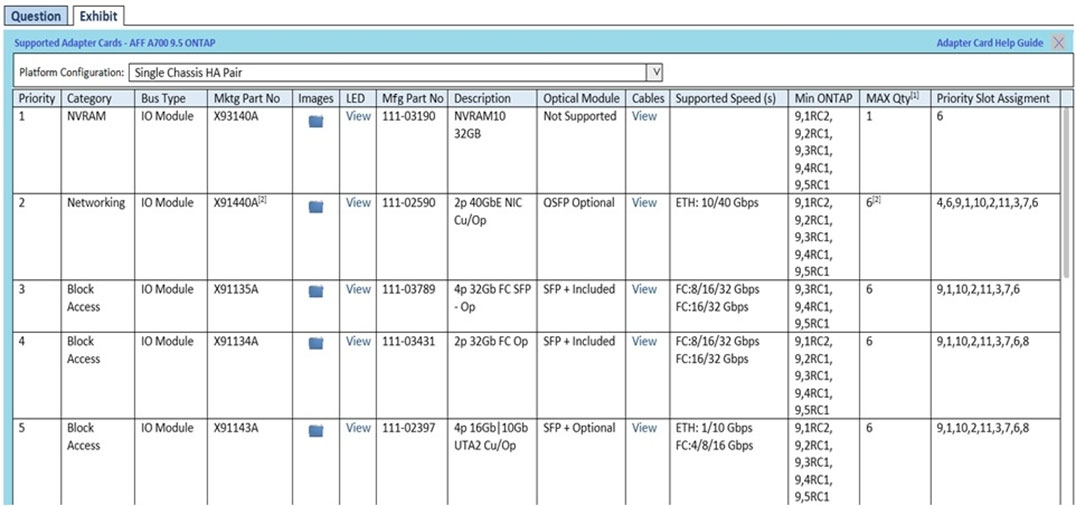
A customer wants to add a 2-port, 32 Gb FC card to support NVMe in an AFF A700 2-node cluster. Currently, there are cards in slots 1, 2, 4, 6, 8, and 9.
Referring to the exhibit, what is the number of the slot that should be used?
A10
B3
C5
D7
A customer is required to encrypt iSCSI traffic across their public network.
In this scenario, which method will accomplish this task?
Adot1q
BIPsec
CNVMe
DCHAP
As a system administrator, you perform a routine check of available storage space on your FAS2750. You notice that the vol_1 volume is approaching 100% capacity. The volume is configured with the space guarantee set to volume and the LUN reservation is disabled. You want to free up space in the volume without increasing its size.
Which action would accomplish this task?
AIncrease the size of the LUN.
BIncrease the Snapshot Reserve.
CIncrease the aggregate size.
DUse deduplication.
You have a 4-node cluster with an AFF A300 HA pair and a FAS8200 HA pair. You plan on using the default storage efficiency settings. With inline data compaction, you estimate that you can save 6% of storage space. AFF A300 LUNs that use under 5000 IOPS are moved to a FAS8200 using the lun move command.
In this scenario, what happens to the data after the LUN is moved? (Choose two.)
AThe new written data is not compacted.
BThe new written data is compacted.
CThe existing data is compacted.
DThe existing data is not compacted.
You are configuring both NVMe and FC on the same AFF A800 2-node ONTAP 9.5 cluster. You are configuring both protocols on the same Cisco FC network switches.
In this scenario, which configuration on the cluster is supported?
Aa volume with both LUNs and namespaces
Ban SVM with both nvme and fcp allowed protocols
Can AFF A800 node HBA with both NVMe/FC and FC on the same port
Da LIF with both fc-nvme and fcp data protocols
Click the Exhibit button.
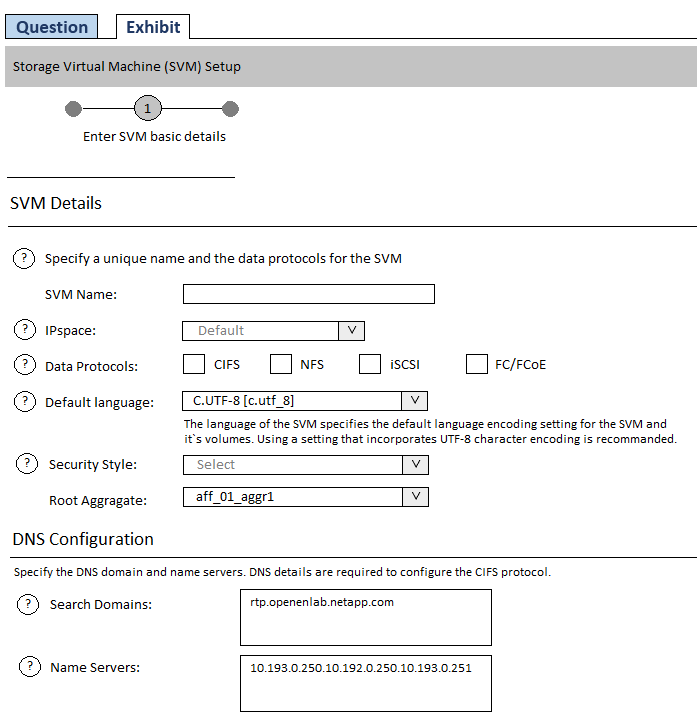
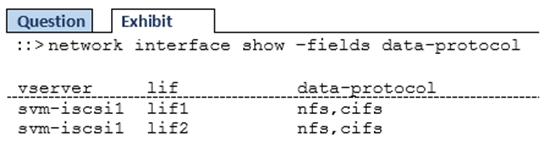
You are asked to serve iSCSI LUNs in an existing SVM on your AFF A220 using ONTAP 9.5. You verified that the iSCSI license is configured on your cluster and that the iSCSI protocol is enabled.
Referring to the exhibit, what is needed to allow hosts to log into the iSCSI target?
ACreate new LIFs with the iSCSI data protocol.
BCreate new igroups with the host IQNs.
CAdd iSCSI to the data protocol of the existing LIFs.
DMap LUNs to the igroups.
A company has 20 ESX hosts. Ten of the hosts are connected using FC, and the rest are connected over iSCSI. The FC host HBA queue depth is set to 32, and the iSCSI LUN queue depth is set to 64. The FC hosts are now experiencing random connectivity issues.
In this scenario, what would be the reason for the disconnects?
AThe FC host has a lower queue depth.
BAccording to the IMT, unsupported HBA firmware is in use.
CAll of the hosts are part of the same cluster.
DThe queue depth is not consistent across the cluster.
Click the Exhibit button.
You have an existing 2-node AFF A300 cluster with premium bundle licensing applied. You need to have consistently low front end latency, and have determined that NVMe satisfies this requirement.
Referring to the exhibit, which two actions would accomplish this task? (Choose two.)
AAdd a UTA2 adapter to each of the two AFF A300 nodes.
BAdd a 32 GB FC HBA to each of the two AFF A300 nodes.
CApply the license for FCP.
DApply the license for NVMe.
Click the Exhibit button.
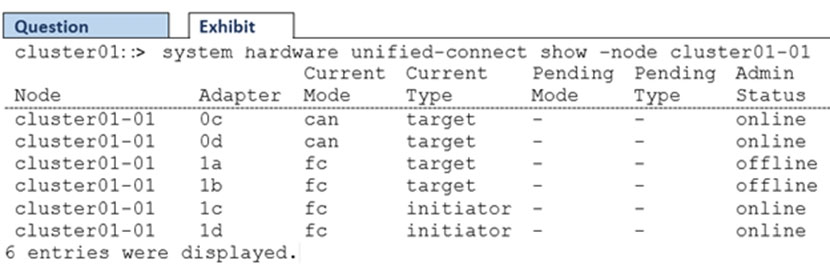
Referring to the exhibit, what happens when you change the type for port 1a from target to initiator?
AThe port type for 1a changes to initiator, and you must reboot the controller for the changes to take effect.
BYou receive an error message that you must take ports 1a and 1b offline before you can change the type.
CB. You receive an error message that you must take the port 1a offline before you can change the type.
DThe port type for 1a and 1b changes to initiator, and you must reboot the controller for the changes to take effect.