About the Exam

This specialist-level Juniper certification exam is for data center networking professionals with intermediate knowledge of Juniper Apstra and data center devices. It covers data center architectures such as IP fabrics, EVPN-VXLAN and VXLAN, plus Juniper Apstra architecture, design, build, deploy, operations, multitenancy, and intent-based analytics. Passing demonstrates understanding of data center technologies and related configuration and troubleshooting skills.

Exam Topics

  • Data Center Architectures (IP Fabrics, EVPN-VXLAN)0%
  • Juniper Apstra Architecture0%
  • Apstra Design Phase0%
  • Apstra Build and Deploy Phases0%
  • Blueprint Operations0%
  • Data Center Multitenancy0%
  • Intent-Based Analytics0%

How to Use This Practice Exam

  1. Browse — Read each question, select your answer, and reveal the explanation.
  2. Exam Mode — Simulate real exam conditions with a timed session and score report.
  3. Learn Mode — Spaced repetition schedules questions you struggle with for long-term retention.

Download the Full Exam PDF

Get every question and answer in a clean, printable PDF built for offline study. Purchase once, keep permanent access, and re-download the latest version anytime.

Last updated July 11, 2026 at 9:25 PM

Topic filter
Retired questions
Question sort
Questions per page

QuestionQ1

Apstra Design Phase

Which three port-group roles can you assign to a logical device?

Choose three
Explanation

Juniper Apstra logical-device port groups can be assigned connection roles such as Leaf, Spine, and Generic. The supported role set does not include Empty or Root.

Learn more

Community Discussion

No comments yet. Be the first to start the discussion!

QuestionQ2

Blueprint Operations

You use tags in Juniper Apstra to search blueprint information about existing elements. In this scenario, which other construct also uses tags?

Explanation

Configlets use tags to define their application scope. A tag can identify the applicable systems or devices, avoiding the need to list each one individually.

Learn more

Community Discussion

No comments yet. Be the first to start the discussion!

QuestionQ3

Intent-Based Analytics

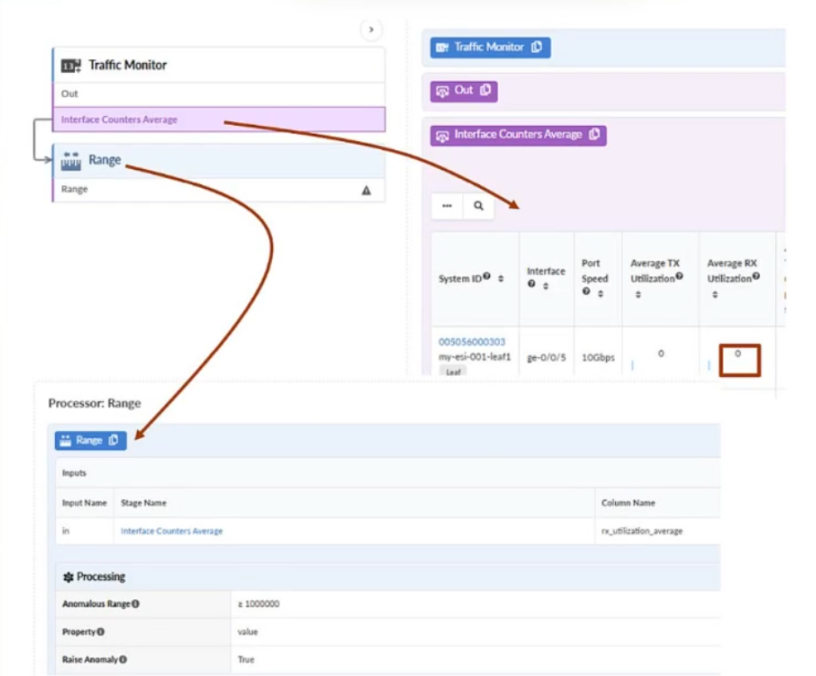
The analytics probe shown in the exhibit is enabled. The ge-0/0/5 interface on the my-esl-001-leaf1 node receives an average traffic rate greater than 1 Mbps.

Which two statements are correct in this scenario?
Question Image

Choose two
Explanation

A Range processor marks a matching input as anomalous. With its threshold set to 1,000,000 and Raise Anomaly enabled, received traffic above 1 Mbps generates an actual IBA probe anomaly. IBA probe anomalies appear under Blueprint Analytics, so the Analytics indicator reflects the anomaly. Service anomalies are distinct from analytics anomalies and are associated with service, discovery, or configuration conditions rather than this probe result. Range Processor | Juniper Apstra 6.0

Learn more

Community Discussion

No comments yet. Be the first to start the discussion!

QuestionQ4

Apstra Design Phase

You are using Juniper Apstra to create security policies that generate ACLs on fabric devices.

Which two valid objects would be used in Apstra for this scenario?

Choose two
Explanation

Apstra security policies can use Virtual Network and Routing Zone as source or destination point types. The platform renders the resulting security policies as ACLs at the applicable enforcement points on fabric devices.

Learn more

Community Discussion

No comments yet. Be the first to start the discussion!

QuestionQ5

Data Center Architectures (IP Fabrics, EVPN-VXLAN)

You need to deploy a collapsed fabric architecture.

Which two statements are accurate for this deployment?

Choose two
Explanation

A collapsed fabric consolidates leaf, spine, and border-leaf functions into the leaf devices. The leaf layer is interconnected as a full mesh, and those devices perform the EVPN-VXLAN overlay functions.

Learn more

Community Discussion

No comments yet. Be the first to start the discussion!
Know a question that should be here? Contribute to this exam
Back home