Establishing the schedule for each testing activity and the test milestones for a test project, based on activity estimates, available resources, and other constraints, is a typical task carried out during:
ATest execution.
BTest design.
CTest analysis.
DTest planning.
0
Community Discussion
No comments yet. Be the first to start the discussion!
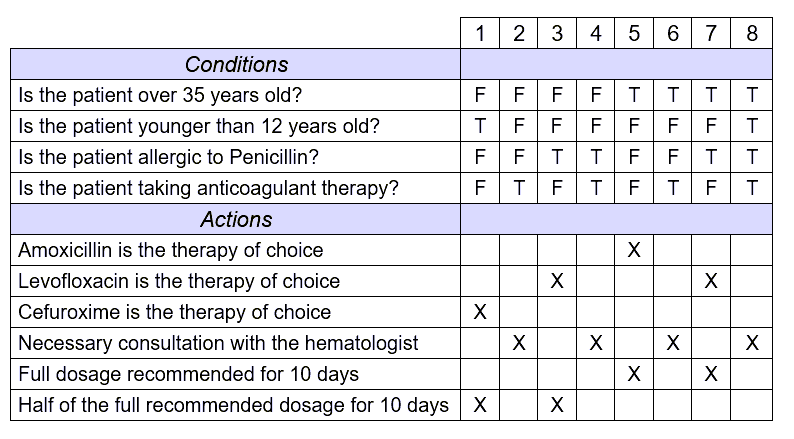
The following decision table is an extract from a larger table that helps a doctor determine drug therapy for a patient aged 6 to 65 years who has acute sinusitis. The table contains four Boolean conditions and six actions:
Based solely on the information provided, which of the following represents an impossible situation?
A7
B1
C8
D3
0
Community Discussion
No comments yet. Be the first to start the discussion!
Which ONE of the following options MOST PRECISELY defines statement testing?
AIn statement testing, the coverage items are control flow transfers between branches. The aim is to design test cases to exercise branches in the code until an acceptable level of coverage is achieved, expressed as a percentage.
BIn statement testing, the coverage items are decisions and statements. The aim is to design test cases that exercise statements in the code until an acceptable level of coverage is achieved, expressed as a percentage.
CIn statement testing, the coverage items are branches, and the aim is to design test cases to exercise branches in the code until an acceptable level of coverage is achieved, expressed as a percentage.
DIn statement testing, the coverage items are executable statements. The aim is to design test cases that exercise statements in the code until an acceptable level of coverage is achieved, expressed as a percentage.
0
Community Discussion
No comments yet. Be the first to start the discussion!
No comments yet. Be the first to start the discussion!
0
Community Discussion
No comments yet. Be the first to start the discussion!
Save question
0
Community Discussion
No comments yet. Be the first to start the discussion!
Save question
0
Community Discussion
No comments yet. Be the first to start the discussion!
0
Community Discussion
No comments yet. Be the first to start the discussion!
Save question
0
Community Discussion
No comments yet. Be the first to start the discussion!
Save question
0
Community Discussion
No comments yet. Be the first to start the discussion!
Save question
0
Community Discussion
No comments yet. Be the first to start the discussion!
Save question
0
Community Discussion
No comments yet. Be the first to start the discussion!
Save question
0
Community Discussion
No comments yet. Be the first to start the discussion!
Save question
0
Community Discussion
No comments yet. Be the first to start the discussion!
0
Community Discussion
No comments yet. Be the first to start the discussion!
Save question
0
Community Discussion
No comments yet. Be the first to start the discussion!
Save question
0
Community Discussion
No comments yet. Be the first to start the discussion!
Save question
0
Community Discussion
No comments yet. Be the first to start the discussion!
Save question
0
Community Discussion
No comments yet. Be the first to start the discussion!
Save question
0
Community Discussion
No comments yet. Be the first to start the discussion!
Save question
0
Community Discussion
No comments yet. Be the first to start the discussion!
0
Community Discussion
No comments yet. Be the first to start the discussion!
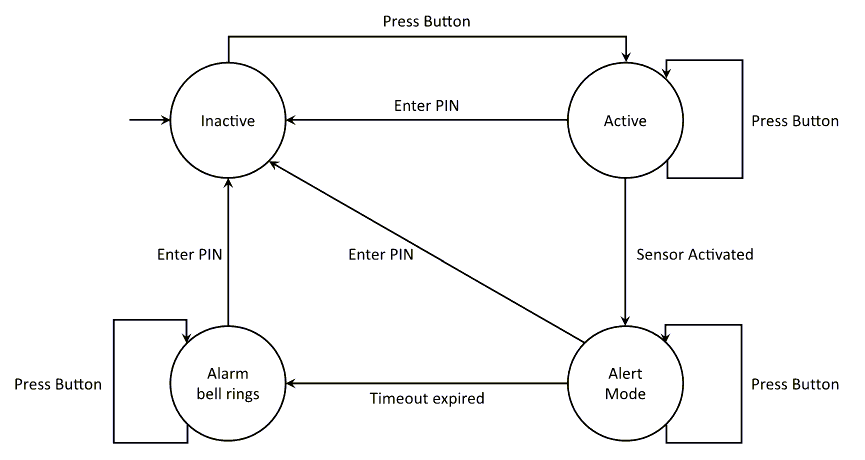
An anti-intrusion system is battery powered and is activated by pressing its only available button. To deactivate the system, the operator must enter a PIN code. The system remains in alert mode for a configurable timeout, and an alarm bell rings if it is not deactivated before the timeout expires. The following state-transition diagram describes the system behavior:
What is the minimum number of test cases required to cover every unique sequence of exactly 4 states / 3 transitions that starts and ends in the “Inactive” state? (Note that “Inactive” is not a final state in the diagram.)
A1
B2
C3
D4
Which of the following is a good testing practice that applies independently of the software development lifecycle used?
ANot all development activities should have corresponding test activities
BLarge amount of redundancy between test levels is good because it prevents bug leakage
CReviews should be done after the work products have been finalized
DEach test level should have an appropriate test objective
User story:
As a member of the “Agnotoly” association, I want to pay the association’s dues by an automatic payment method so that I can forget payment deadlines.
Acceptance criteria:
The member may pay only with an “Agnosis Master” credit card.
The member must register their cell phone number.
The member must register the credit card in the association’s payment system.
The member must choose one of these credit-card payment methods: monthly or annual.
For the payment system to process the transaction, the member must accept the terms and conditions that apply to the selected payment method (monthly or annual payment).
If the member accepts the terms and conditions, the payment system sends a message containing a one-time password to the member’s mobile/cell phone and prompts the member to enter that one-time password.
The payment method is registered in the association’s payment system after the one-time key sent by the payment system has been verified.
After the payment method is registered, the association’s payment system charges the member on the first business day of the next month.
Remark:
Registering the payment method is a transactional process; therefore, if acceptance criteria 1 through 7 are not fulfilled, the payment system reverts to its previous state and retains no information that may have been entered.
In the test cycle that has just finished, these objectives were achieved:
Association members were able to pay association dues using the credit card.
Dues payments were made monthly and for more than a year after the initial payment.
Which ONE of the following options identifies the acceptance criterion that has NOT been fully covered in the test cycle described above?
AAcceptance criteria 8 has not been fully covered during the above test cycle.
BAcceptance criteria 4 has not been fully covered during the above test cycle.
CAll acceptance criteria have been fully covered during the above test cycle.
DAcceptance criteria 6 has not been fully covered during the above test cycle.
Which ONE of the following statements represents the MOST DIRECT expected advantage of the whole-team approach?
ACapitalizing on the combined skills of business representatives, testers, and developers working together to contribute to project success.
BReducing the involvement of business representatives because of enhanced communication and collaboration between testers and developers.
CAvoiding requirements misunderstandings that may not have been detected until dynamic testing when they are more expensive to fix.
DHaving an automated build and test process, at least once a day, that detects integration errors early and quickly.
Which testing principle offers a sound reason for basing testing on risk-mitigation priorities?
ATesting shows the presence of defects
BExhaustive testing is impossible
CTests wear out
DDefects tend to cluster in a few modules
Consider the following user story for an e-commerce website registration feature, which permits only registered users to make purchases:
> “As a new user, I want to register on the website, so that I can start shopping online”
The following acceptance criteria are defined for the user story:
[a] The registration form includes these fields: username, email address, first name, last name, date of birth, password, and repeat password.
[b] To submit a registration request, the new user must complete every registration-form field with valid values and agree to the terms and conditions.
[c] For an email address to be valid, it must not be supplied by free online mail services that permit creation of disposable email addresses. A dedicated error message must inform the new user when an invalid address is entered.
[d] For first name and last name to be valid, they must contain only alphabetic characters and be between 2 and 80 characters long. A dedicated error message must inform the new user when an invalid first name and/or last name is entered.
[e] After the registration request is submitted, the new user must receive an email containing the confirmation link at the email address entered in the registration form.
Based only on the information provided, which of the following ATDD tests is MOST LIKELY to be written first?
AThe new user enters valid values in the fields of the registration form, except for the email address, where he/she enters an e-mail address provided by a free online mail service that allow to create disposable email addresses. Then he/she is informed by the website about this issue.
BThe new user enters valid values in the fields of the registration form, except for the first name, where he/she enters a first name with 10 characters that contains a number. Then he/she is informed by the website about this issue.
CThe user accesses the website with a username and password, and successfully places a purchase order for five items, paying by Mastercard credit card.
DThe new user enters valid values in all the fields of the registration form, confirms to accept all the terms and conditions, submits the registration request and then receives an e-mail containing the confirmation link to the e-mail address specified in the registration form.
Which of the following statements is true?
AUnlike functional testing, non-functional testing can only be applied to conventional systems, not artificial intelligence-based system.
BFunctional testing focuses on what the system is supposed to do, while white-box testing focuses on how well the system does what it is supposed to do.
CFunctional testing can be applied to all test levels, while non-functional testing can be applied only to system and acceptance test levels.
DBlack-box test techniques and experience-based test techniques may be applicable to both functional testing and non-functional testing.
Which of the following is not an example of a typical generic skill needed for testing?
ABe able to apply test-driven development.
BBe able to use test management tools and defect tracking tools.
CBe able to communicate defects and failures to developers as objectively as possible.
DPossess the necessary social skills that support effective teamwork.
You have just finished a retrospective at the end of a sprint. A developer raised an issue that defect reports do not include information about the configuration, data, and system in use when the failure occurred. When this occurs, the developer rejects the defect report, and the tester must update and resubmit it. It can sometimes take three or four iterations to include all the required information in the report. The test team will use this feedback to improve the detail included in defect reports.
This is an example of which type of testing benefit?
AIncreased test effectiveness / efficiency
BTeam bonding and learning
CImproved quality of the test basis
DIncreased quality of the test cases
A developer assumed that users would always filter items by category to refine their search. However, during usability testing, a tester found that most users instead prefer the search bar, exposing a potential gap in the user-interface design.
Which practice enabled the benefit described in the scenario?
AShift left
BIndependence of testing
CConfirmation testing
DRetrospectives
Which of the following statements concerning static testing and dynamic testing is correct?
AUnlike dynamic testing, which can be also performed manually, static testing cannot be performed without specialised tools.
BStatic testing is usually much less cost-effective than dynamic testing.
CUnlike dynamic testing, which focuses on detecting potential defects, static testing focuses on detecting failures which may be due to actual defects.
DBoth static testing and dynamic testing can be used to highlight issues associated with non-functional characteristics.
Consider the following statements (I–V) regarding software testing:
AStatements I, III, and IV
BStatements II, IV, and V
CStatements I, II, and IV
DStatements II, III, and V
Several characteristics are listed regarding the impact of the SDLC on the testing effort.
Completion of the requirements review leading to test analysis
Both static and dynamic testing performed at the unit-testing level
Frequent regression testing may need to be performed
Extensive product documentation
Greater use of exploratory testing
Which of the following statements is MOST correct?
Ai, ii and iii are characteristics of sequential models; iv and v are characteristics of iterative and incremental models
Biii and iv are characteristics of sequential models; and i, ii and v are characteristics of iterative and incremental models
Ci and iv are characteristics of sequential models; ii, iii and v are characteristics of iterative and incremental models
Dii and iv are characteristics of sequential models; i in and v are characteristics of iterative and incremental models
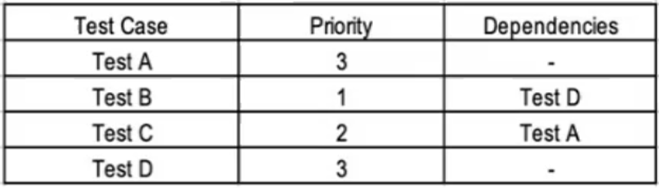
You are a tester on a critical project. Based on the risk analysis, you must determine the test-execution order. Which of the following lists the correct test-execution sequence? Priority 1 is the highest, and Priority 3 is the lowest.
AD-С-В-A
BC-B-A-D
CD-A-B-C
DD-B-A-C
Which of the following should be reviewed through static testing?
AMemory leak during execution
BPerformance of a module under load
CInteractive output from a debugger
DTest plan
For a specified set of test cases, which of the following is an advantage of executing these tests with a test automation tool?
ATest coverage is increased
BThe time spent on repetitive tasks is reduced
CThe number of found bugs is reduced
DThe total cost of the test project always decreases
What is meant by error guessing?
AA test technique in which the tester anticipates the mistakes the developer might make, defects they might introduce, and failures that may occur due to these defects
BA test technique in which a tester designs, implements, and executes tests to cover test conditions from a checklist built based on knowledge about how software fails
CA test estimation technique in which testers use their knowledge and experience to estimate the effort needed to fix problems in the test process due to testers’ mistakes
DA type of software testing that identifies vulnerabilities, threats, and risks in a system to ensure its resources are protected from unauthorized access and malicious attacks
Which of these statements about static and dynamic testing is TRUE?
AStatic testing is better suited than dynamic testing for highlighting issues that could indicate inappropriate code modularization.
BDynamic testing can only be applied to executable work products, while static testing can only be applied to non-executable work products.
CBoth dynamic testing and static testing cause failures, but failures caused by static testing are usually easier and cheaper to analyze.
DSecurity vulnerabilities can only be detected when the software is being executed, and thus they can only be detected through dynamic testing, not through static testing.
When tests are designed to achieve statement coverage, what do they execute?
AOnly the decisions in the code
BOnly the loops in the code
COnly the executable statements in the code
DAll lines of code including executable statements and comments
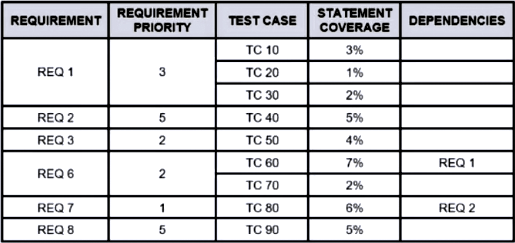
Consider the following table containing test-case information from the test management system:
Where:
REQ means REQuirement.
TC means Test Case.
TC 60 depends on REQ 1.
TC 80 depends on REQ 2.
A test case inherits the priority of its requirement.
Priorities range from 1 to 5.
Priority 5 is the highest.
Which ONE of the following options orders the test cases according to the statement-coverage strategy while accounting for practical constraints?

Community Discussion